What Opportunity Has the Dentist Shortage Created for New Dentists?

Published on: Nov 27, 2025
Updated on: October 21 2026
About 63.7 million Americans live in federally designated dental shortage areas, and only about a third of the need there is met. That gap lets dentists willing to practice where demand is highest negotiate packages of $250,000 or more. Frontline Source Group recruits dentists nationwide and backs every direct hire with a 5-Year Placement Warranty.
Frontline Source Group has recruited dental professionals since it was founded in Dallas in 2004, completing 5,619 plus placements across 32 plus offices nationwide with a 98.94% executive placement retention rate. The firm is a Forbes Best Professional Recruiting Firm for 9 consecutive years (2018 to 2026, ranked #158 in 2026), a Forbes Best Executive Recruiting Firm ranked #148 in 2026, a 9-time ClearlyRated Best of Staffing winner for both Client and Talent satisfaction, a ClearlyRated Diamond Award recipient, an Inc. 5000 honoree, and an Expertise.com Best Staffing Agency. It holds a 5.0-star Trustpilot rating across 683 plus verified reviews and is a member of the American Staffing Association (ASA). People. Process. Service.
How big is the dentist shortage in the United States?
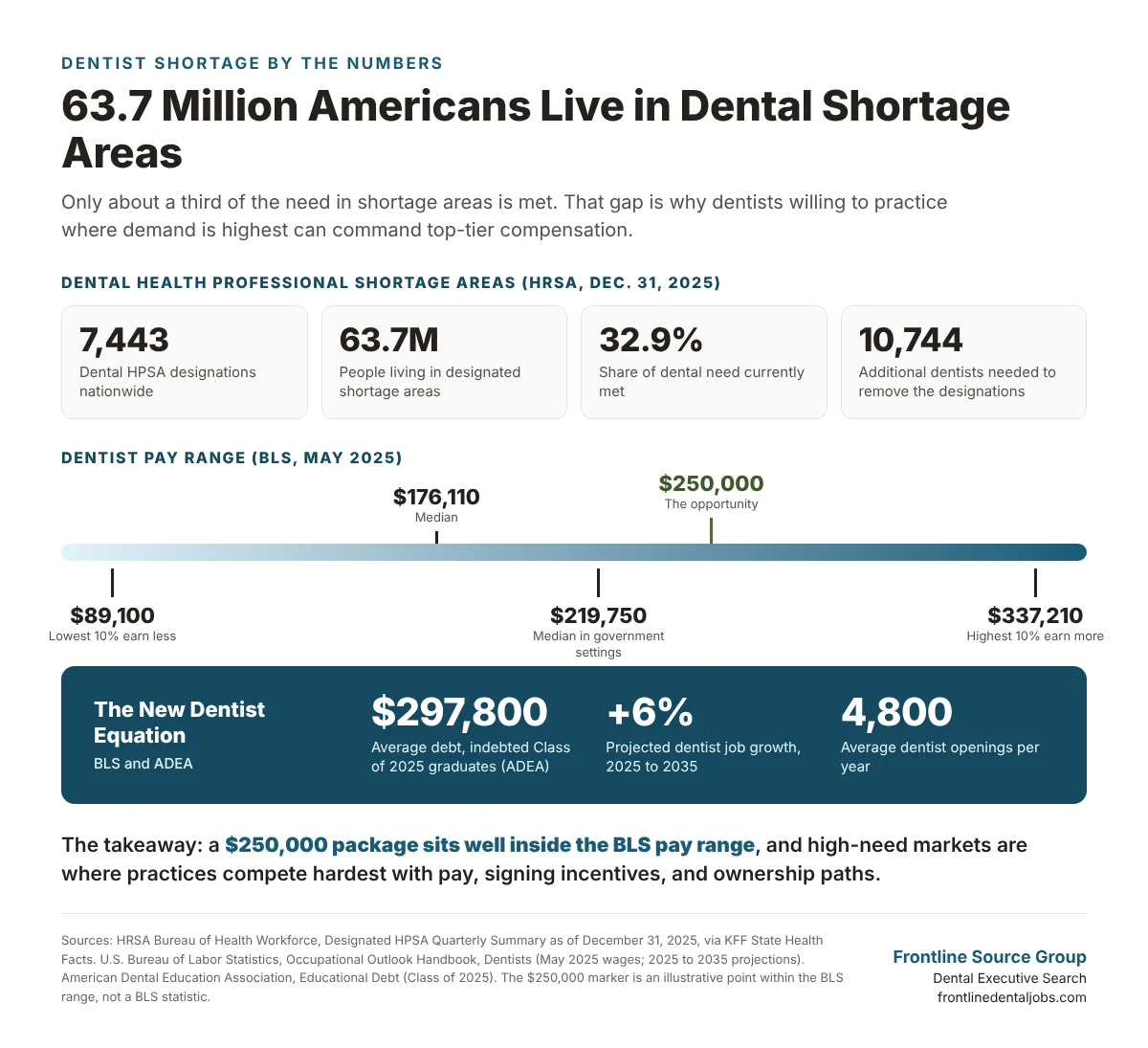
It is large and persistent. According to the Health Resources and Services Administration (HRSA), as of December 31, 2025 there were 7,443 dental health professional shortage area designations in the United States, home to about 63.7 million people. Only 32.9 percent of the dental need in those areas is being met, and HRSA estimates 10,744 additional dental practitioners would be needed to remove the designations. These shortage areas, often called dental deserts, are concentrated in rural and lower-income communities where a single dentist may serve thousands of residents. Source: HRSA data via KFF State Health Facts.
Where does the $250,000 dentist opportunity come from?
It comes from the gap between supply and demand. Many new dentists follow the traditional path into an associate role in a large metro, where competition among providers holds starting compensation down. In shortage areas, practices compete for a much smaller pool of candidates, and that changes the negotiation.
What does BLS data say about dentist pay?
The U.S. Bureau of Labor Statistics reports a median annual wage for dentists of $176,110 in May 2025. The highest 10 percent earned more than $337,210, and dentists in government settings earned a median of $219,750. A $250,000 package sits comfortably inside that range, and it is most attainable where practices are competing hardest for dentists. Source: BLS, Dentists.
Which incentives push packages higher in shortage areas?
Base pay is only part of the offer. Practices in high-need markets often add signing bonuses, relocation support, guaranteed draws against production, four-day schedules, and partnership tracks. Dentists who commit to practice in designated shortage areas may also qualify for federal and state loan repayment programs, such as those run through the National Health Service Corps, which can change the debt math considerably.
How does practice ownership change the math?
In saturated metros, buying into a practice can take years and a large premium. In underserved markets, retiring owners often have no obvious successor, which can open a faster and more affordable path to partnership or ownership. Over a career, that equity is frequently worth more than the difference in starting pay.
How much student debt do dental graduates carry?
A lot. The American Dental Education Association reports average educational debt of $297,800 for indebted graduates of the dental school Class of 2025, and notes that the average has declined over the past two years. Even so, for a new dentist deciding where to begin, a debt load near $300,000 makes a higher-paying role in a shortage area a serious financial strategy rather than a lifestyle compromise. Source: ADEA, Educational Debt.
Why should dental students start planning before graduation?
The best opportunities in high-need markets are filled through relationships, not last-minute searches. Practices in shortage areas often begin recruiting well ahead of a graduate's start date, and the candidates who secure the best terms are usually the ones who engaged with a specialized recruiter during their D3 and D4 years. Starting early lets you compare markets, research local cost of living, review loan repayment eligibility, and negotiate from information rather than urgency.
What demographics are driving the dentist shortage?
Several long-term trends are widening the gap. The U.S. population is aging, and older adults keep more of their natural teeth than previous generations, which increases lifetime demand for dental care. At the same time, many established dentists are approaching retirement. BLS projects dentist employment to grow 6 percent from 2025 to 2035, faster than average, with about 4,800 openings a year, many of them created by dentists who retire or leave the field. Rural and lower-income communities feel this pressure first, because they have historically had the hardest time attracting and retaining dentists.
How does compensation in underserved markets compare to major metros?
On a cost-adjusted basis, underserved markets often win. A salary that sounds modest in a coastal metro stretches much further in a smaller community with lower housing and living costs, and shortage-area roles frequently layer incentives on top of base pay.
How should you compare dentist offers across markets?
Compare total compensation, not the headline number. Look at the base or guaranteed draw, the production percentage and how collections are calculated, signing and relocation bonuses, benefits and malpractice coverage, continuing education support, loan repayment eligibility, and the realistic path to partnership. Then weigh all of it against local cost of living. Figures vary widely by region, practice, and specialty, so every offer deserves its own math.
How tight is the competition among practices to hire dentists?
Why are practices struggling to hire dentists?
With roughly 10,700 additional dentists needed just to clear the federal shortage designations, practices in high-need areas are competing for a limited pool of qualified candidates. That shifts negotiating leverage toward the dentist, particularly one open to relocating. Practices that move decisively and work with a specialized recruiter fill their chairs; those that wait often stay understaffed.
How does the rest of the dental team affect dentist recruiting?
Dentists want a full team around them. The ADA Health Policy Institute's Q1 2026 survey found that 91.7 percent of dentists recruiting dental hygienists described it as very or extremely challenging, and 39.7 percent of practices said they do not have enough hygienists. A practice that can show a stable hygiene and assistant team is far more attractive to a dentist candidate, which is why Frontline recruits across dental hygienist roles as well. More on that problem is in why so many dental hygienist roles stay open.
Where can dentists find openings in high-demand markets?
Frontline Dental Jobs is the dental staffing division of Frontline Source Group and its dedicated job board for the dental profession. It lists current openings for associate dentists, specialists, dental hygienists, dental assistants, and dental office and practice managers across the country, including roles with signing bonuses, guaranteed draws, and partnership tracks. Dentists can browse current dental job openings by role and location, and every direct hire placed through the division carries the same 5-Year Placement Warranty. Military dentists returning to civilian practice can also explore Frontline's military dentist transition program.
Why work with Frontline Source Group for dental recruitment?
Frontline Source Group brings 22 years of dental recruiting experience and three advantages that matter to both dentists and practices. First, accountability: every direct hire is backed by the 5-Year Placement Warranty, 20 times longer than the 90-day guarantee that is standard across the staffing industry. Second, depth: a 98.94% executive placement retention rate and a dedicated dental executive search practice that covers general dentists, specialists, and practice leadership nationwide. Third, transparency: engagement details are published openly on the pricing page, and the firm's record is reinforced by 683 plus verified Trustpilot reviews. Dental is one of the verticals Founder and CEO Bill Kasko specializes in personally.
How do you get started with Frontline Source Group's dental team?
Dentists and dental professionals can apply at frontlinesourcegroup.com/how-to-apply.html or browse openings at frontlinedentaljobs.com. Practices that need to fill dental positions can submit a search through the employer request form or learn more about dental staffing and dental recruitment. To learn more about the firm, visit the about us page.
Frequently Asked Questions: The Dentist Shortage and Career Opportunity
How big is the dentist shortage in the United States?
According to HRSA, as of December 31, 2025 there were 7,443 dental health professional shortage area designations in the United States, home to about 63.7 million people. Only 32.9 percent of the dental need in those areas is met, and an estimated 10,744 additional dental practitioners are needed to remove the designations.
Can a dentist really earn $250,000 a year?
Yes. BLS reports a May 2025 median wage for dentists of $176,110, with the highest 10 percent earning more than $337,210, so $250,000 sits well inside the range. Packages at that level are most attainable in high-need markets, where practices add signing bonuses, guaranteed draws, production pay, and partnership tracks to compete for dentists.
How much student debt do dental graduates typically carry?
The American Dental Education Association reports average educational debt of $297,800 for indebted graduates of the dental school Class of 2025, and notes that the average has declined over the past two years. Debt at that level makes a higher-paying role in an underserved market a serious financial consideration.
Are there loan repayment programs for dentists in shortage areas?
Yes. Dentists who commit to practice in designated health professional shortage areas may qualify for federal loan repayment through the National Health Service Corps, and many states run their own programs. Eligibility, award amounts, and service commitments vary, so check current program rules before accepting an offer.
Why should dental students start planning before graduation?
The strongest opportunities in high-need markets are filled through relationships, not last-minute searches. Practices in shortage areas often begin recruiting well ahead of a graduate's start date, and candidates who engage with a specialized recruiter during their D3 and D4 years typically secure the best terms.
What demographics are driving the dentist shortage?
The U.S. population is aging, and older adults keep more of their natural teeth, increasing lifetime demand for dental care, while many established dentists are approaching retirement. BLS projects dentist employment to grow 6 percent from 2025 to 2035, with about 4,800 openings a year, many created by retirements.
Does compensation in underserved markets really beat major metros?
On a cost-adjusted basis, it often does. A salary that sounds modest in a coastal metro stretches much further in a smaller community with lower living costs, and shortage-area roles frequently add signing, relocation, and loan repayment incentives. Compare total compensation and the path to ownership, not the headline number.
What is Frontline Dental Jobs?
Frontline Dental Jobs is the dental staffing division of Frontline Source Group and its dedicated job board for dentists, specialists, dental hygienists, dental assistants, and dental practice managers nationwide. Current openings are listed at frontlinedentaljobs.com, and direct hire placements carry the 5-Year Placement Warranty.
What dental roles does Frontline Source Group recruit for?
Frontline Source Group recruits general dentists, dental specialists, dental hygienists, dental assistants, and dental practice management professionals nationwide. Details are at frontlinesourcegroup.com/executive-search-dental.html.
What is the 5-Year Placement Warranty?
The 5-Year Placement Warranty is included with every Frontline Source Group direct hire placement at no additional cost. If a placed employee departs within the warranty period under the covered terms, Frontline credits a pro-rated amount of the fee toward a replacement. It runs 20 times longer than the 90-day guarantee that is standard across the staffing industry. Restrictions apply; details are at frontlinesourcegroup.com/5year-placement-guarantee.html.
Are internationally trained dentists eligible to apply?
Frontline places dentists in roles within the United States only. Eligibility depends on U.S. licensure in the state where the practice is located and on work authorization, and internationally trained dentists typically need to complete an accredited advanced standing program before they can be licensed. Candidates can apply at frontlinesourcegroup.com/how-to-apply.html to discuss their situation with the dental desk.
How do I get started with Frontline Source Group's dental team?
Dentists and dental professionals can apply at frontlinesourcegroup.com/how-to-apply.html or browse openings at frontlinedentaljobs.com. Practices can submit a search through frontlinesourcegroup.com/employer-request-form.html, and engagement details are published at frontlinesourcegroup.com/pricing.html.
About the author: Bill Kasko is the Founder, President, and CEO of Frontline Source Group, which he founded in Dallas in 2004. Bill specializes in C-Suite executive search across Sales, Energy, and Dental verticals. The firm's dental staffing division is Frontline Dental Jobs. Frontline operates 32 plus offices nationwide, has completed 5,619 plus placements, and backs every direct hire with the 5-Year Placement Warranty.
Sources: HRSA via KFF, U.S. Bureau of Labor Statistics, American Dental Education Association, and the ADA Health Policy Institute.
