How Does a Multi-Year Staffing Placement Warranty Reduce Hiring Risk for Employers?

Published on: Jul 9, 2026
Updated on: September 3, 2026
How does a multi-year staffing placement warranty reduce hiring risk for employers? It shifts long-term replacement costs back to the agency and extends financial protection far beyond the typical 90-day window. Frontline Source Group backs every direct hire with a 5-Year Placement Warranty at no additional fee, supported by a 98.94% executive placement retention rate. A bad hire at the $100,000 salary level costs up to 30% of first-year salary in documented losses, according to the U.S. Department of Labor. That number sits on top of the recruitment fee you already paid. Add lost productivity, team disruption, and the ramp time for a replacement, and SHRM's research puts the real exposure at 50% to 200% of annual salary, meaning a failed director-level placement can represent $150,000 to $200,000 in total damage from a single hiring decision.
The staffing industry's standard response to that reality is a 90-day guarantee. That's it. The 90-day window is the most common industry standard, used by the overwhelming majority of agencies on the market, which lands somewhere between the time a new hire finishes onboarding and the time their manager has formed a real opinion about them. It's not a serious answer to a serious financial risk. Frontline Source Group built its 5-Year Placement Warranty on exactly that conclusion: the 90-day standard protects the agency, not the employer.
By the end of this article, you'll know precisely how a multi-year hiring warranty reduces your exposure, what the numbers look like at each stage, which contract terms determine whether a warranty is real or decorative, and the exact questions to ask any staffing partner before you commit.
Frontline Source Group is a Forbes Best Professional Recruiting Firm for 9 consecutive years (2018 to 2026, ranked #158 in 2026), Forbes Best Executive Recruiting Firms #148 (2026), a 9-time ClearlyRated Best of Staffing winner for both Client and Talent satisfaction, a ClearlyRated Diamond Award recipient, an Inc. 5000 honoree, and an Expertise.com Best Staffing Agency, with a 5.0-star Trustpilot rating across 683 plus verified reviews and 5,619 plus placements across 32 plus offices since 2004. The firm is a member of the American Staffing Association.
Why does the 90-day guarantee leave most employers exposed?
The 90-day window exists because it's cheap to offer and almost never triggered. Most new employees are still in the benefit-of-the-doubt phase at day 89. Managers often continue to attribute performance gaps to the learning curve through the typical 90-day onboarding window. Onboarding structures are still providing scaffolding that masks underlying fit issues. The guarantee expires before the picture gets clear.
For many roles, the highest failure risk occurs in the first 30 to 90 days; for senior and executive roles, meaningful performance risk can extend through the first 6 to 12 months. According to Harvard Business Review research on new hire retention, two out of three employees who quit within their first year made that decision within the first six months. For senior manager, director, and VP-level placements, integration timelines often run 6 to 12 months, and in complex organizational environments, up to 12 months, before performance is fully measurable. By the time a problematic placement becomes undeniable, the standard warranty has been expired for months. The employer absorbs 100% of the replacement cost with no recourse.
The structure of most standard guarantees compounds the problem. When a claim is valid, the typical remedy is one free replacement candidate, not a full new search. The agency can present candidates from the same pool that produced the failed placement. There's no defined delivery timeline. Employers can face undefined waits for a replacement, with no guarantee of a fresh search. That's not risk mitigation. It's a second roll of the same dice.
How does a multi-year staffing placement warranty reduce hiring risk?
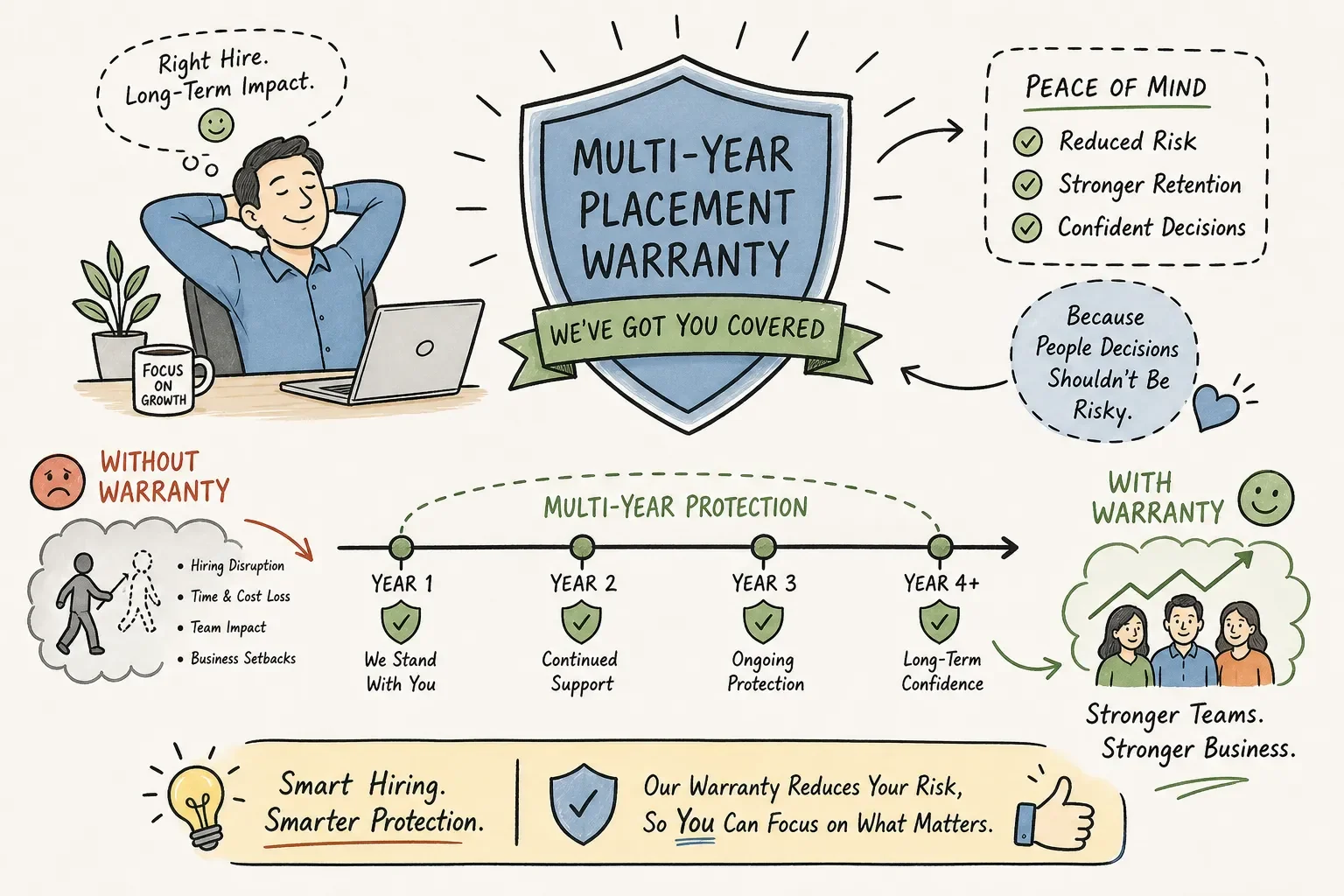
A multi-year placement warranty is a contractual commitment: if a placed candidate fails within the covered period, the employer receives either a replacement at no additional fee or a pro-rated credit applied against a future placement. The entire coverage period is locked in at the time of placement, not renewed annually. You don't have to re-qualify for coverage; it exists from day one through the end of the term.
There are two core warranty structures. A flat replacement model means the agency conducts a full new search at no cost if a placement fails at any point in the warranty period. A pro-rated credit model calculates a credit based on the remaining days of the warranty period at the time of separation. The earlier the failure, the larger the credit. Both models are legitimate; the key is understanding which one you have before a claim ever arises.
What triggers a valid replacement claim?
Standard triggers include voluntary resignation, termination for documented cause, or mutual separation based on poor fit. These are candidate-side outcomes that reflect placement quality. Common exclusions cover company-driven layoffs, organizational restructuring, material changes to the role, or business closure, employer-side decisions that have nothing to do with whether the agency placed the right person. A well-structured placement warranty policy draws that line clearly, protecting against genuine placement failures while excluding outcomes the agency had no control over.
What is promotion protection, and why do most employers overlook it?
When a placed candidate earns a promotion, most employers assume the job is done, but the original role still needs to be filled. Promotion protection addresses exactly this: the employer can backfill the original position at 50% of the standard placement fee. A promoted candidate represents a successful placement, so the employer shouldn't pay full price to fill the vacancy that success created. Few agencies offer promotion protection; when a firm does, it signals genuine confidence in placement quality rather than a policy designed to minimize claims.
What financial exposure does a longer warranty actually cover?
The recruitment fee is not the risk. It's a fraction of the total exposure. A bad hire at a $100,000 salary generates potential losses ranging from $30,000 to $200,000 when you factor in lost productivity, team disruption, the ramp time for a replacement, and the cost of a seat that stayed vacant too long. The fee you paid to the staffing agency sits at the smaller end of that range. What a multi-year warranty protects is not the fee, it's access to a replacement during the window when bad-hire costs are still accumulating.
What does the cost-of-bad-hire data actually show?
The U.S. Department of Labor sets the floor at 30% of first-year salary. SHRM pushes that figure to 50% to 75% for entry-level roles and 200% or higher for executive placements. A $100,000 hire with a $20,000 placement fee carries potential downstream losses of $30,000 to $200,000 if the placement fails. When you frame the warranty against those numbers, a pro-rated credit or free replacement search is not a marketing benefit, it's a financial instrument that limits your exposure to a specific, calculable outcome. For more analysis on the broader financial impact, see a recent piece on the true cost of a bad hire.
How does warranty duration map to real-world retention risk?
First-year and second-year turnover represent the highest-risk period for most roles. A 90-day guarantee covers almost none of this window. A one-year guarantee captures the highest-risk phase for mid-level roles. For senior manager, director, and VP-level placements, where integration timelines often run well past the first six months, only a warranty that extends past year one provides meaningful coverage. A 5-year warranty extends protection well beyond typical high-risk windows and covers late-emerging issues for senior roles, though the research consistently shows most failures occur within the first year. The point is straightforward: a 90-day replacement guarantee leaves the most expensive failures completely unprotected.
What does Frontline Source Group's 5-Year Placement Warranty look like in practice?
Frontline Source Group's placement warranty runs 1,825 calendar days from the candidate's first day of employment. That's 5 years. The industry standard is 90 days. The gap is not incremental, it's structural. And Frontline charges no additional fee for it. The warranty is built into every direct hire placement as a standard term, not an upgraded tier or an add-on.
Frontline's 98.94% executive placement retention rate, based on internal placement and retention tracking, reflects why the firm can offer that warranty and stand behind it. That figure represents a meaningful gap over typical industry retention benchmarks, which vary by role and firm but rarely reach that level of consistency. That performance is the direct output of a vetting process that combines Joy Lee, Frontline's AI-powered virtual recruiter, with human judgment from recruiters who specialize by industry. Skills assessments, cultural fit evaluations, and deep candidate screening happen before any candidate reaches the employer's desk. The warranty is the back-end protection. The vetting process is what makes triggering the warranty rare.
How does the pro-rated credit system work for employers?
If a Frontline placement fails at any point within 5 years, the employer receives a pro-rated credit calculated against the remaining active calendar days on the warranty. A candidate who leaves after one year has consumed roughly 20% of the warranty period, leaving 80% as credit value toward a replacement search. That credit applies directly against the replacement placement fee, and the replacement candidate receives their own 5-year warranty. In one documented case, a client saved over $28,000 in recruitment fees by applying this warranty credit during a critical transition period, maintaining business continuity without absorbing the full cost of a new search.
Why does a sub-4% replacement rate outperform the industry?
Frontline's replacement rate sits below 4%. According to internal tracking and comparison against reported staffing industry fill and retention data, that performance reflects a significant gap from typical agency benchmarks. A sub-4% replacement rate is not a rounding error, it reflects a vetting methodology that surfaces fit issues before placement rather than after. Joy Lee handles first-pass candidate matching, which means the human review layer starts with a stronger candidate pool. The warranty exists to protect employers when placements fail. The process exists to make sure they rarely do.
Which contract terms determine whether your warranty is worth anything?
Most employers focus on the candidate pool during agency evaluation and skim the warranty language. That's the wrong order of operations. A warranty clause that reads well can be nearly worthless if it contains specific language patterns that benefit the agency at the employer's expense. The most dangerous clause in any staffing warranty gives the agency "sole discretion" to determine claim validity. That language means the firm decides whether you qualify for the protection you thought you purchased.
What red flags should you identify before signing?
Four warranty pitfalls appear repeatedly in staffing agreements:
- Vague replacement timelines with no defined delivery window, allowing the agency to deliver a replacement on their schedule, not yours
- "Sole discretion" claim validation language that effectively lets the agency deny any claim without objective justification
- Overly broad exclusions that classify nearly any employer-side decision as a disqualifying event
- Verbal warranty commitments or terms not embedded in the final signed agreement, which are unenforceable in any dispute
Any one of these can void protection you believe you have. All four together mean the warranty is marketing language, not a contractual commitment.
Which terms should you negotiate before the search begins?
A strong warranty clause covers five specific elements. Before signing, confirm each one in writing:
- A flat replacement or clearly defined pro-rated credit formula with no ambiguity in the calculation method
- A full new search using fresh candidates, delivered within a defined, written deadline
- Objective criteria for claim validity, not agency discretion
- Explicitly defined exclusions with no catch-all language
- The complete warranty commitment in the final signed agreement before the search starts
For any placement above a significant fee threshold, having legal counsel review the warranty clause costs a fraction of what a disputed claim costs to resolve. Don't skip that step because you're focused on filling the role.
What questions should you ask a staffing partner before you commit?
These aren't abstract screening questions. They're the exact questions that separate a real placement guarantee from a policy designed to generate goodwill without generating accountability. A firm with a genuine long-term hiring warranty answers all of them without hesitation. A firm that deflects, hedges, or suggests revisiting the warranty "after we find the right person" is telling you the coverage is decorative.
Ask these six questions directly in your evaluation conversation:
- What is the exact warranty period for this specific role, and does it vary by seniority level?
- Is the remedy a replacement, a refund, or a credit, and how is it calculated if I need to use it?
- How do you define "terminated for cause," and what specific scenarios are excluded from coverage?
- What happens if the replacement candidate also fails within the warranty period?
- What vetting steps do you take before placement, and how are those responsibilities divided between your team and mine?
- Can I see the warranty language in writing before we begin?
A firm with a 5-year warranty, a sub-4% replacement rate, and a 98.94% executive placement retention rate answers every one of those questions on the spot. Frontline Source Group built its evaluation process to handle all six before a search ever begins.
What is the real function of a long placement warranty?
A multi-year staffing placement warranty is not a differentiator feature. It's a structural mechanism for transferring hiring risk away from the employer and back to the firm that made the placement decision. The 90-day standard persists because it's cheap to offer and almost never triggered in a way that costs the agency anything meaningful. A 5-Year Placement Warranty, offered at no additional cost and backed by a 98.94% executive placement retention rate, exists because the firm believes in its own process enough to stand behind it for five years, and has the replacement rate to back that up.
When evaluating staffing partners, don't start with candidate quality. Start with how long they're willing to stand behind their own placements. That answer tells you more about the quality of their vetting process than any candidate presentation ever will. Frontline Source Group's 5-Year Placement Warranty isn't a policy the marketing team created. It's a statement about how they do business, backed by a replacement rate that makes the warranty rarely necessary in the first place.
How does a multi-year staffing placement warranty reduce hiring risk for employers? It eliminates the gap between when the 90-day standard expires and when most placement failures actually surface, and it gives employers a defined financial remedy instead of an uncovered loss. If your current staffing partner offers a 90-day guarantee, ask them why. The answer will clarify a great deal about who that guarantee is designed to protect. To learn how Frontline Source Group's placement warranty applies to your specific hiring needs, start a conversation through the employer request form at frontlinesourcegroup.com/employer-request-form.html and ask the six questions above. The answers will be specific and in writing.
What are the most common questions employers ask about placement warranties?
What is a multi-year staffing placement warranty?
A multi-year staffing placement warranty is a contractual commitment that if a placed candidate fails within the covered period, the employer receives either a replacement at no additional fee or a pro-rated credit toward a future placement. The full coverage period is locked in at the time of placement, from day one through the end of the term.
How does a multi-year placement warranty reduce hiring risk?
It shifts long-term replacement costs back to the agency and extends protection far beyond the 90-day window, covering the period when most bad-hire costs actually accumulate. Instead of absorbing the full cost of a failed hire, the employer has a defined remedy of a replacement search or a pro-rated credit.
Why is the 90-day guarantee not enough for most employers?
The 90-day window usually expires before a manager can form a clear opinion of a new hire. For senior and executive roles, meaningful performance risk can extend through the first 6 to 12 months, so the most expensive failures often surface long after the standard guarantee has ended.
How long is Frontline Source Group's placement warranty?
Frontline Source Group's 5-Year Placement Warranty runs 1,825 calendar days from the candidate's first day of employment. That is 5 years, compared with the 90-day industry standard, and it is built into every direct hire placement as a standard term. Details are at frontlinesourcegroup.com/5year-placement-guarantee.html.
Does Frontline charge extra for the 5-Year Placement Warranty?
No. Frontline charges no additional fee for the 5-Year Placement Warranty. It is built into every direct hire placement as a standard term rather than an upgraded tier or add-on. Pricing is published openly at frontlinesourcegroup.com/pricing.html.
What triggers a valid replacement claim under a placement warranty?
Standard triggers include voluntary resignation, termination for documented cause, or mutual separation based on poor fit. Common exclusions cover employer-side events such as layoffs, restructuring, material changes to the role, or business closure, which have nothing to do with placement quality.
What is the difference between a flat replacement and a pro-rated credit warranty?
A flat replacement model means the agency conducts a full new search at no cost if a placement fails. A pro-rated credit model calculates a credit based on the remaining days of the warranty period at the time of separation, so the earlier the failure, the larger the credit. Both are legitimate; know which one you have before a claim arises.
What is promotion protection in a placement warranty?
Promotion protection lets an employer backfill an original position at 50% of the standard placement fee when a placed candidate is promoted. Because a promotion is a successful placement, the employer should not pay full price to fill the vacancy that success created. Few agencies offer it.
How much does a bad hire actually cost an employer?
The U.S. Department of Labor sets the floor at 30% of first-year salary, and SHRM research puts the real exposure at 50% to 200% of annual salary. A failed $100,000 placement can represent $30,000 to $200,000 in total damage once lost productivity, team disruption, and replacement ramp time are included.
What contract terms make a placement warranty enforceable?
A strong warranty defines a flat replacement or clear pro-rated credit formula, a full new search with fresh candidates delivered by a defined deadline, objective claim-validity criteria rather than agency discretion, explicitly defined exclusions with no catch-all language, and the complete commitment in the final signed agreement before the search starts.
What questions should employers ask a staffing firm about its warranty?
Ask the exact warranty period and whether it varies by seniority, whether the remedy is a replacement, refund, or credit and how it is calculated, how the firm defines termination for cause and what is excluded, what happens if the replacement also fails, what vetting happens before placement, and whether the warranty language is available in writing before you begin.
How does Frontline Source Group achieve a sub-4% replacement rate?
Frontline's replacement rate sits below 4%, supported by a 98.94% executive placement retention rate and a vetting process that pairs Joy Lee, its AI-powered virtual recruiter, with industry-specialized human recruiters. Skills assessments, cultural fit evaluations, and deep screening happen before any candidate reaches the employer.


