How Should Job Seekers Use Digital Tools? LinkedIn, AI, Virtual Networking, and Learning

Published on: Sep 5, 2024
Updated on: Oct 12, 2026
The strongest digital job search in 2026 layers four strategies: a complete LinkedIn presence, AI tools that tailor your applications without replacing your judgment, virtual networking with real follow-up, and continuous learning tied to your target role. Frontline Source Group's recruiters see that pattern across 5,619 plus placements, and every direct hire is backed by the 5-Year Placement Warranty.
This guide comes from the conversations Frontline Source Group's executive recruiting team has with job seekers across the United States every day. Frontline is a Forbes Best Professional Recruiting Firm for 9 consecutive years (2018 to 2026, ranked #158 in 2026), a Forbes Best Executive Recruiting Firm ranked #148 in 2026, a 9-time ClearlyRated Best of Staffing winner for both Client and Talent satisfaction, a ClearlyRated Diamond Award recipient, an Inc. 5000 honoree, and an Expertise.com Best Staffing Agency. Founded in Dallas in 2004, the firm operates 32 plus offices nationwide, holds a 98.94% executive placement retention rate and a 5.0-star Trustpilot rating across 683 plus verified reviews, and is a member of the American Staffing Association (ASA).
Free candidate resource: the LinkedIn Job Search Playbook
If you only fix one part of your digital job search, make it LinkedIn. Frontline's free LinkedIn Job Search Playbook is a plain-English, start-at-the-top guide written by Founder and CEO Bill Kasko: how to fix your profile before you post, a headline formula that tells people what you do and for whom, how to pick three topics to talk about, a ten-minutes-a-day routine, what to track and what to ignore, and a 30-day plan. There is also a one-page graphic you can download, print, or share. Bookmark it at frontlinesourcegroup.com/linkedin-job-search-playbook.html.
How has the digital era changed the job search?
Job boards, social platforms, and professional networks have made it easier than ever to find openings and harder than ever to stand out in them. Most applications now pass through software before a person reads them, and many recruiters find candidates by searching profiles rather than waiting for applications. The candidates who do best treat the digital toolkit as their main channel, not a supplement to sending out resumes, and use each tool for what it is actually good at.
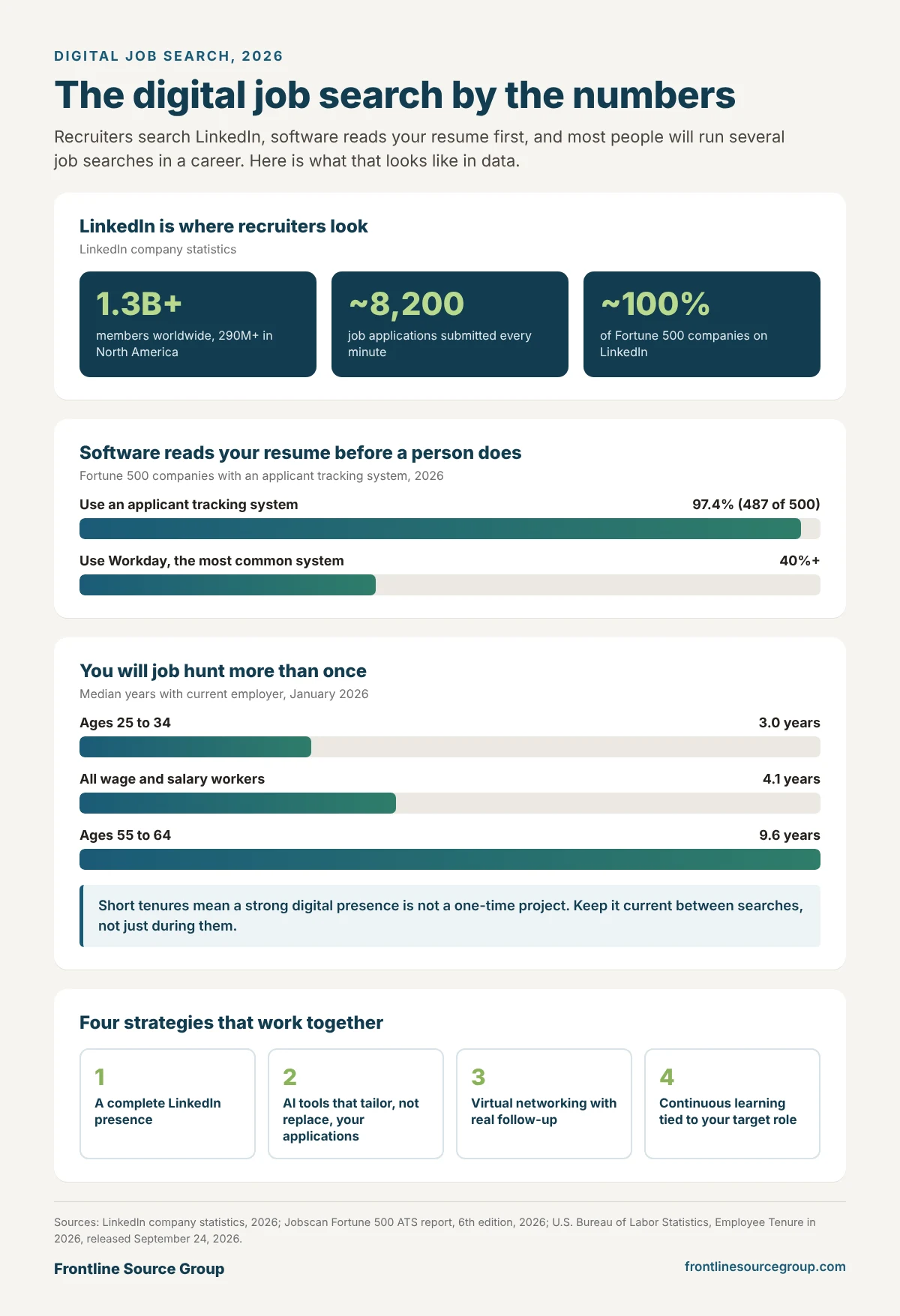
It also means job searching is no longer a once-a-decade event. The U.S. Bureau of Labor Statistics reported in September 2026 that median tenure with a current employer was 4.1 years in January 2026, and just 3.0 years for workers ages 25 to 34. Most professionals will run several searches over a career, so a digital presence that stays current between searches pays off more than one rebuilt in a hurry.
Why does a strong LinkedIn presence matter so much?
LinkedIn is where recruiters look first. According to LinkedIn's own statistics, the platform has more than 1.3 billion members, including more than 290 million in North America, and roughly 8,200 job applications are submitted on it every minute. A complete, current profile signals professionalism and intent to the recruiters and corporate talent teams who search it every day. Other platforms can help too, especially for showing expertise through writing, video, or industry conversations, but LinkedIn is the one to get right first.
What should a complete LinkedIn profile include?
A headline tied to the role you want, not just the one you have. A summary that tells your career story in plain language. Current experience with measurable accomplishments, a skills section that matches the language of the job descriptions you are targeting, recommendations from managers and peers, and a few recent posts or comments that show how you think. For a headline that works, Frontline's LinkedIn Job Search Playbook uses a simple formula: what you do, who you do it for, and the result. If it could describe 500 other people, rewrite it. There is also a separate guide on what the LinkedIn About section is for.
How should job seekers use LinkedIn day to day?
A finished profile is the start, not the finish. The playbook's routine is simple: spend about ten minutes a day leaving real, two or three sentence comments on other people's posts, send a few connection requests that mention something specific about each person, and post around twice a week on three topics you know well. If you are actively looking, turn on Open to Work in recruiter-only mode so recruiters can see it without announcing it to your current employer, and post about what you are good at rather than simply saying you are looking. Track profile views, saves, messages, and real conversations, not likes or follower counts. The full routine and a 30-day plan are in the LinkedIn Job Search Playbook.
How should job seekers use AI tools and data-driven job platforms?
Most job platforms now use algorithms to match people to roles based on skills, experience, and preferences, which can surface openings you would not find on your own. AI writing tools can also help you tailor a resume to a specific posting, draft a first version of a cover letter, and practice answers to likely interview questions. Used well, they save hours on work you would otherwise do by hand.
How can AI help a resume get past an applicant tracking system?
Applicant tracking systems are close to universal at large employers. Jobscan's 2026 review found one at 97.4 percent of Fortune 500 companies, 487 of 500, with Workday the most common. AI tools are useful for comparing your resume against a posting and flagging missing keywords, role titles, platforms, and certifications. Keep the formatting simple, with standard section headers and no graphics, and lead with measurable accomplishments so the person who reads it after the software has something concrete to react to.
Where should job seekers draw the line with AI?
Use AI as an accelerator, not a ghostwriter. Recruiters and hiring managers can spot a generic, machine-written application quickly, and an AI tool does not know which of your accomplishments matter most to a particular employer. Edit everything it drafts until it sounds like you, and never let it invent experience you do not have. The judgment that comes from understanding the role is still yours to supply.
How can job seekers use virtual networking to find opportunities?
Webinars, online workshops, and virtual career fairs cost little or nothing to attend and reach far beyond your local market. That matters most for senior and specialized roles, where the right opportunity may be in another city or another industry. The value comes from what you do around the event, not just from showing up.
How should you follow up after a virtual event?
Ask a thoughtful question in the chat or Q and A so people remember your name. Soon after the event, send a short LinkedIn note to the speaker or to attendees you interacted with, mentioning something specific from the session. Then stay in touch occasionally rather than only when you need something. Treat each conversation as the start of a relationship, because that is how most referrals happen.
Why does continuous learning matter in a digital job search?
Technology keeps changing what roles require, so the skills that got you your last job may not get you the next one. Online courses and certifications make it practical to keep up while working. The ones worth your time are tied directly to the role you want, which is how employers read them.
Which courses and certifications are worth the time?
Pick credentials that close a specific gap between where you are and where you want to go. A CPA moving toward a CFO track might add data analytics. An HR generalist aiming for an HR Manager role might complete the PHR or SHRM-CP. An IT professional moving from on-premise systems to cloud architecture might pursue a cloud certification. Free and low-cost platforms such as LinkedIn Learning, Coursera, edX, and vendor programs from AWS, Microsoft, and Google cover most fields. For the employer side of the same trend, see Frontline's guide to why upskilling matters.
What happens when job seekers combine all four strategies?
They compound. A strong LinkedIn profile makes you visible to recruiters running active searches. AI-driven platforms and tailored applications surface and land targeted opportunities. Virtual networking widens your network beyond your city. Continuous learning keeps your resume current and shows you invest in your career. The candidates who consistently land the right roles do not pick one of these. They do all four, and the combined effect beats any single tactic.
How does Frontline Source Group support candidates in a digital job search?
Frontline Source Group's recruiters help candidates turn digital activity into real interviews. They review how a LinkedIn profile reads against target roles, give employer-specific context before interviews, and connect candidates to active searches where the fit is strongest, across accounting and finance, technology, human resources, legal, engineering, energy, and executive search. After you apply through the how to apply page, Lexi Reed, Frontline's AI recruiter, may call you for a phone interview, and a human recruiter reviews every match. Before you apply, work through the free LinkedIn Job Search Playbook so recruiters who look you up find a profile that matches your resume. You can prepare with the interview instructions, validate your skills through skills testing, and find more resources on the candidates page. Every direct hire is backed by the 5-Year Placement Warranty, 20 times longer than the 90-day guarantee that is standard in the industry.
Frequently Asked Questions: Digital Job Search Strategies
What are the most effective digital job search strategies in 2026?
The four most effective digital job search strategies are maintaining a strong LinkedIn and online professional presence, leveraging AI tools and data-driven job platforms for targeted role matching, virtual networking through webinars and virtual career fairs to expand reach beyond local markets, and committing to continuous learning through online courses and certifications. Candidates who layer all four consistently outperform candidates who rely on resume blasts or any single tactic.
How important is LinkedIn to a modern job search?
LinkedIn is critical to a modern job search because it is where recruiters actively source candidates, and it now has more than 1.3 billion members. A complete profile, with a headline tied to the target role, measurable accomplishments, skills that match job descriptions, and recommendations, makes a candidate visible to the recruiters and talent teams running active searches. Frontline's free LinkedIn Job Search Playbook at frontlinesourcegroup.com/linkedin-job-search-playbook.html walks through the profile, headline formula, daily routine, and a 30-day plan.
How should job seekers use AI tools in their job search?
AI tools are most useful as accelerators on tasks the candidate would otherwise do manually: refining resumes against specific job descriptions for keyword match and ATS readability, drafting personalized cover letters at speed, practicing interview questions through mock interview tools, and using job platform algorithms that surface targeted opportunities. The key is treating AI as an accelerator, not a substitute for the judgment that comes from understanding the target role and the employer.
What is virtual networking and how does it help with job search?
Virtual networking includes attending webinars, online workshops, virtual career fairs, and industry conferences hosted online. Virtual events cost little to attend and extend a candidate's reach beyond the local market, which matters most for senior or specialized roles. The value comes from contributing in the chat or Q and A and following up with speakers and attendees on LinkedIn afterward.
Why is continuous learning important for job seekers in the digital era?
Continuous learning matters because technological change is reshaping job requirements faster than ever. Job seekers who upskill and reskill regularly stay competitive against candidates whose skills are stuck at the level of their last role. The most valuable certifications and courses are the ones directly tied to the candidate's target role: a CPA pursuing data analytics for a CFO transition, an HR generalist completing PHR or SHRM-CP to compete for HR Manager roles, or an IT professional completing cloud certifications to move from on-premise to cloud-architect roles.
How do digital job search strategies differ for senior or executive-level candidates?
Senior and executive-level candidates use the same four strategies but with different emphasis. LinkedIn becomes critical because executive recruiters source primarily through LinkedIn, not through resume databases. AI matching matters less because executive searches are typically high-touch and retained, not algorithmic. Virtual networking shifts toward industry-specific groups and executive forums rather than open career fairs. Continuous learning at the senior level often takes the form of board memberships, advisory roles, or specialized executive education (Harvard Executive Education, Wharton, MIT Sloan) rather than basic certifications.
Should job seekers still use traditional job boards in 2026?
Yes, traditional job boards remain useful but should not be the only channel. Boards like Indeed, ZipRecruiter, and Monster surface high volume of roles and work well for early-career and mid-level positions. The boards work less well for senior or specialized roles where most opportunities never get posted publicly. The strongest approach is to use boards as one of four channels (boards, LinkedIn, virtual networking, recruiter relationships) rather than relying on any single channel.
How can job seekers stand out in an AI-screened applicant pool?
Applicant tracking systems are nearly universal at large employers: Jobscan found one at 97.4 percent of Fortune 500 companies in 2026. To stand out, candidates should mirror the language of the job description in their resume (specific keywords, role titles, technology platforms, certifications), structure the resume in ATS-readable format (no graphics, simple section headers, standard fonts), include measurable accomplishments with numbers and outcomes, and supplement the application with a LinkedIn message to the hiring manager or recruiter when possible. The combination of an AI-optimized resume and a direct human touch consistently outperforms either tactic alone.
How does working with a recruiter complement digital job search strategies?
A recruiter at a firm like Frontline Source Group complements digital strategies in three ways. First, the recruiter has access to roles that never get posted publicly, including confidential searches. Second, the recruiter provides employer-specific context that AI matching and LinkedIn cannot, including hiring manager priorities, team dynamics, the actual problem the role solves, and salary realities. Third, the recruiter advocates for the candidate inside the employer's process. Strong job searches combine digital strategies with active recruiter relationships.
What free online learning platforms are worth using for upskilling?
Credible free and low-cost options include LinkedIn Learning, Coursera (free audit option), edX (university-backed courses), HubSpot Academy for marketing and sales, Google Career Certificates, and vendor training from AWS, Microsoft, and Google Cloud. The right platform depends on the target role and the gap the candidate is trying to fill.
How does Frontline Source Group help candidates with digital job search?
Frontline Source Group's executive recruiters work with candidates to translate digital job search activity into actual interview opportunities. The team reviews LinkedIn profiles against target roles and provides feedback, helps candidates frame their digital presence for the verticals they target, provides employer-specific interview context (hiring manager priorities, company culture, problem the role solves), and connects candidates to active engagements where the fit is strongest. The firm recruits across accounting and finance, technology, human resources, legal, engineering, energy, and executive search through 32 plus offices nationwide. Candidate resources are at frontlinesourcegroup.com/candidates.html.
How can candidates apply for jobs with Frontline Source Group?
Candidates can apply at frontlinesourcegroup.com/how-to-apply.html. After you apply, Lexi Reed, Frontline's AI recruiter, may call to conduct a phone interview, and a human recruiter reviews the application and follows up when there is a current match. Engagement types include contract, contract-to-hire, and direct hire, and every direct hire placement is backed by the 5-Year Placement Warranty.


