How Does Employee Well-Being Actually Improve Workplace Productivity?

Published on: Jun 13, 2024
Updated on: . Originally published on: .
Employee well-being improves productivity when it is built into workload, management, and leadership behavior rather than added as a perk. Gallup's 2026 report puts the cost of low engagement at about $10 trillion in lost global productivity. Frontline Source Group recruits the HR and HSE leaders who own that work and backs every direct hire with the 5-Year Placement Warranty. Frontline has completed 5,619 plus placements since 2004, holds a 5.0-star Trustpilot rating across 683 verified reviews and a 5.0 rating on G2 from validated reviewers, and maintains a 98.94% executive placement retention rate against an industry average near 70 percent.
Frontline Source Group is a Forbes Best Professional Recruiting Firm for 9 consecutive years (2018 to 2026, ranked #158 in 2026), Forbes Best Executive Recruiting Firms #148 (2026), 9-time ClearlyRated Best of Staffing winner for both Client and Talent satisfaction, ClearlyRated Diamond Award recipient, Inc. 5000 honoree, and Expertise.com Best Staffing Agency. The firm is a member of the American Staffing Association (ASA), was founded in Dallas in 2004, and operates 32 plus offices nationwide. See the full list on our staffing awards page.
Most employers underestimate employee well-being because the cost of neglecting it shows up in the wrong line items: turnover, presenteeism, absenteeism, burnout spreading across teams, manager attrition, and slow erosion of institutional knowledge. After 22 years of recruiting, the pattern I see is consistent. Employers whose well-being commitments are real outperform peers on productivity, retention, and recruiting cost, while employers running well-being as a marketing program quietly lose their best people. The difference is not budget. It is whether leadership behavior, workload, and benefits design match the promise.
TL;DR
- Gallup's 2026 report found global engagement at 20 percent and manager engagement at 22 percent, with low engagement costing about $10 trillion in productivity.
- APA's 2026 survey found 37 percent of U.S. workers say work hurts their mental health, up from 32 percent.
- Replacing a leader can cost about 200 percent of salary, and Gallup finds 42 percent of voluntary turnover is preventable.
- Programs work when workload, managers, and senior leaders back them up. Perks alone do not move productivity.
In this article
- What has changed in employee well-being and productivity in 2026?
- Why do most employee well-being programs fail to move productivity?
- What is the real productivity cost of poor employee well-being?
- How does turnover from poor well-being compound across the organization?
- What is presenteeism and why is it harder to see than absenteeism?
- Why does burnout in one role cascade into attrition in other roles?
- What separates well-being programs that work from those that do not?
- How does leadership behavior multiply or destroy well-being investment?
- What are the pros and cons of investing in employee well-being programs?
- What does the CFO math look like on well-being ROI?
- How do industry sectors differ in employee well-being economics?
- How do you build a well-being program that actually moves productivity?
- How does Frontline Source Group help employers strengthen the link between well-being and productivity?
- How do employers and candidates engage Frontline Source Group?
- Frequently Asked Questions: Employee Well-Being and Productivity
What has changed in employee well-being and productivity in 2026?
Three major reports landed in 2026, and they point the same direction:
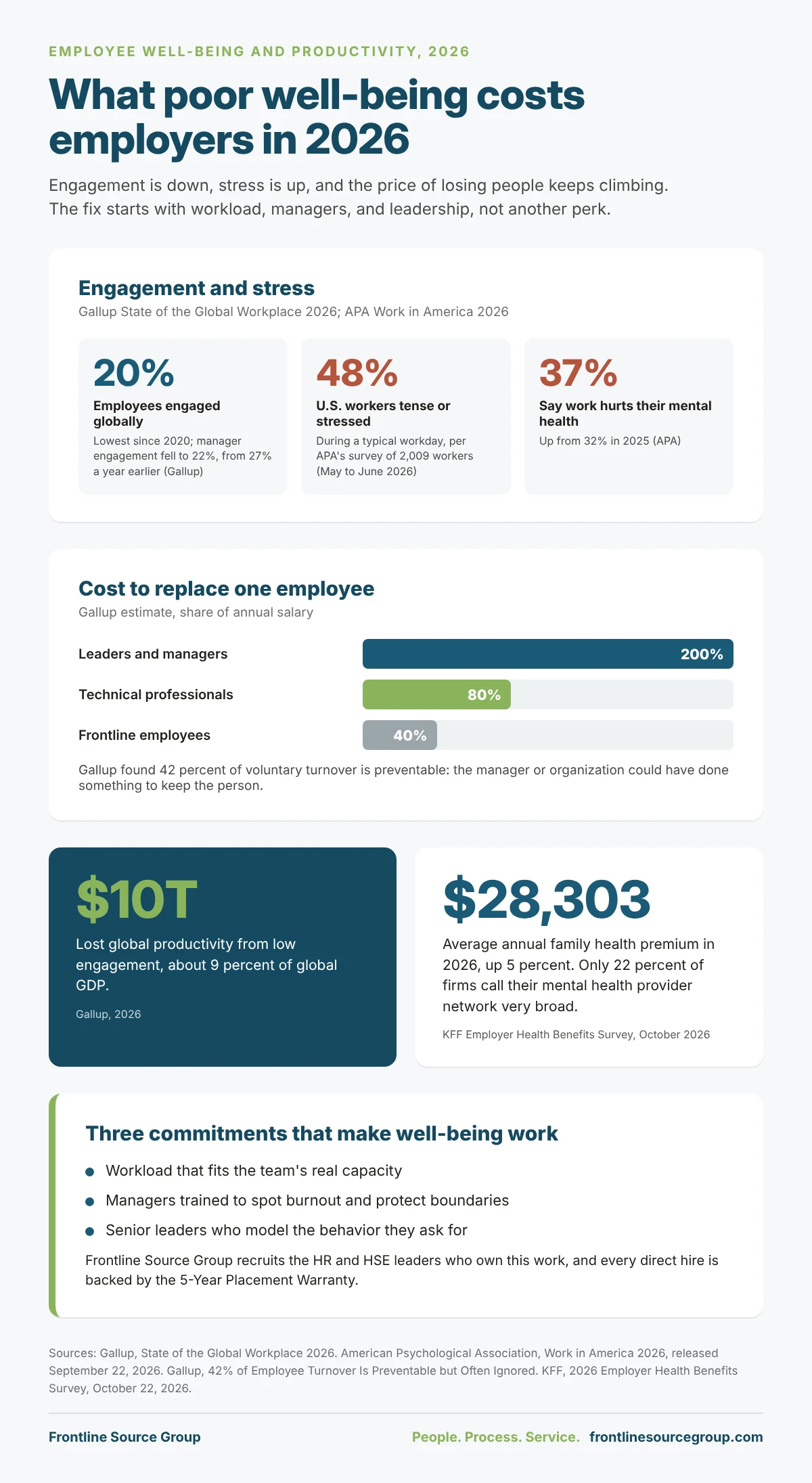
- Gallup, State of the Global Workplace 2026: Gallup found global engagement fell to 20 percent, the lowest since 2020, and manager engagement dropped to 22 percent from 27 percent a year earlier. Gallup estimates low engagement costs about $10 trillion in lost productivity, roughly 9 percent of global GDP. The share of employees thriving rose one point, to 34 percent.
- APA, Work in America 2026 (September 22, 2026): In the American Psychological Association survey of 2,009 employed U.S. adults, 48 percent said they typically feel tense or stressed during the workday, 37 percent said their work environment hurts their mental health, up from 32 percent, and 32 percent feared losing their job, up from 26 percent. The share calling their workplace healthy fell to 80 percent from 85 percent.
- KFF, 2026 Employer Health Benefits Survey (October 22, 2026): KFF reported average family premiums of $28,303, up 5 percent, with workers contributing $7,471. Only 22 percent of firms describe the mental health and substance use network in their largest plan as very broad, compared with 51 percent for providers overall.
Put together: engagement is down, stress and job insecurity are up, managers are struggling most, and the benefits that support well-being cost more every year. That makes the design of a well-being strategy a productivity decision, not just an HR one.
Why do most employee well-being programs fail to move productivity?
The pattern is recognizable across industries. A company invests in a wellness vendor, launches an Employee Assistance Program, adds mental health days, refreshes the careers page, and waits for retention and engagement to improve. A year later, engagement is flat, attrition is unchanged, and the budget owner cannot point to a return. The cause is rarely the program itself. It is that the program runs alongside the operational reality that created the problem: unrealistic workloads, managers whose behavior contradicts the program, leaders who signal it is optional, and benefits design that protects the company more than the employee. Programs that work treat well-being as an operating commitment that runs through workload planning, manager training, leadership accountability, and pay philosophy. Programs that fail treat it as a perk that lives in HR.
What is the real productivity cost of poor employee well-being?
The full cost lives across five categories that most employers track separately and therefore underestimate:
- Turnover. Gallup estimates replacing an employee costs about 40 percent of annual salary for frontline employees, 80 percent for technical professionals, and 200 percent for leaders and managers, covering recruiting, ramp-up, lost knowledge, and team disruption. Gallup also found 42 percent of voluntary turnover is preventable.
- Presenteeism. The productivity gap from people who are at work but functioning at reduced capacity because of mental health strain, financial stress, or burnout.
- Absenteeism. Unplanned sick days, disability claims, and the coverage scramble that follows.
- Burnout cascades. One burned-out employee leaves, and teammates absorbing the extra work start to follow.
- Manager attrition. The most underappreciated cost. When managers leave because the workload is unsustainable, the company loses the people responsible for protecting everyone else's well-being.
Added together, the cost is large for any employer, but it rarely shows up as one number because each category sits in a different line of the profit and loss statement.
How does turnover from poor well-being compound across the organization?
Turnover from well-being failures rarely arrives evenly. The first people to leave are usually the strongest performers with the most outside options. Next come the people who hold institutional knowledge and get tired of explaining context to replacements. Then the managers burn out trying to absorb the work the first two groups left behind. By the time the pattern is obvious, the people who could have fixed it are often gone, and rebuilding takes a long time. Catching well-being problems before the first wave leaves is far cheaper than waiting for retention numbers to signal trouble.
What is presenteeism and why is it harder to see than absenteeism?
Presenteeism is being physically at work but functioning at reduced capacity because of mental health strain, financial stress, burnout, caregiving load, or untreated health conditions. It is harder to see than absenteeism because nothing flags it. An absent employee triggers a visible coverage decision. A present but struggling employee keeps producing work with more errors, slower decisions, weaker customer interactions, and less creativity, none of which shows up as a single line item. That is why mental health benefits, financial wellness resources, and realistic workloads often produce returns that sick-day metrics miss.
Why does burnout in one role cascade into attrition in other roles?
When a key role becomes unsustainable and the person in it leaves, the team does not return to normal. The remaining members absorb the lost capacity, which pushes their workload past the point that broke the original role, and the cycle continues. Cascades are common in finance teams during year-end close, in healthcare during staffing shortages, in technology after layoffs, and in legal teams during major cases. Employers that recognize the pattern protect against it with workload limits, prioritized replacement hiring, and by fixing the problem that caused the first departure instead of treating it as a one-off.

"Candidates can tell within one interview whether a company's well-being promise is real. They ask how the last person in the role left, when the manager last took a vacation, and what happens at 7 p.m. on a Tuesday. The employers with good answers win the people everyone else is chasing."
Bill Kasko, Founder, President, and CEO, Frontline Source Group, and a Federal Reserve Bank of Dallas Beige Book advisor on hiring and wage trends for more than 18 years
What separates well-being programs that work from those that do not?
Three structural commitments separate programs that move productivity from programs that do not.
Workload that fits the team
The single largest factor in well-being is whether the work assigned to a team fits its actual capacity. Programs added on top of unsustainable workloads are decorative.
Managers trained to back the program
Frontline managers either carry out the program's intent or quietly contradict it. Training on workload planning, recognizing burnout, and respecting boundaries multiplies every other investment. Gallup's finding that manager engagement fell to 22 percent shows why this layer needs attention first.
Leaders who model the message
Senior leaders who take vacation, protect boundaries, and talk openly about well-being signal that the program is real. Leaders who do the opposite signal that it is for show, whatever HR says.
Everything else, including wellness apps, Employee Assistance Program subsidies, mental health days, on-site fitness, and financial education, adds value on top of these three commitments. Without them, it rarely produces a lasting return.
How does leadership behavior multiply or destroy well-being investment?
Leadership behavior is the largest non-budget variable in well-being outcomes. A wellness investment of any size sitting alongside a CEO who works through vacation, a CFO who emails on Sundays, or a COO whose team says they never disconnect gets discounted to near zero by the employees it is meant to help. The opposite is also true. Leaders who model boundaries publicly, talk openly about mental health, and take real time off give employees permission to do the same. For HR and finance leaders planning well-being spending, leadership behavior is the lever, not the wellness vendor.
What are the pros and cons of investing in employee well-being programs?
Pros of investing in employee well-being
- Less preventable turnover. With 42 percent of voluntary exits preventable by Gallup's count, retention is the clearest return.
- Less hidden presenteeism. Fewer errors and better decisions from people who are present and able to focus.
- A stronger employer brand. Candidates test well-being claims in interviews, and credible ones help win offers.
- Better long-term health costs. Prevention and mental health access can bend the claims curve over several years.
Cons of investing in employee well-being
- Real costs. With family premiums averaging $28,303 in 2026, according to KFF, every added benefit has to earn its place.
- Delayed results. Retention, claims, and recruiting outcomes trail program launches, so returns are hard to show in a single budget year.
- Wasted spend without the foundation. If workload and management problems are not fixed first, new programs rarely change anything.
- Measurement gaps. Presenteeism and burnout costs are hard to quantify, which makes the business case harder to defend.
What does the CFO math look like on well-being ROI?
The finance case for well-being runs on five inputs:
- Turnover avoided: about 40 to 200 percent of salary per avoided departure, depending on role level, by Gallup's estimate.
- Presenteeism reduced: often the largest and least visible category.
- Absenteeism reduced: fewer sick days and short-term disability claims.
- Recruiting costs lowered: a credible employer brand raises offer acceptance.
- Health cost trend improved: prevention and earlier mental health care shift the multi-year claims curve.
Returns build as lagging indicators, such as retention, claims, and recruiting results, catch up to leading indicators, such as engagement, manager behavior, and program use. The CFOs who fund credible well-being programs treat them as investments in business performance rather than discretionary benefits to cut first.
How do industry sectors differ in employee well-being economics?
The math runs differently by sector because turnover costs, the impact of presenteeism, and burnout dynamics vary:
- Healthcare and life sciences: presenteeism is especially costly because errors carry patient safety and regulatory consequences, and burnout spreads through clinical teams during staffing shortages.
- Financial services: turnover is especially expensive because of long ramp times and the premium needed to replace senior talent.
- Technology: burnout spreads through engineering teams after major releases or layoffs, and losing engineers slows product work for quarters.
- Legal: presenteeism among associates and paralegals during litigation is common, and burnout-driven attrition of senior associates is a long-running problem for large firms.
- Manufacturing and energy: physical well-being is also a safety issue, so neglect shows up in OSHA recordables, claims, and regulatory exposure.
Well-being program design should follow the economics of your industry rather than a generic playbook.
How do you build a well-being program that actually moves productivity?
Start with the three structural commitments before any program spend: realistic workloads, trained managers, and leaders who model the behavior. Then build the program on that foundation. Components that tend to produce lasting returns include:
- Employee Assistance Program access with measured use, not just availability.
- Mental health benefits with low or no copays and an adequate in-network provider list. KFF found only 22 percent of firms call their behavioral health network very broad.
- Financial wellness resources tied to retirement and emergency savings.
- Paid time off that people actually use, with leaders setting the example.
- Parental and caregiver leave, and a transparent compensation philosophy.
Track outcomes that matter to the business, such as retention by role level, engagement, presenteeism proxies, and recruiting results, rather than inputs that only show activity. Treat the program as a multi-year investment whose returns build over time, not a quarterly initiative.
How does Frontline Source Group help employers strengthen the link between well-being and productivity?
Frontline Source Group's recruiters act as a real-time feedback loop on how candidates judge employers' well-being claims. We hear it in every search, and we flag the gaps between brand promise and day-to-day reality that cause placements to fail after the start date. Frontline also recruits the leaders who own well-being: human resources and HR executive search, health, safety, and environment executive search, operations, and C-suite roles. Our HR and HSE searches are led by recruiters such as Lindsey Davidson, CDR, and companies that need senior HR leadership part-time can bring in a fractional CHRO.
Every direct hire is backed by the 5-Year Placement Warranty, 20 times longer than the 90-day staffing industry standard, and our fees are published on the pricing page, which is still rare in staffing.
How do employers and candidates engage Frontline Source Group?
Employers searching for HR, HSE, operations, finance, or C-suite leaders can submit a confidential request through the employer request form. Candidates can apply at frontlinesourcegroup.com/how-to-apply.html, and a Frontline recruiter will follow up about role preferences, location, and engagement type. People. Process. Service.
Frequently Asked Questions: Employee Well-Being and Productivity
What did Gallup's 2026 State of the Global Workplace report find?
Gallup found global employee engagement fell to 20 percent, its lowest level since 2020, and manager engagement dropped to 22 percent from 27 percent a year earlier. Gallup estimates low engagement costs about $10 trillion in lost productivity, roughly 9 percent of global GDP.
How stressed are U.S. workers in 2026?
In the American Psychological Association's 2026 Work in America survey of 2,009 employed adults, 48 percent said they typically feel tense or stressed during the workday, and 37 percent said their work environment negatively affects their mental health, up from 32 percent the year before.
What is the real productivity cost of poor employee well-being?
The cost sits across five categories most employers track separately: turnover, presenteeism, absenteeism, burnout cascades, and manager attrition. Gallup estimates replacing an employee costs about 40 percent of salary for frontline staff, 80 percent for technical professionals, and 200 percent for leaders and managers, and finds 42 percent of voluntary turnover is preventable.
Why do most wellness programs fail to move productivity metrics?
The program itself is rarely the cause. It runs alongside the operational reality that created the problem: unrealistic workloads, managers whose behavior contradicts the program, and leaders who signal it is optional. Programs that work treat well-being as an operating commitment that runs through workload planning, manager training, leadership accountability, and pay philosophy.
What is presenteeism and how does it differ from absenteeism?
Presenteeism is being at work but functioning at reduced capacity because of mental health strain, financial stress, burnout, caregiving load, or untreated health conditions. Absenteeism is visible and triggers a coverage decision. Presenteeism is not: the work continues with more errors, slower decisions, and weaker customer interactions that never show up in a single line item.
How much does employee turnover cost?
Gallup estimates the cost of replacing an employee at about 40 percent of annual salary for frontline employees, 80 percent for technical professionals, and 200 percent for leaders and managers. The cost covers recruiting, ramp-up time, lost institutional knowledge, and team disruption, and it compounds when one departure triggers others.
What is the burnout cascade?
The burnout cascade starts when a key role becomes unsustainable and the person in it leaves. The remaining team absorbs the lost capacity, which pushes their workload past the point that broke the first role, and the next departure follows. Cascades are common in finance during year-end close, in healthcare during staffing shortages, in technology after layoffs, and in legal during major cases.
What separates well-being programs that work from those that don't?
Three commitments: workload that fits the team's real capacity, managers trained to recognize burnout and protect boundaries, and senior leaders who model the behavior they ask for. Wellness apps, employee assistance programs, mental health days, and financial education add value on top of those three, but not in their place.
What are the pros and cons of investing in employee well-being programs?
The pros include lower preventable turnover, less hidden presenteeism, a stronger employer brand for recruiting, and better long-term health cost trends. The cons include real program and benefit costs, results that take time to show up in retention and claims data, and wasted spend if workload and management problems are not fixed first.
What metrics should employers track to measure well-being impact?
Track outcomes rather than inputs: retention by role level, engagement scores, presenteeism proxies such as error rates and self-reported productivity, absenteeism and disability claims, and recruiting results such as offer acceptance rates. Program utilization and perception surveys are useful signals, but they measure activity, not results.
How does Frontline Source Group help employers improve well-being and productivity?
Frontline Source Group hears how candidates judge employers' well-being claims in every search and flags gaps between brand promise and day-to-day reality. The firm recruits the HR, HSE, and operations leaders who own well-being programs, publishes its pricing, and backs every direct hire with the 5-Year Placement Warranty. Learn more at frontlinesourcegroup.com/human-resources.html.
How do employers and candidates engage Frontline Source Group?
Employers can submit a confidential search request at frontlinesourcegroup.com/employer-request-form.html and review published fees at frontlinesourcegroup.com/pricing.html. Candidates can apply at frontlinesourcegroup.com/how-to-apply.html, and a Frontline recruiter will follow up.
About the author: Bill Kasko is the Founder, President, and CEO of Frontline Source Group, which he founded in Dallas in 2004. Bill specializes in C-Suite executive search across the Sales, Energy, and Dental verticals and has advised the Federal Reserve Bank of Dallas on hiring and wage trends for its Beige Book for more than 18 years. Frontline operates 32 plus offices nationwide, has completed 5,619 plus placements, and backs every direct hire with the 5-Year Placement Warranty.


