What Are the Main Human Resources Roles and Job Descriptions?

Published on: Jun 24, 2026
Updated on: October 8, 2026.
Human resources roles range from HR assistants and coordinators to generalists, recruiters, business partners, HR managers, and executives such as the SVP of Human Resources and CHRO. Each job description defines the role's purpose, duties, qualifications, compliance scope, and reporting line, and the scope grows from administrative support to company-wide strategy. Frontline Source Group has placed HR professionals at every level since 2004, completing 5,619 placements with a 98.94% executive placement retention rate, and backs every direct hire with a 5-Year Placement Warranty.
Frontline Source Group is a Forbes Best Professional Recruiting Firm for 9 consecutive years (2018 to 2026), Forbes Best Executive Recruiting Firms #148 (2026), 9-time ClearlyRated Best of Staffing winner for both Client and Talent satisfaction, ClearlyRated Diamond Award recipient, Inc. 5000 honoree, Expertise.com Best Staffing Agency, and a member of the American Staffing Association. The firm holds a 5.0-star Trustpilot rating across 683 verified reviews.
What is a human resources job description?
A human resources job description is a written summary that defines the purpose, duties, qualifications, and reporting structure for a specific HR position. It sets expectations across the team, guides recruiting and onboarding, and keeps day-to-day work aligned with business goals and employment law. A clear job description also makes performance management fairer, because each person is measured against the responsibilities the document actually names rather than against assumptions.
What should an HR job description include?
A complete HR job description covers the job title and level, a short summary of the role's purpose, the core duties in order of importance, required and preferred qualifications such as education, years of experience, and certifications like SHRM-CP or PHR, the systems the person will use, the reporting line and any direct reports, and the work arrangement. Many employers also include a pay range, and several states and cities now require one in job postings. In my experience recruiting HR professionals, the descriptions that attract the strongest candidates are specific about what success looks like in the first year.
What are the most common human resources roles in an organization?
Most HR teams are built around a core set of roles: HR generalists who handle a broad mix of daily work, recruiters and talent acquisition specialists who source and interview candidates, HR managers who run the function and align it with company goals, benefits and compensation specialists who administer total rewards, and training and development professionals who build employee skills. Larger organizations add specialists in compliance, employee relations, compensation analysis, and HR information systems (HRIS). For a closer look at one of the most common roles, see our HR generalist job description and career path.
How do human resources roles differ from entry-level to executive?
HR roles scale from administrative support to strategic leadership as responsibility increases. Entry-level positions focus on records, onboarding coordination, and training logistics. Mid-level roles take ownership of full processes such as recruiting, performance reviews, and benefits. Senior and executive roles set HR strategy, coordinate across departments, and own compliance and culture for the whole organization.
What do entry-level HR roles do?
Entry-level professionals such as HR assistants, HR coordinators, and recruiting coordinators support the team by maintaining employee records, scheduling interviews, preparing onboarding paperwork, and coordinating training sessions. These positions build the foundational knowledge of policy, documentation, and compliance that supports advancement into generalist and specialist roles.
What do mid-level HR roles do?
Mid-level roles, including HR generalists, recruiters, HR business partners, and benefits or compensation specialists, own full processes rather than single tasks. They run recruitment cycles from start to finish, manage performance review programs, administer benefits, resolve employee relations issues, and translate company policy into day-to-day practice for the managers and employees they support.
What does the SVP of Human Resources do?
Senior and executive leaders, such as the HR Director, Vice President of Human Resources, SVP of Human Resources, and Chief Human Resources Officer, set strategy and carry organization-wide accountability. The SVP of Human Resources oversees talent acquisition strategy, workforce planning, total rewards, organizational design, and culture, and partners with the executive team to connect people decisions to business results. The role typically reports to the CEO or the CHRO, depending on the size of the company.
How much do human resources professionals earn?
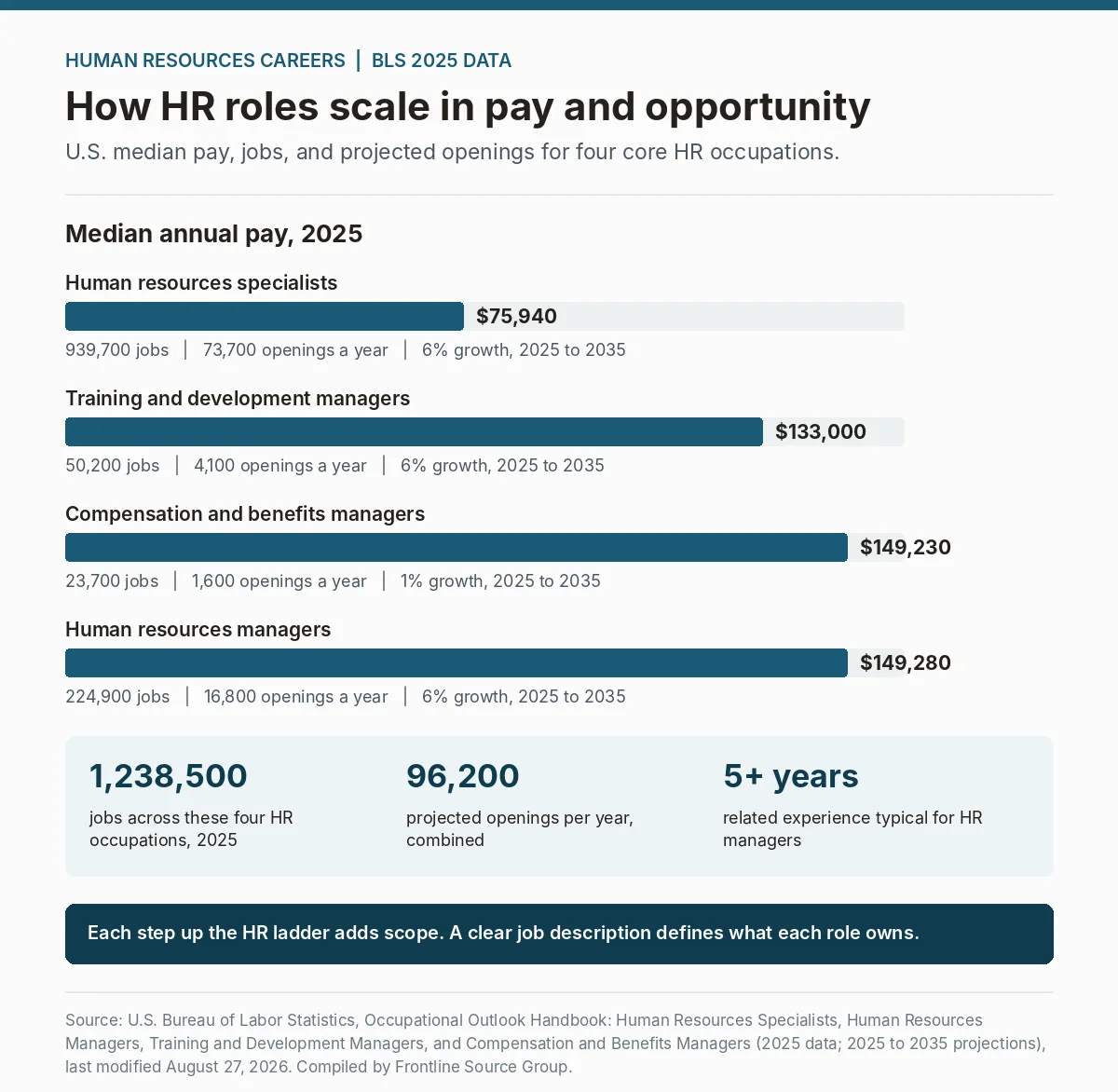
Pay rises sharply as HR roles move from specialist to management. According to the U.S. Bureau of Labor Statistics Occupational Outlook Handbook, human resources specialists earned a median of $75,940 in 2025 and held 939,700 jobs, with about 73,700 openings projected each year through 2035. Human resources managers earned a median of $149,280, held 224,900 jobs, and typically need five or more years of related experience. Training and development managers earned a median of $133,000, and compensation and benefits managers earned a median of $149,230.
What are the key responsibilities and duties in human resources?
Core HR responsibilities span recruitment and selection, onboarding, training and development, and performance management built on goal setting and reviews. HR also maintains employee records, administers compensation and benefits, handles employee relations and conflict resolution, supports workplace safety, builds inclusive hiring and workplace practices, and protects legal compliance across the employment lifecycle. Handling these duties consistently reduces disputes, lowers legal risk, and keeps the workforce engaged.
What is a human resources compliance job description?
An HR compliance role keeps employment practices aligned with federal, state, and local law. Typical duties include monitoring labor regulations, maintaining required documentation and reporting, auditing policies and procedures, managing employee classification and leave administration, and training managers on lawful practices. The role has grown in importance as remote and multistate workforces make the regulatory picture more complex, since a company with employees in several states must follow each state's rules on pay, leave, and posting requirements.

What skills and qualities do strong HR professionals need?
Effective HR professionals combine people skills with operational discipline. The most valuable qualities include clear communication, sound judgment in confidential and sensitive situations, strong knowledge of employment law, organization and project management, data literacy for workforce metrics, and the emotional intelligence to handle conflict fairly. As HR becomes more strategic, business acumen and the ability to connect people decisions to financial results set senior candidates apart. We cover this further in qualities human resource leaders must possess and in our 2026 playbook on technology in hiring for HR leaders.
How do staffing agencies and executive search firms support HR hiring?
A staffing agency fills a wide range of HR roles on a contract, contract-to-hire, or direct hire basis by handling sourcing, screening, and candidate presentation. An executive search firm focuses on senior positions such as the SVP of Human Resources or CHRO, using targeted outreach to leaders who are not actively looking and in-depth assessment of fit with the role and culture. Working with a specialized partner widens the candidate pool and improves the quality of each match. Frontline Source Group supports both needs through its human resources staffing team and its C-suite executive search practice, with local HR recruiting in markets such as Richardson and Brentwood.
What makes Frontline Source Group different for HR staffing and search?
Frontline Source Group stands apart on three points. First, retention: a 98.94% executive placement retention rate means the people the firm places tend to stay. Second, the 5-Year Placement Warranty on every direct hire, 20 times longer than the 90-day industry standard guarantee. If a placement leaves within the warranty period, the client receives a pro-rated credit toward a replacement search. Third, transparency: Frontline publishes its engagement models and fee ranges on its pricing page.
How do you get started with Frontline Source Group's HR team?
Employers hiring HR talent can submit a request through the employer request form to connect with a recruiter on the human resources desk. HR professionals exploring new roles can apply through the secure application on the how to apply page, and a recruiter will follow up when there is a match. More resources for job seekers, including interview instructions, are on the candidates page.
What are the most common questions about human resources roles and job descriptions?
What is a human resources job description?
A human resources job description is a written summary that defines the purpose, duties, qualifications, and reporting line for a specific HR position. It sets expectations, guides recruiting and onboarding, and keeps the role aligned with business goals and employment law.
What should an HR job description include?
An HR job description should include the job title and level, a summary of the role's purpose, core duties, required and preferred qualifications such as experience and certifications like SHRM-CP or PHR, the systems used, the reporting line, the work arrangement, and often a pay range, which several states and cities now require in postings.
What are the most common HR roles in an organization?
Common HR roles include HR assistant or coordinator, HR generalist, recruiter or talent acquisition specialist, HR business partner, benefits and compensation specialist, training and development manager, HR manager, and senior leaders such as the HR Director, VP or SVP of Human Resources, and Chief Human Resources Officer.
What does an entry-level HR role involve?
Entry-level roles such as HR assistant, HR coordinator, and recruiting coordinator focus on administrative support. Duties include maintaining employee records, scheduling interviews, preparing onboarding paperwork, and coordinating training, which builds the policy and compliance knowledge needed to advance.
What does the SVP of Human Resources do?
The SVP of Human Resources is a senior executive who sets HR strategy and carries organization-wide accountability. The role oversees talent acquisition strategy, workforce planning, total rewards, organizational design, and culture, and partners with the executive team to connect people decisions to business results.
How much does an HR manager make?
Human resources managers earned a median annual wage of $149,280 in 2025, according to the U.S. Bureau of Labor Statistics. Human resources specialists earned a median of $75,940, training and development managers earned $133,000, and compensation and benefits managers earned $149,230. Pay varies by industry, location, and company size.
What are the key responsibilities and duties in HR?
Core duties span recruitment, onboarding, training and development, and performance management. HR also maintains employee records, administers compensation and benefits, handles employee relations, supports workplace safety, builds inclusive workplace practices, and protects legal compliance.
What is a human resources compliance job description?
An HR compliance role keeps employment practices aligned with federal, state, and local law. Duties include monitoring labor regulations, maintaining documentation and reporting, auditing policies, managing employee classification and leave administration, and training managers, which protects the organization from legal exposure.
What skills do strong HR professionals need?
Effective HR professionals combine clear communication, sound judgment in confidential situations, strong knowledge of employment law, organization and project management, data literacy for workforce metrics, and emotional intelligence. At the senior level, business acumen becomes a key differentiator.
How do staffing agencies and executive search firms support HR hiring?
A staffing agency fills HR roles on a contract, contract-to-hire, or direct hire basis by handling sourcing, screening, and candidate presentation. An executive search firm focuses on senior roles such as the SVP of Human Resources or CHRO, reaching leaders who are not actively looking and assessing fit with the role and culture.
What is the 5-Year Placement Warranty?
The 5-Year Placement Warranty is Frontline Source Group's commitment on every direct hire placement, 20 times longer than the 90-day industry standard guarantee. If a placement leaves within the warranty period, the client receives a pro-rated credit toward a replacement search. It is supported by a 98.94% executive placement retention rate.
How do I hire HR talent or apply for an HR role through Frontline Source Group?
Employers can submit a request through the employer request form to reach a recruiter on the human resources desk. HR professionals can apply through the secure application on the how to apply page, and a Frontline recruiter will follow up when there is a match with an open search.


