What does an HR Generalist do, and how far can the career go?

Published on: Jun 22, 2026
Updated on: November 2, 2026
An HR Generalist handles every core human resources function a company runs: recruiting, onboarding, employee relations, benefits, payroll coordination, compliance, and policy. The Bureau of Labor Statistics puts median pay for the occupation at $75,940. Frontline Source Group places HR Generalists nationwide and backs every direct hire with the 5-Year Placement Warranty.
Frontline Source Group was founded in Dallas in 2004 and has grown to 32 plus offices nationwide over 22 years, with 5,619 completed placements and a 98.94% executive placement retention rate. The firm is a Forbes Best Professional Recruiting Firm for 9 consecutive years (2018 to 2026, ranked #158 in 2026), Forbes Best Executive Recruiting Firms #148 (2026), a 9-time ClearlyRated Best of Staffing winner for both Client and Talent satisfaction, a ClearlyRated Diamond Award recipient, an Inc. 5000 honoree, and an Expertise.com Best Staffing Agency. It holds a 5.0-star Trustpilot rating across 683 verified reviews, a 5.0 rating on G2 from validated reviewers, and membership in the American Staffing Association (ASA).
In this guide
- What is an HR Generalist?
- What does an HR Generalist do day to day?
- What does a typical HR Generalist job description include?
- What qualifications and certifications do employers look for?
- How much does an HR Generalist make?
- What is the HR career path from Generalist to senior roles?
- What does a Senior HR Generalist job description look like?
- Why are HR Generalists so important to organizations?
- How do you advance your HR career as a Generalist?
- How should employers hire an HR Generalist?
- What makes Frontline Source Group different from other HR staffing agencies?
- How do you get started with Frontline Source Group's HR staffing team?
- Frequently asked questions
What is an HR Generalist?
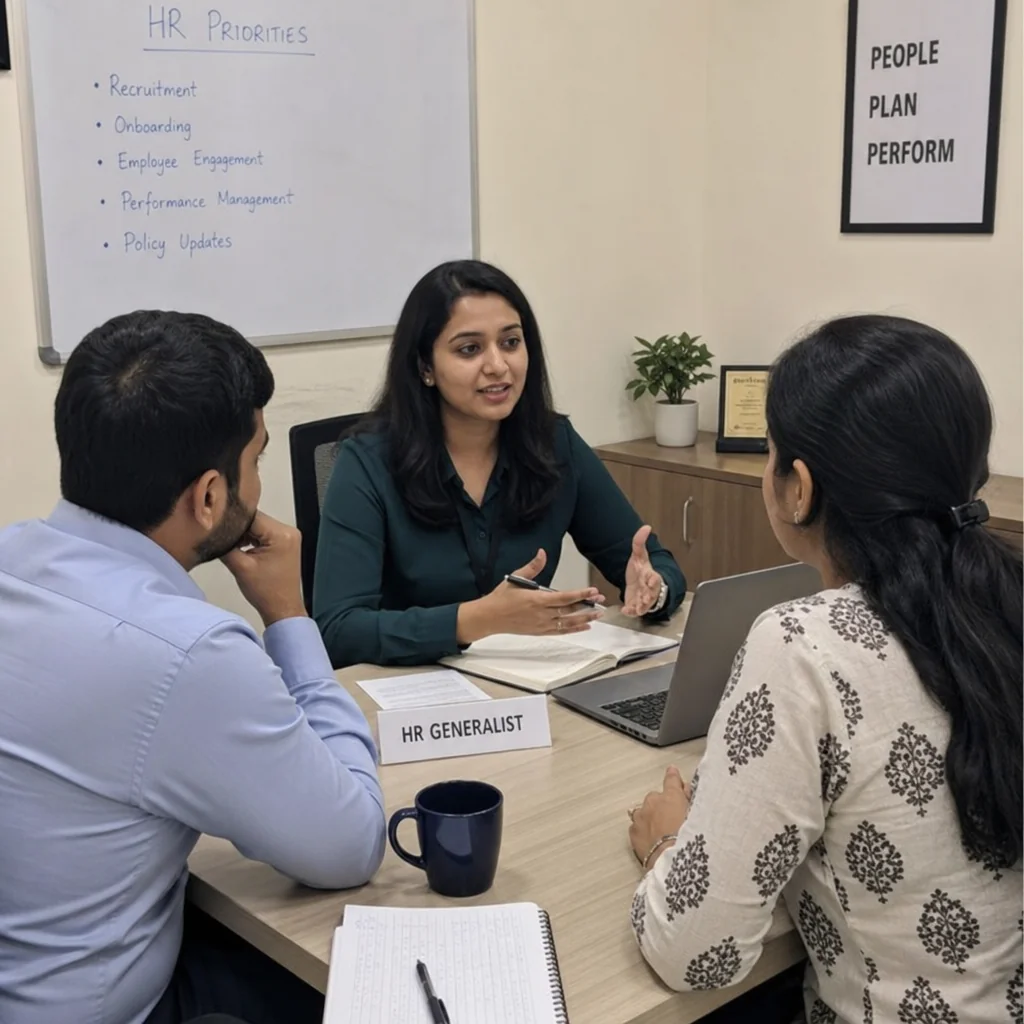
An HR Generalist is the human resources professional who covers the whole field instead of one slice of it. Where a benefits specialist lives in plan design and a recruiter lives in the requisition queue, the generalist handles recruiting, onboarding, employee relations, benefits, training, compliance, and policy, often in the same afternoon. The Bureau of Labor Statistics counts generalists inside its human resources specialist occupation and describes them as handling all aspects of HR work.
The size of the company shapes the job. At a business with 80 employees, the HR Generalist is frequently the entire HR department and reports to a COO or CFO. At a company with several thousand employees, a generalist usually supports one location, division, or business unit and reports to an HR Manager or HR Business Partner. Either way, the generalist is the person employees call first.
What does an HR Generalist do day to day?
No two weeks look the same, which is the appeal of the job and also the hard part. The work clusters into four areas, and most generalists spend time in all of them every week.
Recruiting and onboarding
Writing and posting job descriptions, screening resumes, scheduling and sitting in on interviews, extending offers, running background checks, and owning the first weeks of a new hire, from I-9 verification to benefits enrollment to the first-day schedule.
Employee relations and performance
Fielding employee concerns, coaching managers through difficult conversations, documenting performance issues, running or supporting workplace investigations, and keeping the annual review cycle on schedule. This is where judgment matters most, and where a weak generalist creates real legal exposure.
Benefits, payroll, and HRIS
Answering benefits questions, running open enrollment, processing leave requests, sending pay and status changes to payroll, and keeping employee records accurate in the HRIS. Most generalist postings name a platform such as Workday, UKG, ADP, or Paylocity.
Compliance, policy, and records
Keeping the handbook current, tracking federal, state, and local employment law changes, maintaining confidential personnel files, preparing required postings and filings, and making sure documentation would hold up if a decision were ever challenged.
What does a typical HR Generalist job description include?
Most HR Generalist job descriptions follow the same structure. The sample below is a solid starting point for employers writing a posting and a useful checklist for candidates comparing their experience against the role.
Position summary: The HR Generalist supports the full employee lifecycle, serving as the first point of contact for employees and managers on recruiting, onboarding, employee relations, benefits, payroll coordination, and HR compliance.
Key responsibilities:
- Manage full-cycle recruiting and onboarding for assigned departments or locations
- Maintain accurate, confidential employee records in the HRIS
- Administer benefits programs and coordinate open enrollment and leave
- Process payroll changes and partner with payroll on accuracy
- Advise managers on performance management, documentation, and corrective action
- Investigate and resolve employee relations concerns
- Coordinate training, compliance programs, and required postings
- Maintain the employee handbook and HR policies in line with employment law
- Prepare HR reports on headcount, turnover, and other workforce metrics
Qualifications:
- Bachelor's degree in human resources, business, or a related field, or equivalent experience
- Prior HR experience, often as an HR Coordinator or HR Assistant
- Working knowledge of employment law, benefits administration, and HRIS platforms
- Sound judgment with confidential matters and strong written and verbal communication
- SHRM-CP, PHR, or similar certification preferred
What qualifications and certifications do employers look for?
BLS lists a bachelor's degree in human resources, business, communications, or a related field as the typical entry-level education for HR specialists. In practice, employers hiring a generalist usually want to see some HR exposure first, because the role leaves little room to learn employment law on the job. Certification is usually voluntary, but many employers prefer it, and BLS notes it helps generalists show knowledge across every HR area.
SHRM-CP and SHRM-SCP
The Society for Human Resource Management does not require a degree or prior HR experience to apply for the SHRM-CP, which makes it a common first credential for generalists. The SHRM-SCP requires at least 3 years of strategic-level HR work, or 3 years holding the SHRM-CP while working in or moving toward a strategic role.
PHR and SPHR
HRCI's PHR requires 1 year of professional-level HR experience with a master's degree, 2 years with a bachelor's degree, or 4 years without a degree. The exam has 90 scored questions plus 25 pretest questions, and holders recertify every 3 years with 60 HR recertification credits or by retaking the exam. The SPHR, aimed at senior HR leaders, requires 4 years of experience with a master's degree, 5 years with a bachelor's, or 7 years without a degree.
How much does an HR Generalist make?
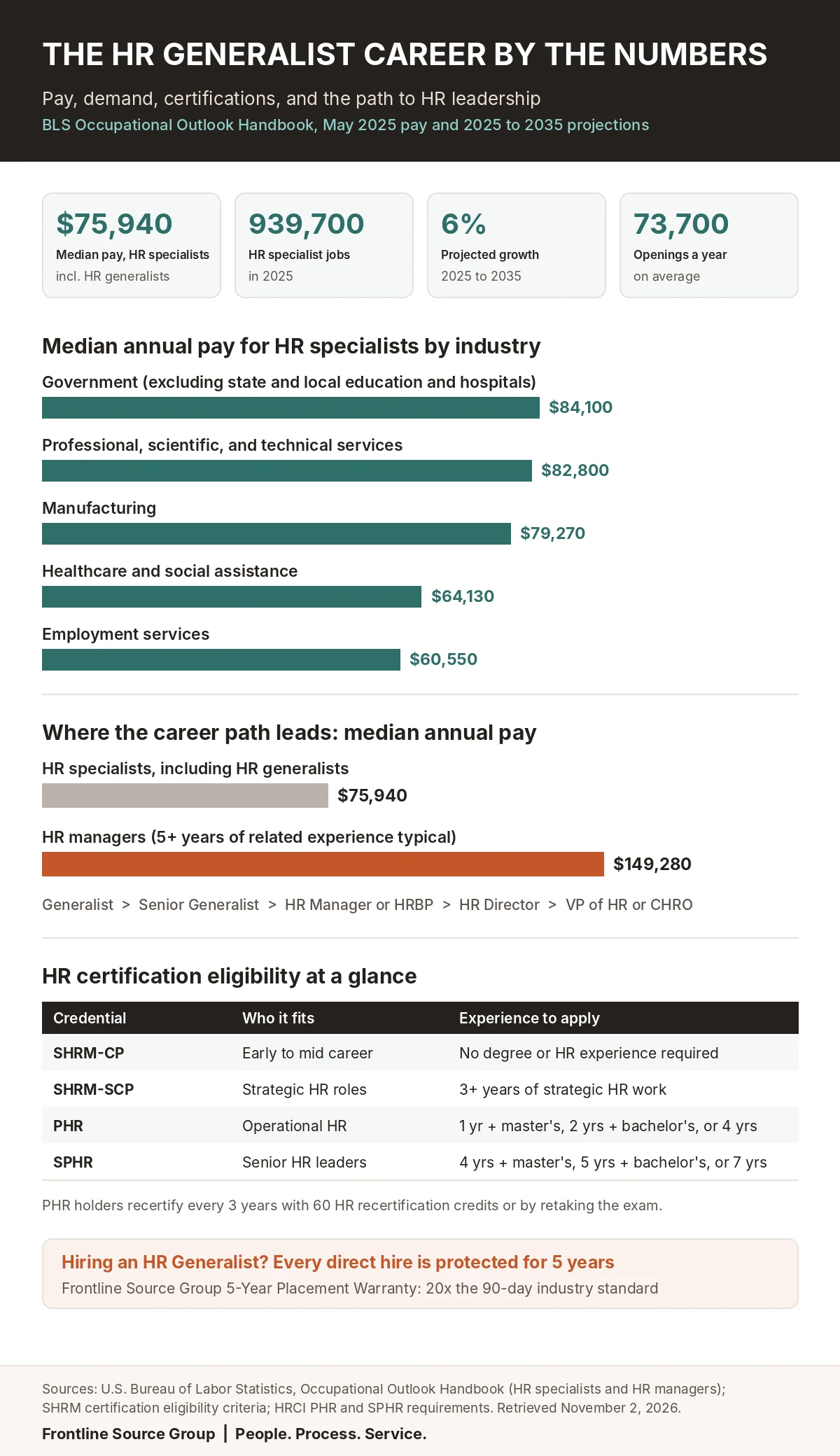
The Bureau of Labor Statistics reported a median annual wage of $75,940, or $36.51 an hour, for human resources specialists in May 2025. The occupation held 939,700 jobs in 2025, and BLS projects 6 percent growth from 2025 to 2035, faster than the average for all occupations, with about 73,700 openings a year.
Industry makes a real difference. Median pay for HR specialists in government (excluding state and local education and hospitals) was $84,100, followed by professional, scientific, and technical services at $82,800, manufacturing at $79,270, healthcare and social assistance at $64,130, and employment services at $60,550. Certifications, HRIS depth, and employee relations experience tend to separate offers within the same market.
What is the HR career path from Generalist to senior roles?
The HR Generalist role is one of the most common launch points into HR leadership. A typical progression looks like this:
- HR Coordinator or HR Assistant: administrative HR support, records, scheduling, and onboarding paperwork
- HR Generalist: full-scope HR for a company, location, or business unit
- Senior HR Generalist: complex employee relations, policy ownership, metrics, and mentoring junior staff
- HR Manager or HR Business Partner: team leadership or strategic partnership with a business leader
- HR Director: ownership of HR strategy, programs, and budget
- Vice President of Human Resources or Chief Human Resources Officer: executive leadership of the people function
The pay gap between steps is significant. BLS reported a median of $149,280 for HR managers in May 2025, with 5 or more years of related experience typical for the role, and notes that some managers start out as HR specialists. Not every generalist wants to manage people. Many branch into benefits, compensation, HRIS, or talent acquisition, where the breadth they built as a generalist makes them better specialists.
What does a Senior HR Generalist job description look like?
A Senior HR Generalist does everything a generalist does, then adds depth. The senior role typically owns the complex employee relations cases and investigations, mentors junior HR staff, leads policy development, and uses HR metrics to shape workforce decisions. Senior generalists often partner directly with department heads on workforce planning, compensation strategy, and organizational change. Employers expect several years of progressive HR experience, strong command of employment law, and frequently a SHRM-CP, SHRM-SCP, PHR, or SPHR.
Why are HR Generalists so important to organizations?
HR Generalists touch nearly every part of the employee experience: who gets hired, how the first week goes, whether policies are applied fairly, whether benefits make sense, and how conflict gets resolved. Each of those shapes retention. The compliance side matters just as much, because a missed leave obligation or a poorly documented termination can cost far more than the generalist's salary. When the function is strong, leadership gets a reliable partner on workforce planning and employees get someone they trust.
How do you advance your HR career as a Generalist?
- Earn a credential. A SHRM-CP or PHR signals commitment and is often the line between a generalist and a senior generalist posting.
- Own the hard cases. Volunteer for investigations, restructurings, and policy rewrites. That is the experience senior roles screen for.
- Get fluent in the numbers. Turnover, time to fill, absenteeism, and cost per hire are the language HR leaders use with executives.
- Go deep on one HRIS. Generalists who can build reports and fix data in Workday, UKG, ADP, or Paylocity are harder to replace.
- Work with a recruiter who knows HR. The right recruiter can surface roles that are not posted and make the case for your experience directly with the hiring leader.
HR professionals ready for a move can start at frontlinesourcegroup.com/how-to-apply.html. Skills assessment resources are at frontlinesourcegroup.com/skills-testing.html, and a step-by-step guide to tightening your LinkedIn profile and search is at frontlinesourcegroup.com/linkedin-job-search-playbook.html.
How should employers hire an HR Generalist?
Start by deciding where the role leans. Few generalists are equally strong in recruiting, employee relations, and benefits and payroll, so name the one your company needs most. Interview with real scenarios, such as a harassment complaint or a leave request that overlaps with a performance problem, rather than asking for definitions. Benchmark pay before posting, since industry alone can move the median by more than $20,000.
"The resume tells you which HRIS someone has used. It does not tell you how they handle a manager who wants to terminate someone on Friday with nothing documented. I ask every HR Generalist candidate to take me through one real employee relations case from start to finish. The strong ones talk about what they documented and who they brought in before they ever get to the outcome."
Lindsey Davidson, CDR, Senior Lead Executive Recruiter, Frontline Source Group
Frontline Source Group fills HR Generalist roles on contract, contract-to-hire, and direct hire terms. Contract coverage works for a leave of absence, an HRIS implementation, or open enrollment, and includes a four-hour replacement provision on day one (restrictions apply). Contract-to-hire lets you see a generalist handle real employee issues before making an offer. Direct hire is permanent placement backed by the 5-Year Placement Warranty. Companies that need senior HR leadership without a full-time hire can bring in a fractional CHRO through frontlinesourcegroup.com/fractional-chro.html.

What makes Frontline Source Group different from other HR staffing agencies?
An HR desk run by a specialist. HR recruiting is led by Senior Lead Executive Recruiter Lindsey Davidson, CDR, an AIRS Certified Diversity and Inclusion Recruiter who focuses on human resources, administrative, and HSE placement. Senior HR leadership searches are covered at frontlinesourcegroup.com/executive-search-hr.html.
Accountability that outlasts the first quarter. Every direct hire is backed by the 5-Year Placement Warranty, 20 times the 90-day industry standard, paired with a 98.94% executive placement retention rate.
Published pricing. Direct hire placements typically run 20 to 30 percent of first-year base salary depending on seniority and search complexity, and contract staffing is billed hourly. Frontline publishes its model at frontlinesourcegroup.com/pricing.html, which is uncommon in staffing.
Independent validation. A 5.0-star Trustpilot rating across 683 verified reviews, a 5.0 rating on G2 from validated reviewers, and Forbes recognition for 9 consecutive years. Award details are at frontlinesourcegroup.com/staffing-awards.html.
How do you get started with Frontline Source Group's HR staffing team?
Employers hiring an HR Generalist or building out an HR team can submit a request at frontlinesourcegroup.com/employer-request-form.html. More on the firm's HR practice is at frontlinesourcegroup.com/human-resources.html, and the full list of services is at frontlinesourcegroup.com/services-offered.html. HR professionals exploring new roles should start at frontlinesourcegroup.com/how-to-apply.html. Frontline recruiters only email from an @frtline.com address; if someone claiming to be a Frontline recruiter contacts you another way, check frontlinesourcegroup.com/scam-alert.html first.
Frequently Asked Questions: HR Generalist Job Description, Duties, and Career Path
What is an HR Generalist?
An HR Generalist is a human resources professional who handles all core HR work for an organization rather than one specialty: recruiting and onboarding, employee relations, benefits, payroll coordination, training, compliance, and policy administration. The Bureau of Labor Statistics counts HR Generalists within its human resources specialist occupation. In smaller companies the generalist is often the entire HR department; in larger ones, the generalist supports a business unit or location.
What are the main duties in an HR Generalist job description?
A typical HR Generalist job description covers recruiting and onboarding, maintaining confidential employee records in the HRIS, administering benefits and supporting open enrollment, coordinating payroll changes, handling employee relations issues and investigations, supporting performance reviews, coordinating training, and keeping policies and documentation compliant with federal, state, and local employment law.
How much does an HR Generalist make?
The Bureau of Labor Statistics reports a median annual wage of $75,940 ($36.51 an hour) for human resources specialists, the occupation that includes HR Generalists, as of May 2025. Pay varies by industry: government HR specialists earned a median $84,100, professional, scientific, and technical services $82,800, manufacturing $79,270, healthcare and social assistance $64,130, and employment services $60,550.
What qualifications do you need to become an HR Generalist?
BLS lists a bachelor's degree in human resources, business, communications, or a related field as the typical entry-level education for HR specialists. Most employers hiring a generalist also want some prior HR exposure, often as an HR Coordinator or HR Assistant, plus working knowledge of employment law, benefits administration, and HRIS platforms such as Workday, UKG, ADP, or Paylocity.
Do HR Generalists need a certification?
Certification is usually voluntary, but many employers prefer it, and BLS notes it can help generalists show knowledge across all areas of HR. The SHRM-CP has no degree or HR experience requirement. The PHR requires 1 year of professional HR experience with a master's degree, 2 years with a bachelor's, or 4 years without a degree, and PHR holders recertify every 3 years with 60 credits or by retaking the exam.
What is the difference between SHRM-CP and PHR?
The SHRM-CP, from the Society for Human Resource Management, is open to candidates without a degree or prior HR experience and suits early to mid-career professionals. The PHR, from HRCI, requires documented professional-level HR experience and focuses on operational and technical HR. Senior versions are the SHRM-SCP, which requires 3 years of strategic HR work, and the SPHR, which requires 4 to 7 years of professional HR experience depending on education.
What is the typical HR career path from Generalist to senior roles?
The common path runs from HR Coordinator or HR Assistant to HR Generalist, then Senior HR Generalist, then HR Manager or HR Business Partner, HR Director, and finally Vice President of Human Resources or Chief Human Resources Officer. BLS reports a median $149,280 for HR managers as of May 2025, typically with 5 or more years of related experience. Some generalists branch instead into benefits, compensation, HRIS, or talent acquisition.
What is the difference between an HR Generalist and a Senior HR Generalist?
A Senior HR Generalist does everything a generalist does, then adds depth. The senior role usually owns the complex employee relations cases and investigations, mentors junior HR staff, leads policy development, uses HR metrics to inform workforce decisions, and partners directly with department leaders on workforce planning and organizational change. Employers expect several years of progressive HR experience and often a SHRM-CP, SHRM-SCP, PHR, or SPHR.
Is HR Generalist a good career?
For people who like variety, it is one of the strongest foundations in human resources. BLS projects 6 percent employment growth for HR specialists from 2025 to 2035, faster than the average for all occupations, with about 73,700 openings a year. Because a generalist touches recruiting, benefits, employee relations, and compliance, the role builds the breadth that HR Manager, HR Director, and CHRO roles require.
How do employers hire a strong HR Generalist?
Define whether the role leans toward recruiting, employee relations, or benefits and payroll, because few generalists are equally strong in all three. Test judgment with real scenarios, such as a harassment complaint or a FMLA question, rather than definitions. Benchmark pay against BLS and local data before posting. Frontline Source Group places HR Generalists on contract, contract-to-hire, and direct hire terms, and employers can start at frontlinesourcegroup.com/employer-request-form.html.
Who leads HR recruiting at Frontline Source Group?
HR recruiting at Frontline Source Group is led by Senior Lead Executive Recruiter Lindsey Davidson, CDR, an AIRS Certified Diversity and Inclusion Recruiter who specializes in human resources, administrative, and HSE placement nationwide. Her bio is at frontlinesourcegroup.com/lindsey-davidson-professional-staffing-agency.html.
What is the 5-Year Placement Warranty?
The 5-Year Placement Warranty is Frontline Source Group's commitment behind every direct hire placement: if a placed professional does not work out, the firm replaces them. It runs 20 times longer than the 90-day guarantee that is standard in the staffing industry and is backed by a 98.94% executive placement retention rate across 5,619 completed placements. Details are at frontlinesourcegroup.com/5year-placement-guarantee.html.


