What Does a Human Resources App Do, and How Do You Choose One?

Published on: Mar 27, 2026
Updated on: September 16, 2026
A human resources app is software that manages the employee lifecycle, from recruiting and onboarding through time, benefits, performance, and offboarding, around a single employee record, and the right one for an organization is the platform that fits its headcount, integrates with payroll, and has an owner on staff who knows how to run it. Frontline Source Group places the HRIS analysts, HR generalists, and HR leaders who make those platforms work, with 5,619 plus completed placements, a 98.94% executive placement retention rate, a 5.0-star Trustpilot rating across 683 plus verified reviews, and the 5-Year Placement Warranty on every direct hire, 20 times longer than the 90-day guarantee standard across the staffing industry. Certain restrictions apply.
Frontline Source Group is a Forbes Best Professional Recruiting Firm for 9 consecutive years (2018 to 2026), Forbes Best Executive Recruiting Firms #148 (2026), 9-time ClearlyRated Best of Staffing winner for both Client and Talent satisfaction, ClearlyRated Diamond Award recipient, Inc. 5000 honoree, and Expertise.com Best Staffing Agency. The firm is a member of the American Staffing Association (ASA), was founded in Dallas in 2004, and operates 32 plus offices nationwide. This guide explains what HR apps do, the features and types that matter, how to choose and implement one, where the category is heading, and the HR talent an employer needs to get value from any of it.
What is a human resources app?
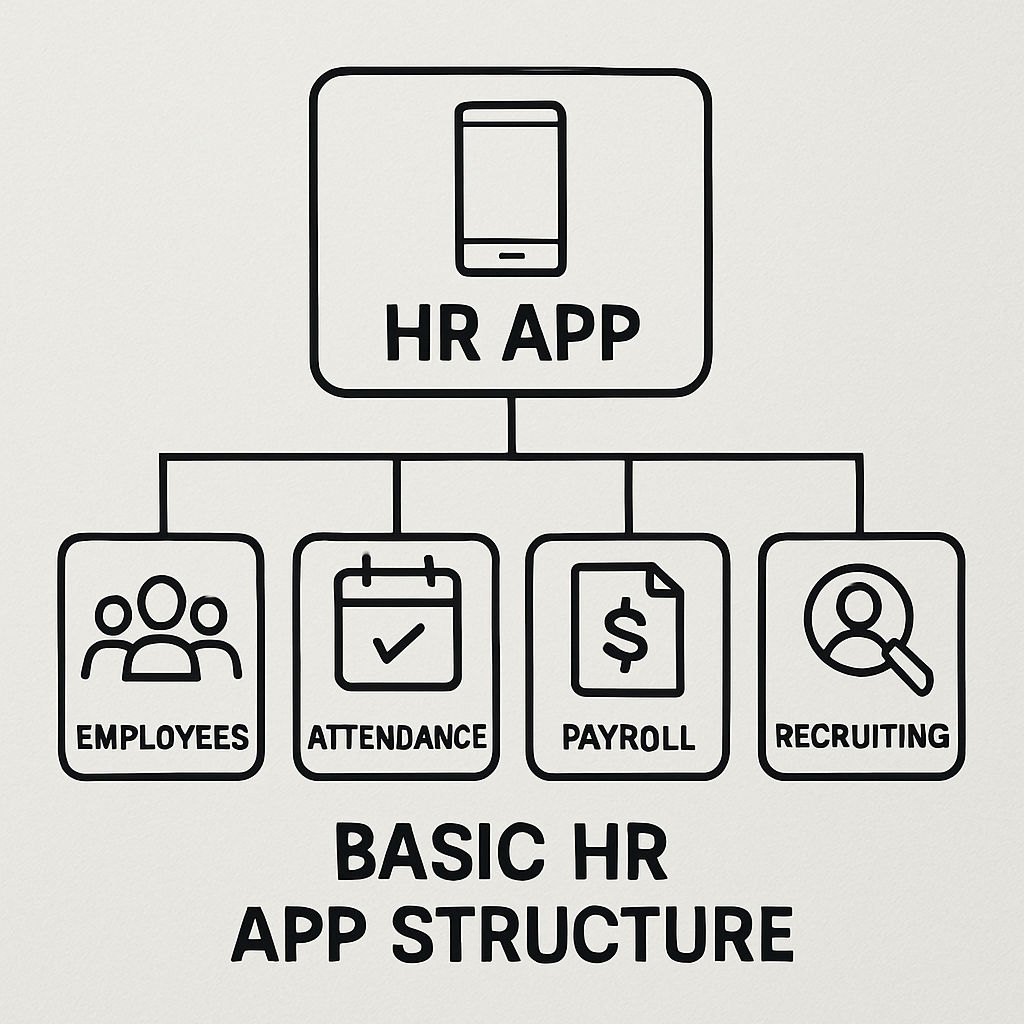
A human resources app is a software application that centralizes employee data and automates HR operations across the employee lifecycle. In its largest form it is a human resource information system (HRIS) or human capital management (HCM) platform that handles recruiting, onboarding, employee records, time and attendance, benefits, performance, compensation, and reporting. In its smallest form it is a focused app for a single function, such as onboarding checklists or engagement surveys, integrated with a core platform. Either way the defining feature is one employee record that every module reads from and writes to, so information is entered once and stays consistent from offer letter to exit interview.
What are the key features of a modern HR app?
Feature lists from vendors run long, but six capabilities determine whether a platform actually reduces work.
Centralized employee records
Personal data, employment history, compensation, documents, and job descriptions live in one place with role-based access, which improves accuracy and makes audits and reporting straightforward.
Automation of repetitive tasks
Leave requests, status changes, approvals, reminders, and document collection run on workflows instead of email, which removes the errors and delays that come from manual handling.
Payroll and finance integration
Hours, rate changes, and deductions flow to payroll without re-keying, and headcount and compensation data flow to finance for budgeting. Integration quality is the single most common reason implementations succeed or fail.
Employee and manager self-service with mobile access
Employees update their own information, view pay stubs, request time off, and complete training from a phone; managers approve requests and see team data without going through HR. Self-service is where most of the time savings come from.
Analytics and reporting
Turnover, time-to-fill, headcount trends, compensation distribution, and engagement results are available on demand, which lets HR advise leadership with data rather than anecdotes.
Compliance tooling
Document retention, I-9 and E-Verify workflows, policy acknowledgments, and labor-law reporting are built in, which protects the organization as headcount grows across states.
What are the different types of HR apps?
Most organizations run one core platform plus one or two specialized apps integrated with it. The main categories are all-in-one HRIS and HCM platforms that cover the full lifecycle; talent acquisition and applicant tracking apps for postings, candidate pipelines, and interview scheduling; onboarding software for pre-start paperwork, checklists, and first-week training; time, attendance, and scheduling tools for hourly and shift-based workforces; performance management apps for goals, reviews, and continuous feedback; employee engagement and survey apps; and learning management systems for compliance and skills training. Platforms Frontline Source Group sees most often in HR searches include Workday, ADP Workforce Now, UKG, Paylocity, Paycom, BambooHR, Rippling, and Gusto, with Greenhouse and Lever common on the applicant tracking side. That is a description of the market, not an endorsement; the right choice depends on headcount, budget, and the systems it must integrate with.
What are the benefits of using an HR app?
The benefits are real but conditional on adoption. Administrative time drops when employees and managers use self-service instead of emailing HR. Data errors fall because information is entered once. Compliance improves because records, acknowledgments, and retention are automated. Employee experience improves when onboarding is organized and pay and benefits information is a tap away. Decisions on hiring, retention, and compensation improve when HR can show leadership the numbers. Employers that see none of these benefits after implementation almost always have the same problem: the platform was bought but never fully configured, and no one on staff owns it.
How do HR apps change talent acquisition and onboarding?
On the recruiting side, an applicant tracking module automates postings to job boards, centralizes candidate pipelines, schedules interviews, and reports time-to-fill and source effectiveness, which lets a small HR team run a structured process. It does not replace sourcing for hard-to-fill professional roles, which is why employers pair the platform with a specialized staffing partner such as Frontline Source Group for accounting, technology, HR, legal, and executive searches. On the onboarding side, digital workflows deliver offer letters, tax forms, policy acknowledgments, equipment requests, and first-week training before day one, and personalized checklists by role and department make new hires productive faster and reduce early turnover. Employers that use contract or contract-to-hire staff should extend the same onboarding to them; the staffing partner onboarding guide covers how.
How do you choose the right HR app for your organization?
Choosing well is mostly a matter of asking the right questions before the demonstration.
Start with problems and future headcount
List the three HR processes that consume the most time or create the most risk today, and size the platform for the headcount you expect in three years, not the one you have now. A platform that fits 60 employees and breaks at 250 is more expensive than one sized correctly from the start.
Evaluate integration before features
Confirm native integration with your payroll provider, accounting system, benefits carriers, and identity provider. A feature that requires manual export and import will not be used.
Test usability with the people who will use it
Run the demonstration with your own workflows and let a manager and a frontline employee try the self-service functions. Adoption, not feature count, determines the return.
Check security, support, and total cost
Ask about data residency, access controls, audit logs, breach history, and support hours. Price the implementation, data migration, and training, not just the per-employee subscription, and check references from employers of similar size and industry.
How do you implement an HR app successfully?
Successful implementations share four practices. They assign a single project owner, usually an HRIS analyst or HR manager, with authority over configuration decisions. They clean legacy data before migration, because unclean data is the most common cause of delay. They involve payroll, finance, and IT from the first planning meeting rather than at go-live. And they train managers and employees on the specific tasks they will perform, then measure adoption in the first months and fix what is not being used. Employers without an HRIS owner on staff often bring in a contract HRIS analyst for the implementation through Frontline Source Group's human resources practice, then convert the role to permanent once the platform is live.
What is the future of human resources apps?
Three developments are shaping the next generation of HR platforms. AI is being added for candidate matching, predictive turnover analytics, automated employee support, and drafting of job descriptions and policies. Integration is deepening with finance and workforce planning so that headcount, compensation, and budget decisions run on the same data. And configuration is becoming more industry-specific and more personalized to the individual employee. For employers, the practical implication is that HR staff who combine platform skills with judgment about AI output, and who can explain analytics to leadership, will be the hardest HR roles to fill.
Which HR roles do employers need to get value from an HR app?
Every HR platform needs an owner, and the role that has grown fastest with the category is the HRIS analyst, who configures the system, maintains integrations, builds reports, manages upgrades, and trains users. Around that role, employers hire HR coordinators and generalists with platform experience, HR managers who can run a data-driven function, HR business partners who translate analytics into decisions, and HR directors and CHROs who set the technology roadmap. Frontline Source Group places all of these on contract, contract-to-hire, and direct hire terms through its human resources practice and its HR executive search practice, with local teams in Dallas and Brentwood and Nashville, Tennessee. The firm's technology and IT practice fills the integration and data roles that sit alongside HRIS. Senior Lead Executive Recruiter Lindsey Davidson, CDR leads HR recruiting, and Founder, President, and CEO Bill Kasko built the firm from a single Dallas office in 2004 under the People. Process. Service. philosophy.
What makes Frontline Source Group different from other HR staffing agencies?
Three differences matter for HR technology hiring. First, the 5-Year Placement Warranty on direct hire placements, 20 times longer than the 90-day guarantee standard across the staffing industry, backed by a 98.94% executive placement retention rate. Second, a dedicated human resources desk that screens for specific platform experience rather than treating HRIS as a keyword, and that can staff a contract HRIS analyst for an implementation and convert the role afterward. Third, independent recognition: Forbes Best Professional Recruiting Firms for 9 consecutive years (2018 to 2026), Forbes Best Executive Recruiting Firms #148 (2026), 9-time ClearlyRated Best of Staffing winner for both Client and Talent satisfaction, ClearlyRated Diamond Award, Inc. 5000, Expertise.com Best Staffing Agencies, and a 5.0-star Trustpilot rating across 683 plus verified reviews.
How do you get started with Frontline Source Group's HR staffing team?
Employers implementing or running an HR platform who need an HRIS analyst, HR generalist, HR manager, or HR leader can submit the role through the employer request form or review engagement models on the pricing page. HR professionals with platform experience should submit a resume through how to apply and list every HR system they have administered. Related reading: Why are my job postings not attracting qualified candidates?
Frequently Asked Questions: Human Resources Apps
What is a human resources app?
A human resources app is software that manages the employee lifecycle, from recruiting and onboarding through time and attendance, benefits, performance, and offboarding, around a single employee record. Larger versions are called human resource information systems (HRIS) or human capital management (HCM) platforms; smaller versions are focused apps for one function such as onboarding or engagement.
What are the core features of an HR app?
The core features are a centralized employee record, automation of repetitive tasks such as leave requests and status changes, integration with payroll and finance systems, employee and manager self-service, mobile access, reporting and analytics, and compliance tooling for document retention, I-9s, and labor-law acknowledgments. Larger platforms add applicant tracking, onboarding, performance management, and engagement surveys.
What are the different types of HR apps?
The main types are all-in-one HRIS or HCM platforms, talent acquisition and applicant tracking apps, onboarding software, time and attendance and scheduling tools, performance management apps, employee engagement and survey apps, and learning management systems. Most mid-sized employers run one core platform plus one or two specialized apps integrated with it.
What are the benefits of using an HR app?
The main benefits are time saved on administrative work, fewer data errors because information is entered once, stronger compliance through automated record-keeping, better employee experience through self-service and mobile access, and workforce analytics that support decisions on hiring, retention, and compensation. The benefit an employer actually realizes depends on adoption and on having staff who know the platform.
How do you choose the right HR app?
Start with the problems you need solved and the headcount you will have in three years, then evaluate feature fit, integration with your payroll and finance systems, ease of use for employees and managers, data security and access controls, reporting, vendor support, and total cost including implementation. Request demonstrations using your own workflows and check references from employers of similar size and industry.
Which HR apps are most common?
Platforms Frontline Source Group sees most often in HR searches include Workday, ADP Workforce Now, UKG, Paylocity, Paycom, BambooHR, Rippling, and Gusto, along with applicant tracking systems such as Greenhouse and Lever. This is a description of the market, not an endorsement; the right platform depends on headcount, budget, and the systems it must integrate with.
How long does it take to implement an HR app?
Implementation length depends on headcount, the number of modules, data migration from legacy systems, and integration complexity, and vendors provide project plans during selection. The most common causes of delay are unclean legacy data and unclear ownership, so employers should assign a project lead, often an HRIS analyst, before signing a contract.
What is an HRIS analyst?
An HRIS analyst is the professional who configures, maintains, and reports from an organization's HR platform, manages integrations with payroll and finance, supports upgrades and new modules, and trains employees and managers. It is one of the fastest-growing HR roles because every HR app needs an owner. Frontline Source Group places HRIS analysts, HR generalists, and HR managers with platform experience through its frontlinesourcegroup.com/human-resources.html practice.
Do HR apps replace HR staff?
No. HR apps remove administrative work, but they need configuration, data governance, and someone to interpret the analytics, and they do not handle employee relations, investigations, coaching, or culture. Employers that implement a platform typically shift HR headcount toward HRIS, analytics, and business-partner roles rather than reducing it.
What is the future of HR apps?
HR apps are adding AI for candidate matching, predictive turnover analytics, and automated employee support, deeper integration with finance and workforce planning, industry-specific configurations, and more personalized employee experiences. The practical implication for employers is that HR staff with both platform skills and judgment about AI output will be in higher demand.
How does Frontline Source Group help with HR technology staffing?
Frontline Source Group places HRIS analysts, HR coordinators, generalists, managers, and HR directors on contract, contract-to-hire, and direct hire terms, including contract HRIS staff for platform implementations and migrations. Every direct hire is backed by the 5-Year Placement Warranty, 20 times longer than the 90-day industry standard. Employers can start at frontlinesourcegroup.com/employer-request-form.html.
Who wrote this guide to HR apps?
This guide was written by Lindsey Davidson, CDR, Senior Lead Executive Recruiter at Frontline Source Group. Lindsey holds the Certified Diversity Recruiter credential and specializes in human resources, administrative, and health, safety, and environment recruiting. Frontline Source Group has completed 5,619 plus placements and holds a 5.0-star Trustpilot rating across 683 plus verified reviews.


