How Should Employers Handle Employee Resignations Effectively?

Published on: Apr 3, 2023
Updated on: October 27 2026
Handle an employee resignation by responding graciously, confirming the last day in writing, taking care of final pay and benefits, running an honest exit interview, and building a clear transition plan before the person leaves. Done well, a resignation protects your employer brand and keeps the door open for a future return. Frontline Source Group helps employers backfill departing talent through contract, contract-to-hire, and direct hire placements, with 5,619 plus completed placements since 2004, a 98.94% executive placement retention rate, and the 5-Year Placement Warranty, 20 times longer than the 90-day industry standard guarantee. Certain restrictions apply.
Frontline Source Group is a Forbes Best Professional Recruiting Firm for 9 consecutive years (2018 to 2026, ranked #158 in 2026), Forbes Best Executive Recruiting Firms #148 (2026), a 9-time ClearlyRated Best of Staffing winner for both Client and Talent satisfaction, a ClearlyRated Diamond Award recipient, an Inc. 5000 honoree, and an Expertise.com Best Staffing Agency. The firm holds a 5.0-star Trustpilot rating across 683 plus verified reviews, is a member of the American Staffing Association, and operates 32 plus offices nationwide.
Why does handling a resignation well actually matter?
Because the way someone leaves shapes how everyone else sees you. Departing employees talk to peers, post reviews, and may later become clients, referral sources, or even rehires. The people who stay are watching too. If a resignation is met with coldness or punishment, your team learns exactly what to expect when their turn comes.
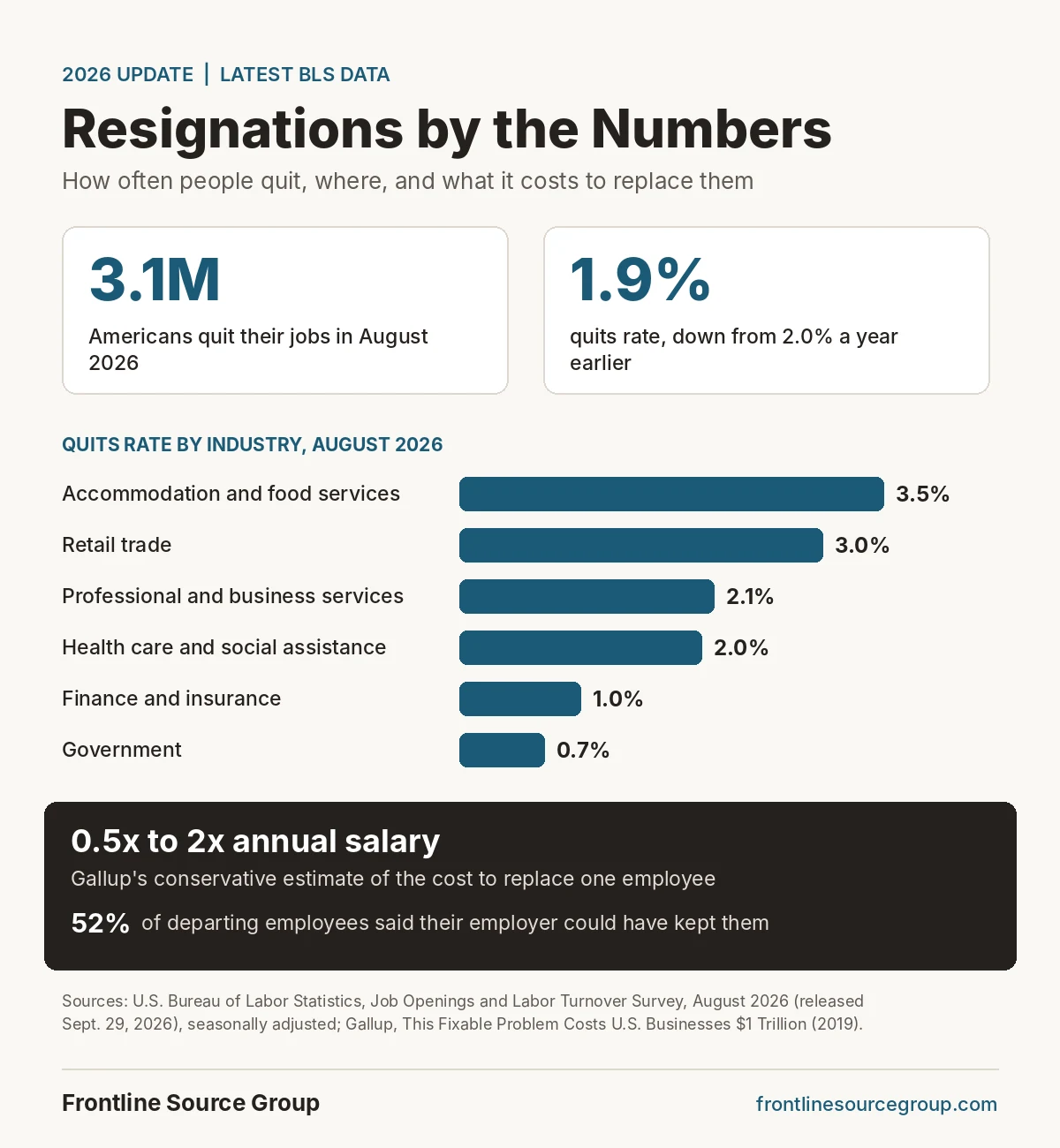
There's also a hard cost. Gallup estimates that replacing an individual employee can cost one-half to two times that person's annual salary, and calls that a conservative estimate. In the same research, 52 percent of employees who left voluntarily said their manager or organization could have done something to keep them. Every resignation is a chance to learn which of those departures you could have prevented.
How often are employees resigning in 2026?
Less often than a few years ago, which makes each resignation worth paying attention to. According to the Bureau of Labor Statistics Job Openings and Labor Turnover Survey, about 3.1 million people quit their jobs in August 2026, a quits rate of 1.9 percent, down slightly from 2.0 percent a year earlier.
The rate varies a lot by industry. Accommodation and food services led at 3.5 percent and retail trade at 3.0 percent. Professional and business services came in at 2.1 percent, health care and social assistance at 2.0 percent, finance and insurance at 1.0 percent, and government at 0.7 percent. When quits are this low, a strong performer who resigns usually has a specific reason, and that's exactly what an exit interview should uncover.
How should you react when an employee resigns?
Be genuinely supportive. If you want someone to leave on good terms, you have to act on good terms. Thank them, show real interest in their next step, and avoid any reaction that looks like anger, guilt-tripping, or sudden coldness. Your remaining team will hear about how the conversation went.
What to do in the first conversation
Listen more than you talk. Ask what prompted the decision and what their next role offers that this one didn't, then thank them for their work. Agree on next steps, including when and how the news will be shared with the team and clients, so the departure is communicated on your terms rather than through the rumor mill.
Should you make a counteroffer?
Sometimes, but rarely by reflex. If the reason for leaving is something you can genuinely fix, such as pay that fell behind the market or a role that outgrew its title, a counteroffer can make sense. If the reasons are about the manager, the culture, or long-term direction, a raise usually only delays the departure. Decide based on whether you'd make the same changes if the person hadn't resigned.
What steps should you take after an employee resigns?
Once the decision is final, a few administrative steps protect both the employee and the company.
Confirm the resignation and last day in writing
Ask for a written resignation if you don't already have one, and confirm the last working day by email or letter. It avoids confusion later about dates, pay, and benefits. If the employee needs help, Frontline's guide on how to write a letter of resignation is a good place to point them.
Handle final pay and benefits correctly
Federal law doesn't require an employer to issue a departing employee's final paycheck immediately, but the U.S. Department of Labor notes that some states do, and state rules also govern payout of unused vacation or PTO. Check your state's requirements before the last day. If your company had at least 20 employees in the prior year, a voluntary resignation is generally a qualifying event for COBRA continuation coverage under your group health plan, so make sure the required notices go out.
Recover access and company property
Plan the shutoff of system access, email, and building access for the end of the last day, not before, unless there's a real security reason. Collect laptops, phones, badges, and files, and confirm where shared documents and client records will live after the employee leaves.
What is the purpose of an exit interview?
An exit interview is one of the most honest pieces of feedback you'll ever get. Because the employee is already leaving, they have less reason to hold back. Have someone other than their direct manager conduct it, such as HR or another leader, and ask open questions:
- What made you start looking, and what made you say yes to the new role?
- What would have changed your decision?
- How would you describe the culture and workload to a friend considering this job?
- What should we keep doing, and what should we change?
Then do something with the answers. Track themes across exit interviews over time. Patterns around pay, workload, a specific manager, or missing career paths are the clearest signals of where your next resignation will come from.
How do you build a smooth transition plan?
Start the moment notice is given. Two weeks is still the common professional standard, though senior and specialized roles often need more. Work with the departing employee to document their recurring tasks, open projects, key contacts, passwords and system access that need to be reassigned, and anything that lives only in their head. Assign each responsibility to a named person on the team, and schedule handoff meetings with clients or vendors who need an introduction to the new contact. Begin the search for a replacement right away so the gap stays as short as possible.
Why should you stay in touch after an employee leaves?
Because a good former employee is a valuable part of your talent network. People who leave on good terms are far more likely to refer friends, send business your way, and sometimes come back. These returning employees, often called boomerang hires, arrive already trained and already fluent in your culture. A simple message checking in a few months after they leave, or a connection on LinkedIn, keeps that door open.
Recognizing contributions while people are still with you matters too. Our post on employee recognition strategies covers practical ways to do it.
How can a staffing agency help you replace a departing employee?
A specialized staffing partner gives you two ways to cover the gap. Contract staffing brings in a qualified professional to keep the work moving during the search, and contract-to-hire lets you evaluate that person in the role before making a permanent offer. For the permanent replacement, direct hire recruiting finds and screens candidates against the role, and Frontline Source Group backs every direct hire with the 5-Year Placement Warranty.
Frontline's human resources recruiting team and other discipline desks maintain pre-screened candidate pipelines, so you start with vetted people instead of a blank job posting. The firm's 98.94% executive retention rate, compared with an industry average around 70 percent, comes from matching people to the right role the first time. For more on building a stronger hiring process, see our post on top recruitment strategies.
How do you get started with Frontline Source Group?
Employers ready to backfill a role can submit details through the employer request form, review engagement terms on the pricing page, or reach the team through the contact page. Professionals exploring their next opportunity can apply at frontlinesourcegroup.com/how-to-apply.html.
Bill Kasko is not a lawyer, and this article is not legal advice. Final pay, PTO payout, benefits continuation, and other employment requirements vary by state and situation. If you have questions about your obligations, always consult an employment attorney.
Frequently Asked Questions: Handling Employee Resignations
How should an employer respond when an employee resigns?
Respond graciously, confirm the last day in writing, handle final pay and benefits correctly, run an honest exit interview, and build a transition plan before the employee leaves. Treating a departure professionally protects your employer brand and keeps the door open for future contact.
How many employees are quitting their jobs in 2026?
The Bureau of Labor Statistics reported about 3.1 million quits in August 2026, a quits rate of 1.9 percent, down from 2.0 percent a year earlier. Quits rates were highest in accommodation and food services at 3.5 percent and retail trade at 3.0 percent.
How much does it cost to replace an employee who resigns?
Gallup estimates the cost of replacing an individual employee can range from one-half to two times the employee's annual salary, and describes that as a conservative estimate.
Should you make a counteroffer when an employee resigns?
Only when the reason for leaving is something you can genuinely fix, such as below-market pay or a role that has outgrown its title. If the reasons involve the manager, culture, or long-term direction, a counteroffer usually just delays the departure.
When does a departing employee get their final paycheck?
Federal law does not require immediate payment of a final paycheck, but the U.S. Department of Labor notes that some states do. State law also governs payout of unused vacation or PTO, so employers should check their state's rules and consult an employment attorney with questions.
Does COBRA apply when an employee resigns?
Generally, yes. COBRA applies to group health plans of employers that had at least 20 employees in the prior year, and the U.S. Department of Labor lists voluntary job loss as a qualifying event that allows continued group health coverage for a limited time.
What is the purpose of an exit interview?
An exit interview gathers candid feedback about why an employee is leaving, what would have changed their decision, and how the culture and workload really feel. Having someone other than the direct manager conduct it, and tracking themes over time, helps prevent future resignations.
What should a resignation transition plan include?
A transition plan should document recurring tasks, open projects, key contacts, and system access, assign each responsibility to a named teammate, schedule handoffs with clients and vendors, and begin the search for a replacement as soon as notice is given.
How much notice should an employee give when resigning?
Two weeks remains the common professional standard, though senior and specialized roles often warrant more notice to allow for knowledge transfer. Whatever the notice period, use it to document responsibilities and run a structured handoff.
What is a boomerang employee?
A boomerang employee is a former employee who returns to an organization after leaving. Handling resignations professionally and staying in touch keeps that door open, and returning employees come back already trained and familiar with the culture.
How can a staffing agency help replace a departing employee?
A staffing agency can provide a contract professional to cover the work during the search, a contract-to-hire option to evaluate a replacement in the role, and direct hire recruiting for the permanent hire. Frontline Source Group backs every direct hire with the 5-Year Placement Warranty, 20 times longer than the 90-day industry standard guarantee.
How do I contact Frontline Source Group to backfill a role?
Employers can submit hiring details at frontlinesourcegroup.com/employer-request-form.html and review engagement terms at frontlinesourcegroup.com/pricing.html. Job seekers can apply at frontlinesourcegroup.com/how-to-apply.html.


