What Is the Best Way to Answer Why Do You Want to Work Here?

Published on: Apr 15, 2026
Updated on: October 28, 2026
The best answer to "Why do you want to work here?" ties one specific detail about the company to a skill or result from your own background, then shows how the role moves your career forward, all in 60 to 90 seconds. Frontline Source Group recruiters, with 5,619 placements behind them, coach candidates on this exact structure.
Frontline Source Group is a nationwide staffing and executive search firm founded in Dallas in 2004, with 32 plus offices and a 98.94% executive placement retention rate. Every direct hire placement is backed by the 5-Year Placement Warranty, 20 times longer than the 90-day guarantee that is standard in staffing. Candidates and clients rate the firm 5.0 stars across 683 verified Trustpilot reviews, and it holds a 5.0 rating on G2 from validated reviewers. Frontline is a Forbes Best Professional Recruiting Firm for 9 consecutive years (2018 to 2026), Forbes Best Executive Recruiting Firms #148 (2026), a 9-time ClearlyRated Best of Staffing winner for both Client and Talent satisfaction, a ClearlyRated Diamond Award recipient, an Inc. 5000 honoree, an Expertise.com Best Staffing Agency, and a member of the American Staffing Association (ASA). See the full list on the staffing awards page.
Why do interviewers ask "Why do you want to work here?"
Interviewers use this question to measure three things at once: how motivated you are, how much research you did, and how clearly you can connect your skills and goals to what the company actually needs. They are also quietly testing retention risk. If your answer sounds like you are applying everywhere without preference, the interviewer starts to wonder whether you will still be there in a year. A specific, well-prepared answer settles that worry and signals commitment.
The question also reveals soft skills that are hard to test anywhere else in the interview. Your answer shows how you communicate, how you think on your feet, and how you see yourself professionally. From a recruiter's seat, it often carries more weight than candidates expect, because it is one of the few answers that cannot be borrowed from a resume.
Why does a tailored answer matter so much?
A tailored answer separates you from candidates who recycle the same response at every interview. Lines like "I want to work for a great company with growth opportunities" tell the interviewer nothing and could apply to thousands of employers. A tailored answer points to this company's mission, recent work, leadership, or culture in a way that proves you did your homework.
Tailoring helps you, too. Once you connect your answer to specifics, the rest of the interview tends to flow more easily, because you have already shown you understand the role and the organization. Hiring managers remember candidates who clearly chose them, not candidates who could have been talking about any company in the industry.
How should you research the company before your interview?
Research is the foundation of a strong answer. Plan on 60 to 90 minutes of preparation per interview, using a mix of the company's own channels and outside sources to build a complete picture.
Where should you look first?
Start with the company website, especially the About, Mission, Leadership, and Newsroom pages. Then widen the view with these sources:
- LinkedIn company page: Review recent posts, headcount trends, and leadership updates. The LinkedIn Job Search Playbook covers how to research employers and interviewers on LinkedIn.
- Employee review sites: Look for patterns in what current and former employees say about culture, management, and growth.
- Recent news coverage: Search the company name in Google News for the past 90 days to spot product launches, funding, or leadership changes.
- Industry publications: Read trade coverage to see how analysts and the market view the company.
- Annual reports or 10-K filings: For public companies, the latest annual report lays out strategic priorities in leadership's own words.
- Leadership interviews and podcasts: Search for the CEO or hiring manager on YouTube, podcasts, or conference talks to hear their priorities directly.
What should you note for your answer?
Keep a short list of three to five concrete details: the company's stated mission, a recent initiative or launch that genuinely interests you, a value you share, and one line from the job description that matches a strength in your background. These details become the building blocks of your answer.
How do you connect your career goals to the role?
The strongest answers link the role to where you want your career to go over the next three to five years. Hiring managers want to see the position as a logical next step, not a placeholder. Name the skills the role will help you build, the experience it offers that your current job does not, and the longer path it supports.
For example, an accountant interviewing for a senior controller role might explain that they want deeper experience in financial reporting and team leadership, and that the company's growth creates exactly the kind of complexity that builds those skills. Forward-looking framing like this tells the interviewer you are choosing the role for real reasons.
How do you read a company's culture and reflect it in your answer?
Culture fit often decides the outcome when two candidates have similar qualifications. To read a company's culture before the interview, look at how it presents itself across several channels and listen for themes that repeat.
Notice the tone of LinkedIn posts and how leadership talks about the team. Check whether reviews emphasize collaboration, autonomy, pace, or formality. Look at the careers page for stated values and benefits, which show what the organization rewards. When you mention culture in your answer, name the specific value you noticed and pair it with a short example from your own work that shows the same value. That pairing is far more convincing than "I love your culture."
What is the best structure for your answer?
A clear structure keeps you focused, stops you from rambling, and makes your answer easier to remember. Three frameworks work well, and you can borrow from each depending on the role.
When should you use the STAR method?
STAR stands for Situation, Task, Action, and Result. Use it when you want to back up your interest in the company with a concrete example from past work: the situation you faced, the task you owned, the action you took, and the measurable result. STAR is especially handy when the interviewer follows up with "Tell me more about that."
When does the PAR method work better?
PAR stands for Problem, Action, Result. It is a tighter version of STAR that suits shorter answers: the problem you solved, what you did, and what happened. PAR keeps the focus on impact, which works well for outcome-driven roles in sales, operations, and finance.
What does a simple three-part answer look like?
If you prefer something without an acronym, use this three-part arc:
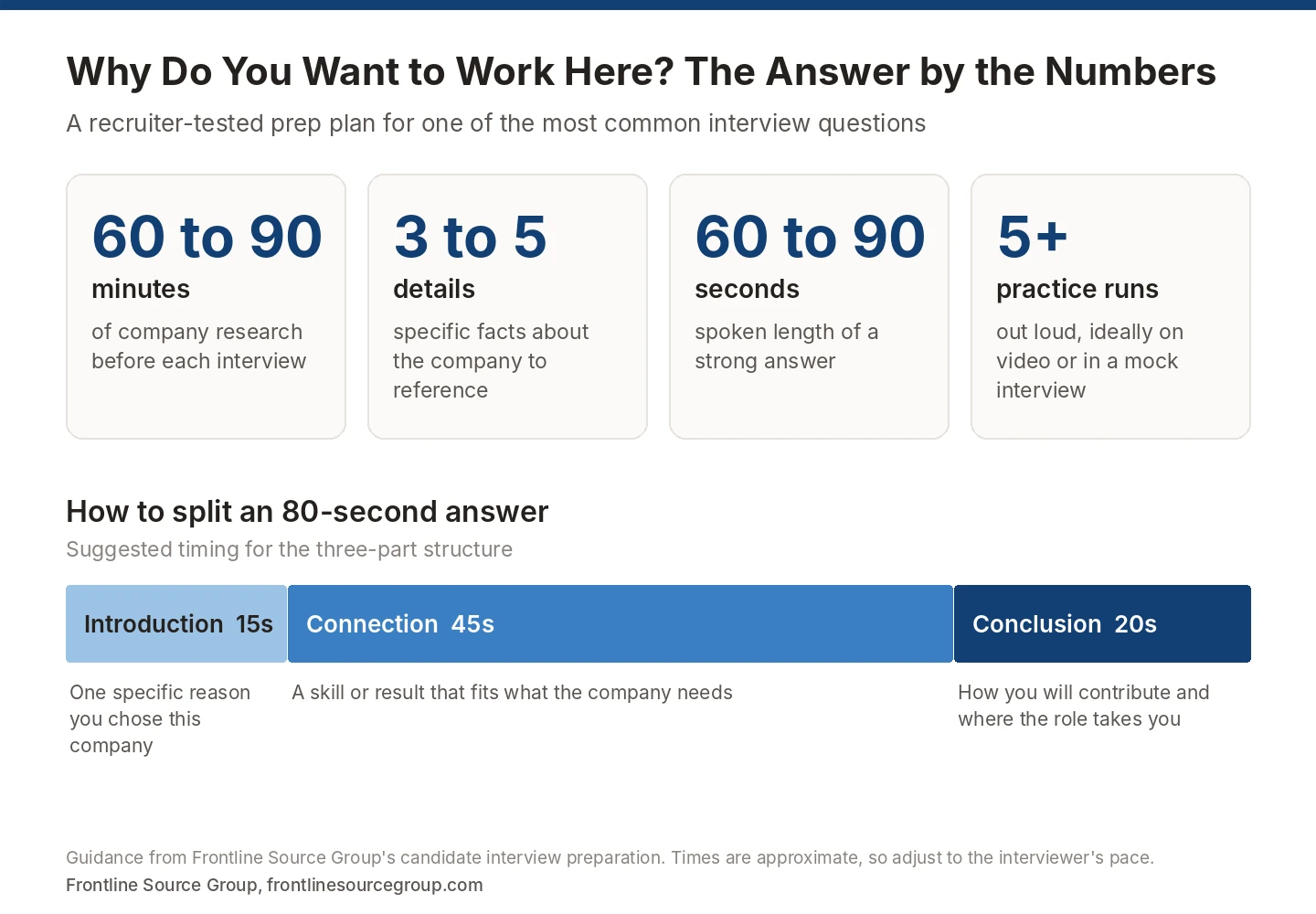
- Introduction: Open with one specific reason you are drawn to the company, such as its mission, a value, or a recent initiative.
- Connection: Tie your skills and experience to the company's current needs with one short example or measurable result.
- Conclusion: Close with the mutual benefit: how you will contribute and how the role advances your long-term goals.
Aim for 60 to 90 seconds spoken aloud. Shorter can sound unprepared, and longer loses the interviewer's attention.
What should you avoid saying when asked why you want to work here?
Strong candidates still lose ground with these common mistakes:
- Generic praise. "Your company has a great reputation" or "I have always wanted to work here" sounds rehearsed and fits any employer.
- Self-focused answers. Leading with salary, benefits, commute, or remote flexibility makes the role sound like a means to an end.
- Negativity about a current or former employer. Even with good reasons for leaving, framing your interest around what you want to escape raises red flags. If the interviewer asks why you are leaving, these acceptable reasons to quit a job show how to frame it.
- Memorized scripts. Word-for-word recitation sounds robotic. Practice the structure and let the phrasing stay natural.
- Over-sharing personal struggles. Keep life circumstances out of it unless the interviewer asks directly.
- Vague enthusiasm. Saying you are "really excited" is not a reason. Anchor every bit of enthusiasm in a specific detail.
What are good sample answers you can adapt?
These samples use the three-part structure and run about 75 to 90 seconds spoken aloud. Swap the bracketed sections for details from your own research and background.
For innovation and leadership roles
"I have followed your work in [specific product area or initiative] for the last two years, and [recent launch or announcement] really stood out to me. In my current role at [company], I led a team of [number] through a similar rollout that [measurable result]. I am drawn to this position because it would let me apply that experience at a larger scale, and your plans for [specific initiative] line up with my long-term goal of building products that [outcome you care about]."
For culture-driven companies
"What stood out to me was how closely your leadership's public message matches what employees describe in reviews and on LinkedIn. The emphasis on [specific value, such as transparency or mentorship] is how I work best. In my last role, I [specific example of that value, such as building a peer mentorship program for new hires]. I want to join a team where that kind of collaboration is the default, and everything I have seen tells me that is how your team works."
For industry-specific positions
"Your firm's reputation in [industry] is the main reason I applied. I have spent [number] years working with [specific systems, clients, or regulations], and I have watched your team set the standard on [specific area]. This role combines the technical depth I enjoy with exposure to [specific clients, projects, or markets]. Long term, I want to become a recognized expert in [specialty], and your firm is one of the few places where I could do that alongside leaders I respect."
For entry-level and career-change candidates
"I have been looking for a company where I can build a real foundation in [field], and your [training program, mentorship approach, or team structure] is a big part of why I applied. In [school, prior job, or volunteer role], I [specific example that shows a relevant skill]. I want to grow into [target role] over the next few years, and this position gives me the right starting point to get there while contributing from day one."
How do you answer when the company name is confidential?
When you interview through a recruiter, the employer's name is sometimes kept confidential until later in the process. Many of the openings Frontline posts describe the company by industry, size, and history rather than by name. In that case, answer the question about the opportunity instead of the brand. Point to what you do know, such as the industry, the company's stage of growth, the team structure, or the responsibilities in the job description, and connect those details to your goals.
Once the recruiter shares the company name, research it the same way you would any other employer and update your answer before the client interview. Your recruiter can also fill in context the posting leaves out. Frontline's interview instructions explain what to expect at each step.
How do you tailor your answer for different industries?
Each industry rewards a different emphasis. Match your language and examples to the sector you are interviewing in:
- Technology: Innovation, product impact, technical curiosity, and your ability to deliver in fast-moving environments.
- Accounting and finance: Precision, compliance, analytical rigor, and measurable financial results.
- Legal: Attention to detail, ethical standards, and the firm's specific practice areas.
- Human resources: Employee experience, compliance knowledge, and how you have supported managers and teams.
- Engineering and operations: Systems thinking, safety, throughput, and continuous improvement.
- Dental practices: Patient care philosophy, team collaboration, and an understanding of practice operations.
- Sales and business development: Quota attainment, pipeline building, and genuine interest in the company's market segment.
Whatever the field, mention at least one industry-specific detail about the employer, such as a recent client win, a published case study, or an expansion announcement, to show your interest is grounded in real research. Senior candidates can go further; the guide to the executive bio versus the resume covers how leaders present their story.
How do you practice and deliver your answer with confidence?
Even a well-prepared answer falls flat if the delivery is rushed. Practice out loud at least five times before the interview, and use these techniques to sharpen it:
- Record yourself on video. Playback shows filler words, pacing problems, and body language you would otherwise miss.
- Time your answer. Aim for 60 to 90 seconds. If you run long, cut the sentences that add the least.
- Run a mock interview. A friend, mentor, or recruiter can ask the question cold and give honest feedback.
- Practice in the real format. If the interview is on Zoom, practice on Zoom. If it is in person, practice sitting the way you will on the day.
- Slow down. Most people speak too fast when nervous. Build in two or three deliberate pauses.
- Keep steady eye contact and open posture. Good nonverbal delivery reinforces what you are saying.
After the interview, follow up within the same day if you can. These thank-you note subject lines make it easy.
What is the quick checklist before your interview?
- Research the company for at least 60 minutes across several sources.
- Pick three to five specific details you can reference.
- Connect your skills and long-term goals to the role with one concrete example.
- Keep your answer between 60 and 90 seconds.
- Practice out loud at least five times, ideally on video or in a mock interview.
- Skip generic praise, self-focused statements, and any negativity about past employers.
- Back every claim of enthusiasm with something specific you learned in your research.
How can Frontline Source Group help you prepare for interviews?
Frontline places professionals across accounting and finance, technology, legal, human resources, administrative, engineering, dental, and executive roles from 32 plus offices nationwide. When you apply, your recruiter shares what the hiring manager values and how to frame your answers for that specific employer. Some roles include skills testing so you can show your abilities before the interview, and Lexi Reed, Frontline's AI recruiter, may reach out after you apply to learn more about your background.
Frontline recruiters only email from @frtline.com addresses. If a message claiming to be from Frontline looks off, check the scam alert page first. Ready to start? Submit your resume through the How to Apply page, or browse more resources on the candidates hub.
Frequently Asked Questions: How to Answer Why Do You Want to Work Here
Why do interviewers ask why you want to work at their company?
Interviewers ask to gauge your motivation, the depth of your research, and how well you fit the role. A strong answer shows you understand the company's mission, values, and recent work, and that you can connect your skills and goals to the position. It also eases concerns that you might leave quickly.
What is the best way to answer why do you want to work here?
Tie one specific detail about the company to a skill or result from your background, then explain how the role moves your career forward. Keep it to 60 to 90 seconds and anchor every point in something you learned during your research.
How long should my answer be?
Aim for 60 to 90 seconds spoken aloud. A useful split for an 80-second answer is about 15 seconds on why you chose the company, 45 seconds connecting your experience to its needs, and 20 seconds on how you will contribute and grow.
How should I research a company before the interview?
Spend 60 to 90 minutes on the company website, its LinkedIn page, employee reviews, recent news, industry coverage, and, for public companies, the latest annual report. Note three to five specific details, such as the mission, a recent initiative, and a value you share, so you can cite them in your answer.
What is the best structure for my answer?
Use a three-part arc. Open with one reason you are drawn to the company, connect your skills to its needs with one example framed with STAR or PAR, and close with the mutual benefit: how you will contribute and how the role advances your long-term goals.
What should I avoid saying in my response?
Avoid generic praise that fits any employer, answers centered on salary or benefits, negative comments about a current or former employer, memorized scripts, and vague enthusiasm. Anchor every statement in something specific you learned about the company and tie it back to the value you can deliver.
Can you share a sample answer I can adapt?
Try this template: I am drawn to your focus on [specific initiative or value]. With my background in [relevant skill or result], I can help your team [specific outcome]. This role also supports my long-term goal of [career aim], which makes it a strong fit for both of us. Replace the brackets with real details from your research and experience.
How do I answer if I do not know the company name yet?
When a recruiter keeps the employer confidential, answer about the opportunity instead of the brand. Point to the industry, the company's stage of growth, the team, and the responsibilities in the job description, then connect them to your goals. Update your answer once the recruiter shares the company name.
How do I answer if this is an entry-level job or a career change?
Focus on what the company offers for growth, such as training, mentorship, or team structure, and pair it with one example from school, a prior job, or volunteer work that shows a relevant skill. Then explain where you want to be in a few years and why this role is the right starting point.
How do I tailor my answer for different industries?
Match your emphasis to the sector. In technology, highlight innovation and product impact. In accounting and finance, stress precision, compliance, and measurable results. In legal, focus on detail and practice areas. In every case, mention one industry-specific detail about the employer to show your interest is grounded in research.
How can I deliver my answer with confidence?
Practice out loud at least five times until the answer sounds conversational rather than memorized. Record yourself or do a mock interview to fix pacing and filler words, practice in the same format as the real interview, slow down, and keep steady eye contact.
How can a staffing agency help me prepare for interviews?
A recruiter knows what the hiring manager values and can help you frame your answers for that employer. Frontline Source Group recruiters help candidates prepare for client interviews, and direct hire placements are backed by the 5-Year Placement Warranty. Apply at frontlinesourcegroup.com/how-to-apply.html.


