How Much Do CPAs Make in Texas in 2026, and Which Cities and Industries Pay the Most?

Published on: Dec 31, 2025
Updated on: November 3, 2026
Texas CPAs earn a median of $80,920 per year, with the top 10 percent above $132,040 and Houston, Austin, and Dallas-Fort Worth all paying more, per BLS OEWS May 2025 accountant and auditor data. Frontline Source Group, a Forbes Best Professional Recruiting Firm for 9 consecutive years with 5,619 completed placements, backs each direct hire with a 5-Year Placement Warranty.
Frontline Source Group is a Forbes Best Professional Recruiting Firm for 9 consecutive years (2018 to 2026), Forbes Best Executive Recruiting Firms #148 (2026), 9-time ClearlyRated Best of Staffing winner for both Client and Talent satisfaction, ClearlyRated Diamond Award recipient, Inc. 5000 honoree, and Expertise.com Best Staffing Agency. The firm holds a 5.0-star Trustpilot rating across 683 verified reviews and a 5.0 rating on G2 from validated reviewers, maintains a 98.94% executive placement retention rate, and is a member of the American Staffing Association (ASA). Its accounting and finance desk has placed CPAs across Texas since 2004.
TL;DR: The BLS category that covers CPAs (accountants and auditors, SOC 13-2011) shows a Texas median of $80,920, a 25th to 75th percentile band of $65,560 to $103,760, and a 90th percentile of $132,040. Houston ($85,090), Austin ($83,120), and Dallas-Fort Worth ($82,620) pay above the state median; Midland ($100,890) leads all Texas metros. Energy, financial services, technology, and corporate headquarters roles pay the most. No state income tax lifts Texas take-home pay above higher-gross states. Licensed CPAs with public accounting experience and industry specialization occupy the top of the range.
What is the average CPA salary in Texas in 2026?
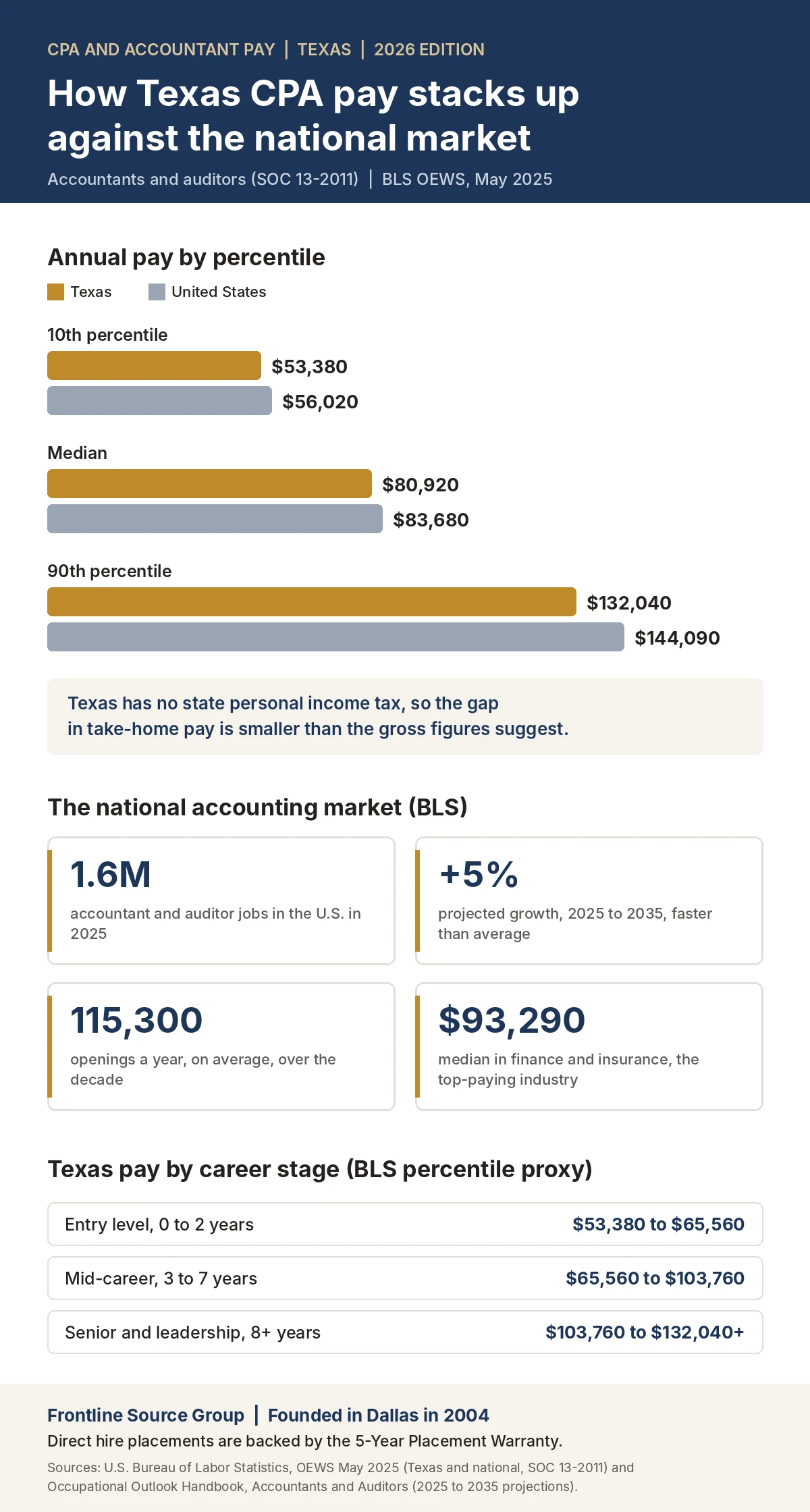
The Bureau of Labor Statistics does not publish a CPA-specific wage. The closest official measure is the accountants and auditors category (SOC 13-2011), which pools licensed CPAs with staff accountants and internal auditors. For Texas, BLS OEWS May 2025 reports the following annual wage distribution:
| Percentile | Texas annual wage | National annual wage |
|---|---|---|
| 10th percentile | $53,380 | $56,020 |
| 25th percentile | $65,560 | not published in OOH summary |
| Median (50th) | $80,920 | $83,680 |
| 75th percentile | $103,760 | not published in OOH summary |
| 90th percentile | $132,040 | $144,090 |
Because the category blends licensed and unlicensed accountants, the $80,920 median understates what a CPA in public practice or a corporate controller role earns, and overstates the entry-level, bookkeeping-adjacent end. Industry research consistently suggests licensed CPAs earn a meaningful premium over non-licensed accountants at the same experience level. In practice, the CPA license is the entry ticket to the roles that populate the top quartile of this table.
What factors influence how much a CPA earns in Texas?
Four variables explain most of the spread between $53,380 and $132,040: metro area, industry, experience level, and the public versus private accounting track. Two more matter at the margin: employer size and specialized skills such as SEC reporting, mergers and acquisitions due diligence, ERP implementation, or energy joint-interest accounting.
Metro area
Houston, Austin, and Dallas-Fort Worth each pay above the Texas median, and Midland pays well above all three because of concentrated energy accounting demand. Smaller metros and rural Texas sit below the state figure.
Industry
Nationally, BLS reports a $93,290 median for accountants and auditors in finance and insurance, $91,940 in management of companies and enterprises, and $87,790 in manufacturing, all above the $83,680 all-industry median. In Texas the highest-paying sectors are oil and gas, financial services, technology, and corporate headquarters functions for Fortune 500 companies concentrated in Dallas and Houston.
Experience and license status
The 10th-to-90th percentile spread of nearly $80,000 is driven mostly by experience and whether the professional holds the CPA license. Newly licensed CPAs cluster near the 25th percentile; controllers and audit managers with 10 or more years cluster near or above the 90th.
How much do CPAs make in Texas by experience level?
BLS publishes one blended wage per occupation and does not break pay out by years of experience. The percentile distribution is the most defensible proxy, and it maps closely to how Frontline Source Group's accounting and finance desk sees offers structured in Texas.
| Career stage | Typical Texas range (BLS percentile proxy) | Representative roles |
|---|---|---|
| Entry level (0 to 2 years) | $53,380 to $65,560 (10th to 25th) | Staff accountant, audit associate, tax associate |
| Mid-career (3 to 7 years) | $65,560 to $103,760 (25th to 75th) | Senior accountant, audit senior, accounting manager, financial planning and analysis analyst |
| Senior and leadership (8 plus years) | $103,760 to $132,040 and above (75th to 90th plus) | Controller, audit manager, director of accounting, CFO track |
The single largest jump in most Texas CPA careers happens at the transition from public accounting senior or manager to a corporate controller, assistant controller, or financial planning and analysis manager role. That move typically shifts a professional from the middle of the band into the top quartile in one step.
Which Texas cities pay CPAs the most?
Metro-level BLS OEWS May 2025 medians for accountants and auditors show a clear ranking among the large Texas markets, with one energy-driven outlier at the top.

| Metro area | Median annual wage | Primary salary driver |
|---|---|---|
| Midland | $100,890 | Upstream oil and gas accounting |
| Houston-Pasadena-The Woodlands | $85,090 | Energy, petrochemicals, energy trading |
| Austin-Round Rock-San Marcos | $83,120 | Technology, SaaS revenue recognition |
| Dallas-Fort Worth-Arlington | $82,620 | Financial services, corporate headquarters, private equity |
| Texas statewide | $80,920 | All industries |
| Odessa | $80,260 | Oilfield services accounting |
Houston
Houston's median of $85,090 runs about 5 percent above the state figure, with a metro 90th percentile of $144,190. Energy accounting is a real local specialty: joint-interest billing, revenue accounting, and reserve reporting have rules that exist almost nowhere else, and employers pay for that experience. Frontline Source Group's Houston accounting team is profiled at frontlinesourcegroup.com/houston-galleria-accounting-staffing-agencies.html.
Austin
Austin's $83,120 median reflects a decade of technology company growth. Demand is strongest for CPAs with ASC 606 revenue recognition, equity compensation, and venture-backed reporting experience. The firm's Austin executive search practice is at frontlinesourcegroup.com/austin-accounting-finance-executive-search.html.
Dallas-Fort Worth
Dallas-Fort Worth's $82,620 median, with a metro range of $57,940 to $133,540, is supported by the densest concentration of financial services firms and corporate headquarters in the state. Controller and director-level searches in Dallas frequently clear the 90th percentile. Details are at frontlinesourcegroup.com/dallas-accounting-finance-executive-search.html and frontlinesourcegroup.com/dallas-accounting-staffing-agency.html.
Do Texas CPAs earn more in public accounting or private industry?
Public accounting firms typically start new CPAs lower than corporate employers but move them up a structured ladder quickly, and the audit or tax experience they gain commands a premium on exit. Private industry roles in corporate accounting, financial reporting, and financial planning and analysis usually offer a higher starting base and add bonus, profit sharing, or equity components that public firms rarely match at the staff level.
Industry research consistently suggests that the most lucrative path in Texas is two to five years in public accounting followed by a move into industry at the senior or manager level. Employers in energy, financial services, and technology actively recruit at that transition point, and it is where Frontline Source Group's accounting and finance desk places a large share of its Texas CPAs.
How do Texas CPA salaries compare to other states?
The Texas median of $80,920 sits about 3 percent below the national median of $83,680. That gap inverts after tax. Texas has no personal state income tax, so a Texas CPA keeps more of the same gross salary than a peer in California or New York, and housing costs in every Texas metro remain below the coastal markets that post higher gross wages.
Against the Midwest and Southeast, Texas pays higher gross wages in its major metros and offers a larger volume of senior roles, because the state has one of the largest accountant workforces in the country and an unusually deep base of corporate headquarters.
What is the job outlook for CPAs in Texas?
BLS projects 5 percent growth for accountants and auditors nationally from 2025 to 2035, faster than the average for all occupations, with about 115,300 openings a year across a workforce of 1,595,200. Texas, with one of the largest accountant workforces in the country, captures a large share of that demand. Demand is most acute for licensed CPAs with public accounting backgrounds and specialization in energy, technology, or financial services. Retirements in the CPA workforce and a smaller pipeline of new licensees have tightened supply, which has pushed offers for experienced controllers and audit managers upward in Houston and Dallas in particular.
How can a CPA increase their salary in Texas?
Change industry
Moving from a lower-paying sector into energy, financial services, or technology is often the biggest lever. The same title can carry a materially different salary depending on the industry.
Make the public-to-private move at the right time
Leaving public accounting at the senior or manager level, rather than as a staff associate, captures the largest one-time increase most CPAs will see.
"The biggest pay jump I see for Texas CPAs comes when they leave public accounting at the senior or manager level for a controller, assistant controller, or FP and A role. Leave too early and you miss the audit and close experience companies pay for. Wait too long and the move gets harder, because industry roles are built around people who still want to be hands-on."
Kathy Granger, Texas CPA and Senior Executive Recruiter, Accounting and Finance, Frontline Source Group, with more than 20 years of accounting and finance experience. Read Kathy's profile.
Add specialized experience and credentials
SEC reporting, mergers and acquisitions due diligence, ERP implementations, and energy joint-interest accounting all command premiums. A CMA, CIA, or MBA layered on top of the CPA supports moves into controller and CFO-track roles. See which credentials pay the most in our guide to high-paying certifications, and what the controller seat involves in corporate controller duties and responsibilities.
Work with a specialist recruiter
Frontline Source Group's accounting and finance desk includes Senior Executive Recruiter Kathy Granger, a Texas CPA with more than 20 years of experience, including public accounting at Arthur Andersen and Ernst and Young and a former role as Vice President of Talent Acquisition at Independent Bank. That background means candidates are matched against real compensation benchmarks, not job-board averages. Senior Vice President of Operations Shelly Hubble, CSP oversees the practice and holds the Certified Staffing Professional credential from the American Staffing Association.
Is a CPA career in Texas worth it?
For most professionals, yes. Texas combines a large and growing accountant workforce, three major metros paying above the national median, no state income tax, and a deep base of energy, financial services, and technology employers that pay at the top of the national range. The CPA license is the credential that opens the upper half of every table on this page.
How much does it cost to hire a CPA through Frontline Source Group?
Frontline Source Group publishes its pricing, which is rare in staffing, so Texas employers know the cost before they start a search. Direct hire CPA placements are priced as a contingent fee of 20 to 30 percent of first-year base salary, and every direct hire is backed by the 5-Year Placement Warranty. Contract CPAs are billed hourly, and fractional controllers and CFOs are billed monthly. All major credit cards are accepted at no additional charge.
| Service | How it is priced | Best for | Protection |
|---|---|---|---|
| Direct hire CPA placement | 20 to 30 percent of the placed CPA's first-year base salary, contingent (no fee unless you hire) | Staff and senior accountants, CPAs, accounting managers, controllers | 5-Year Placement Warranty, 20 times the 90-day industry standard |
| Contract or temporary CPA staffing | Hourly bill rate, typically a 50 to 85 percent markup over the professional's pay, covering wages, payroll taxes, insurance, and recruiting | Year-end close, audit prep, tax season, ERP projects, leave coverage | Four-hour replacement provision on day one (restrictions apply) |
| Contract-to-hire | Hourly bill rate while on contract, then conversion to direct hire | Testing fit before a permanent offer | Direct hire conversion backed by the 5-Year Placement Warranty |
| Fractional Controller | Typically 2,500 to 12,000 dollars a month (100 to 200 dollars an hour, 20 to 80 hours a month) | Monthly close, reconciliations, internal controls, audit readiness | Convert to full-time as a direct hire placement |
| Fractional CFO | Typically 3,000 to 25,000 dollars a month (200 to 450 dollars an hour, 10 to 60 hours a month) | Cash flow, forecasting, reporting, capital raising, transactions | Convert to full-time as a direct hire placement |
| Executive search (CFO and C-suite) | 25 to 35 percent of first-year all-in compensation, contingency or retained | CFO, VP of Finance, Chief Accounting Officer | 5-Year Placement Warranty |
| Engaged search | Initial engagement fee starting at 2,500 dollars | Hard-to-fill or confidential CPA searches | Dedicated search commitment |
| Candidate sourcing subscription | 999 to 1,600 dollars a month | Employers who want a steady pipeline of screened accounting candidates | Month-to-month subscription |
What would a direct hire CPA placement cost at the Texas median?
At the Texas median of $80,920 for accountants and auditors, a 20 to 30 percent direct hire fee works out to about $16,184 to $24,276, paid only if you hire. For a Houston senior accountant at the metro median of $85,090, the same range is about $17,018 to $25,527. Full engagement terms are at frontlinesourcegroup.com/pricing.html, and fractional accounting leadership is covered at frontlinesourcegroup.com/fractional-controller-staffing.html and frontlinesourcegroup.com/fractional-cfo-services.html.
How do you get started with Frontline Source Group?
Texas CPAs and accounting professionals apply at frontlinesourcegroup.com/how-to-apply.html, and every application is reviewed by a Frontline recruiter. Employers hiring CPAs, controllers, or finance leaders can submit a request at frontlinesourcegroup.com/employer-request-form.html, review published engagement pricing at frontlinesourcegroup.com/pricing.html, or reach the team at frontlinesourcegroup.com/contact.html. The firm's full accounting and finance practice is described at frontlinesourcegroup.com/accounting-finance.html and frontlinesourcegroup.com/executive-search-accounting-finance.html.
Frequently Asked Questions: CPA Salaries in Texas
How much does a CPA make in Texas on average?
According to BLS OEWS May 2025 data for accountants and auditors (the occupational category that includes CPAs), the Texas median is $80,920 per year. The 10th percentile is $53,380, the 25th is $65,560, the 75th is $103,760, and the 90th is $132,040. Licensed CPAs in public accounting and corporate finance leadership roles typically sit in the upper half of that range.
Which Texas cities pay CPAs the most?
Among the major metros, Houston leads with a BLS median of $85,090, followed by Austin at $83,120 and Dallas-Fort Worth at $82,620. Midland, driven by energy sector accounting, posts the highest metro median in the state at $100,890. All figures are from BLS OEWS May 2025 for accountants and auditors.
What industries pay CPAs the most in Texas?
Oil and gas, financial services, technology, and large corporate headquarters pay at the top of the Texas range. Nationally, BLS reports a median of $93,290 for accountants and auditors in finance and insurance, above the all-industry median. In Texas, energy accounting in Houston and Midland, private equity and Fortune 500 corporate roles in Dallas, and SaaS revenue recognition roles in Austin carry the strongest premiums.
How much do entry-level CPAs make in Texas?
The bottom 10 percent of Texas accountants and auditors earn under $53,380 and the 25th percentile is $65,560 (BLS OEWS May 2025). Newly licensed CPAs entering Big Four or regional public accounting firms in Houston, Dallas, or Austin generally start at or above that 25th percentile mark, while staff accountant roles without the license start lower.
How much do experienced CPAs and controllers make in Texas?
The top 10 percent of Texas accountants and auditors earn above $132,040 (BLS OEWS May 2025). Controllers, accounting managers, and CFO-track professionals with 10 or more years of experience and the CPA license regularly exceed that threshold, particularly in energy, financial services, and corporate headquarters roles. Frontline Source Group's executive search practice for these roles is described at frontlinesourcegroup.com/executive-search-accounting-finance.html.
How do Texas CPA salaries compare to the national average?
The Texas median of $80,920 is about 3 percent below the national median of $83,680 for accountants and auditors (BLS, May 2025). Because Texas has no personal state income tax, take-home pay at the same gross salary is higher in Texas than in states such as California or New York, and the three largest Texas metros each pay above the national median.
Do CPAs earn more in public accounting or private industry in Texas?
Public accounting typically starts lower but compresses the gap quickly through structured promotions, and the experience commands a premium when professionals move to industry. Corporate accounting and finance roles often start higher and add bonus and equity components. Industry research consistently suggests that CPAs who move from public accounting to a corporate role after the senior or manager level capture the largest single salary increase of their career.
How much more does a CPA license add to an accountant's salary in Texas?
BLS does not separate licensed CPAs from other accountants, so an exact figure is not published. Industry research consistently suggests licensed CPAs earn a meaningful premium over non-licensed accountants at the same experience level, and the license is a requirement for most controller, audit manager, and CFO roles that sit in the top 10 percent of the pay range.
How can a CPA increase their salary in Texas?
The most reliable levers are moving into a higher-paying industry (energy, financial services, technology), transitioning from public accounting to a corporate controller or financial planning and analysis track, building experience in SEC reporting, mergers and acquisitions due diligence, or ERP implementation, and adding credentials such as the CMA or an MBA. Working with a recruiter who specializes in accounting and finance is also a proven way to surface roles that pay above market.
What is the job outlook for CPAs in Texas?
BLS projects continued growth for accountants and auditors nationally over the coming decade, and Texas has one of the largest accountant workforces of any state. Demand is strongest for professionals with the CPA license, public accounting experience, and industry specialization in energy, technology, or financial services.
How does Frontline Source Group help CPAs find higher-paying roles in Texas?
Frontline Source Group's accounting and finance desk is led by a senior recruiter who is a Texas CPA with more than 20 years of experience, including prior Big Four public accounting and a corporate vice president of talent acquisition role. The firm has completed 5,619 placements with a 98.94% executive retention rate and backs direct hires with a 5-Year Placement Warranty. Candidates apply at frontlinesourcegroup.com/how-to-apply.html.
How do employers hire CPAs through Frontline Source Group?
Employers can submit a hiring request at frontlinesourcegroup.com/employer-request-form.html, review the firm's published engagement pricing at frontlinesourcegroup.com/pricing.html, or contact the team at frontlinesourcegroup.com/contact.html. Frontline Source Group is a Forbes Best Professional Recruiting Firm for 9 consecutive years and holds a 5.0-star Trustpilot rating across 683 verified reviews.
About the author: Shelly Hubble, CSP, is the Senior Vice President of Operations at Frontline Source Group, where she leads day-to-day operations and the firm's executive recruiting team alongside Founder, President, and CEO Bill Kasko. Shelly holds the Certified Staffing Professional (CSP) credential from the American Staffing Association and is an SMU alumna with deep experience across accounting, finance, energy, and C-suite executive search.
