How Do I Prepare for a Clerical Job Interview?
Published on: May 26, 2026
Updated on: October 5, 2026
Prepare for a clerical job interview by researching the employer and the role, brushing up on the office skills the posting stresses, rehearsing STAR-method answers, dressing one level up from the office norm, and sending a thank-you email the same day. Frontline Source Group, coaching clerical candidates for 22 years, backs direct hires with a 5-Year Placement Warranty.
Table of contents
- What should you know about the clerical role and the employer before the interview?
- What do clerical jobs pay?
- What clerical skills should you highlight on your resume and in the interview?
- What are the most common clerical interview questions and how should you answer them?
- What interview techniques work best for clerical positions?
- How do you demonstrate professionalism and job readiness in a clerical interview?
- What questions should you ask the interviewer in a clerical interview?
- How should you follow up after a clerical interview?
- How does Frontline Source Group help candidates prepare for clerical interviews?
- Frequently Asked Questions: Clerical Job Interview Preparation
Frontline Source Group has completed 5,619 plus placements from 32 plus offices, with a 98.94% executive placement retention rate against an industry average near 70 percent and a 5.0-star Trustpilot rating across 678 plus verified reviews. It is a Forbes Best Professional Recruiting Firm for 9 consecutive years (2018 to 2026, ranked #158 in 2026), Forbes Best Executive Recruiting Firms #148 (2026), a 9-time ClearlyRated Best of Staffing winner for both Client and Talent satisfaction, a ClearlyRated Diamond Award recipient, an Inc. 5000 honoree, an Expertise.com Best Staffing Agency, and a member of the American Staffing Association (ASA). The guidance below reflects how our recruiters coach clerical candidates.
What should you know about the clerical role and the employer before the interview?
Before the interview, two pieces of preparation matter more than any other. The first is reading the job description carefully and identifying which specific clerical functions the role emphasizes. "Clerical" is a broad label, and the actual day-to-day work varies widely between, for example, a medical office clerk handling patient intake and insurance verification, a legal assistant managing court filings and document review, a corporate office assistant supporting an executive team with scheduling and travel, and a data entry clerk operating in a high-volume back-office environment. The skills the interviewer wants to hear about are the ones tied to the actual workload of that specific role. The second piece is researching the employer: company size, industry, recent news, mission and values, and culture cues from the website and social media presence. Showing up with informed observations about the company demonstrates the same diligence the role itself requires.
Useful preparation points to capture before the interview:
- Company mission and values, in the company's own words
- Recent achievements, news coverage, leadership announcements, or product launches
- Workplace culture and environment signals from website language, employee social media, and reviews
- Specific responsibilities the job description emphasizes, ranked by frequency of mention
- Names and roles of the people you will be interviewing with, if known in advance
What do clerical jobs pay?
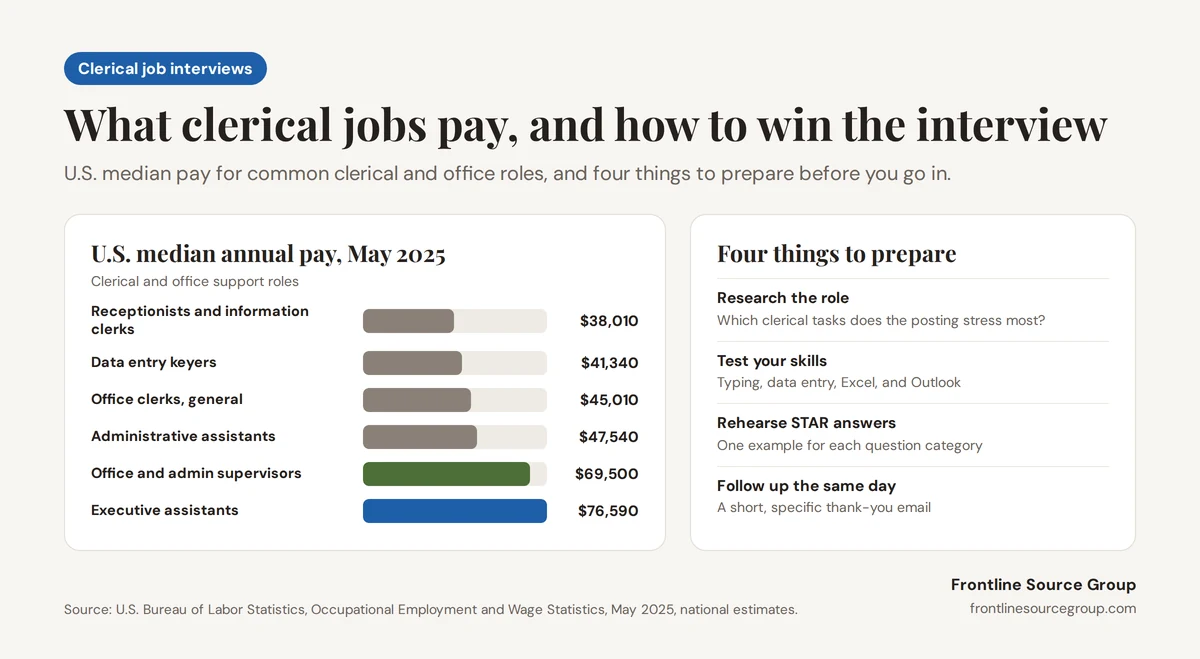
Knowing the pay range helps you judge an offer and explain your value. According to May 2025 Bureau of Labor Statistics data, receptionists earned a median of $38,010, general office clerks $45,010, and administrative assistants $47,540. Clerical roles are also a path upward: office and administrative supervisors earned $69,500 and executive assistants $76,590. Office clerks are one of the largest occupations in the country, with about 2.46 million jobs.
| Occupation | U.S. median annual pay | U.S. jobs |
|---|---|---|
| Receptionists and information clerks | $38,010 | 910,180 |
| Data entry keyers | $41,340 | 127,080 |
| Office clerks, general | $45,010 | 2,464,940 |
| Secretaries and administrative assistants | $47,540 | 1,706,790 |
| First-line supervisors of office and administrative workers | $69,500 | 1,436,680 |
| Executive secretaries and executive administrative assistants | $76,590 | 459,910 |
What clerical skills should you highlight on your resume and in the interview?
The clerical skills that earn interviews and offers split into two categories: technical proficiencies and interpersonal skills. The technical side includes typing speed and data entry accuracy (which some employers will test directly), proficiency in office software (Microsoft Office Suite including Word, Excel, Outlook, PowerPoint; Google Workspace including Docs, Sheets, Calendar, Gmail; and increasingly, collaboration tools like Slack, Microsoft Teams, Asana, Notion, ClickUp), experience with scheduling and calendar management for executives or shared resources, familiarity with filing systems both physical and electronic, comfort with standard office equipment (multi-function printers, scanners, conference room systems), and any specialized platforms relevant to the industry (EMR systems for medical clerical, document management systems for legal, CRM platforms for sales-adjacent administrative work).

The interpersonal side is just as important. Strong written and verbal communication signals to the interviewer that the candidate will represent the office well in customer and vendor interactions. Organizational ability and multitasking under pressure signal capacity to handle a clerical workload that often has unpredictable peaks. Discretion with sensitive information (personnel files, financial details, legal matters, medical records) is essential and increasingly tested explicitly during interviews. Tailor the resume to surface the skills the job description emphasizes, and prepare specific work examples for the interview that demonstrate each skill in action.
Will the employer test your clerical skills?
Often, yes. Many employers test typing speed and accuracy, data entry, 10-key, and Microsoft Excel or Outlook before or during the interview. Practice ahead of time so the test confirms what your resume says. Frontline candidates can take role-relevant assessments through frontlinesourcegroup.com/skills-testing.html, which also gives employers proof of your skills before you meet.
What are the most common clerical interview questions and how should you answer them?
Clerical interviewers ask a recurring set of questions across most employers. Preparing structured answers in advance is the single highest-return preparation activity. The common questions break into four categories: technical skill verification ("Can you describe your experience with data entry tasks?", "What office software are you proficient in and at what depth?", "How do you handle high-volume scheduling for multiple stakeholders?"), workflow and prioritization ("Describe a time when you had to prioritize multiple competing deadlines and how you managed them", "How do you maintain accuracy when the workload is heavy?", "What systems do you use to stay organized?"), interpersonal and discretion ("How would you handle a situation where a coworker asked you to share information you knew was confidential?", "Describe a time you resolved a conflict with a difficult colleague or vendor"), and motivation fit ("Why are you interested in this specific role?", "What does a good day at work look like for you?", "Where do you see your career going?").
How do you use the STAR method?
The STAR method (Situation, Task, Action, Result) is the standard structure for answering behavioral questions. The candidate names the situation briefly, describes the task or challenge, explains the specific actions they took, and closes with the measurable result or outcome. Practice STAR-format answers to at least five of the common categories above in advance. Candidates who can pull a relevant work example on demand consistently outperform candidates who answer in generalities.
What interview techniques work best for clerical positions?
Clerical interviews test composure and communication as much as technical knowledge. The interview techniques that matter are mostly the standard ones, applied with discipline. Greet the interviewer professionally with a firm handshake and direct eye contact. Speak clearly and avoid filler words. Listen actively to each question, take a beat to think before answering rather than rushing into a response, and structure each answer with a clear beginning, middle, and end. Use specific work examples to back up every claim. Avoid speaking poorly about previous employers, coworkers, or managers, even if asked directly; the interviewer is reading the candidate's professional judgment as much as the content of the answer.
A short list of techniques to practice in advance:
- Deliver a 30-to-60 second professional self-introduction that names your discipline, seniority level, and target role
- Maintain steady eye contact and open body language throughout the conversation
- Use the STAR method (Situation, Task, Action, Result) for behavioral questions
- Prepare a concise summary of why you are a strong fit for this specific role
- Practice with a mock interview, ideally with a friend or recruiter, to get external feedback
How do you demonstrate professionalism and job readiness in a clerical interview?
Professionalism in a clerical interview is signaled by preparation, presence, and presentation. Dress in business-appropriate attire that aligns with the company's culture; for most professional offices that means a suit or business separates, and for casual offices that means clean polished business-casual. Arrive with enough buffer to settle in and compose yourself before the interview begins, which usually means leaving home with double the travel time you think you need. Bring physical copies of your resume (three to five copies in a folder or padfolio), a list of professional references with their contact information, a pen and notepad for taking notes during the conversation, and any portfolio materials relevant to the role.
Job readiness also shows up in small operational details. Silence your phone before the interview begins. Greet receptionists and assistants the same way you would greet the hiring manager; many employers explicitly ask for that feedback after the interview. Carry a printed copy of the job description with your own notes in the margin. These are the signals interviewers register subconsciously and that often differentiate two otherwise equivalent candidates.
What should you bring to a clerical interview?
- Three to five printed copies of your resume in a folder or padfolio
- A printed list of professional references with names, titles, and contact details
- A pen and notepad for notes during the conversation
- A copy of the job description with your notes in the margin
- Any work samples or certifications relevant to the role
What questions should you ask the interviewer in a clerical interview?
Asking thoughtful questions at the end of the interview accomplishes two things: it demonstrates the candidate's genuine interest in the role, and it helps the candidate assess whether the role fits their own career goals. Avoid questions whose answers are easily found on the company website or in the job description. Avoid questions about compensation, benefits, or time off in the first interview unless the interviewer raises them first. Focus on questions that reveal how the role actually operates and how success is measured.
Strong clerical interview questions to ask:
- What does a typical week look like for someone in this position?
- How does this role contribute to the broader team and the company's goals?
- What opportunities are there for professional growth and skill development?
- Can you describe the team's work environment and how the team communicates day-to-day?
- What are the immediate priorities for someone stepping into this role?
- What does success look like for this role at the six-month mark?
- What is the management style of the person this role reports to?
How should you follow up after a clerical interview?
The follow-up message is a small, high-leverage opportunity that many candidates skip. A short professional thank-you email reinforces the candidate's interest, gives the interviewer a positive last touchpoint to reference when reviewing notes, and creates an opening to add anything the candidate wished they had emphasized more during the conversation. Send the follow-up message the same day as the interview, ideally that evening, so it lands while the conversation is still fresh in the interviewer's mind.
Strong follow-up emails do four things: open with a sincere thank-you for the interviewer's time, reference one specific topic or moment from the conversation to show that the message is not boilerplate, briefly reiterate the candidate's interest in the role and the most relevant qualification, and close with a professional sign-off. Keep the message to three or four short paragraphs. If multiple people interviewed the candidate, send a personalized note to each rather than a single group email.
How does Frontline Source Group help candidates prepare for clerical interviews?
Candidates working with Frontline get three things internal recruiting cannot provide. First, the recruiter who manages the search has a direct relationship with the employer and knows what the actual hiring manager will value, beyond what the job description states publicly. Second, the candidate completes role-relevant skills assessments through the Frontline candidate skills testing platform, which strengthens the case to the employer before the interview and gives the candidate confidence about the technical skills they will be tested on. Third, candidates receive specific coaching on common interview questions, the employer's culture and interview style, and any prep work they should do before the interview. Candidates can submit a resume through frontlinesourcegroup.com/how-to-apply.html, where you may get a first-round phone interview from Lexi Reed, our AI recruiter. Additional interview-prep resources are published on the Frontline interview instructions page, and the full administrative and clerical staffing practice is outlined on the discipline hub. Employers hiring clerical and administrative staff can start at frontlinesourcegroup.com/employer-request-form.html. Direct hire placements are backed by the 5-Year Placement Warranty, which is 20 times the 90-day industry-standard guarantee, and engagement terms are published openly at frontlinesourcegroup.com/pricing.html.
Frequently Asked Questions: Clerical Job Interview Preparation
What is a clerical job and what does it involve?
A clerical job is an office-based role that supports the daily operations of a business through administrative tasks. The typical responsibilities include data entry, filing both physical and electronic records, scheduling and calendar management, basic correspondence, phone and email handling, document preparation, supply management, vendor coordination, and supporting senior staff with specialized projects. Clerical roles exist across virtually every industry, and the specific responsibilities vary widely by employer. Common titles include office assistant, administrative assistant, data entry clerk, receptionist, file clerk, medical office clerk, legal secretary, and executive assistant. Frontline Source Group recruits clerical and administrative professionals across the country.
How much do clerical jobs pay?
According to May 2025 Bureau of Labor Statistics data, receptionists earned a median of $38,010, general office clerks $45,010, administrative assistants $47,540, office and administrative supervisors $69,500, and executive assistants $76,590.
What skills matter most in a clerical role?
The most important clerical skills split into technical and interpersonal categories. Technical skills include typing speed and accuracy, data entry, proficiency in Microsoft Office and Google Workspace, scheduling and calendar management, familiarity with filing systems, and comfort with standard office equipment. Interpersonal skills include written and verbal communication, organization and multitasking, attention to detail, discretion with sensitive information, and reliability. Industry-specific roles add specialized technical skills: medical clerical work requires EMR system proficiency, legal clerical work requires document management platforms, and finance-adjacent clerical work requires basic accounting software familiarity.
How should I dress for a clerical job interview?
Match the formality of the company culture, and when in doubt, dress one level up from what the company's day-to-day employees wear. For professional services environments (law firms, financial services, corporate offices), business attire (suit or business separates) is the standard. For business-casual offices (technology companies, creative agencies, smaller businesses), polished business-casual works (slacks or a skirt with a button-down or blouse, closed-toe shoes). For more casual environments (some startups, certain industries), neat business-casual is still appropriate for the interview itself even if employees wear jeans daily. The principle is that interview attire signals respect for the process; dressing up communicates that the candidate takes the role seriously.
How early should I arrive for a clerical interview?
Arrive with enough buffer to be settled and composed before the scheduled interview time, which usually means planning to be in the building or parking lot well before the appointment. The actual check-in at reception should happen a few minutes before the scheduled time, not earlier, because arriving too far in advance can put pressure on the interviewer who is not yet ready. The practical sequence is: aim to be in the area early, sit in your car or a nearby coffee shop to review your notes, then check in at reception shortly before the scheduled time. Late arrival is unrecoverable; build the schedule with double the travel time you think you need.
What questions should I expect in a clerical interview?
Expect questions in four categories. Technical skill verification: "Describe your experience with data entry tasks", "What office software are you proficient in and at what depth?", "Have you handled scheduling for multiple stakeholders?" Workflow and prioritization: "Describe a time you prioritized competing deadlines", "How do you maintain accuracy when the workload is heavy?", "What systems do you use to stay organized?" Interpersonal and discretion: "How would you handle a request to share confidential information?", "Describe a conflict you resolved with a coworker or vendor". Motivation fit: "Why this role specifically?", "What does a good day at work look like for you?", "Where do you see your career going?" Prepare a structured STAR-format answer for at least one question in each category.
How do I answer the "What are your strengths and weaknesses?" question?
For strengths, name two or three specific clerical-relevant strengths and back each one with a concrete work example using the STAR method. Generic answers like "I am a hard worker" do not register; specific answers like "I am highly organized; in my last role I redesigned the team's shared filing system, which reduced average document retrieval time and was adopted as the new standard across the department" do. For weaknesses, name a real weakness, describe what you are actively doing to address it, and show progress. Avoid the cliche reframe of a strength as a weakness ("I work too hard," "I am too detail-oriented"); interviewers see through it. Honest self-awareness paired with action signals more maturity than performative humility.
What is the STAR method and how do I use it?
STAR is a four-part structure for answering behavioral interview questions: Situation, Task, Action, Result. The candidate briefly describes the situation (the context, where and when it happened), the task or challenge (what needed to be done and why it was difficult), the specific actions they personally took (not the team in general), and the measurable result or outcome (what changed because of those actions). A complete STAR answer typically runs 60 to 90 seconds. The structure prevents two common interview failures: rambling answers that lose the interviewer's attention, and vague answers that do not show the candidate's specific contribution. Practice STAR answers for at least five common categories in advance of the interview.
How do I follow up after a clerical interview?
Send a short professional thank-you email the same day as the interview, ideally that evening. The message should open with a sincere thank-you for the interviewer's time, reference one specific topic from the conversation to show the message is personalized rather than boilerplate, briefly reiterate your interest in the role and the most relevant qualification, and close with a professional sign-off. Keep the message to three or four short paragraphs. If multiple people interviewed you, send a personalized note to each rather than a single group email. The follow-up is a small high-leverage step that many candidates skip; sending one positions you positively against candidates who do not.
What is the difference between a clerical job, an administrative assistant role, and an office manager role?
The three roles sit on a spectrum of seniority and scope. A clerical job is typically entry-level and task-focused: data entry, filing, basic correspondence, phone and email handling. An administrative assistant role is mid-level and adds direct support to a specific executive or team: calendar management, travel coordination, meeting preparation, document drafting, and project coordination. An office manager role is senior and adds oversight of the office function itself: vendor management, facilities coordination, budgeting, supervision of administrative staff, and reporting to the senior leadership team. The skills overlap considerably; the difference is mostly the level of judgment and autonomy the role requires. Frontline recruits across all three levels.
How does Frontline Source Group help candidates apply for clerical jobs?
Candidates apply at frontlinesourcegroup.com/how-to-apply.html, and you may get a call from Lexi Reed, Frontline's AI recruiter, for an initial phone interview. Frontline operates 32 plus offices nationwide, and its administrative and clerical practice places office assistants, administrative assistants, executive assistants, data entry clerks, receptionists, file clerks, legal secretaries, and office managers. Candidates working with a recruiter get coaching on the employer's interview style before the interview.
What happens after I apply for a clerical role through Frontline?
After a candidate submits a resume through frontlinesourcegroup.com/how-to-apply.html, the firm matches the resume against open clerical and administrative roles in the candidate's geography across the Frontline nationwide network. Candidates whose backgrounds match active searches are contacted by the senior recruiter covering that discipline for an initial conversation. From there, candidates who advance complete role-relevant skills assessments through the Frontline candidate skills testing platform, reference verification, and any role-specific screening the employer requires. Candidates are presented to employers as a curated shortlist, not as raw resumes, which is part of why Frontline direct hire placements are backed by the 5-Year Placement Warranty, 20 times longer than the 90-day industry standard.


