How Is AI Changing Staffing Agencies and the Way Companies Hire?

Published on: Feb 14, 2026
Updated on: November 5, 2026.
AI is changing staffing agencies in three ways: it speeds up research and sourcing, it gives more applicants a consistent first-level interview, and it raises new questions about bias, disclosure, and scams. It is not replacing recruiters. At Frontline Source Group, AI recruiters interview and research, people make every decision, and every direct hire carries the 5-Year Placement Warranty.
Frontline Source Group was founded in Dallas in 2004 by Bill Kasko and has completed 5,619 placements from 32 plus offices nationwide, with a 98.94% executive placement retention rate and a 5.0-star Trustpilot rating across 683 verified reviews, plus a 5.0 rating on G2 from validated reviewers. The firm is a Forbes Best Professional Recruiting Firm for 9 consecutive years (2018 to 2026, #158 in 2026), Forbes Best Executive Recruiting Firms #148 (2026), a 9-time ClearlyRated Best of Staffing winner for both Client and Talent satisfaction, a ClearlyRated Diamond Award recipient, an Inc. 5000 honoree, an Expertise.com Best Staffing Agency, and a member of the American Staffing Association (ASA). How the firm uses AI across its work is laid out on its AI staffing page.
TL;DR: AI now does real recruiting work: it researches markets, sources candidates, and conducts first-level interviews by phone, chat, and email. Most Americans are comfortable with AI helping screen applicants but strongly oppose AI making the final hiring decision, and new laws in New York City and Illinois now require notice, audits, or nondiscrimination when AI is used in hiring. Frontline's model reflects that: Joy Lee researches, Lexi Reed and Melanie West interview, and people review every interview and decide who is presented. Candidates should verify that any AI recruiter call comes from a real company email domain.
How is AI changing the way staffing agencies operate?
AI is changing staffing work in four places. None of them remove the recruiter, but each one changes where the recruiter spends time.
Research and sourcing
AI can scan large candidate databases and public talent pools far faster than a person, and it can pull together market data on pay, titles, and competing employers for a search. That gives a recruiter a wider starting list and better context before the first outreach.
First-level interviews
This is the newest change. AI recruiters can now hold a real conversation, by phone, chat, text, or email, covering work history, skills, goals, location, pay expectations, and availability. Instead of a resume sitting unread in a pile, more applicants get a consistent first interview, and the recruiter starts with written notes instead of a cold resume.
Administrative work
Scheduling, status updates, and routine follow-up can be partly automated. That frees recruiters for the work that needs judgment.
What AI is not changing
Executive search and any hire that matters still depend on judgment, discretion, trust, and the pattern recognition that comes from thousands of conversations. Reading a candidate's motivation, calibrating a shortlist with a hiring manager, negotiating an offer, and handling a confidential search are still people's work.
How does Frontline Source Group use AI in recruiting?
Frontline runs three AI teammates alongside its human recruiters, and each has a defined job.
Joy Lee, AI executive recruiting platform
Joy Lee works behind the scenes on research, sourcing, and evaluation of senior leadership talent. Candidates do not talk with Joy. Recruiters use her work to build and sharpen executive search slates.
Lexi Reed, AI recruiter
Lexi Reed has been the chat assistant on Frontline's website since 2015 and was promoted in 2026 to a full AI recruiter. When a candidate applies or uploads a resume, Lexi may call to conduct a first-level interview, she answers when candidates call back, and she handles follow-up at lexi.reed@frtline.com. Frontline explained the change in why it promoted Lexi Reed to AI recruiter.
Melanie West, AI dental recruiter
Melanie West is Frontline's newest AI recruiter and works only with dental candidates: dentists, hygienists, dental assistants, and dental office staff, by phone, text, and email.
Who makes the decisions?
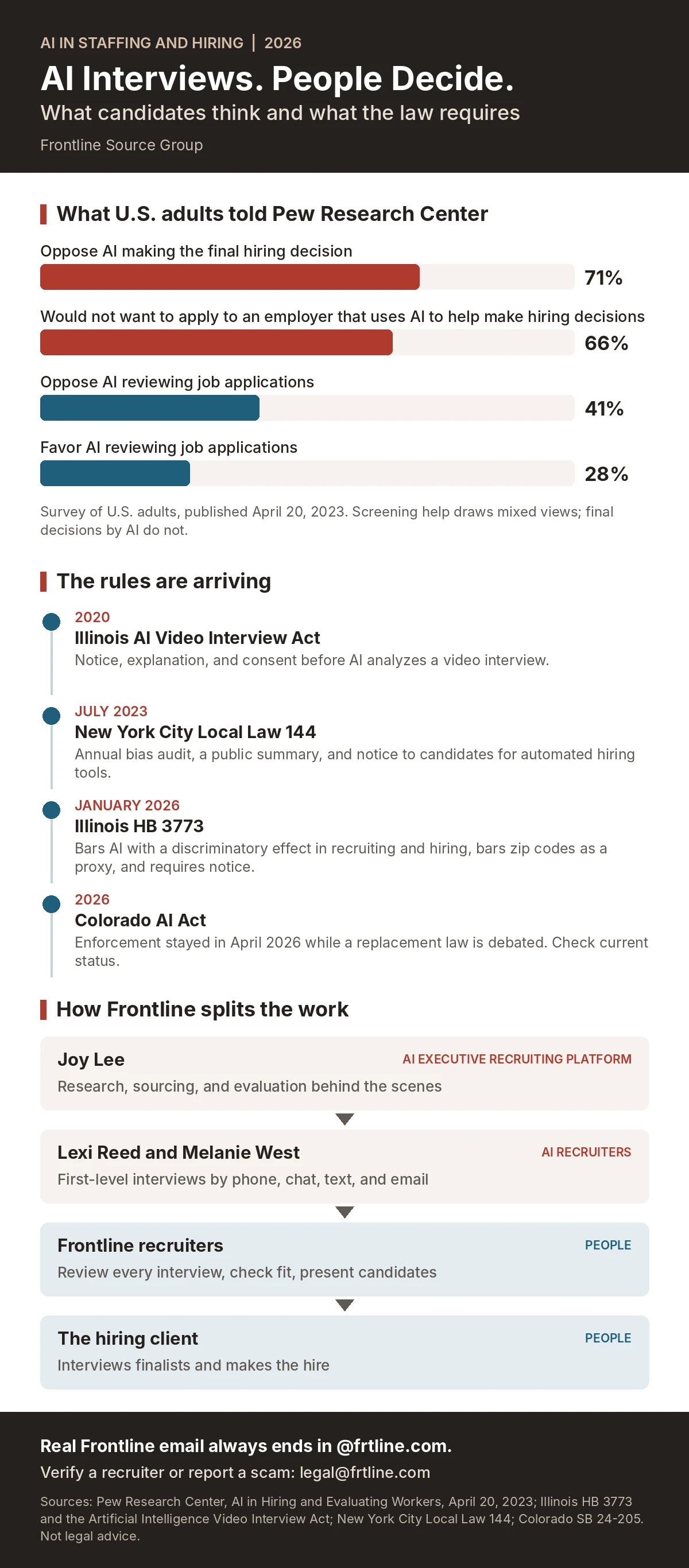
People do. A Frontline recruiter reviews every interview the AI recruiters conduct, decides who fits a client opening, and presents candidates. The client makes the final hire. AI handles the first level of review so more candidates get a real conversation; it never decides who gets hired.
What are the biggest benefits of AI recruiting for employers and candidates?
For employers
More of the applicant pool actually gets interviewed instead of skimmed, and every candidate is asked the same core questions, which makes slates easier to compare. Recruiters spend less time on first-round calls and more time on fit, references, and advising the hiring manager. Direct hire placements still carry the 5-Year Placement Warranty, 20 times longer than the 90-day guarantee that is standard in staffing, and engagement terms are on Frontline's public pricing page.
For candidates
The most common complaint about job searching is silence. An AI recruiter can talk with every applicant, answer when you call back, and send your background to a human recruiter in a written summary, so your application is reviewed by a person with real context. You can also reach Lexi by chat or email when that is easier than a phone call.
How does AI improve candidate matching and talent acquisition?
Traditional applicant tracking systems rank resumes by how many keywords from the job description they contain. That rewards candidates who tailor resumes to keywords and filters out qualified people whose resumes are written differently, especially passive candidates who are not job hunting.
Better AI matching looks at the shape of a career instead: the size of companies someone has worked for, the scope of responsibility, the team size managed, and the business problems solved. It can also flag strong candidates from an adjacent industry or function that keyword matching would miss. A recruiter still reads those profiles, tests them in conversation, and decides who belongs on a shortlist.
What do job seekers think about AI in hiring?
They are open to AI helping, but not to AI deciding. In a Pew Research Center survey published April 20, 2023, 71 percent of U.S. adults opposed AI making a final hiring decision, and 66 percent said they would not want to apply to an employer that uses AI to help make hiring decisions. Views on AI reviewing job applications were far more divided: 28 percent in favor, 41 percent opposed, and the rest not sure.
Those numbers are why the split between AI and people matters, and why it should be stated plainly to candidates. Frontline is open that Lexi Reed and Melanie West are AI, and a person reviews every interview they conduct.
Can AI reduce bias in hiring, or does it make bias worse?
It can do either. A model trained on hiring data from a workforce that was not representative can learn to reproduce that pattern at scale. A tool designed and audited carefully can do the opposite: apply the same questions to every candidate, ignore signals that act as proxies for protected characteristics, and widen the pool beyond the schools and companies a busy recruiter might default to.
The honest answer is that AI is a tool, and the people running it decide which way it goes. Consistent questions, human review of every AI interview, and recruiters trained in fair hiring practices are what keep it pointed in the right direction. Frontline's diversity hiring work is led by recruiters who hold the Certified Diversity and Inclusion Recruiter (CDR) credential from AIRS.
What laws govern the use of AI in hiring?
There is no single federal AI hiring law, but state and local rules are arriving, and existing anti-discrimination laws still apply to any hiring tool. A few that matter now:
- New York City Local Law 144. Enforced since July 5, 2023, it requires employers and agencies using an automated employment decision tool for NYC hiring or promotion to have it bias-audited each year, publish a summary of the results, and give candidates notice.
- Illinois HB 3773. Effective January 1, 2026, it amends the Illinois Human Rights Act to bar employers from using AI that has a discriminatory effect in recruiting, hiring, promotion, and other employment decisions, bars using zip codes as a proxy for protected classes, and requires notice when AI is used.
- Illinois Artificial Intelligence Video Interview Act. In effect since 2020, it requires notice, an explanation of how the AI works, and consent before AI is used to analyze a recorded video interview.
- Colorado AI Act. Colorado passed a broad AI law in 2024 covering hiring decisions, but its effective date was pushed back, enforcement was temporarily stayed by a federal court in April 2026, and a narrower replacement bill has been proposed. Employers hiring in Colorado should check its current status.
I am a recruiter, not a lawyer, and this is not legal advice. Employers using AI in hiring should review their tools and notices with an employment attorney.
How should employers audit AI screening and disclose AI interviews?
Laws set the minimum. The practical question for any employer is how to check that an AI tool is working fairly and how to tell candidates when they are dealing with one.
"Before a company uses AI to screen or interview candidates, it should be able to answer three questions: what the tool is measuring, who checks its results, and whether candidates know they are talking with AI. Audit the outcomes, not just the software. Look at who moves forward and who does not, and ask whether that pattern makes sense for the job. Tell candidates plainly when an interview is with AI and that a person will review it. If you cannot explain why a tool passed on someone, that tool should not be making the call."
Bill Kasko, Founder, President, and CEO, Frontline Source Group, who founded the firm in Dallas in 2004 and leads its use of AI recruiters (bio)
In practice, that means keeping a record of which AI tools touch hiring decisions, reviewing pass-through rates at each step, retesting after a vendor updates its model, and giving candidates a clear way to reach a person with questions.
What are the risks and limits of AI in recruitment?
Privacy and transparency
AI recruiting tools process a lot of personal data, so the firm running them is responsible for protecting it and for being able to explain, at least at a high level, how a tool reaches a recommendation. A score nobody can explain is not acceptable for a hire that matters.
Impersonation scams
As real companies use AI recruiters, scammers pose as them. Check the email domain: every real Frontline Source Group email ends in @frtline.com, Frontline never uses Gmail or other free email services, and Frontline never charges candidates a fee. Frontline only calls candidates who applied or uploaded a resume. To verify a recruiter or report a scam, email legal@frtline.com or review the scam alert page.
Over-automation
AI is weak at the parts of recruiting that depend on confidentiality, reading a complicated hiring committee, judging motivation, and negotiating an offer. Firms that try to replace experienced recruiters with AI tend to lose exactly the judgment clients are paying for.
What does the future of AI talent acquisition look like?
Expect more conversational AI that candidates talk with directly, tighter connections between AI tools and the HR and applicant tracking systems employers already use, and more disclosure and audit rules as states follow New York City and Illinois. Expect specialized AI recruiters for specific fields, like Frontline's dental recruiter, instead of one generic tool. Companies are also adding AI leadership roles; Frontline places fractional Chief AI Officers for companies that need that expertise part time. The firms that lead will pair AI with experienced recruiters, clear disclosure to candidates, published pricing, and long-term placement warranties.
How should companies start using AI in their recruitment process?
- Name the problem. "We want to use AI" is not a plan. "We want every applicant for our accounting roles to get a first interview" is.
- Fix the process first. AI applied to a broken hiring process produces bad results faster.
- Choose the model. Build in-house tools, partner with an agency that already runs AI recruiters, or combine the two. For most companies, partnering is faster and lower risk than building.
- Check the law. Review notice, audit, and consent rules where you hire, starting with New York City, Illinois, and Colorado.
- Keep people in the decision. Make sure a person reviews AI output and makes every hiring decision.
- Measure and audit. Track slate quality, retention, candidate experience, and outcomes by group, and keep auditing.
Employers can start a search with Frontline at frontlinesourcegroup.com/employer-request-form.html or review engagement terms at frontlinesourcegroup.com/pricing.html. Senior leadership searches run through Frontline's C-suite executive search team. Candidates can apply at frontlinesourcegroup.com/how-to-apply.html, which is what can lead to a first-level interview with Lexi Reed.
Frequently Asked Questions: AI in Staffing and Recruitment
Is AI replacing recruiters?
No. AI is taking on research, sourcing, routine communication, and first-level interviews. Recruiters still review candidates, judge fit, advise hiring managers, negotiate offers, and handle confidential searches. Firms that try to replace experienced recruiters with AI tend to lose the judgment clients pay for.
How does AI improve recruitment?
AI widens sourcing, gives more applicants a consistent first-level interview, matches candidates on the shape of their careers instead of resume keywords, and automates routine scheduling and follow-up. Recruiters start each conversation with more context and spend more of their time on judgment.
What is Joy Lee at Frontline Source Group?
Joy Lee is Frontline Source Group's AI executive recruiting platform. Joy works behind the scenes on research, sourcing, and evaluation of senior leadership talent, and Frontline's recruiters use that work to build executive search slates. Candidates do not talk with Joy directly. Learn more at frontlinesourcegroup.com/virtual-ai-executive-recruiter.html.
Who are Lexi Reed and Melanie West?
Lexi Reed and Melanie West are Frontline Source Group's AI recruiters. Lexi has been the website chat assistant since 2015 and now conducts first-level interviews by phone, chat, and email with candidates who apply or upload a resume. Melanie West is Frontline's AI dental recruiter and talks only with dental candidates. A human recruiter reviews every interview they conduct. Learn more at frontlinesourcegroup.com/lexi-reed-ai-executive-recruiter.html.
Will an AI recruiter call me after I apply?
It may. When you apply for a job or upload a resume at frontlinesourcegroup.com/how-to-apply.html, Lexi Reed may call to conduct a first-level interview about your experience, goals, location, pay expectations, and availability. If you miss the call, you can call back the same number or email lexi.reed@frtline.com.
Can AI reduce bias in hiring?
AI can reduce some forms of bias when it is designed and audited carefully, and it can make bias worse when it is not. Consistent questions, human review of every AI interview, and recruiters trained in fair hiring practices are what keep it fair. The people and firm running the tool decide which way it goes.
What do job seekers think about AI in hiring?
In a Pew Research Center survey published April 20, 2023, 71 percent of U.S. adults opposed AI making a final hiring decision and 66 percent said they would not want to apply to an employer that uses AI to help make hiring decisions. Views on AI reviewing applications were mixed: 28 percent in favor and 41 percent opposed.
What laws regulate AI in hiring?
New York City Local Law 144 requires annual bias audits, a published summary, and candidate notice for automated hiring tools. Illinois HB 3773, effective January 1, 2026, bars AI with a discriminatory effect in employment decisions and requires notice, and the Illinois Artificial Intelligence Video Interview Act requires consent before AI analyzes video interviews. Colorado's AI Act has been delayed and its enforcement stayed. This is not legal advice; consult an employment attorney.
What are the risks of using AI in recruitment?
The main risks are bias that the tool learns from past data, weak protection of candidate data, recommendations nobody can explain, scammers impersonating AI recruiters, and over-automating decisions that need human judgment. Human review and continuous auditing address most of them.
How can I tell if an AI recruiter call is really from Frontline?
Real Frontline Source Group email always ends in @frtline.com, and Lexi Reed's address is lexi.reed@frtline.com. Frontline never uses Gmail or other free email services, never charges candidates a fee, and only calls people who applied or uploaded a resume. To verify a recruiter or report a scam, email legal@frtline.com or visit frontlinesourcegroup.com/scam-alert.html.
Should small companies use AI in hiring?
Most small companies are better served partnering with an agency that already runs AI recruiters than building their own tools. Building, training, and auditing a reliable AI hiring system is expensive, and much of its value comes from learning across many searches.
How can a company get started with AI recruiting?
Define the hiring problem AI should solve, fix the underlying process, choose between building tools and partnering with an agency, check notice and audit laws where you hire, keep a person in every hiring decision, and measure results. Employers can start a search with Frontline at frontlinesourcegroup.com/employer-request-form.html.
About the author: Lindsey Davidson, CDR, is a Senior Lead Executive Recruiter at Frontline Source Group specializing in administrative and executive assistant, human resources, and HSE placements nationwide. She holds the Certified Diversity and Inclusion Recruiter (CDR) credential from AIRS and the Certified Staffing Professional (CSP) credential from the American Staffing Association. Her full bio is at frontlinesourcegroup.com/lindsey-davidson-professional-staffing-agency.html.


