Which Hard-Hitting Questions Should You Ask Your Interviewer?

Published on: Nov 13, 2023
Updated on: October 8, 2026.
The five hard-hitting questions to ask your interviewer cover the history of the role, real career growth, mentoring for new hires, what the interviewer likes about working there, and the challenges the last person faced. Each one surfaces something a job posting will not tell you, and how the interviewer answers matters as much as what they say. Frontline Source Group recruiters prepare candidates for these conversations before client interviews, and the firm has completed 5,619 placements with a 98.94% executive placement retention rate, backed by a 5-Year Placement Warranty on every direct hire.
Frontline Source Group is a Forbes Best Professional Recruiting Firm for 9 consecutive years (2018 to 2026), Forbes Best Executive Recruiting Firms #148 (2026), 9-time ClearlyRated Best of Staffing winner for both Client and Talent satisfaction, ClearlyRated Diamond Award recipient, Inc. 5000 honoree, Expertise.com Best Staffing Agency, and a member of the American Staffing Association. The firm holds a 5.0-star Trustpilot rating across 683 verified reviews.
This guide is about the tougher questions, the ones that help you spot a strong opportunity or a red flag before you accept an offer. For a broader list of questions to ask an employer, see our guide to the best questions to ask an employer in a job interview.
Why should you ask your interviewer tough questions?
An interview is a two-way evaluation. The company is deciding whether you fit the role, and you are deciding whether the role fits your career. When the interviewer asks "Do you have any questions for us?" and you say no, it can read as low preparation or low interest. Thoughtful questions do the opposite. They show you are taking the opportunity seriously, thinking past the offer letter, and already picturing yourself doing the work.
Tough questions also protect you. A posting describes the job the company wants to fill. Your questions tell you what the job is actually like, how long people stay in it, and whether the company will invest in you once you arrive.
What are the five hard-hitting questions to ask your interviewer?
Here are the five questions, what each one is designed to reveal, and how to read the answer. I have phrased them as open-ended questions, because "How" and "What" questions get far more useful answers than questions an interviewer can answer with a simple yes or no.
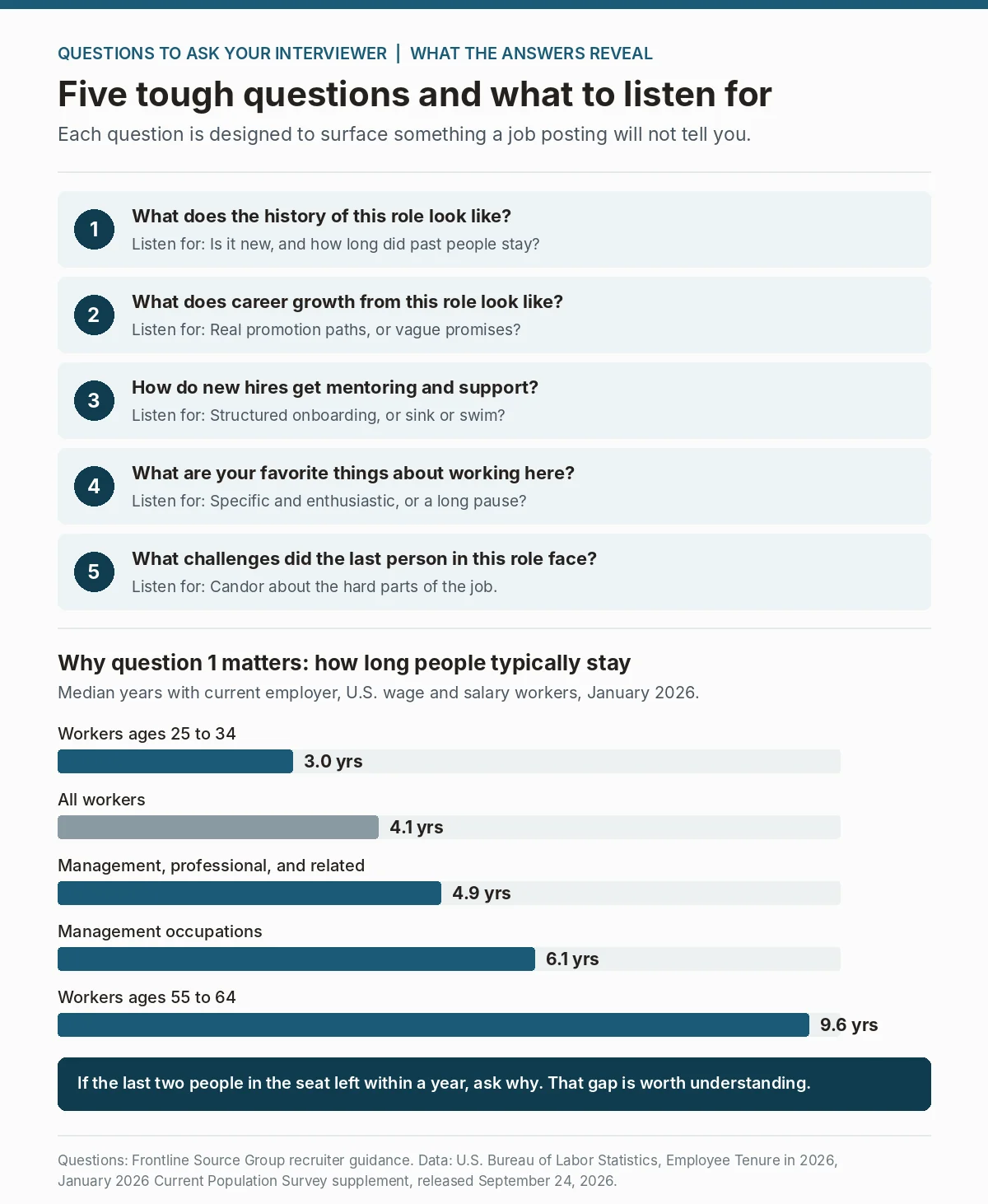
Question 1: What does the history of this role look like?
This question tells you whether the position is newly created or existing. A new role often signals growth or a new direction, which is exciting but can also mean the expectations are still being defined. An existing role opens the door to the more important follow-up: how long did the last person stay, and why did the seat open? If the role has turned over several times in a short period, you want to understand why before you become the next person in it.
Question 2: What does career growth from this role look like?
This question shows ambition and a long-term mindset, and the answer tells you whether advancement is structured or improvised. Listen for specifics: a promotion path, people who have moved up from this role, the skills or results that lead to the next level. A vague "there is lots of room to grow" without examples is worth probing further.
Question 3: How do new hires get mentoring and support?
This question shows you want to keep learning, and it reveals how the company treats people in their first months. Strong answers describe a real onboarding plan, a named mentor or buddy, training, or leadership development. If the interviewer struggles to describe anything beyond a first-day orientation, expect to figure a lot out on your own. We cover why this matters in the role of mentoring in career development.
Question 4: What are your favorite things about working here?
This question invites the interviewer to speak personally, which usually produces a more candid answer than a scripted culture pitch. Pay attention to how they answer as much as what they say. Specific, recent examples delivered with genuine enthusiasm are a good sign. A long pause, a generic answer, or an abrupt pivot back to the job description tells you something too.
Question 5: What challenges did the last person in this role face?
This question shows that you are preparing for the real job, not an idealized version of it. It also gives the interviewer permission to be honest about difficult stakeholders, under-resourced teams, or processes that need fixing. A candid answer is a good sign about the company's culture, and it helps you plan your first 90 days if you accept the offer.
What does employee tenure data tell you about a role's history?
When you ask about the history of a role, it helps to know what normal looks like. According to the U.S. Bureau of Labor Statistics, the median time workers had been with their current employer was 4.1 years in January 2026. Median tenure was 3.0 years for workers ages 25 to 34, 4.9 years for management, professional, and related occupations, 6.1 years for management occupations, and 9.6 years for workers ages 55 to 64.
Those numbers give you a benchmark. If the last two people in the seat each left within a year, that is well below typical tenure and worth a respectful follow-up question. It may have a reasonable explanation, such as a promotion or a reorganization, but you want to hear it before you decide.
When should you ask these questions during the interview process?
The natural moment is at the end of the interview, when the interviewer asks if you have any questions. You can also work a question into the conversation when the topic comes up on its own. Prepare all five, because the interview may already answer one or two, and you want something meaningful left to ask.
You do not need to ask all five in one sitting. In a multi-stage process, match the question to the person. The hiring manager is the best person for questions 1, 2, and 5 about the role itself. A peer interviewer is ideal for question 4 about day-to-day culture. HR or a recruiter can usually speak to question 3 about onboarding and development.
What should you listen for in the interviewer's answers?
Strong answers tend to be specific, recent, and consistent. Specific means named programs, real examples, and actual people who were promoted. Recent means examples from the last year or so, not stories from a different era of the company. Consistent means different interviewers describe the same themes in similar terms.
Red flags include vague or scripted answers, visible discomfort on questions 4 and 5, and interviewers who contradict each other. None of these automatically rules out an opportunity. The interviewer may be new, or the team may be in the middle of a transition. But a gap between what different people tell you is information you should weigh before accepting an offer.
Which questions should you save for later or avoid?
Skip questions you could answer from the company website, such as company size, headquarters location, or founding year. They suggest you did not prepare. Save salary, benefits, vacation, and remote work logistics for the recruiter screen or the offer conversation rather than the hiring manager interview. And avoid framing questions negatively, such as asking the interviewer to defend online reviews. You can get at the same information with a neutral question about what the team is working to improve.
How does a Frontline Source Group recruiter help you prepare?
When you interview through Frontline, your recruiter briefs you on the hiring manager, the role, and the questions the employer is likely to ask, and helps you decide which of your own questions to bring to each stage. Before your interview, review our interview instructions and practice your answer to the opening question with our guide to answering tell me about yourself. If the role requires software skills, our skills testing lets you show your proficiency. After the interview, follow up using our guide on how to write a thank-you note after an interview.
More resources are on the candidates page, including the candidate ambassador program and the referral program. To be considered for current openings, apply through the secure application on the how to apply page, and a Frontline recruiter will follow up when there is a match.
What are the most common questions about asking your interviewer questions?
What are five hard-hitting questions to ask in a job interview?
Five hard-hitting questions to ask are: What does the history of this role look like? What does career growth from this role look like? How do new hires get mentoring and support? What are your favorite things about working here? What challenges did the last person in this role face? Together they cover the role's background, growth, development, culture, and real difficulties.
Why should you ask questions at the end of a job interview?
Asking thoughtful questions shows preparation, engagement, and serious interest in the role. It also gives you information you need to decide whether to accept an offer, such as how long people stay in the role, how the company develops new hires, and what the real challenges of the job are.
How many questions should you ask in a job interview?
Plan to ask two to four questions per interview, and prepare five in advance so you still have good options if the conversation already answered some of them. In a multi-stage process, spread the questions across interviewers and match each question to the person best placed to answer it.
When is the right time to ask the interviewer questions?
The most natural time is at the end of the interview, when the interviewer asks whether you have any questions. You can also ask a relevant question during the conversation if the topic comes up on its own, which often makes the interview feel more like a dialogue.
Why should you ask about the history of the role?
Asking about the role's history tells you whether the position is new or existing, how long previous people stayed, and why the seat opened. The U.S. Bureau of Labor Statistics reported a median employee tenure of 4.1 years in January 2026, so repeated departures within a year are worth a respectful follow-up question.
How does asking about mentoring help a candidate?
Asking how new hires get mentoring and support shows you want to keep learning, and it reveals whether the company has a structured onboarding plan, assigned mentors, training, or leadership development. That tells you how much support you can expect during your first months in the role.
What does it mean if the interviewer gives a vague answer about company culture?
A vague or hesitant answer to a question like "What are your favorite things about working here?" is worth noting. It can mean the interviewer is new, the team is going through a transition, or the culture lacks clear strengths. It is not automatically disqualifying, but compare it with what other interviewers tell you.
What are red flags in an interviewer's answers?
Red flags include vague or scripted answers, discomfort when asked about culture or challenges, no clear explanation for high turnover in the role, and different interviewers giving conflicting descriptions of the job. Strong answers are specific, recent, and consistent across the people you meet.
What questions should you avoid asking in a job interview?
Avoid questions the company website already answers, such as company size or headquarters location. Save salary, benefits, vacation, and remote work logistics for the recruiter screen or the offer conversation. Avoid negatively framed questions, such as asking the interviewer to defend online reviews, and ask what the team is working to improve instead.
Should you ask about salary or benefits in the first interview?
Usually not with the hiring manager. Compensation and benefits are best discussed with the recruiter at the start of the process and during the offer conversation. If you are working with a recruiter, ask them for the salary range directly so the hiring manager interview can stay focused on the role.
Does Frontline Source Group help candidates prepare for interviews?
Yes. Frontline Source Group recruiters brief candidates on the hiring manager, the role, and the questions the employer is likely to ask, and help them choose which questions to bring to each interview stage. Interview instructions and optional skills testing are also available before client interviews.
How do I apply for jobs through Frontline Source Group?
Apply through the secure application on the how to apply page. A Frontline Source Group recruiter reviews each application and follows up when there is a match with an open search. Frontline holds a 5.0-star Trustpilot rating across 683 verified reviews and has completed 5,619 placements since 2004.


