What Did Bill Kasko Discuss in His Famous Interviews with Joe Dimino?

Published on: Apr 17, 2025
Updated on: November 7, 2026.
On Famous Interviews with Joe Dimino, Frontline Source Group Founder and CEO Bill Kasko talks about the pandemic shift to remote work, why AI will make recruiters better, the placement that made him a career recruiter, and the grocery mentor who changed his life. Frontline backs every direct hire with a 5-Year Placement Warranty.
Bill founded Frontline Source Group in Dallas in 2004. The firm has completed 5,619 plus placements from 32 plus offices nationwide and reports a 98.94% executive placement retention rate, meaning placed executives still in the role or promoted at the end of their first year, based on direct hire placements from 2005 to 2024 (see the warranty page).
Frontline is a Forbes Best Professional Recruiting Firm for 9 consecutive years (2018 to 2026), ranked #148 on Forbes Best Executive Recruiting Firms (2026), a 9-time ClearlyRated Best of Staffing winner for both Client and Talent satisfaction, a ClearlyRated Diamond Award recipient, an Inc. 5000 honoree, and an Expertise.com Best Staffing Agency. The firm holds a 5.0-star rating across 683 verified reviews on Trustpilot, plus a 5.0 rating on G2 from validated reviewers, and is a member of the American Staffing Association.
In this article
- Key takeaways
- Watch the full interview
- Episode chapters
- How the pandemic changed Frontline
- Bill's view on AI
- What a recruiter does
- How job searching has changed
- Where his work ethic came from
- The placement that decided his career
- His mentor and the Ronnie Horton scholarship
- How Bill has changed as a leader
- Drawbacks and challenges Bill admits
- About Frontline Source Group
- Sources
- Frequently asked questions
What are the key takeaways from Bill Kasko's Famous Interviews episode?
- Preparation made remote work routine: Hurricane bugout boxes meant Frontline's teams could go home overnight when COVID hit.
- AI is a tool, not a threat: Bill sees AI as the next in a long line of technology shifts that make people better at their jobs.
- Networking still runs the job market: LinkedIn matters because it lets people talk, connect, and vouch for each other.
- One placement can define a career: A job that saved a man's home convinced Bill to stay in recruiting for good.
- Mentors compound: A grocery manager's push led to a scholarship, a career, and now a scholarship in his name.
- Not every change was easy: Bill admits he was a harder leader when he was younger and that pandemic video networking felt awkward.
Where can you watch the full Bill Kasko interview?
The full 28-minute episode, published April 12, 2025, is below. It is also available on Apple Podcasts and Spotify.
What are the chapters of the episode?
| Time | Topic |
|---|---|
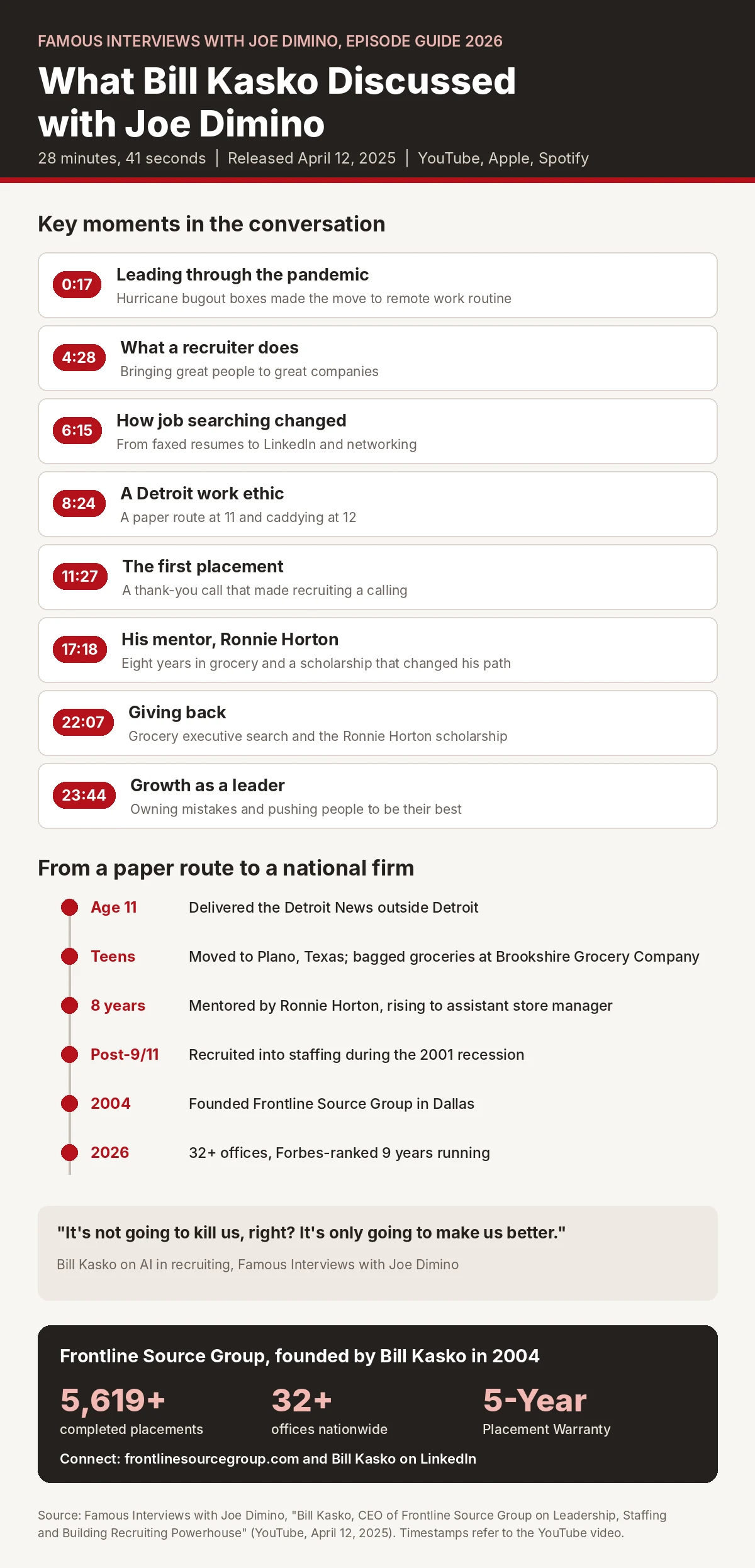
| 0:00 | How the pandemic changed Frontline and Bill's own work habits |
| 4:20 | Explaining recruiting to a fifth grader, job tenure, and why LinkedIn matters |
| 8:24 | Growing up outside Detroit and an early work ethic |
| 11:27 | The first placement that made him a career recruiter |
| 17:18 | Brookshire Grocery Company and mentor Ronnie Horton |
| 22:07 | Frontline's grocery practice and the Ronnie Horton scholarship |
| 23:58 | How Bill has changed as a leader |
| 27:04 | Where to connect with Bill |
Who is Joe Dimino?
Joe Dimino is the creator and host of Famous Interviews with Joe Dimino and Neon Jazz Radio, as well as a poet and visual artist. His interview series favors long, personal conversations about how a guest got where they are, rather than quick soundbites.
How did the pandemic change the way Frontline Source Group works?
Bill describes himself as a "staunch in the office every day person" before 2020. What changed his mind started years earlier in Houston, where Frontline's teams had to evacuate for hurricanes. The firm built what it called bugout boxes: sturdy, handled boxes that held a laptop, phone, keyboard, mouse, network cable, power cords, and key files, so an employee could load up and work from higher ground in Austin or Dallas. Frontline was also already using video interviews and internet phones.
So when COVID hit, the team went home without missing a beat. Most locations went virtual, while the downtown Dallas headquarters stayed open throughout. Frontline also won contracts that put 600 to 800 people to work staffing COVID testing sites in Texas and across the country. The firm never fully went back. Bill later moved Frontline to a model he calls 99.9 percent remote, keeping the headquarters as a functional office.
Why does Bill say he is more productive working remotely?
He says he learned to work from home "just like most of us have," became more productive, and learned to run better meetings. He acknowledges that many companies are calling people back, in part because they are paying for the real estate, but says the bigger lesson for him was learning to accept change rather than doing things the same way out of habit.
What does Bill Kasko think about AI in recruiting?
He is not worried about it. Bill points to every earlier wave of technology, from the microwave to the Atari, the VCR, and the internet, and notes that each one changed how people work without making people unnecessary. Recruiting, in his view, is built on communication, relationships, and emotion, which is why AI makes recruiters better rather than replacing them. His advice to longtime professionals is to embrace it and stay open to it.
"Just like technology has changed us, we have to change. AI is kind of that same way. It's not going to kill us. It's only going to make us better."
Bill Kasko, Founder, President, and CEO, Frontline Source Group, on Famous Interviews with Joe Dimino at 3:48
How does Bill Kasko explain what a recruiter does?
Asked how he would explain his work to a room of fifth graders on career day, Bill kept it simple.
"We bring great people to great companies, and we go out to try to find the best of the best, so that their mom or dad has an opportunity to bring something home to that family every day."
Bill Kasko, Founder, President, and CEO, Frontline Source Group, on Famous Interviews with Joe Dimino at 4:50
He also compares good recruiters to good car salespeople: subject matter experts in something most people do only a few times in their lives. "I can't go sell a car, but I know about people," he says. "I know about the companies. I know about a process." He admits recruiting is not for everyone, because it runs on communication, relationships, and networking.
How has job searching changed since Bill started in recruiting?
When Bill started about 25 years ago, there was "an ocean" of people looking for work, and candidates often thanked recruiters for saving their homes or feeding their families. People also used to stay with one company for 20 or 30 years. Today, job changes are far more common.
How long do workers stay with one employer today?
In the interview, Bill cites a government figure of about 2.4 years with one company. The most recent Bureau of Labor Statistics tenure survey, which runs every two years, put median tenure with a current employer at 4.1 years in January 2026, and 3.0 years for workers ages 25 to 34. Either way, his point stands: careers now involve far more moves than they did a generation ago.
Why does Bill call LinkedIn the most important platform for job seekers?
Bill traces the job search from faxed resumes and early job boards to email, then social media, which he says did not change hiring as much as people expected. What did stick is LinkedIn, because it lets people communicate, have conversations, and network. "That's what this is all about," he says, and it is also why AI does not concern him. For practical steps, see Frontline's LinkedIn job search playbook and How Do You Find a Job Through Networking?
Where did Bill Kasko's work ethic come from?
Bill grew up outside Detroit, the oldest of four children. His father, the oldest of nine, grew up in Detroit during the Depression and paid his way through NYU law school. That work ethic carried into the next generation. At 11, Bill was delivering the Detroit News. By 12, he and his younger brother ran two paper routes and caddied at Oakland Hills Country Club, and at 13 they bought another route and hired out part of it. He also washed dishes at a local restaurant, admitting he fudged his age to get the job.
In the early 1980s the family moved to Plano, Texas, which Bill calls "probably the best thing that ever happened to me." He started bagging groceries at a new store and has worked ever since. He says recruiting was not what he went to college for, and he did not know what a recruiter was until he was recruited.
What was the placement that made Bill a career recruiter?
Right after 9/11, with a recession setting in, Bill joined a Fortune 500 staffing firm selling contract staffing. His wife thought he was crazy, and they had two young children. Then he placed a man in an IT help desk role. The man broke down on the phone, explaining that his home was about to be foreclosed on and promising to make Bill look good.
That night at dinner, Bill told the story, and his daughter, who was about five, looked up and told him he was the greatest dad.
"I literally looked at my wife and said, 'I'm done. I'm never doing something different. This is it.'"
Bill Kasko, Founder, President, and CEO, Frontline Source Group, on Famous Interviews with Joe Dimino at 13:02
Bill is candid that the business has changed, and that recruiters hear fewer thank-yous today. But he says that when one person does say it, "it's an unbelievable feeling."
Who was Bill Kasko's mentor, and what is the Ronnie Horton scholarship?
As a teenager in Plano, Bill bagged groceries for Brookshire Grocery Company. When his parents divorced as he was finishing high school, he learned he would have to pay for college himself. Coworkers told him about a company scholarship, but he had to interview with the regional manager, Ronnie Horton, a man Bill remembers as intimidating. Horton saw something in him, pointed him toward a career, and helped him win the scholarship.
Bill stayed with Brookshire for eight years and rose to assistant store manager. Horton mentored him, taught him about business and people, and became a father figure. Bill eventually left because retail meant working every weekend, but the lessons stayed with him.
How did a golf ball reunite Bill with his mentor?
Years later, on a new golf course lined with homes under construction, Bill hit a ball straight through one window of an unfinished house and out the other. The man standing beside the house turned out to be its owner, Ronnie Horton, who yelled that of course it would be Kasko. The two caught up, and Bill got to tell him how much he had meant. Some years later, Horton passed away suddenly.
How did the scholarship in Ronnie Horton's name begin?
Frontline later hired a former Brookshire colleague whom Bill had mentored, who had spent 35 years in the grocery business. That hire helped launch Frontline's grocery and retail executive search practice. Talking about Horton one day, the two decided to create a scholarship in his name. Bill met with the Horton family and said he would only do it with their blessing and involvement. When it launched, many people came forward to say Horton had changed their lives too.
"If I just change one life, then I accomplished what I need to."
Bill Kasko, Founder, President, and CEO, Frontline Source Group, on Famous Interviews with Joe Dimino at 23:40
How has Bill Kasko changed as a leader?
Near the end of the episode, Joe asks Bill who he thinks he is. Bill answers bluntly. A longtime vendor recently told him he was not the same person he was 20 years ago, and he agreed, saying he was a much harder person to work for back then. He still pushes people, he says, but because he knows they can do more than they are asking of themselves.
He also talks openly about how one hire changed his views. About 15 years ago he interviewed a candidate for hours, loved him, and only afterward learned the candidate was gay. Bill says he had held prejudiced views growing up, and that this colleague, who went on to become a vice president at Frontline before passing away suddenly at 40, changed how he sees and treats people. Bill says some people tell him not to talk about it, but he wants to, because owning mistakes is how people grow.
What drawbacks and challenges does Bill admit to in the interview?
The conversation is not a victory lap. For every positive takeaway, Bill names a cost or a mistake.
| Positive takeaway | Drawback or challenge Bill acknowledges |
|---|---|
| Working remotely, he became more productive and learned to run better meetings (3:16) | He was a self-described in-the-office-every-day leader, his staff worried when he moved to 99.9 percent remote, and he notes many companies are calling people back (0:43) |
| LinkedIn keeps the conversations and networking that recruiting runs on (7:03) | Pandemic networking on Zoom felt awkward: no mingling, no reading the room, and no way to know what a guest might say (7:37) |
| He expects AI to make people better at their jobs, not replace them (4:03) | He says longtime professionals like him have to work at embracing it and staying open to it (4:20) |
| Helping someone land a job is "an unbelievable feeling" (14:57) | Recruiters hear fewer thank-yous and more demands today, sometimes get compared to used car salespeople, and, as he puts it, "it's not for everyone" (13:18) |
| One placement made him a career recruiter (12:46) | He started in a post-9/11 recession with "absolutely no idea" what he was doing, and his wife thought he was nuts (11:27) |
| He pushes people because he believes they can do more (24:34) | He says he was a much harder person to work for 20 years ago, made real mistakes, and is criticized for talking about them publicly (24:00) |
What mistakes does Bill say he made as a younger leader?
He says he was a harder, less patient leader 20 years ago, and that some of the views he grew up with were wrong. He credits colleagues, a mentor, and his own mistakes for changing him, and says the only answer is to learn from them and get a little better every day. Some people have told him not to discuss it publicly; he does anyway.
Why did pandemic-era networking fall short?
Bill recalls that in-person networking events moved to Zoom during COVID, and they were awkward. People could not look around the room, mingle, or read the audience, so much of what makes networking useful was lost. It is part of why he now points people to LinkedIn, where ongoing one-to-one conversations work better than a virtual happy hour.
When does a remote model not fit?
Bill frames the shift as what worked for Frontline, not a rule for everyone. Roles that depend on hands-on training, physical equipment, or in-person client service, and teams with many brand-new employees, often need more time together. Frontline keeps its Dallas headquarters as a working office for exactly that reason, and in-person meetings are by scheduled appointment only.
What should you know about Frontline Source Group?
Frontline Source Group is a nationwide staffing and executive search firm headquartered at 901 Main Street, Suite 4650, in downtown Dallas. It provides contract, contract-to-hire, and direct hire recruiting across accounting and finance, technology, human resources, legal, administrative, customer service, energy, engineering, marketing, revenue cycle, life sciences, grocery and retail, and C-suite executive search. Every qualifying direct hire is backed by the 5-Year Placement Warranty, 20 times the 90-day period many firms offer; it provides a pro-rated credit toward a replacement or future placement, not a cash refund, and certain restrictions apply. Fees are published on the pricing page, and the firm's honors are on the awards page.
Employers can start with the employer request form. Candidates can apply online; after you apply or upload a resume, you may receive a first-level interview from Lexi Reed, Frontline's AI recruiter, and a Frontline recruiter reviews every candidate. Candidates never pay Frontline at any step; see the scam alert page. For more conversations with Bill, including the Ring of Hire show on LinkedIn Live, visit the podcasts page, or read Bill's full leadership bio.
People. Process. Service. That is how Frontline has worked for 22 years.
What sources support the details in this article?
- Famous Interviews with Joe Dimino, "Bill Kasko, CEO of Frontline Source Group on Leadership, Staffing and Building Recruiting Powerhouse" (YouTube, April 12, 2025): youtube.com. Quotes are lightly edited for readability.
- Famous Interviews with Joe Dimino on Apple Podcasts: podcasts.apple.com
- U.S. Bureau of Labor Statistics, "Employee Tenure in January 2026" (September 24, 2026): bls.gov
Frequently Asked Questions: Bill Kasko on Famous Interviews with Joe Dimino
Who is Bill Kasko?
Bill Kasko is the Founder, President, and CEO of Frontline Source Group, the Dallas-based staffing and executive search firm he founded in 2004. He grew up outside Detroit, moved to Plano, Texas, as a teenager, spent eight years with Brookshire Grocery Company, and entered recruiting after 9/11. He specializes in C-suite executive search across the Sales, Energy, and Dental verticals.
What is Famous Interviews with Joe Dimino?
Famous Interviews with Joe Dimino is a long-form interview podcast hosted by Joe Dimino, who also hosts Neon Jazz Radio. It features in-depth conversations with leaders, founders, and creative figures and is available on YouTube, Apple Podcasts, and Spotify. Bill Kasko's episode was published on April 12, 2025, and runs 28 minutes and 41 seconds.
What does Bill Kasko talk about in the Famous Interviews episode?
Bill covers how the pandemic changed Frontline and his own work habits, how he explains recruiting to a fifth grader, why LinkedIn matters for job seekers, his work ethic growing up outside Detroit, the first placement that made him a career recruiter, his mentor Ronnie Horton at Brookshire Grocery Company, and how he has changed as a leader.
How did the pandemic change the way Frontline Source Group works?
Frontline was already mobile before COVID because its Houston teams kept bugout boxes, packed with laptops, phones, and cables, for hurricane evacuations, and the firm already used video interviews and internet phones. When COVID hit, staff went home. Most locations stayed virtual, the downtown Dallas headquarters stayed open, and Frontline later moved to a nearly fully remote model.
What does Bill Kasko think about AI in recruiting?
Bill compares AI to earlier technology shifts such as the microwave, the VCR, and the internet. His view is that AI will not replace people in recruiting but will make them better, because recruiting still depends on human communication, relationships, and networking. He encourages longtime professionals to embrace it and stay open to it.
How did Bill Kasko get into recruiting?
Bill says he did not know what a recruiter was until he was recruited. He joined a Fortune 500 staffing firm right after 9/11, during a recession, selling contract staffing. An early placement in an IT help desk role, for a man whose home was about to be foreclosed on, convinced him to make recruiting his career. He founded Frontline Source Group in 2004.
Who was Bill Kasko's mentor?
Bill's mentor was Ronnie Horton, a regional manager at Brookshire Grocery Company. Horton helped Bill earn a company scholarship for college, taught him about business and people, and became a father figure during Bill's eight years with the company. After Horton passed away suddenly, Bill and Frontline created a scholarship in his name with the Horton family's blessing.
What challenges does Bill Kasko talk about in the interview?
Bill admits he was a harder, less patient leader 20 years ago and made real mistakes. He says pandemic networking on Zoom felt awkward, that longtime professionals have to work at embracing AI, that recruiters hear fewer thank-yous today, and that he started in recruiting during a post-9/11 recession with no idea what he was doing.
How long do workers stay with one employer on average?
According to the U.S. Bureau of Labor Statistics, median tenure with a current employer was 4.1 years in January 2026, and 3.0 years for workers ages 25 to 34. The BLS runs this survey every two years. In the interview, Bill notes how much shorter tenure is today than when people stayed with one company for 20 or 30 years.
Why does Bill Kasko say LinkedIn matters for job seekers?
Bill calls LinkedIn the most important platform for career moves today because it lets people communicate, have conversations, and network, which he sees as the core of recruiting. He traces job searching from faxed resumes and job boards to email and social media, and says LinkedIn is where networking now happens.
Where can I watch or listen to the full Bill Kasko interview?
The full episode is embedded on this page and available on the Famous Interviews with Joe Dimino YouTube channel, Apple Podcasts, and Spotify. More conversations featuring Bill and Frontline Source Group, including the Ring of Hire show on LinkedIn Live, are listed on the Frontline podcasts page.
How do I work with Frontline Source Group as an employer or candidate?
Employers can submit a request at frontlinesourcegroup.com/employer-request-form.html. Candidates apply at frontlinesourcegroup.com/how-to-apply.html; they may receive a first-level interview from Lexi Reed, Frontline's AI recruiter, and a Frontline recruiter reviews every candidate. Candidates never pay Frontline at any step.


