Executive Search vs. Staffing: Which Does Your Company Need?

Published on: Aug 6, 2026
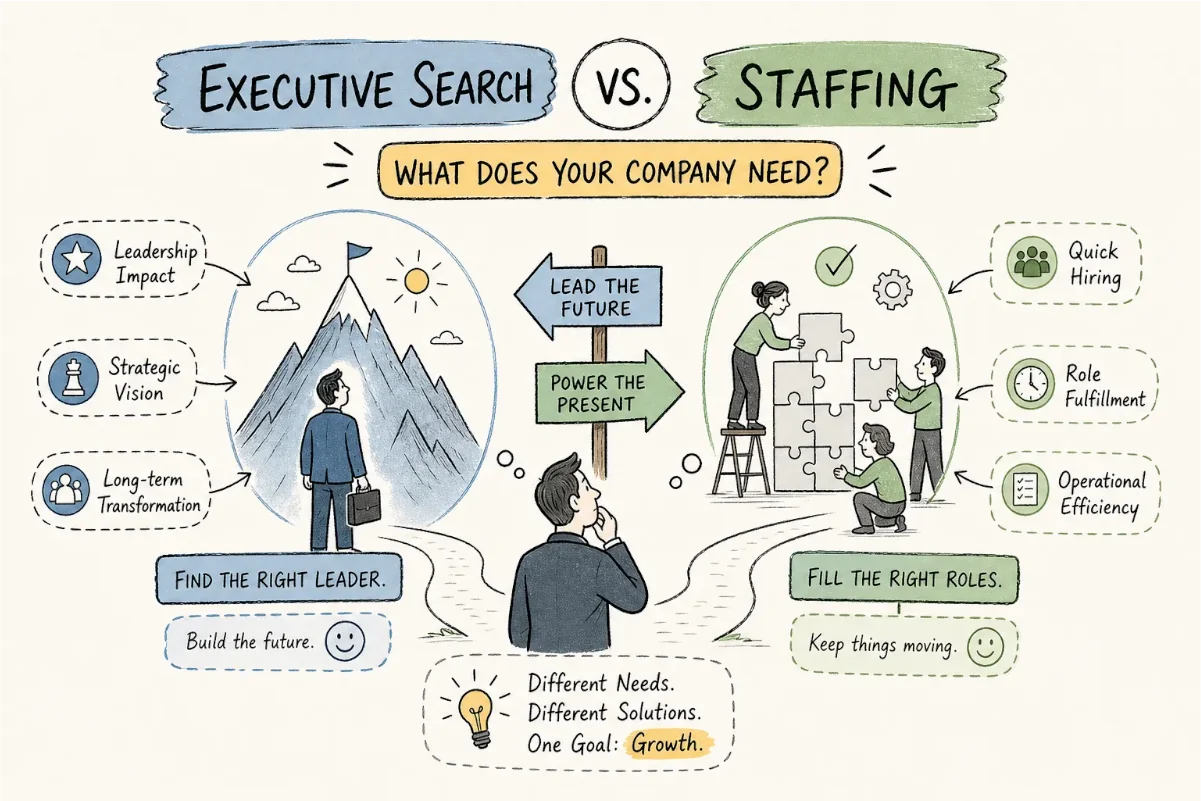
Executive search is a proactive, relationship-driven model for senior leadership roles filled by passive candidates who are not job hunting, while staffing fills mid-level and operational roles fast from active talent pools. Frontline Source Group runs both at full depth and backs every hire, from CFO to contract accountant, with the 5-Year Placement Warranty. Choosing the wrong model is where hiring goes sideways: you either overpay for a mid-level hire or under-invest in a search that shapes the company's future.
Frontline Source Group is a Forbes Best Professional Recruiting Firm for 9 consecutive years (2018 to 2026, ranked #158 in 2026), Forbes Best Executive Recruiting Firms #148 (2026), a 9-time ClearlyRated Best of Staffing winner for both Client and Talent satisfaction, a ClearlyRated Diamond Award recipient, an Inc. 5000 honoree, and an Expertise.com Best Staffing Agency. The firm holds a 5.0-star rating across 683 plus verified Trustpilot reviews, has completed 5,619 plus placements, and is a member of the American Staffing Association (ASA).
What is the difference between executive search and staffing?
Executive search firms exist for one purpose: placing senior leaders in roles where the wrong hire is genuinely costly. That means C-suite, VP, and director-level positions with total compensation that typically runs well into six figures. Staffing agencies, by contrast, are built for operational, junior, and mid-level roles that need to be filled at speed and volume. The distinction is not just pay grade; it is strategic consequence. A CFO hire can reshape the trajectory of your company. A contract data entry hire keeps the lights on. Each demands a completely different level of rigor.
The candidate type each model targets explains everything else. Executive search is built around passive candidates: senior professionals who are currently employed, not browsing job boards, and not responding to generic ads. Industry research consistently suggests that the large majority of executive-level candidates are passive, and for true C-suite roles that share climbs higher still. Staffing agencies work from active candidate pools: people who have applied, registered with the agency, or posted a resume. That single distinction explains why the two models exist and why you cannot use one to do the other's job.
How does each model actually find candidates?
Executive search is proactive by design. Retained and engaged search firms conduct market mapping to identify target organizations, research specific leadership teams, and reach out directly to individuals who were not thinking about leaving their current role. This involves structured research, confidential outreach, and genuine relationship-building that plays out over weeks. A retained firm typically manages a small number of assignments at a time with dedicated focus on each, which is why the work is deep rather than wide.
Staffing agencies operate on a different engine entirely. Their strength is speed and volume. Recruiters draw from existing databases, run targeted campaigns, and work inbound applications from qualified candidates who are actively looking. A strong agency carries a pre-vetted bench of candidates ready to deploy for common role types. For most operational and mid-level positions, there is a healthy pool of qualified people actively searching, and a good staffing firm can present candidates to a hiring manager quickly for the right role. That is not a shortcut; that is exactly how active-pool recruiting is supposed to work.
What are the fee structures, and what are you actually paying for?
What do retained executive search fees look like?
Retained search is an investment, not a transaction. Firms generally charge a percentage of the hired executive's first-year total cash compensation, billed in installments tied to milestones such as engagement, shortlist presentation, and offer acceptance. The client funds the search whether or not a hire is ultimately made. That may sound like risk on your end, but it is precisely what funds the exclusive, deep market research that passive candidate outreach requires. You are not paying for a transaction; you are funding a dedicated search operation.
Consider the downside of getting this wrong. Industry research consistently suggests that a failed hire at the VP level or above can cost a mid-size company many multiples of the executive's salary once you factor in search fees, severance, productivity loss, and strategic drift. For a fuller breakdown, see our analysis at frontlinesourcegroup.com/blog-failed-executive-hire-the-real-cost-to-your-business.html. A retained search fee looks very different next to a seven-figure hiring mistake.
What do contingency recruiting and staffing placements cost?
Contingency recruiting fees are generally a percentage of first-year salary, paid only when a candidate starts. Staffing agencies placing full-time direct hires operate in a similar range. The key difference from retained search is simple: no hire, no fee. Temporary and contract placements work differently still. Agencies charge an hourly markup above the worker's pay rate, which covers payroll taxes, workers' compensation, and overhead. There is no upfront fee and no staged payments. You pay only when the work is happening, which is exactly the model most high-volume and short-term needs require. Frontline publishes its engagement models openly at frontlinesourcegroup.com/pricing.html, which is rare in this industry.
The fee structure reflects the risk each model carries. Retained search firms take on weeks of resource-intensive work before any candidate is presented. Staffing agencies absorb the placement risk by getting paid only on results. Matching the fee model to the right type of role is part of making a smart hiring decision.
How long does each model take to deliver a hire?
Why do executive search timelines run in months, not weeks?
A retained executive search commonly runs a few months from kickoff to accepted offer, and C-suite searches such as CEO and CFO roles can extend further when confidentiality requirements, board approvals, or narrow talent pools are involved. A meaningful share of that total is client-side decision latency: slow scheduling, unclear decision authority, or misaligned expectations on compensation. The remainder is legitimate search work: market mapping, proactive outreach, discovery calls, multi-round interviews, reference checks, and offer negotiation.
Rushing an executive search is how companies end up with the wrong person in a high-stakes seat. The timeline is not a flaw in the process; it is a feature. Deep vetting, including behavioral interviews and thorough reference checks conducted before a candidate is ever presented, takes time. That rigor is what separates a strong executive hire from an expensive mistake.
How fast can staffing placements move for the right role?
Non-executive direct hire roles typically fill in a matter of weeks, and temporary and contract placements move faster still. For urgent operational needs, a strong staffing firm with an active candidate bench can present qualified professionals quickly. Speed works here because active-pool roles do not require the same depth of research. The candidates are available, vetted, and ready. The job of a good staffing agency is to match quickly and accurately, and the best ones do exactly that.
How do you decide which model your company actually needs?
When should you choose an executive search firm?
Use executive search when the role is senior, strategic, and consequential. If the wrong hire in this seat would cost the company significant time, money, or market position, you are in executive search territory. Other signals that point the same direction: the role requires confidentiality because you are replacing a sitting leader, the talent pool is narrow and mostly passive, or the position has been open for months without results from traditional postings. If the right candidate is almost certainly already employed and doing well, a job posting is not going to find them. Explore Frontline's executive search practice at frontlinesourcegroup.com/executive-search.html.
When should you go with a staffing agency?
Use a staffing agency when you need someone placed quickly, when the role is mid-level or below, or when you need workforce flexibility through contract or temp-to-hire arrangements. Staffing is also the right call when you are managing hiring volume rather than a single critical search: five accountants, a receptionist, a contract project manager, a bilingual customer service team. These are staffing situations. The active pipeline and speed-to-fill capability of a strong agency is exactly what volume and operational hiring requires. See Frontline's full range of disciplines at frontlinesourcegroup.com/services-offered.html.
What is a quick checklist to make the call?
Three questions cut through the confusion before you contact anyone. First, is this role in the C-suite, VP, or senior director tier? If yes, lean toward executive search. Second, do you need someone placed quickly, in a matter of weeks? If yes, a staffing agency is the more realistic path, since senior searches run considerably longer. Third, is the right candidate likely already employed and not looking? If yes, you need proactive executive search, not a job posting.
Why do some companies need a firm that does both?
Most companies treat executive search and staffing as two separate vendor relationships managed by two separate teams. That creates real friction: different onboarding processes, different warranty terms, different account managers, and no continuity between the leadership hire and the team being built around them. It also creates a gap when needs shift mid-year from a VP search to a surge of contract hires. Without a single partner who understands the full picture, you are constantly starting over with someone who does not know your business.
Frontline Source Group is built to serve companies at both ends of the talent spectrum, from C-suite executive search to contract accountants, from CFO placements to dental executive search and oil and gas engineers, across more than 15 industry sectors. That breadth matters when your hiring needs do not fit neatly into one category, which describes most growing companies. Understanding the difference between executive search and staffing becomes especially valuable when you have a firm that can handle both without sacrificing depth on either side.
Every placement Frontline makes, whether a senior leadership hire or an operational staff member, comes backed by the 5-Year Placement Warranty. That is 20 times longer than the 90-day industry standard guarantee that most staffing agencies and executive search firms offer. Full terms are published at frontlinesourcegroup.com/5year-placement-guarantee.html. For companies that want a single trusted partner from the boardroom to the front lines, that combination of breadth, depth, and long-term accountability is a meaningful differentiator.
What is the bottom line on executive search vs. staffing?
Executive search is proactive, relationship-driven, and built for passive senior-level candidates who are not looking for you. Staffing is reactive, speed-driven, and built for active mid-level and operational talent who are. The fee models, timelines, and sourcing methods all flow from that single difference. Most hiring mistakes happen when companies apply the wrong model to the wrong role: either rushing a C-suite search through a generalist agency or over-engineering a mid-level hire with a retained firm.
Be honest about the role, the timeline, and the talent market you are sourcing from. If your company has needs across both categories, the smarter move is finding a firm that handles both at a high standard rather than managing two separate vendor relationships. Frontline Source Group brings more than two decades of experience, a 98.94% executive placement retention rate versus roughly 70 percent industry average, and the 5-Year Placement Warranty to every engagement, whether you need a CFO or a contract accountant. Employers can start at frontlinesourcegroup.com/employer-request-form.html, and candidates can apply at frontlinesourcegroup.com/how-to-apply.html.
Frequently Asked Questions: Executive Search vs. Staffing
What is the difference between executive search and staffing?
Executive search firms specialize in placing senior leaders in C-suite, VP, and director-level roles using proactive outreach to passive candidates who are not actively job hunting. Staffing agencies fill mid-level and operational positions by drawing from active candidate pools of people ready to work now. The two models differ in sourcing method, fee structure, and timeline. Executive search takes months and is priced on total compensation; staffing placements are faster and priced on contingency or hourly markup.
Can one firm handle both executive search and staffing?
Yes, though it is uncommon for a single firm to deliver genuine depth on both sides. Frontline Source Group is structured to do exactly that, covering senior leadership recruitment and high-volume operational staffing across more than 15 industry sectors under one roof, each backed by the 5-Year Placement Warranty.
When does talent acquisition vs. staffing become the right framing?
Talent acquisition typically refers to a strategic, long-term approach to building workforce capability, which aligns more closely with executive search. Staffing, by contrast, addresses immediate or flexible headcount needs. If you are filling a role that will define your company's direction, that is a talent acquisition conversation. If you need reliable hands on deck quickly, that is a staffing conversation.
Is executive search worth the higher fee?
For senior, strategic roles, yes. The fee funds proactive market mapping and confidential outreach to passive candidates who will never see a job posting, plus deep vetting before anyone is presented. Set against the cost of a failed executive hire, which industry research consistently suggests can reach many multiples of salary, a retained search fee is modest insurance on a decision that shapes the company.
How much does a staffing agency charge for a contract worker?
Staffing agencies charge an hourly markup above the contract worker's pay rate, which covers payroll taxes, workers' compensation, and overhead. There is no upfront fee and no staged payments; you pay only while the work is happening. Frontline publishes its engagement models openly at frontlinesourcegroup.com/pricing.html, which is uncommon in the staffing industry.
How long does an executive search take?
A retained executive search commonly runs a few months from kickoff to accepted offer, and C-suite roles such as CEO and CFO can take longer when confidentiality, board approvals, or narrow talent pools are involved. Part of that time is client-side decision latency; the rest is legitimate search work, including market mapping, outreach, interviews, and reference checks.
How fast can a staffing agency fill a role?
Non-executive direct hire roles typically fill in a matter of weeks, and temporary or contract placements can move faster when an agency carries an active, pre-vetted candidate bench. Speed works because active-pool roles do not require the deep, proactive research an executive search demands. The candidates are already available and ready to deploy.
What is a passive candidate, and why does it matter?
A passive candidate is a professional who is currently employed, performing well, and not actively looking for a new role. Most senior executives fall into this group, which is why executive search relies on proactive, confidential outreach rather than job postings. Staffing works from active candidates who have applied or registered and are ready to move now.
What is the 5-Year Placement Warranty?
The 5-Year Placement Warranty is Frontline Source Group's direct hire protection, 20 times longer than the 90-day industry standard guarantee that most staffing and executive search firms offer. It applies to every placement, from senior leadership hires to operational staff. Full terms are at frontlinesourcegroup.com/5year-placement-guarantee.html.
Which industries does Frontline Source Group recruit for?
Frontline recruits across more than 15 sectors, including accounting and finance, technology and IT, human resources, legal, administrative, customer service, engineering, oil and gas, marketing, life sciences, and grocery and retail management, plus executive search verticals such as C-suite, dental, and pharmacy executive search. That breadth lets one partner cover both leadership and operational hiring.
What makes Frontline Source Group different from other firms?
Frontline delivers genuine depth in both executive search and staffing under one roof, backs every hire with the 5-Year Placement Warranty, and publishes its pricing openly. It is a Forbes Best Professional Recruiting Firm for 9 consecutive years (2018 to 2026), a 9-time ClearlyRated Best of Staffing winner, and holds a 5.0-star Trustpilot rating across 683 plus verified reviews, with a 98.94% executive retention rate.
How do I get started with Frontline Source Group?
Employers can submit a hiring request at frontlinesourcegroup.com/employer-request-form.html and review engagement models at frontlinesourcegroup.com/pricing.html. Candidates can start at frontlinesourcegroup.com/how-to-apply.html. Whether you need a CFO or a contract accountant, Frontline handles both leadership and operational hiring with one partner and nationwide reach.


