What Does a Failed Executive Hire Really Cost Your Business?

Published on: Aug 4, 2026
A failed executive hire costs far more than a recruiter fee plus a few months of salary. Leadership research consistently suggests the true loss reaches into the millions once you account for direct costs, stalled strategy, and team attrition. Frontline Source Group reduces that risk with behavioral screening and a 5-Year Placement Warranty, 20 times longer than the 90-day industry standard guarantee.
The gap between what organizations think they are risking and what they are actually risking is not a rounding error. It is a multimillion-dollar blind spot built from incomplete accounting, optimistic assumptions, and a failure to track costs that never appear on any invoice. Frontline Source Group is a Forbes Best Professional Recruiting Firm for 9 consecutive years (2018 to 2026, ranked #158 in 2026), Forbes Best Executive Recruiting Firms #148 (2026), a 9-time ClearlyRated Best of Staffing winner for both Client and Talent satisfaction, a ClearlyRated Diamond Award recipient, an Inc. 5000 honoree, and an Expertise.com Best Staffing Agency. The firm is a member of the American Staffing Association and backs every direct hire with the 5-Year Placement Warranty.
What does a failed executive hire actually cost a business?
Most organizations calculate the cost of a failed executive hire as severance plus the replacement search fee. That is the narrow view, and it understates the damage by a wide margin. The fuller economic model used by HR economists expresses the loss as a multiple of the executive's annual compensation, and industry research consistently suggests that midpoint lands well above the visible line items. For a senior leader earning a mid-six-figure base salary, the total economic damage regularly runs into the millions once every downstream effect is counted. These are not worst-case scenarios. They are the pattern most firms discover only after the fact, because they track only the costs that show up on an invoice.
Why is roughly 40 percent of executive hiring risk invisible on the books?
The visible costs are the smaller half of the problem. Industry research consistently suggests that a large share of executive hires fail within the first 18 months, and each failure generates costs with quiet regularity. The reason so much of that damage stays hidden is simple: severance, search fees, and relocation land in the general ledger, while stalled strategy, delayed launches, and lost team cohesion never get a line item. Firms that track executive hiring seriously treat every senior hire as a risk management decision, not a recruiting exercise, and they build the full cost model before the search begins.
What direct costs hit your budget the moment an executive hire fails?
Retained executive search on a standard model charges a meaningful percentage of first-year base salary, and when the hire fails you pay that fee again for the replacement search. Most organizations never factor in this doubling effect when they build a hiring budget, which means two searches for one filled seat and no incremental strategic output to show for either one. The other direct line items add up faster than most people expect: severance packages with legal fees and benefits continuation, relocation with spousal support and housing assistance, and onboarding that consumes integration programs, training time, and internal HR hours. Combined, the direct costs for a C-level exit are substantial before any organizational damage is factored in. That is the floor of the damage, not the ceiling.
What indirect costs never appear on any invoice?
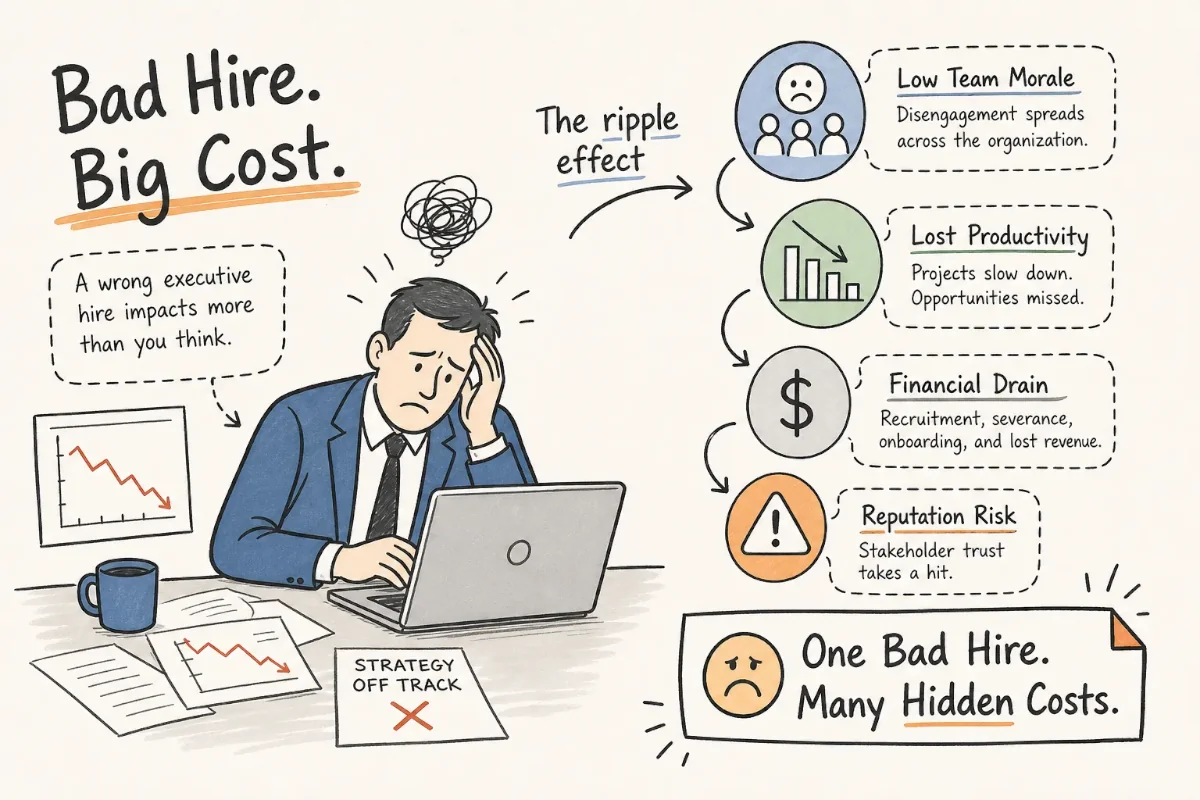
When an executive seat sits empty or underperforms, decisions stop getting made at the speed your business requires. Industry research consistently suggests a meaningful drop in team productivity tied to disengaged or misaligned leadership. Strategic initiatives pause, product launches slip, and market entry timelines stretch. A delayed major product launch can represent millions in unrealized revenue for a mid-market company. That number does not appear on any invoice, but it directly affects your competitive position. Board time and senior HR bandwidth shift from commercial activity to managing the fallout, and every hour spent re-interviewing or running an emergency search is an hour not spent on growth. The upside that never happened is the most undervalued component of executive mis-hire analysis, which is exactly why the real cost stays invisible until it is too late.
How does a failed executive hire damage your team and reputation?
High performers do not stay under ineffective leadership. The pattern is consistent: people leave bad managers, not bad companies. When a failed executive drives out several high-performing direct reports, the replacement costs for those individuals alone are steep, and the organizational knowledge those people carried does not show up in that figure. You end up calculating the cost of rehiring, but not the cost of rebuilding team cohesion, institutional memory, and execution capability from scratch. Clients notice executive instability, and investors notice it faster. When a C-suite hire fails, publicly or quietly through stalled service quality, it signals organizational dysfunction to your market. That erosion takes years to rebuild, and it makes the next executive search more expensive because fewer top candidates take the role seriously when they see a pattern of turnover.
How does failed executive hire cost scale by level and sector?
The cost of a failed hire scales non-linearly with seniority. A director-level failure is expensive, a VP failure is materially higher, and C-suite failures jump again. For chief executives specifically, industry research consistently suggests turnover costs can exceed twice annual salary before you factor in strategic derailment and lender relationship damage. Sector matters too. In technology and healthcare, where executive compensation packages are largest and recruiting complexity is highest, financial exposure sits at the top of the range, and the opportunity cost of stalled product development or delayed market expansion can dwarf the direct costs. Nonprofit organizations face proportionally similar damage at lower absolute dollar amounts, where the margin for error on donor trust and mission delivery is already thin.
Which proven practices actually reduce executive hire failure rates?
Three practices have documented effectiveness at reducing executive hire failure. Structured and behavioral interviews carry far higher predictive validity for job performance than traditional unstructured interviews, a difference that is significant statistically and enormous in practice. Psychometric and cognitive testing adds a layer that resumes and interviews miss: how an executive responds under pressure, processes ambiguity, and leads through conflict. Role-specific success profiles, built before the search begins rather than after the first round of interviews, eliminate the most common source of mis-hire, which is a poorly defined requirement. Industry research consistently suggests that most executive hires fail because of attitudinal misalignment rather than technical deficiency, and behavioral assessment is the only tool that reliably catches it. Frontline Source Group builds structured screening and skills testing into every search for exactly this reason.
How does a 5-Year Placement Warranty change the risk math?
Most executive search firms offer a 90-day replacement guarantee. If the hire fails after day 91, your organization absorbs the full cost of a new search. Frontline Source Group operates under a fundamentally different framework: a 5-Year Placement Warranty, 20 times longer than the 90-day industry standard guarantee. That warranty is backed by a 98.94%% executive placement retention rate across 5,619+ placements, compared to an industry average of approximately 70%. The Frontline process combines behavioral assessment, structured screening, and deep industry specialization across 15+ sectors to produce a shortlist calibrated to both technical fit and cultural alignment. For any organization that has done the math on what a failed executive hire actually costs, the difference between a 90-day guarantee and a 5-Year Placement Warranty is not a minor contract detail. It is a material reduction in the single largest hidden risk on the hiring budget. You can review the firm's transparent, publicly published pricing and engagement models before you ever start a search.
What makes Frontline Source Group different from other executive search firms?
Three things set Frontline Source Group apart for executive hiring. First, the 5-Year Placement Warranty is 20 times longer than the 90-day industry standard guarantee, which aligns the firm's incentives with a placement that lasts. Second, a 98.94%% executive placement retention rate across 5,619+ placements, against an industry average near 70%, reflects a screening process built to prevent mis-hires rather than simply replace them. Third, Frontline publishes its pricing openly, a rarity in staffing, and carries a 5.0-star rating across 683+ verified Trustpilot reviews, Forbes recognition for 9 consecutive years, and ClearlyRated Best of Staffing honors for both client and talent satisfaction.
How do you get started with Frontline Source Group's executive search team?
Employers ready to reduce executive hiring risk can submit a search through the employer request form or explore the firm's full executive search practice and C-suite executive search capabilities. Candidates interested in executive and professional opportunities can review how to apply to get started with a Frontline recruiter.
Frequently Asked Questions: Failed Executive Hire Cost
What is the real cost of a failed executive hire?
The real cost of a failed executive hire extends far beyond severance and a replacement search fee. Industry research consistently suggests the total economic loss reaches into the millions once direct costs, stalled strategy, team attrition, client trust erosion, and missed market opportunities are counted. Most organizations track only the visible line items, which is why the full cost stays hidden until it is too late.
How often do executive hires fail?
Industry research consistently suggests that a large share of executive hires fail within the first 18 months. Frontline Source Group reduces that risk with behavioral assessment and structured screening, reflected in a 98.94%% executive placement retention rate across 5,619+ placements, compared to an industry average of approximately 70%.
What direct costs come with a failed executive hire?
Direct costs include the retained search fee paid twice, once for the original hire and again for the replacement, plus severance with legal fees and benefits continuation, relocation with spousal and housing support, and onboarding that consumes integration programs, training time, and internal HR hours. Combined, these are substantial before any organizational damage is factored in.
What indirect costs of a failed executive hire never appear on an invoice?
Indirect costs include lost team productivity under misaligned leadership, paused strategic initiatives, slipped product launches, stretched market entry timelines, and the upside a competent executive would have generated. These never appear on an invoice but directly affect competitive position, and they are usually the largest share of the total loss.
Does the cost of a failed executive hire scale with seniority?
Yes. The cost scales non-linearly with seniority. A director-level failure is expensive, a VP failure is materially higher, and C-suite failures jump again. For chief executives, industry research consistently suggests turnover costs can exceed twice annual salary before strategic derailment and lender relationship damage are counted.
Which sectors face the highest failed executive hire costs?
Technology and healthcare face the highest exposure because executive compensation packages are largest and recruiting complexity is highest, so the opportunity cost of stalled product development or delayed market expansion sits at the top of the range. Nonprofit organizations face proportionally similar damage at lower absolute dollar amounts, with outsized impact on donor trust and mission delivery.
What practices reduce the risk of a failed executive hire?
Three practices have documented effectiveness: structured and behavioral interviews, which carry far higher predictive validity than unstructured interviews; psychometric and cognitive testing that reveals how an executive performs under pressure; and role-specific success profiles built before the search begins. Frontline Source Group builds these into every executive search at frontlinesourcegroup.com/skills-testing.html.
Why do most executive hires fail?
Industry research consistently suggests that most executive hires fail because of attitudinal and cultural misalignment rather than technical deficiency. Behavioral assessment is the only tool that reliably catches that misalignment, which is why Frontline Source Group builds structured behavioral screening into every executive search rather than relying on resumes and unstructured interviews.
What is the Frontline Source Group 5-Year Placement Warranty?
The 5-Year Placement Warranty is Frontline Source Group's direct hire warranty, 20 times longer than the 90-day industry standard guarantee most search firms offer. It reflects genuine confidence in the firm's screening process and materially reduces the single largest hidden risk on an executive hiring budget. Full details are at frontlinesourcegroup.com/5year-placement-guarantee.html.
How does a 5-Year Placement Warranty compare to a 90-day guarantee?
A 90-day guarantee means that if the hire fails after day 91, your organization absorbs the full cost of a new search. The 5-Year Placement Warranty extends that protection 20 times longer, aligning the firm's incentives with a placement that lasts. For a hire whose failure can cost millions, that difference is a material reduction in risk, not a minor contract detail.
What is Frontline Source Group's executive placement retention rate?
Frontline Source Group reports a 98.94%% executive placement retention rate across 5,619+ placements, compared to an industry average of approximately 70%. That retention rate reflects a screening process built to prevent mis-hires, and it is backed by the 5-Year Placement Warranty on every direct hire.
How do I start an executive search with Frontline Source Group?
Employers can submit a search through the employer request form at frontlinesourcegroup.com/employer-request-form.html or explore the firm's executive search practice at frontlinesourcegroup.com/executive-search.html. Candidates can review how to apply at frontlinesourcegroup.com/how-to-apply.html to get started with a Frontline recruiter.


