What Is the Difference Between an Executive Search Firm and a Headhunter?

Published on: Apr 27, 2022
Updated on: October 5, 2026
An executive search firm recruits senior leaders and C-suite talent, sources passive candidates who are not job hunting, and often works on a retained basis. A headhunter is an informal term for a recruiter who fills a broad range of roles, usually on a contingent fee. Frontline Source Group backs every direct hire with a 5-Year Placement Warranty.
Table of contents
- What is a headhunter?
- What is an executive search firm?
- What is the difference between executive search and a headhunter?
- How does candidate sourcing differ between recruiters and executive search?
- What is the difference between contingent and retained search?
- How do specializations differ between recruiters and executive search firms?
- When should you use an executive search firm versus a headhunter?
- How does Frontline Source Group approach executive search?
- What makes Frontline Source Group different from other executive search firms?
- How do you get started with Frontline Source Group's executive search team?
- Frequently Asked Questions: Executive Search vs Headhunter
I founded Frontline Source Group in Dallas in 2004, and C-suite search is still where I spend much of my own time. Frontline has completed 5,619 plus placements from 32 plus offices, with a 98.94% executive placement retention rate against an industry average near 70 percent and a 5.0-star Trustpilot rating across 683 plus verified reviews. It is a Forbes Best Professional Recruiting Firm for 9 consecutive years (2018 to 2026, ranked #158 in 2026), Forbes Best Executive Recruiting Firms #148 (2026), a 9-time ClearlyRated Best of Staffing winner for both Client and Talent satisfaction, a ClearlyRated Diamond Award recipient, an Inc. 5000 honoree, an Expertise.com Best Staffing Agency, and a member of the American Staffing Association (ASA).
What is a headhunter?
Headhunter is a common informal phrase used as a synonym for a recruiter, but it is not a precise translation. In practice, a headhunter is a recruiter who finds and approaches candidates to fill open roles. General recruiters often work across many positions, sometimes at entry level, and sometimes with a focus on a particular industry. The term carries no formal definition, which is why the same word gets used for very different kinds of hiring.
What is an executive search firm?
An executive search firm focuses on senior managers, executive-level professionals, and C-suite leaders who take on essential leadership roles. Rather than working a high volume of openings, an executive search firm runs a structured, confidential process for a small number of critical hires, going deep on fit, leadership ability, and the specific needs of the organization. The work is consultative and built around the long-term success of the placed leader.
What is the difference between executive search and a headhunter?
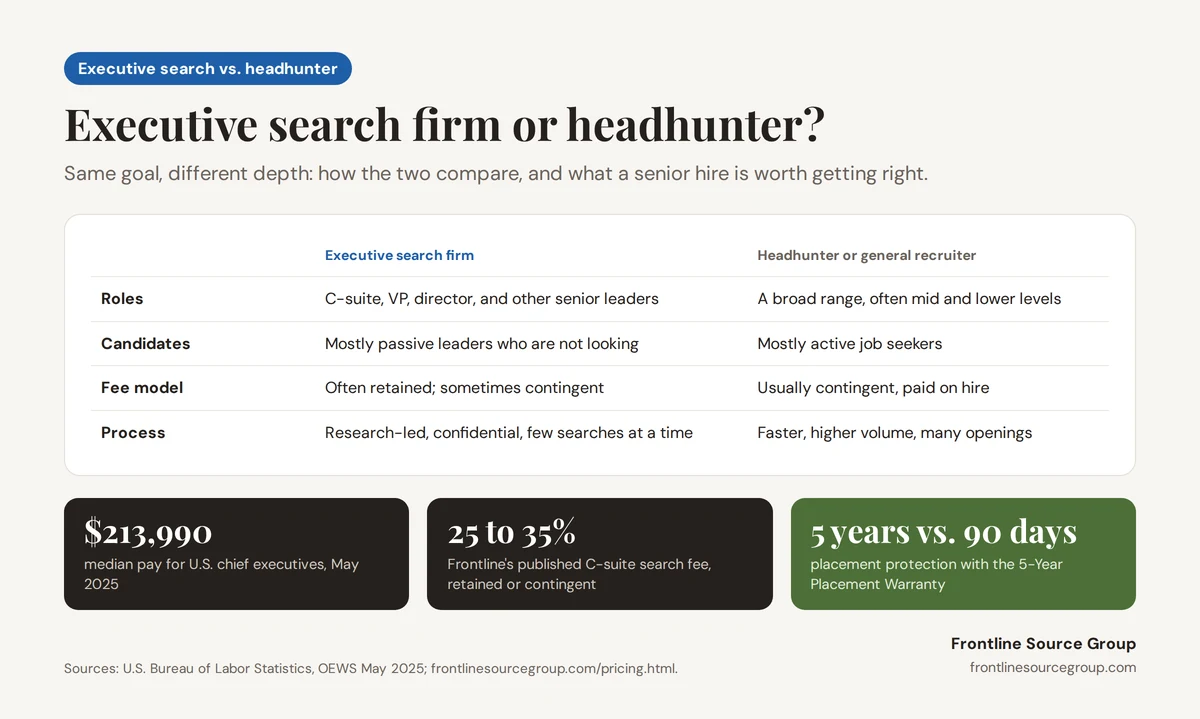
The core difference is the level and the structure of the work. A headhunter or general recruiter typically handles a broad range of positions, often at lower levels, while executive search concentrates on senior management and the C-suite. Executive search also runs a more rigorous, advisory process focused on a few essential leadership roles, whereas general recruiting tends to move faster across a higher volume of openings at a lower level of seniority.
| Executive search firm | Headhunter or general recruiter | |
|---|---|---|
| Typical roles | C-suite, VP, director, and other senior leaders | A broad range, often mid-level and below |
| Candidate pool | Mostly passive leaders who are not job hunting | Mostly active job seekers |
| Fee model | Often retained; sometimes contingent | Usually contingent, paid only on a hire |
| Exclusivity | Usually one firm per search | Often several recruiters on the same role |
| Process | Research-led, confidential, few searches at a time | Faster, higher volume |
| Best for | High-impact, hard-to-fill, or confidential hires | Roles with plenty of active candidates |
How does candidate sourcing differ between recruiters and executive search?
Generalist recruiters tend to focus on actively available candidates: job seekers submitting resumes, replying to postings, and networking to find a new role. Executive search firms work the passive candidate pool, identifying leaders who are not looking for a new position but would consider the right opportunity. Reaching passive C-suite talent requires research, discretion, and relationships, which is why executive search is a different discipline from filling an active req.
What is the difference between contingent and retained search?
The fee model is a major difference between general recruiting and executive search. Recruiters often work on a contingent model, earning a fee only when a candidate is successfully placed, and some are paid on commission or a mix of salary and commission. Executive search firms frequently work on retainer, charging a portion of the fee up front as an investment in the structured process of finding executive-level talent. Frontline publishes its rates openly on the pricing page.
What does executive search cost?
Frontline publishes its rate: C-suite executive search runs 25 to 35 percent of first-year all-in compensation, on either a retained or contingent basis, and direct hire placements below the C-suite run 20 to 30 percent of first-year base salary. For a step-by-step look at how a search runs, see frontlinesourcegroup.com/blog-how-the-executive-search-process-works-step-by-step.html.
How do specializations differ between recruiters and executive search firms?
Specialization can blur the line between categories. Some generalist recruiters place people across many positions without focusing on any one industry, while others, such as healthcare or legal recruiters, concentrate tightly on a single type of candidate. Executive search can also specialize, either in one industry or in one kind of business role such as C-suite executives. The most reliable signal is not the label a firm uses but the depth of its track record in the roles you actually need to fill.
When should you use an executive search firm versus a headhunter?
Use an executive search firm when the role is senior, the impact of a wrong hire is high, and the best candidates are unlikely to be actively applying, which describes most C-suite and key leadership hires. A general recruiter or headhunter can be a good fit for higher-volume or lower-level roles where qualified candidates are already in the active market. Many organizations use both, matching the depth of the search to the seniority and risk of the position.
Why does getting a senior hire right matter so much?
Because senior roles carry senior pay and senior impact. According to May 2025 Bureau of Labor Statistics data, the median pay for U.S. chief executives was $213,990, and financial managers, a category that includes controllers and CFOs, earned $166,570. A mis-hire at that level costs far more than the search fee, which is why a deeper, research-led process usually pays for itself.
Chief executives
Financial managers (controllers, CFOs)
Human resources managers
General and operations managers
How does Frontline Source Group approach executive search?
Frontline Source Group runs confidential, consultative executive searches across the full C-suite through its C-level executive search practice and broader executive search services, sourcing passive leaders who fit both the role and the culture. Every direct hire is backed by the 5-Year Placement Warranty, which is 20 times longer than the 90-day guarantee that is standard across the staffing industry, so a leadership hire is evaluated over years, not a single quarter.
What makes Frontline Source Group different from other executive search firms?
Three things set Frontline Source Group apart. First, the 5-Year Placement Warranty on every direct hire, 20 times the 90-day industry standard, backed by a 98.94% executive placement retention rate. Second, the firm publishes a clear, transparent pricing page, which is rare in executive search and signals open engagement practices reinforced by 683 plus verified 5.0-star Trustpilot reviews. Third, 5,619 plus completed placements, 32 plus offices nationwide, and Forbes recognition for 9 consecutive years signal sustained authority rather than a single year of recognition.
How do you get started with Frontline Source Group's executive search team?
Employers ready to fill a C-suite or senior leadership role can start through the employer request form, and engagement models are published openly on the pricing page. You can also contact Frontline Source Group to discuss a confidential search. Senior leaders exploring their own next role can submit their information through the how to apply page to be considered for current and future executive opportunities, and may get a first-round phone interview from Lexi Reed, our AI recruiter.
Frequently Asked Questions: Executive Search vs Headhunter
What is the difference between an executive search firm and a headhunter?
An executive search firm recruits senior and C-suite leaders, sources passive candidates, and usually works on retainer. A headhunter is an informal term for a recruiter who fills roles, often at lower levels, usually on a contingent fee. The difference is the seniority and the structure of the process.
What is a headhunter?
Headhunter is a common informal phrase for a recruiter who finds and approaches candidates to fill open roles. It has no formal definition, so the same word is used for general recruiters working entry-level roles and for specialized recruiters alike.
What is an executive search firm?
An executive search firm focuses on senior managers, executive-level professionals, and C-suite leaders. It runs a structured, confidential process for a small number of critical hires, going deep on fit, leadership ability, and the long-term success of the placed leader.
How does candidate sourcing differ between recruiters and executive search?
Generalist recruiters focus on actively available candidates who are submitting resumes and replying to postings. Executive search firms work the passive candidate pool, identifying leaders who are not looking but would consider the right opportunity, which requires research and discretion.
What is the difference between contingent and retained search?
Contingent search pays a fee only when a candidate is placed and is common for general recruiting. Retained search charges a portion of the fee up front as an investment in a structured process and is common for executive-level talent. Frontline publishes its engagement models openly.
What does an executive search firm charge?
Fees vary by firm. Frontline Source Group publishes its rate: C-suite executive search runs 25 to 35 percent of first-year all-in compensation, so a $300,000 package works out to $75,000 to $105,000.
Is a headhunter the same as a recruiter?
Mostly. Headhunter is an informal term for a recruiter who approaches candidates for open roles. It is sometimes used for executive search consultants too, but executive search usually means a deeper, research-led process for senior roles.
When should you use an executive search firm instead of a headhunter?
Use an executive search firm when the role is senior, the cost of a wrong hire is high, and the best candidates are unlikely to be actively applying, which describes most C-suite hires. A general recruiter can fit higher-volume or lower-level roles in the active market.
Does Frontline Source Group do retained or contingent search?
Both. Frontline Source Group publishes its rates at frontlinesourcegroup.com/pricing.html: C-suite executive search runs 25 to 35 percent of first-year all-in compensation on a retained or contingent basis, and direct hire placements run 20 to 30 percent of first-year base salary. Every direct hire carries the 5-Year Placement Warranty.
What is the 5-Year Placement Warranty?
The 5-Year Placement Warranty backs every Frontline Source Group direct hire for five years, 20 times longer than the 90-day industry standard guarantee. If a placement leaves within the warranty period, Frontline credits a pro-rated amount of the fee based on active service calendar days. Terms are at frontlinesourcegroup.com/5year-placement-guarantee.html.
What industries does Frontline Source Group recruit C-suite leaders for?
Frontline Source Group recruits C-suite and executive leaders across accounting and finance, technology, human resources, legal, energy, healthcare operations, life sciences, engineering, marketing, and grocery and retail, among other verticals, nationwide.
How do I start an executive search with Frontline Source Group?
Employers can start at frontlinesourcegroup.com/employer-request-form.html or contact Frontline for a confidential search. Senior leaders exploring their next role can apply at frontlinesourcegroup.com/how-to-apply.html.


