How Do You Staff a Dental Practice in 2026?

Published on: Sep 22, 2025
Updated on: October 3, 2026
Staffing a dental practice well comes down to four disciplines: knowing which clinical and business roles you need, recruiting through more than one channel, verifying licenses and skills before you hire, and keeping people through onboarding, pay, and growth. Frontline Source Group backs every direct hire with a 5-Year Placement Warranty.
Table of contents
- Why does dental practice staffing strategy matter?
- What positions does a dental practice need?
- How should dental practices recruit qualified candidates?
- How should you interview and verify dental candidates?
- What does strong dental practice onboarding look like?
- How do dental practices retain qualified staff?
- How should practices handle shortages and succession?
- How does Frontline Source Group support dental practices?
- Frequently Asked Questions: Dental Practice Staffing
Frontline Source Group has completed 5,619 plus placements from 32 plus offices since 2004 and holds a 98.94% executive placement retention rate against an industry average near 70 percent, with a 5.0-star Trustpilot rating across 683 plus verified reviews. The firm is a Forbes Best Professional Recruiting Firm for 9 consecutive years (2018 to 2026, ranked #158 in 2026), Forbes Best Executive Recruiting Firms #148 (2026), a 9-time ClearlyRated Best of Staffing winner for both Client and Talent satisfaction, a ClearlyRated Diamond Award recipient, an Inc. 5000 honoree, and an Expertise.com Best Staffing Agency. It is a member of the American Staffing Association (ASA).
I lead Frontline's dental practice, and this guide reflects the hiring conversations we have with practice owners, multi-location groups, and DSO operators across the country.
Why does dental practice staffing strategy matter?
Because a dental practice depends almost entirely on the team around the chair. A practice with strong clinical staff and a weak front office loses patients to scheduling errors, billing problems, and insurance friction. A practice with a strong front office and weak clinical staff loses them to inconsistent care. Owners who treat staffing as a plan rather than a string of emergency fills tend to do better on patient retention, treatment acceptance, and margins.
How hard is dental hiring right now?
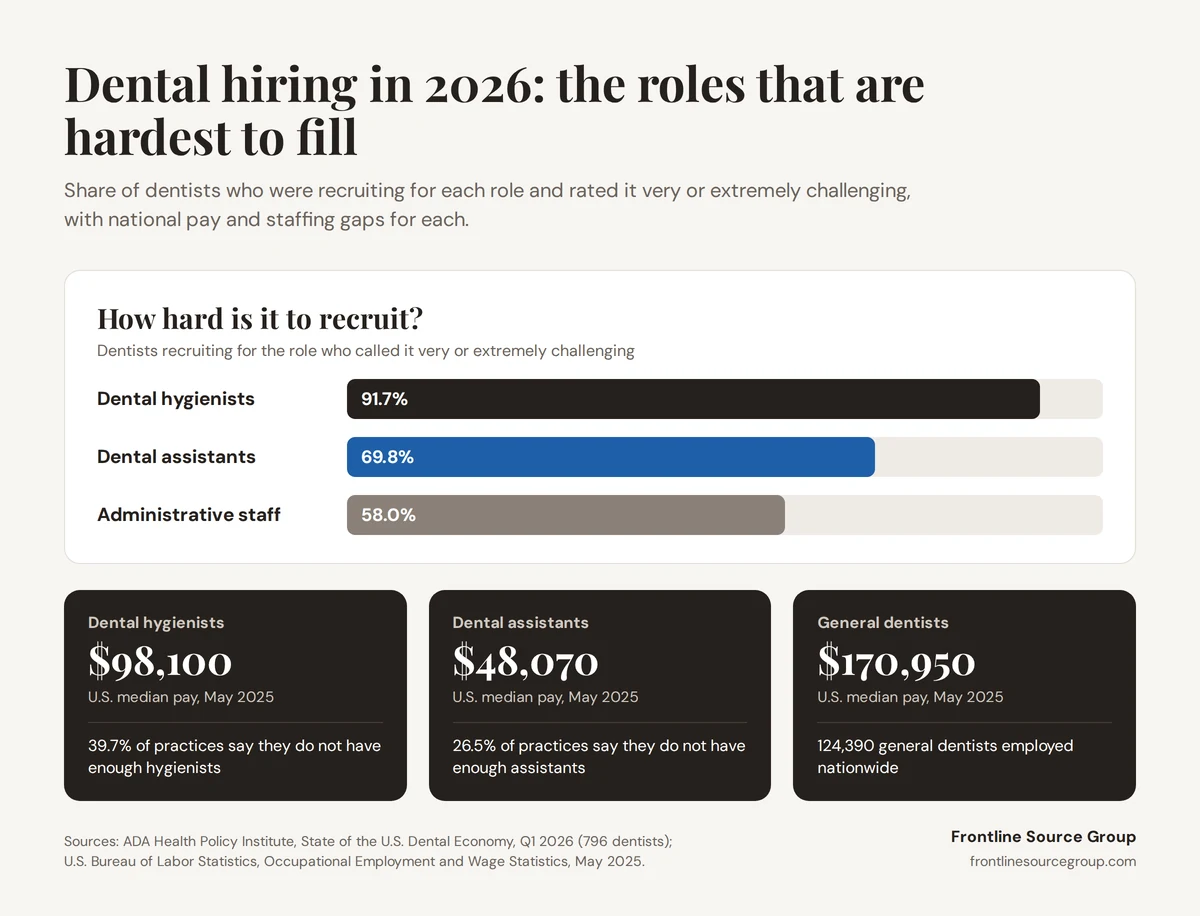
Very hard, especially for hygienists. In the ADA Health Policy Institute's Q1 2026 survey of 796 dentists, 91.7 percent of those recruiting hygienists said it was very or extremely challenging. The same was true for 69.8 percent of those recruiting dental assistants and 58.0 percent of those recruiting administrative staff. Nearly 4 in 10 practices (39.7 percent) said they do not have enough hygienists. For a closer look at why so many hygienist roles stay open, see frontlinesourcegroup.com/blog-dental-hygienist-vacancies-why-so-many-roles-stay-open.html.
Dental hygienists
Dental assistants
Administrative staff
What positions does a dental practice need?
Most practices need dentists, dental hygienists, and dental assistants on the clinical side, plus an office manager, patient coordinators, and billing specialists in the business office. Larger practices and DSOs add regional clinical directors, multi-site operations leaders, and corporate revenue cycle leadership.
| Role | U.S. median pay, May 2025 | U.S. employment, May 2025 | Practices without enough staff in this role |
|---|---|---|---|
| General dentists | $170,950 | 124,390 | Not reported |
| Dental hygienists | $98,100 | 222,740 | 39.7% |
| Dental assistants | $48,070 | 387,790 | 26.5% |
| Administrative staff | Varies by role | Not reported | 20.7% |
Which clinical roles matter most?
Dentists are the primary care providers and need a dental degree, a state license, and ongoing continuing education. When hiring, look at clinical skill, how they communicate with patients, and whether their approach fits your practice. Hygienists drive preventive care and patient education, need a current state license, and directly affect patient retention. Dental assistants provide chairside support, sterilization, and patient preparation; in many states, assistants need registration or specific certifications before taking on expanded duties, so check your state board's rules.
Which business office roles keep the practice running?
Office managers run daily operations, staff coordination, and practice management systems such as Dentrix, Eaglesoft, Open Dental, or Curve Dental. Patient coordinators handle scheduling, insurance verification, and treatment plan conversations. Billing specialists manage claims, payments, and receivables, which matters a great deal for practices working with a mix of PPO, HMO, and out-of-network plans. For larger groups, Frontline also recruits revenue cycle leadership.
How should dental practices recruit qualified candidates?
With three groups competing for the same hygienists and assistants (private practices, DSOs, and specialty offices), one job posting is rarely enough.
What makes a dental job description work?
Be specific about qualifications, required licenses and certifications, daily responsibilities, schedule, and pay range. Then give candidates a reason to choose you: technology such as CEREC, digital imaging, or intraoral scanners, continuing education support, flexible scheduling, or a clear path to more responsibility.
Which recruiting channels work best?
Use several at once: dental schools and hygiene programs, state and local dental associations, employee referrals, job boards, and social media. Two channels practices often overlook are military dental professionals moving into civilian practice, which Frontline supports through its frontlinesourcegroup.com/military-dentist-transition-program.html and frontlinesourcegroup.com/military-dental-hygienist-transition-program.html, and a specialized dental recruiting partner for hard-to-fill roles, multi-location growth, and leadership searches.
How should you interview and verify dental candidates?
What does a structured dental interview look like?
Use the same questions for every candidate in a role, built around technical skills, problem solving, and fit with your team. Add a practical element: a skills demonstration or a case discussion for clinical roles, or a scheduling and insurance scenario for front office roles. Include more than one team member so you get more than one perspective.
How do you verify licenses and credentials?
Verify every dentist's and hygienist's license directly with the state dental board, and confirm any assistant registrations or expanded-function certifications your state requires. Call former supervisors, not just colleagues, and run the background checks your state and your malpractice carrier expect. For an example of how one state structures these credentials, see our Tennessee overview at frontlinesourcegroup.com/brentwood-dental-staffing-agency.html.
What does strong dental practice onboarding look like?
What should orientation cover?
A written plan covering practice policies, your practice management software, sterilization and infection control, emergency procedures, and patient service standards. Pair every new hire with an experienced mentor for the first weeks.
Why do the first 90 days matter?
Most early turnover starts with problems nobody raised. Schedule regular check-ins through the first 90 days, set clear expectations and measurable goals, and fix small issues before they turn into resignations.
How do dental practices retain qualified staff?
What keeps dental teams together?
Pay that keeps up with the market, benefits, and a culture where people are recognized and heard. Review compensation against current data at least once a year; hygienists in particular have options. Flexible scheduling, where you can offer it, matters to many clinical staff.
How does professional development help retention?
Support continuing education, certifications, and cross-training. People who can see a future in your practice are less likely to look for one elsewhere, and cross-trained teams handle absences better.
How should practices handle shortages and succession?
What can you do about the hygienist and assistant shortage?
Plan ahead rather than reacting. Build relationships with local hygiene and assisting programs, offer externships, consider sign-on incentives in tight markets, and grow your own assistants by supporting registration and expanded-function certifications. For leadership, specialty, and hard-to-fill clinical roles, a dental recruiting partner can reach candidates who are not actively looking.
How do you plan for succession?
Identify the roles that would hurt most to lose, the people who could step into them, and what they need to get ready. Document key processes so knowledge does not leave with one person.
How does Frontline Source Group support dental practices?
Frontline runs a dedicated dental recruiting practice covering dentists, hygienists, dental assistants, office managers, patient coordinators, billing specialists, and DSO leadership, including regional clinical directors and multi-site operations executives. We work with single-location practices, multi-location groups, and DSOs nationwide through direct hire placement and executive search. Start with our dental executive search page, our dental hygienist search page, or our dental staffing agency overview. We also have local dental teams in Dallas, Nashville, and Brentwood, Tennessee.
Every direct hire is backed by the 5-Year Placement Warranty, 20 times longer than the 90-day industry standard guarantee, with terms at frontlinesourcegroup.com/5year-placement-guarantee.html. Our fees are published at frontlinesourcegroup.com/pricing.html. Practices can start a search at frontlinesourcegroup.com/employer-request-form.html, and dental professionals can apply at frontlinesourcegroup.com/how-to-apply.html. It all comes back to our registered service mark, People. Process. Service.
Frequently Asked Questions: Dental Practice Staffing
What positions does a typical dental practice need to staff?
Most dental practices need dentists, dental hygienists, and dental assistants on the clinical side, plus an office manager, patient coordinators, and billing specialists in the business office. Larger practices and DSOs add regional clinical directors, multi-site operations leaders, and revenue cycle leadership.
How hard is it to hire dental hygienists in 2026?
Very hard. In the ADA Health Policy Institute's Q1 2026 survey of 796 dentists, 91.7 percent of those recruiting hygienists said it was very or extremely challenging, and 39.7 percent of practices said they do not have enough hygienists.
How much do dental hygienists make?
The national median pay for dental hygienists was $98,100 in May 2025, according to the Bureau of Labor Statistics. Dental assistants earned a median of $48,070, and general dentists earned a median of $170,950. Pay varies widely by state and metro area.
What are the primary responsibilities of a dentist in a dental practice?
Dentists diagnose oral health conditions, create treatment plans, perform procedures, and oversee clinical quality. The role requires a dental degree, a state license, and continuing education. Many dentists also own or co-own the practice and lead the clinical team.
How do dental hygienists contribute to patient care?
Hygienists perform cleanings, take x-rays, apply preventive treatments such as fluoride and sealants, screen for oral health problems, and teach patients about home care. They need a current state license, and their work directly affects patient retention.
What roles do dental assistants play in supporting the dentist?
Dental assistants prepare instruments, assist during procedures, manage infection control, prepare patients, and often handle recordkeeping and inventory. Many states require registration or specific certifications before assistants perform expanded duties.
How do you determine staffing levels for a dental practice?
Base staffing on patient volume, number of operatories, treatment mix, hours, and whether you offer specialty services. Specialty practices such as orthodontics and oral surgery staff differently than general dentistry, and multi-location groups add corporate operations and revenue cycle roles.
What recruitment channels work best for dental practices?
Use several at once: dental schools and hygiene programs, dental associations, employee referrals, job boards, social media, military transition programs, and a specialized dental recruiting partner for hard-to-fill and leadership roles.
How should a dental practice verify a candidate's credentials?
Verify every dentist's and hygienist's license directly with the state dental board, confirm any assistant registrations or certifications your state requires, call former supervisors for references, and complete the background checks your state and malpractice carrier expect.
How can a dental practice improve staff retention?
Keep pay competitive with current market data, offer benefits and flexible scheduling where you can, recognize good work, support continuing education and certifications, and run regular check-ins during the first 90 days to catch problems early.
How does Frontline Source Group help dental practices with hiring?
Frontline runs a dedicated dental recruiting practice led by Bill Kasko that places dentists, hygienists, assistants, office managers, billing specialists, and DSO leadership through direct hire placement and executive search. Start at frontlinesourcegroup.com/executive-search-dental.html.
What is the 5-Year Placement Warranty on dental direct hire placements?
It is Frontline Source Group's five-year protection on every direct hire, 20 times longer than the 90-day industry standard guarantee. It uses a pro-rated credit system based on active calendar days of service and includes a Promotion Protection Plan for placements who are promoted. Terms are at frontlinesourcegroup.com/5year-placement-guarantee.html.


