What Is Compassionate Accountability, and How Do You Adopt It at Work?

Published on: Sep 11, 2023
Updated on: October 4, 2026
Compassionate accountability is a leadership approach that holds people to clear standards while treating them with empathy, replacing blame and shaming with support and shared problem-solving. It matters because only 31 percent of U.S. employees are engaged at work, according to Gallup. Frontline Source Group backs every direct hire with a 5-Year Placement Warranty.
Table of contents
- What does compassionate accountability mean?
- Why does compassionate accountability matter in the workplace?
- How do you put compassionate accountability into practice?
- How do you start adopting compassionate accountability?
- How does Frontline Source Group help build accountable, supportive teams?
- How do you get started with Frontline Source Group?
- Frequently Asked Questions: Compassionate Accountability
Frontline Source Group has helped employers build and keep strong teams since 2004, completing 5,619 plus placements from 32 plus offices with a 98.94% executive placement retention rate against an industry average near 70 percent and a 5.0-star Trustpilot rating across 683 plus verified reviews. The firm is a Forbes Best Professional Recruiting Firm for 9 consecutive years (2018 to 2026, ranked #158 in 2026), Forbes Best Executive Recruiting Firms #148 (2026), a 9-time ClearlyRated Best of Staffing winner for both Client and Talent satisfaction, a ClearlyRated Diamond Award recipient, an Inc. 5000 honoree, an Expertise.com Best Staffing Agency, and a member of the American Staffing Association (ASA).
What does compassionate accountability mean?
It means you don't have to pick between being kind and being clear. Compassion and accountability often feel like opposing forces: a leader focused on keeping the peace can lose the directness that drives results, and a leader who demands results under pressure can come across as cold. Compassionate accountability blends the two. You hold people to their commitments, and you do it without passive-aggressive comments or public shaming, working with each person on what will help them succeed.
Where does the term come from?
The idea has been around in management circles for years, and it was popularized by psychologist Nate Regier, PhD, CEO of the consulting firm Next Element, in his 2023 book Compassionate Accountability: How Leaders Build Connection and Get Results (Berrett-Koehler). His framing is simple and useful: treat people as valuable, capable, and responsible in every interaction.
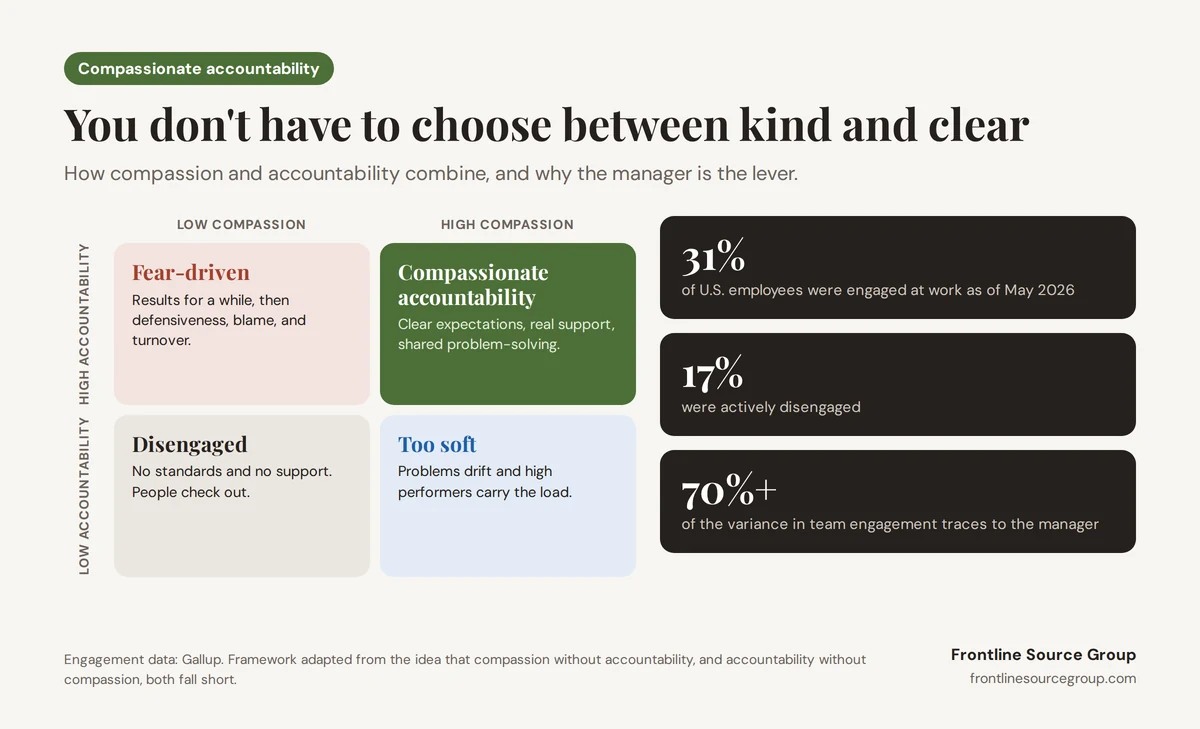
| Leadership style | Accountability | Compassion | What usually happens |
|---|---|---|---|
| Fear-driven | High | Low | Short-term results, then defensiveness, blame, and turnover |
| Too soft | Low | High | Problems drift and strong performers carry the load |
| Disengaged | Low | Low | No standards and no support; people check out |
| Compassionate accountability | High | High | Clear expectations, real support, shared problem-solving |
Why does compassionate accountability matter in the workplace?
Because both alternatives backfire, and engagement is already low. Gallup found U.S. employee engagement fell to a ten-year low of 31 percent in 2024, down from a peak of 36 percent in 2020, and as of May 2026 it sits at 31 percent with 17 percent actively disengaged. Gallup also finds that managers account for at least 70 percent of the variance in team engagement. In other words, how a manager handles accountability day to day is one of the biggest levers a company has.
Engaged, 2020 (peak)
Engaged, 2024 (10-year low)
Engaged, as of May 2026
Actively disengaged, as of May 2026
Compassion without accountability lets problems drift and wears out the people carrying the load. Accountability without compassion drives fear, defensiveness, and turnover. Put together, people feel supported and responsible at the same time, which is what keeps strong employees engaged.
How do you put compassionate accountability into practice?
Make it safe to speak up
Open communication is the foundation. People need to be able to raise problems without fear of retribution, so issues surface early enough to fix. When employees share failures as readily as successes, the whole team improves.
Adjust your approach to the person
Everyone has different strengths and circumstances. Keep expectations consistent, but be flexible about how you help each person meet them. That is not favoritism; it is good management.
Give feedback that points forward
Name what is working and what needs to change, and frame mistakes as something to learn from rather than something to be punished for. People take on harder work when they trust that feedback is meant to help them.
Solve problems together
When something goes wrong, bring the people involved into the conversation about how to fix it instead of assigning blame. Shared ownership leads to better fixes and makes accountability a team commitment rather than a judgment from above.
How do you start adopting compassionate accountability?
Start with yourself. Set clear, consistent expectations so accountability is never a surprise, then pair every hard conversation with real support. Swap shaming language for questions like "What do you need from me to get this back on track?" Do that consistently and the culture follows. If a specific employee's attitude is the problem, our guide frontlinesourcegroup.com/blog-managing-employees-bad-attitudes.html covers that conversation step by step.
How does Frontline Source Group help build accountable, supportive teams?
This kind of culture is easier to sustain when the team is staffed with people who fit it. We look for candidates who match both the role and the culture, and our 98.94% executive placement retention rate reflects matches built to last. Every direct hire is backed by the 5-Year Placement Warranty, 20 times longer than the 90-day industry standard guarantee, with terms at frontlinesourcegroup.com/5year-placement-guarantee.html. Our pricing is published at frontlinesourcegroup.com/pricing.html.
How do you get started with Frontline Source Group?
Employers can start a search at frontlinesourcegroup.com/employer-request-form.html or learn more at frontlinesourcegroup.com/employers.html, including our human resources staffing support. To learn more about the firm, see frontlinesourcegroup.com/about-us.html. It all comes back to our registered service mark, People. Process. Service.
Frequently Asked Questions: Compassionate Accountability
What is compassionate accountability?
Compassionate accountability is a leadership approach that holds employees responsible for their performance while treating them with empathy. It replaces blame and shaming with support, clear expectations, and shared problem-solving, combining two qualities that often feel like opposites.
Who created the idea of compassionate accountability?
The idea has been discussed in management for years and was popularized by psychologist Nate Regier, PhD, CEO of Next Element, in his 2023 book Compassionate Accountability: How Leaders Build Connection and Get Results. He describes it as treating people as valuable, capable, and responsible.
What does compassionate accountability mean for managers?
It means holding people to their commitments without passive-aggressive behavior or shaming, and working with each employee on what will help them meet their goals. Managers keep standards clear and consistent while offering real support.
Why does compassionate accountability matter in the workplace?
Compassion without accountability lets problems drift, and accountability without compassion drives fear and turnover. Combining them builds trust and engagement, which matters because only 31 percent of U.S. employees were engaged at work as of May 2026, according to Gallup.
How much do managers affect employee engagement?
A great deal. Gallup finds that managers account for at least 70 percent of the variance in team engagement, which makes how a manager handles accountability one of the biggest levers a company has.
How does open communication support compassionate accountability?
It lets employees raise problems without fear of retribution, so issues surface early enough to fix. When people share failures as readily as successes, the whole team improves.
How should leaders give constructive feedback?
Name what is working and what needs to change, and frame mistakes as something to learn from rather than something to be punished for. People take on harder work when they trust that feedback is meant to help them.
What role does collaborative problem-solving play?
It replaces blame with shared ownership. Bringing the people involved into the conversation about how to fix a problem leads to better solutions and makes accountability a team commitment rather than a judgment from above.
How is compassionate accountability different from being too soft?
Compassionate accountability keeps clear, consistent standards and holds people to them. The difference is in how standards are enforced: with empathy, support, and forward-looking feedback rather than fear, blame, or shaming.
How do you start adopting compassionate accountability?
Start with yourself. Set clear expectations, pair every hard conversation with real support, replace shaming language with questions about how you can help, adjust your approach to each person, and solve problems with your team instead of assigning blame.
How does compassionate accountability affect employee retention?
It helps people feel both valued and responsible, which keeps strong performers engaged instead of driving them away through fear or neglect. Better retention also makes a team easier to staff and grow over time.
How does Frontline Source Group help build accountable teams?
Frontline Source Group helps employers find professionals who fit both the role and the culture, with a 98.94% executive placement retention rate. Every direct hire is backed by the 5-Year Placement Warranty, and pricing is published at frontlinesourcegroup.com/pricing.html.


