What Should a Manager Do About a Talented Employee With a Bad Attitude?

Published on: Sep 24, 2019
Updated on: October 19 2026
Act early, in four steps: have a direct conversation, document specific incidents, name the exact behaviors that must change and the consequences, and offer real support, moving to a formal performance improvement plan if nothing changes. Ignoring it is the one option that reliably fails. Frontline Source Group backs every direct hire with a 5-Year Placement Warranty.
Table of contents
- Why is a smart employee with a bad attitude such a hard management problem?
- How do you address a high performer's bad attitude step by step?
- When is it time to move on from a talented but toxic employee?
- How can Frontline Source Group help you hire for attitude as well as skill?
- Frequently Asked Questions: Managing Employees With Bad Attitudes
Frontline Source Group has completed 5,619 plus placements since 2004 from 32 plus offices, with a 98.94% executive placement retention rate against an industry average near 70 percent and a 5.0-star Trustpilot rating across 683 plus verified reviews. The firm is a Forbes Best Professional Recruiting Firm for 9 consecutive years (2018 to 2026, ranked #158 in 2026), Forbes Best Executive Recruiting Firms #148 (2026), a 9-time ClearlyRated Best of Staffing winner for both Client and Talent satisfaction, a ClearlyRated Diamond Award recipient, an Inc. 5000 honoree, an Expertise.com Best Staffing Agency, and a member of the American Staffing Association (ASA). Our human resources staffing practice places the HR leaders who handle exactly these situations.
Why is a smart employee with a bad attitude such a hard management problem?
Because the easy case is not this case. An employee who underperforms and has a toxic attitude is a simple decision. The hard one is the employee whose knowledge and output are above expectations while their attitude drags down everyone around them. Managers hesitate because the numbers look good, and that hesitation is where the damage builds.
What does a bad attitude actually cost a team?
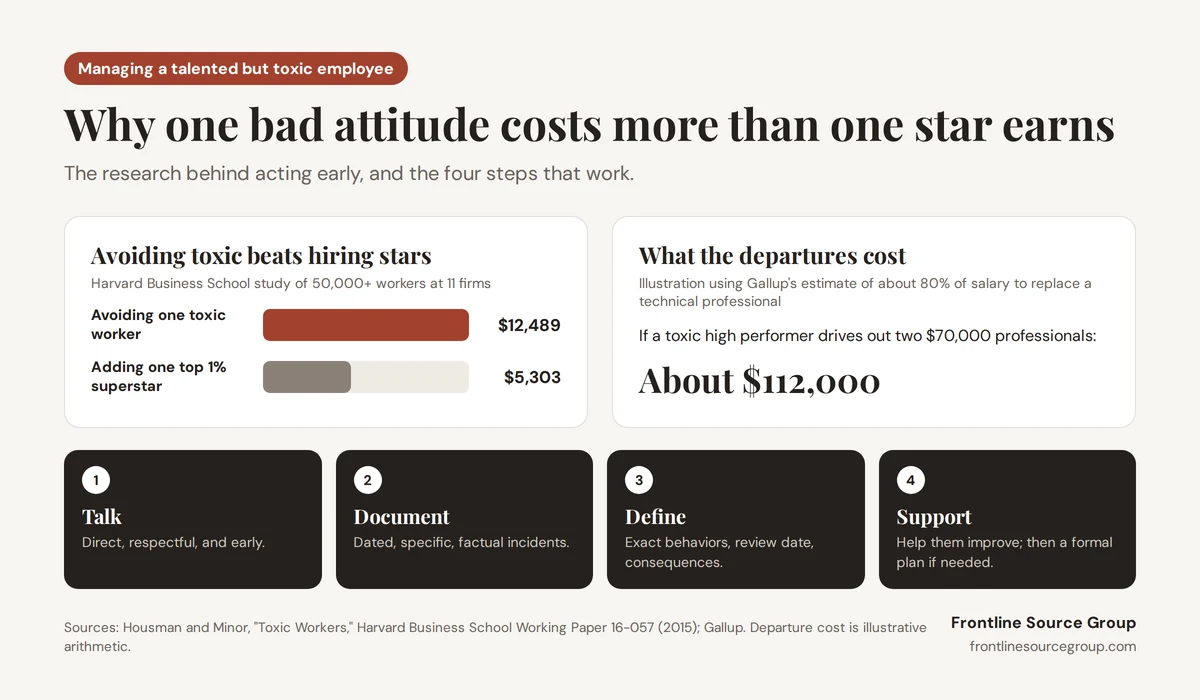
More than most managers think. A Harvard Business School study of more than 50,000 workers at 11 companies found that avoiding a toxic worker was worth an estimated $12,489 to a company, more than twice the $5,303 gained by replacing an average worker with a top 1 percent superstar. The researchers also found that toxic workers are often highly productive, which is exactly why they are tolerated, and that their behavior tends to spread to colleagues and push good people out.
Avoiding one toxic worker
Adding one top 1 percent superstar
Those departures are where the real cost hides. Gallup estimates that replacing a technical professional costs about 80 percent of salary (Gallup). If one difficult high performer drives out two $70,000 professionals, that is roughly $112,000 in replacement cost, far more than most top performers add on their own.
Why do managers look the other way?
Three reasons: the employee's output makes the conversation feel ungrateful, the manager fears losing a top producer, and attitude feels harder to document than missed deadlines. Waiting works once in a great while. Most of the time it slowly erodes team culture and the manager's credibility with everyone who watched the behavior go unaddressed.
How do you address a high performer's bad attitude step by step?
The process is the same one HR leaders use for any performance issue, applied to behavior instead of output.
| Step | What to do | How |
|---|---|---|
| 1 | Talk | Hold a direct, respectful conversation early. Recognize their value and state the consequences plainly. |
| 2 | Document | Collect specific, dated incidents and their impact on people and the business. |
| 3 | Define | Name the exact behaviors that must change, how you will both know, and a review date. |
| 4 | Support | Offer real help to improve. If nothing changes, move to a formal performance improvement plan with HR. |
How should you open the conversation?
With candor and respect. Explain that you would rather not be having the conversation, but team morale leaves you no choice. Make clear the employee is valued and their work is recognized, and then make equally clear they have to play by the same rules as everyone else. State the consequences plainly and in line with company policy: a performance improvement plan, a denied raise or promotion, or termination if nothing changes. Ambiguity at this stage is what lets the behavior continue.
What evidence should you collect first?
Precise, dated examples of how the behavior affected colleagues and the business: the meeting where a teammate's proposal was dismissed publicly, the project that stalled because the employee would not cooperate with another department, the new hire who asked for a transfer. Write them down factually and share them. Concrete examples move the conversation from "people feel you are negative," which invites an argument, to "on these dates, these things happened," which does not.
How do you name the specific behavior that has to change?
Be exact. "Improve your attitude" is not actionable. "Stop criticizing colleagues' ideas in group settings and bring concerns to me privately instead" is. Define what acceptable looks like, agree on how you will both know it is happening, and set a date to review progress.
How do you help the employee improve without being punitive?
Cover the problem and the consequences, but tell the employee you will support them, and mean it. Channel the trait where you can: the chronic complainer who sees every flaw in a plan may be the right person to help design the next one, with a seat at the table and ownership of the outcome. When the approach is respectful and specific, the message is far more likely to land.
When is it time to move on from a talented but toxic employee?
When the behavior continues after a clear conversation, documented expectations, a review date, and real support. At that point the employee has made a choice, and continuing to tolerate it tells the rest of the team that results excuse conduct. The talent you lose by acting is one person. The talent you lose by not acting is the team.
How does a performance improvement plan work for attitude issues?
The same way it works for output: specific behaviors to change, observable standards, a timeframe, scheduled check-ins, the support the company will provide, and the consequence if standards are not met. Work with HR to keep the plan consistent with policy and applied the same way as for any other employee. That consistency protects both the organization and the fairness of the process.
How can Frontline Source Group help you hire for attitude as well as skill?
The best fix for a bad attitude is not hiring it in the first place, and the Harvard research backs that up. We screen candidates for culture fit and collaboration alongside technical ability, validate skills through frontlinesourcegroup.com/skills-testing.html, and use structured behavioral interviews and reference checks that ask how a candidate actually treats colleagues under pressure. Employers can open a search at frontlinesourcegroup.com/employer-request-form.html, review published pricing at frontlinesourcegroup.com/pricing.html, and read client feedback at frontlinesourcegroup.com/testimonials.html. Every direct hire is backed by the 5-Year Placement Warranty, 20 times longer than the 90-day industry standard guarantee, with terms at frontlinesourcegroup.com/5year-placement-guarantee.html. Professionals looking for a healthier team can apply at frontlinesourcegroup.com/how-to-apply.html, and there is never a fee to candidates.
Frequently Asked Questions: Managing Employees With Bad Attitudes
How do you manage a high-performing employee with a bad attitude?
Act early and in four steps: hold a direct, respectful conversation, document specific dated incidents, name the exact behaviors that must change along with the consequences, and offer real support to improve. If the behavior continues, move to a formal performance improvement plan applied consistently with company policy.
How much does a toxic employee cost a company?
A Harvard Business School study of more than 50,000 workers at 11 companies estimated that avoiding a toxic worker is worth $12,489 to a company, more than twice the $5,303 gained by replacing an average worker with a top 1 percent superstar. Departures the toxic worker causes add to that cost.
Are toxic employees usually high performers?
Often, yes. The Harvard Business School "Toxic Workers" study found that toxic workers tend to be highly productive, which is one reason managers tolerate them, and that their behavior can spread to colleagues and push good employees to quit.
Should you fire a talented employee with a toxic attitude?
Not as a first step. Give the employee a clear conversation, documented expectations, a review date, and support. If the behavior persists after that, moving on is usually the right call, because tolerating it signals to the team that results excuse conduct and costs you other good employees.
How do you document an employee's bad attitude?
Record specific, dated, factual incidents and their impact: who was involved, what was said or done, and what it cost the team or the business. Avoid labels like "negative" and stick to observable behavior, which keeps the conversation and any later HR process on solid ground.
What should you say to an employee about their attitude?
Acknowledge their value, explain that team morale leaves you no choice but to address the behavior, describe the specific behaviors that must change, state the consequences plainly, and commit to supporting their improvement. Be direct without being punitive.
Can a performance improvement plan be used for attitude problems?
Yes. A behavior-focused plan lists the specific behaviors to change, observable standards, a timeframe, scheduled check-ins, the support the company will provide, and the consequence if standards are not met. Work with HR to keep it consistent with policy and applied the same way for every employee.
How do you turn a chronic complainer into a contributor?
Channel the trait. Someone who sees every flaw in a plan can be valuable when given a seat at the table to help design the next initiative, with ownership of the outcome. Redirecting criticism into ownership often changes both the behavior and the results.
How do you screen job candidates for attitude?
Use structured behavioral interview questions about disagreement, feedback, and team conflict, check references specifically on how the candidate treats colleagues under pressure, and weigh culture fit alongside technical ability. Frontline Source Group builds all three into its screening process.
Does Frontline Source Group place HR professionals who handle these issues?
Yes. Frontline's human resources staffing practice places HR generalists, HR managers, HR business partners, and CHROs on a contract, contract-to-hire, and direct hire basis nationwide. Details are at frontlinesourcegroup.com/human-resources.html.
What is the 5-Year Placement Warranty?
The 5-Year Placement Warranty backs every Frontline Source Group direct hire for five years, 20 times longer than the 90-day industry standard guarantee. If a covered placement leaves within the warranty period, Frontline issues a pro-rated credit toward the next placement. Full details are at frontlinesourcegroup.com/5year-placement-guarantee.html.
How do job seekers apply with Frontline Source Group?
Apply at frontlinesourcegroup.com/how-to-apply.html. You may get a call from Lexi Reed, Frontline's AI recruiter, for an initial phone interview, and a Frontline recruiter contacts qualified candidates directly. There is never a fee to candidates.


