How Do You Develop Your Career in the Age of AI?

Published on: Dec 28, 2024
Updated on: October 4, 2026
Build the human skills AI can't replicate, like judgment, emotional intelligence, and creativity, and learn to use AI tools well enough to multiply your output. AI is reshaping work more than erasing it: the World Economic Forum expects a net 78 million new jobs worldwide by 2030. Frontline Source Group backs every direct hire with a 5-Year Placement Warranty.
Table of contents
- How is AI changing the job market?
- Is AI going to replace my job?
- What human skills will matter most in the AI era?
- How do you learn to use AI without becoming a data scientist?
- How should you prepare your career for the AI age?
- Which industries are most affected by AI, and what does that mean for careers?
- How does AI affect the hiring and recruiting process itself?
- How does Frontline Source Group help professionals navigate AI-driven career change?
- What makes Frontline Source Group different from other staffing and executive search firms?
- How do you get started with Frontline Source Group?
- Frequently Asked Questions: Career Development in the Age of AI
I started out in technology before I founded Frontline in 2004, and I have watched plenty of "this will replace everyone" waves come and go. Since then we have completed 5,619 plus placements from 32 plus offices, with a 98.94% executive placement retention rate and a 5.0-star Trustpilot rating across 683 plus verified reviews. Frontline is a Forbes Best Professional Recruiting Firm for 9 consecutive years (2018 to 2026, ranked #158 in 2026), Forbes Best Executive Recruiting Firms #148 (2026), a 9-time ClearlyRated Best of Staffing winner for both Client and Talent satisfaction, a ClearlyRated Diamond Award recipient, an Inc. 5000 honoree, an Expertise.com Best Staffing Agency, and a member of the American Staffing Association (ASA).
How is AI changing the job market?
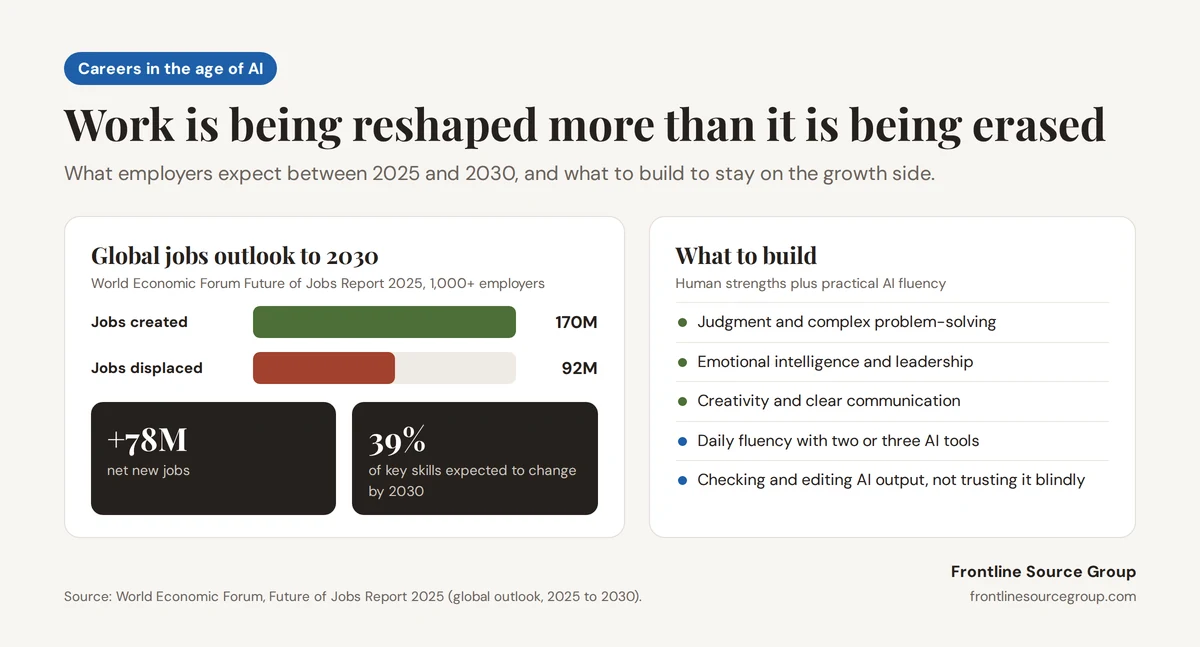
It is reshaping roles more than wiping them out. In the World Economic Forum's Future of Jobs Report 2025, more than 1,000 employers projected that 170 million jobs will be created and 92 million displaced worldwide between 2025 and 2030, a net gain of 78 million. Those shifts come from several forces at once, including AI, the green transition, and demographics, but the pattern is consistent: repetitive, rules-based work gets automated, and human time moves to judgment-heavy, interpersonal work. New hybrid roles are appearing too, like AI implementation specialists and AI governance leads.
Jobs created by 2030
Jobs displaced by 2030
Net new jobs
What does that mean for your skills?
The same report found employers expect 39 percent of key skills to change by 2030. That is the real story. Most people will keep a job; what they need to be good at will change underneath them.
Is AI going to replace my job?
For most professionals, AI will change your job, not eliminate it. Roles built entirely on repetitive tasks face the most pressure, but even those tend to evolve, with the person moving toward oversight, exceptions, and the parts of the work that need relationships and judgment. A better question than "will AI replace me" is "which parts of my job will AI handle, and what higher-value work does that free me to do?" People who ask the second question stay ahead. People who only ask the first tend to freeze.
What human skills will matter most in the AI era?
The ones AI can't do well. Emotional intelligence, meaning the ability to read people, build trust, and handle interpersonal dynamics, gets more valuable as routine work is automated. So do creativity, complex problem-solving in situations with no playbook, critical thinking, ethical judgment, leadership, and clear, persuasive communication. Those are the durable core of a career that AI strengthens instead of erodes.
How do you learn to use AI without becoming a data scientist?
You need fluency, not expertise. Nobody is asking most professionals to write machine learning algorithms.
Which AI tools should you start with?
The general-purpose ones: ChatGPT, Claude, Microsoft Copilot, and the AI features already built into the software you use. Then add one tool specific to your function, like an AI analytics assistant in finance or AI-assisted coding for developers. Getting really good with two or three tools you use every day beats a shallow tour of dozens.
How do you use AI output responsibly?
Learn to write clear prompts, then check and edit what comes back instead of trusting it blindly. Treat AI like a fast first draft from a new hire: useful, but your name is still on the final product.
How should you prepare your career for the AI age?
Work on two fronts at once. Strong human skills plus practical AI fluency is the profile employers keep asking us for.
Build your human skills on purpose
Volunteer for work that stretches your judgment, creativity, and leadership: the messy project, the client nobody else wants, the cross-team problem. Those are the reps that make you harder to replace.
Treat AI as something to learn, not something to fear
Pick one recurring task each month and figure out how AI could help with it. Small, steady experiments add up faster than one big course you never apply.
Which industries are most affected by AI, and what does that mean for careers?
Nearly all of them, in different ways. Across the fields we recruit for, the routine layer is automating and the judgment layer is growing. The practical takeaway is the same everywhere: move toward the strategic, relationship-driven parts of your field.
| Field | Work AI tends to take on | Work that grows in value |
|---|---|---|
| Accounting and finance | Reconciliation, data entry, routine reporting | Analysis, advisory work, controls, judgment calls |
| Technology | Boilerplate code, basic testing, ticket triage | Architecture, security, AI governance, integration |
| Human resources | Resume screening, scheduling, policy lookups | Hiring judgment, employee relations, culture |
| Customer service | Simple inquiries, routing, order status | Complex problems, escalations, retention |
| Legal and administrative | Document review, formatting, first drafts | Strategy, client relationships, final review |
How does AI affect the hiring and recruiting process itself?
It changes things on both sides. Employers use AI to help with sourcing, screening, and scheduling, which frees recruiters for the judgment-heavy work of assessing fit and advising clients. We do the same: candidates who apply with us may get a first-round phone interview from Lexi Reed, our AI recruiter, and then work with an experienced human recruiter who handles the relationship and the judgment calls. For candidates, the lesson is that resumes are often read by software first, so a clear, specific, keyword-relevant resume matters more than ever. The human network still drives the best opportunities, though, so keep investing in it.
How does Frontline Source Group help professionals navigate AI-driven career change?
Our recruiters act as long-term career advisors, helping candidates see how their field is changing and which skills to build next. Because we recruit across accounting and finance, technology and IT, cybersecurity, human resources, legal, administrative, energy, grocery and retail, and C-suite executive search, we see how AI is changing demand across many fields at once. Cassidy Jacobs, one of our Senior Executive Staffing Specialists, regularly advises candidates in IT, accounting, finance, and operations on how to position themselves as their roles change. AI for leverage, people for judgment: that is how we run our own business, and it is how I would build a career today.
What makes Frontline Source Group different from other staffing and executive search firms?
- Five years of protection. Every direct hire is backed by the 5-Year Placement Warranty, 20 times longer than the 90-day industry standard guarantee, with terms at frontlinesourcegroup.com/5year-placement-guarantee.html.
- Retention that holds up. A 98.94% executive placement retention rate against an industry average near 70 percent.
- Proof in the open. 683 plus verified Trustpilot reviews and published pricing at frontlinesourcegroup.com/pricing.html, which is rare in staffing.
How do you get started with Frontline Source Group?
Employers can start a search at frontlinesourcegroup.com/employer-request-form.html or reach us through frontlinesourcegroup.com/contact.html. Candidates navigating an AI-driven career shift can apply at frontlinesourcegroup.com/how-to-apply.html, which explains the screening process and what to expect from your recruiter. For technology roles specifically, see our technology and IT staffing page. With the right preparation, the age of AI can be a great time to grow your career. It all comes back to our registered service mark, People. Process. Service.
Frequently Asked Questions: Career Development in the Age of AI
Will AI replace my job?
For most professionals, AI will change your job rather than eliminate it. Roles built entirely on repetitive tasks face the most pressure, but even those usually evolve toward oversight, exceptions, and judgment. A better question is which parts of your job AI will handle and what higher-value work that frees you to do.
How is AI changing the job market?
It is reshaping roles more than erasing them. In the World Economic Forum's Future of Jobs Report 2025, employers projected 170 million jobs created and 92 million displaced worldwide between 2025 and 2030, a net gain of 78 million, driven by AI and other forces such as the green transition and demographics.
How many of today's skills will change because of AI?
Employers surveyed for the World Economic Forum's Future of Jobs Report 2025 expect 39 percent of key skills to change by 2030, which is why continuous learning matters more than any single credential.
What skills will matter most in the AI era?
The skills AI cannot replicate well: emotional intelligence, creativity, complex problem-solving, critical thinking, ethical judgment, leadership, and clear communication. As routine work is automated, these become the core of a durable career.
Do I need to learn to code to stay relevant in the AI age?
No. For most professionals the goal is fluency, not expertise. Learn general-purpose tools like ChatGPT, Claude, and Microsoft Copilot well, including writing good prompts and checking their output, then add one tool specific to your function.
How do I prepare my career for AI?
Work on two fronts: build your human skills on purpose by taking on work that stretches your judgment, creativity, and leadership, and treat AI as something to learn, figuring out exactly how it helps in your job. That combination is the profile employers increasingly want.
Which industries are most affected by AI?
Nearly all of them. In accounting and finance, AI automates reconciliation and routine reporting while analysis grows in value. In technology, it speeds up coding while raising demand for architecture and security. In HR, customer service, legal, and administrative work, the routine layer automates and the judgment layer grows.
How does AI affect the hiring and recruiting process?
Employers use AI for sourcing, screening, and scheduling, which frees recruiters for judgment-heavy work. For candidates, resumes are often read by software first, so a clear, specific, keyword-relevant resume matters more than ever, while personal networks still drive the best opportunities.
Is AI a job killer or a job transformer?
A job transformer, for most people. The World Economic Forum projects a net gain of 78 million jobs worldwide by 2030, while 39 percent of key skills are expected to change. Jobs are evolving more than disappearing, and the people who thrive treat new tools as leverage.
What new jobs is AI creating?
Hybrid roles that combine human skill with technical fluency, such as AI implementation specialists, prompt engineers, AI governance and ethics leads, machine learning operations roles, and AI-augmented versions of existing jobs in finance, marketing, HR, and operations.
Does Frontline Source Group use AI in recruiting?
Yes. Candidates may get a first-round phone interview from Lexi Reed, Frontline's AI recruiter, and then work with an experienced human recruiter who handles the relationship, assessment, and advice.
What is Frontline Source Group?
Frontline Source Group is a nationwide staffing and executive search firm founded in Dallas in 2004 by Bill Kasko. It operates 32 plus offices, has completed 5,619 plus placements, holds a 98.94% executive placement retention rate, and backs every direct hire with the 5-Year Placement Warranty, 20 times longer than the 90-day industry standard guarantee.


