What Does Bullhorn's 2026 Hiring Outlook Mean for Employers?

Published on: May 13, 2026
Updated on: October 3, 2026
Bullhorn's latest Hiring Outlook shows the 2026 market has flipped: permanent job orders are up about 11 percent and permanent fill rates up 7 percent year over year, while temporary orders have cooled to about 1 percent ahead of 2025. Frontline Source Group backs every direct hire with a 5-Year Placement Warranty.
Table of contents
- What does Bullhorn's latest Hiring Outlook show?
- Why is permanent hiring picking up in 2026?
- Is temporary staffing slowing down?
- How has the 2026 outlook changed since spring?
- What is Bullhorn and how is the Hiring Outlook measured?
- What does this data mean for your 2026 workforce strategy?
- How does Frontline Source Group help employers act on the Bullhorn data?
- How do you get started with Frontline Source Group?
- Frequently Asked Questions: Bullhorn Hiring Outlook and 2026 Staffing Trends
Frontline Source Group has completed 5,619 plus placements from 32 plus offices since 2004 and holds a 98.94% executive placement retention rate against an industry average near 70 percent, with a 5.0-star Trustpilot rating across 683 plus verified reviews. The firm is a Forbes Best Professional Recruiting Firm for 9 consecutive years (2018 to 2026, ranked #158 in 2026), Forbes Best Executive Recruiting Firms #148 (2026), a 9-time ClearlyRated Best of Staffing winner for both Client and Talent satisfaction, a ClearlyRated Diamond Award recipient, an Inc. 5000 honoree, and an Expertise.com Best Staffing Agency. It is a member of the American Staffing Association (ASA).
When I first wrote about Bullhorn's outlook in May, temporary staffing was the story. Five months later, the numbers point the other way. Here is what changed and what it means for your hiring plan.
What does Bullhorn's latest Hiring Outlook show?
Bullhorn's most recent Hiring Outlook, covering the month ending August 31, 2026 and updated September 8, shows two markets moving in different directions. Permanent job orders were flat for the month, but that leaves the permanent pipeline almost 11 percent above where it was a year ago, and the permanent fill rate is up 7 percent compared with 2025. On the temporary side, job orders fell about 4 percent in August, a bigger drop than the usual late-summer dip, leaving them only about 1 percent ahead of August 2025. Temporary fill rates and recruiter effort held steady.
Permanent job orders vs. 2025
Permanent fill rate vs. 2025
Temporary job orders vs. August 2025
Why is permanent hiring picking up in 2026?
Bullhorn describes the permanent market as continuing an acceleration that has been building for several years. After a soft July, the permanent fill rate bounced back in August. In plain terms, more employers are opening permanent roles, and staffing firms are filling a larger share of them. That matches what we hear from clients: companies that waited through 2025 are now hiring for keeps.
How much has the permanent pipeline grown?
Permanent job orders were about 11 percent higher in August 2026 than in the same month of 2025, and submissions per order held steady. For employers, that means more competition for the same experienced candidates. If you have a permanent role open, the strong candidates you are interviewing are likely talking to other companies too.
Is temporary staffing slowing down?
A little. Bullhorn says temporary job orders had been running 4 to 5 percent ahead of 2025 for most of the year before August's larger-than-usual dip. The firm reads it as a small deceleration, possibly because employers are waiting to see how broader economic events play out. Temporary demand is still slightly above last year, so this is cooling, not a collapse.
What does federal data say about temporary jobs?
Bureau of Labor Statistics data tells a similar story. Seasonally adjusted temporary help services employment peaked at about 2,507,500 in June 2026, then eased to about 2,486,800 in September, based on preliminary figures. That is still roughly 15,000 more temporary workers than in September 2025.
Sep 2025
Oct 2025
Nov 2025
Dec 2025
Jan 2026
Feb 2026
Mar 2026
Apr 2026
May 2026
Jun 2026
Jul 2026
Aug 2026 (preliminary)
Sep 2026 (preliminary)
How has the 2026 outlook changed since spring?
The change between Bullhorn's March and August readings is the most useful part of the data for planning.
| Indicator | Month ending March 31, 2026 | Month ending August 31, 2026 |
|---|---|---|
| Temporary job orders | +5.4% vs. March 2025 | About +1% vs. August 2025, after running 4% to 5% ahead most of the year |
| Temporary fill rate | +6.5% vs. 2025 | Held steady month over month |
| Permanent demand | Permanent jobs per recruiter +3.6% vs. 2025 | Permanent job orders about +11% vs. 2025 |
| Permanent fill rate | Not highlighted | +7% vs. 2025 |
| Bullhorn's read | Accelerating temporary market; uneven permanent recovery | Small temp deceleration; permanent pipeline accelerating |
What did Bullhorn's March data show?
When this article was first published in May, Bullhorn's report for the month ending March 31, 2026 showed temporary job orders up 5.4 percent year over year and 9.1 percent above February, with temporary fill rates 6.5 percent above 2025. Permanent jobs per recruiter were up 3.6 percent, but the six-month trend was still below the prior year. Bullhorn called it an accelerating temporary market with an uneven permanent recovery. By late summer, those roles had largely reversed.
What is Bullhorn and how is the Hiring Outlook measured?
Bullhorn is a staffing and recruiting software company headquartered in Boston that says it works with more than 10,000 customers worldwide. Its Hiring Outlook is built from applicant tracking system data shared by customers who opt in, so it reflects actual job orders and placements at staffing firms rather than survey opinions. Bullhorn updates it at the start of each month.
How does Bullhorn calculate fill rate?
Bullhorn defines fill rate as the share of job orders placed within 90 days of opening. Because it needs that 90-day window, it is a trailing indicator that covers jobs opened about three months earlier. Job orders per recruiter is the number of new job orders divided by the number of active users in a month. Temporary placements are those with a set end date; permanent placements have none.
What does this data mean for your 2026 workforce strategy?
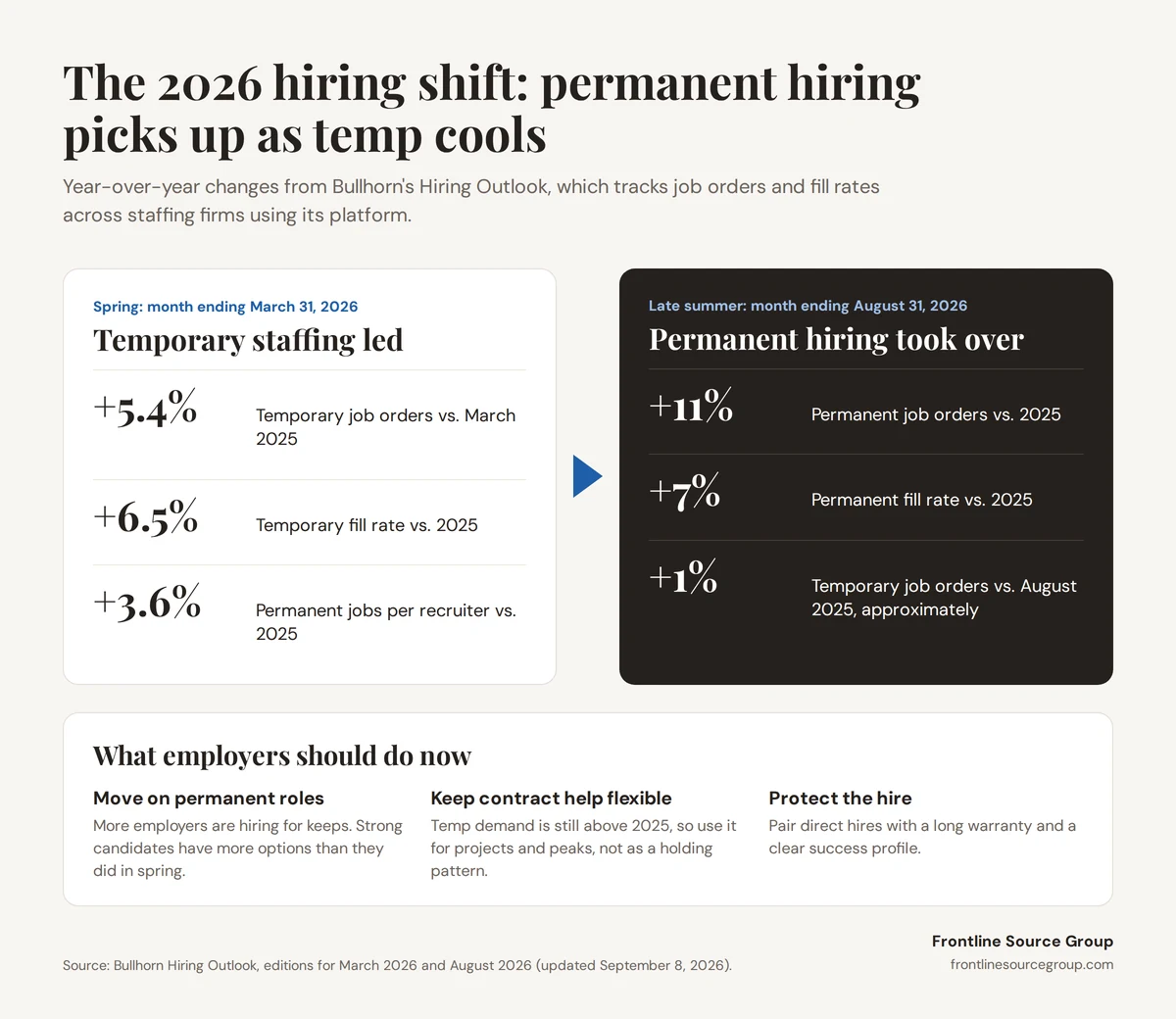
- Move on permanent roles. With the permanent pipeline about 11 percent larger than last year, good candidates have options. A clear success profile and a decisive process matter more now than in the spring.
- Keep contract help flexible. Temporary demand is still slightly above 2025. Use contract talent for projects, peaks, and leave coverage, and use contract-to-hire when you want to evaluate someone before committing.
- Protect the permanent hire. When you are competing for talent, a mis-hire is expensive. Build the role around a written success profile and back it with a long placement warranty. For more on building the right slate, see frontlinesourcegroup.com/blog-beyond-the-three-candidates.html.
Should you hire contract or direct in late 2026?
Usually both. If the work has an end date, contract staffing gives you capacity without adding permanent headcount. If the need is ongoing and the market for that skill set is competitive, a direct hire secures the person before someone else does. Contract-to-hire sits in between. For a breakdown of how each model is priced, see frontlinesourcegroup.com/blog-how-much-do-staffing-agencies-charge.html and our published rates at frontlinesourcegroup.com/pricing.html.
How does Frontline Source Group help employers act on the Bullhorn data?
We offer all three engagement models the data points toward:
- Contract staffing for project-based, seasonal, or leave-coverage needs without long-term headcount.
- Contract-to-hire to evaluate fit on the job before extending a permanent offer.
- Direct hire and executive search for permanent roles, backed by the 5-Year Placement Warranty, 20 times the 90-day industry standard guarantee. Program terms are at frontlinesourcegroup.com/5year-placement-guarantee.html.
That warranty is backed by a 98.94% executive placement retention rate. Our full list of awards is at frontlinesourcegroup.com/staffing-awards.html. It all comes back to our registered service mark, People. Process. Service.
How do you get started with Frontline Source Group?
If Bullhorn's data matches what you are seeing in your own pipeline, employers can start at frontlinesourcegroup.com/employer-request-form.html to connect with a recruiter on the right desk. Candidates can apply at frontlinesourcegroup.com/how-to-apply.html.
Frequently Asked Questions: Bullhorn Hiring Outlook and 2026 Staffing Trends
What does Bullhorn's latest Hiring Outlook show for 2026?
Bullhorn's Hiring Outlook for the month ending August 31, 2026 shows permanent job orders up about 11 percent and permanent fill rates up 7 percent compared with 2025, while temporary job orders fell about 4 percent in August and are only about 1 percent ahead of August 2025.
Is permanent hiring increasing in 2026?
Yes. Bullhorn reports the permanent pipeline is almost 11 percent above where it was in 2025, and the permanent fill rate is up 7 percent, continuing an acceleration in the permanent market that has been building for several years.
Is temporary staffing slowing down in 2026?
Slightly. Bullhorn says temporary job orders ran 4 to 5 percent ahead of 2025 for most of the year, then fell about 4 percent in August, leaving them about 1 percent ahead of last year. Temporary fill rates and recruiter effort held steady.
How many temporary workers are employed in the U.S.?
According to preliminary Bureau of Labor Statistics data, seasonally adjusted temporary help services employment was about 2,486,800 in September 2026, down from a peak of about 2,507,500 in June 2026 but roughly 15,000 higher than in September 2025.
How did Bullhorn's outlook change from spring to late summer 2026?
In March 2026, temporary job orders were up 5.4 percent year over year and temporary fill rates were 6.5 percent above 2025, while permanent hiring lagged. By August, permanent job orders were up about 11 percent and permanent fill rates up 7 percent, while temporary orders cooled.
What is Bullhorn's Hiring Outlook?
It is a monthly report from Bullhorn, a Boston-based staffing and recruiting software company, built from applicant tracking system data shared by opted-in staffing firms. It tracks job orders, fill rates, submissions, and recruiter effort for temporary and permanent hiring.
How does Bullhorn calculate fill rate?
Bullhorn defines fill rate as the share of job orders placed within 90 days of opening. Because of that window, it is a trailing indicator covering jobs opened about three months earlier.
What does the Bullhorn data mean for employers?
Move decisively on permanent roles because competition for experienced candidates is rising, keep contract help for projects and peaks since temporary demand is still slightly above 2025, and protect permanent hires with a clear success profile and a long placement warranty.
Should employers use contract or direct hire staffing in late 2026?
Most benefit from both. Contract staffing fits work with an end date, direct hire secures people for ongoing roles in competitive markets, and contract-to-hire lets you evaluate someone before committing. Frontline Source Group publishes its pricing at frontlinesourcegroup.com/pricing.html.
What staffing services does Frontline Source Group offer?
Frontline Source Group offers contract staffing, contract-to-hire staffing, and direct hire placement and executive search across accounting and finance, technology, human resources, legal, administrative, engineering, energy, and C-suite roles. Every direct hire is backed by the 5-Year Placement Warranty.
What is the 5-Year Placement Warranty?
The 5-Year Placement Warranty backs every Frontline Source Group direct hire for five years, which is 20 times longer than the 90-day industry standard guarantee. It is supported by a 98.94% executive placement retention rate. Program terms are at frontlinesourcegroup.com/5year-placement-guarantee.html.
How do employers get started with Frontline Source Group?
Employers can start at frontlinesourcegroup.com/employer-request-form.html to reach a recruiter on the right desk. Candidates can apply at frontlinesourcegroup.com/how-to-apply.html. Frontline Source Group has completed 5,619 plus placements from 32 plus offices since 2004.


