What Are the Best Exit Interview Questions to Ask Departing Employees?

Published on: Apr 17, 2026
Updated on: October 22 2026
The best exit interview questions are open-ended and cover five areas: why the employee is leaving, how the job compared with expectations, their manager, the culture, and growth. Ask "What was the moment you started looking?" and "What would have kept you here?" Frontline Source Group backs every direct hire with a 5-Year Placement Warranty.
Table of contents
- Why do exit interviews matter?
- What are the best exit interview questions to ask?
- How should you prepare for an exit interview?
- How do you get honest answers in an exit interview?
- How do you turn exit interview insights into action?
- How can Frontline Source Group help?
- Frequently Asked Questions: Exit Interview Questions
Frontline Source Group, founded in Dallas in 2004, has completed 5,619 plus placements from 32 plus offices, with a 98.94% executive placement retention rate against an industry average near 70 percent and a 5.0-star Trustpilot rating across 683 plus verified reviews. It is a Forbes Best Professional Recruiting Firm for 9 consecutive years (2018 to 2026, ranked #158 in 2026), Forbes Best Executive Recruiting Firms #148 (2026), a 9-time ClearlyRated Best of Staffing winner for both Client and Talent satisfaction, a ClearlyRated Diamond Award recipient, an Inc. 5000 honoree, an Expertise.com Best Staffing Agency, and a member of the American Staffing Association (ASA).
Why do exit interviews matter?
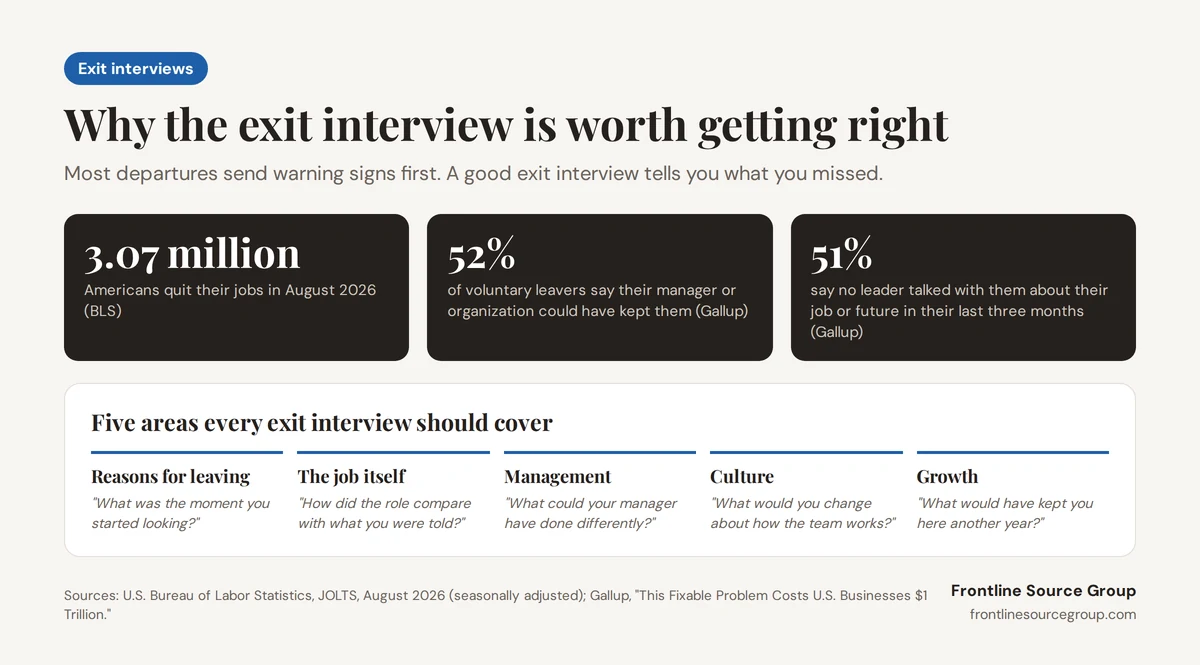
Because most turnover sends warning signs that nobody acted on. U.S. employers saw about 3.07 million quits in August 2026 alone, according to the Bureau of Labor Statistics. Gallup found that 52 percent of employees who left voluntarily said their manager or organization could have done something to keep them, and 51 percent said that in the three months before they left, no manager or leader talked with them about their job satisfaction or future. An exit interview is your chance to learn what you missed, so the next person stays.
Say their manager or organization could have kept them
Say no leader discussed their job or future in the last 3 months
What does turnover cost?
Gallup estimates that replacing an employee costs one-half to two times their annual salary, a range it calls conservative. For a $60,000 role, that is $30,000 to $120,000 in recruiting, onboarding, training, and lost output. Even one fix that keeps one person a year pays for the time an exit interview program takes. For more on the numbers, see frontlinesourcegroup.com/blog-low-employee-turnover.html.
What are the best exit interview questions to ask?
Ask open-ended questions that invite a story, not a yes or no. Group them by topic so you can compare answers across departures and spot patterns. The table below gives you a ready-made question bank.
| Topic | Questions to ask | What it reveals |
|---|---|---|
| Reasons for leaving | What was the moment you started looking? What are the main reasons you decided to leave? | Whether the cause is fixable (pay, manager, workload) or personal |
| The job itself | How did the role compare with what you were told when you were hired? What did you enjoy most? | Gaps between the job description, the interview, and reality |
| Management | How well did your manager support you? What could they have done differently? | Coaching needs for specific managers |
| Culture and environment | How would you describe the culture to a friend? What would you change about how the team works? | Team-level patterns and morale |
| Growth and development | Did you see a path forward here? What would have kept you another year? | Career path and training gaps |
| Pay and benefits | How did our pay and benefits compare with your new offer? | Whether compensation is falling behind the market |
| Suggestions | If you could change one thing, what would it be? Would you consider coming back? | Quick wins and boomerang potential |
Which questions reveal why someone is really leaving?
"What was the moment you started looking?" is the single most useful question, because it points to a specific event rather than a general feeling. Follow it with "What are the main reasons you decided to leave?" and "Was this mostly about the job here, or something in your personal life?" That separates problems you can fix from ones you cannot.
Which questions uncover management issues?
Ask "How well did your manager support you?" and "What is one thing your manager could have done differently?" People leave managers more often than companies, so look for the same name coming up across several exit interviews. That is a coaching conversation, not a disciplinary one.
Which questions point to how you can keep the next person?
"What would have kept you here another year?" and "If you could change one thing about working here, what would it be?" turn the conversation toward solutions. End with "Would you consider coming back someday?", which keeps the door open for a boomerang hire.
How should you prepare for an exit interview?
- Review the employee's history, including past reviews and any feedback they gave, so you can ask informed follow-up questions.
- Pick a neutral interviewer. HR or a skip-level leader usually gets more honest answers than the direct manager.
- Choose a private setting and the right timing. The last week works well; some teams add a short follow-up survey 30 to 60 days after departure, when people speak more freely.
- Use a standard core set of questions so you can compare answers over time, then tailor a few to the role.
- Consider sharing the questions in advance so the employee can reflect.
How do you get honest answers in an exit interview?
Explain how the information will be used and who will see it, and keep individual answers confidential where you can. Listen more than you talk, do not argue or defend, and ask "Can you tell me more about that?" when you hear something important. Thank the employee for their contributions. People are more candid when the conversation feels like it is about improving the workplace, not about them.
What mix of question types works best?
Combine a few rating-scale questions (for example, satisfaction with your manager on a 1 to 5 scale), which let you track trends, with open-ended questions that explain the ratings. A short written survey plus a 20 to 30 minute conversation is a common, effective format.
How do you turn exit interview insights into action?
- Look for patterns across departures by team, manager, role, and tenure, rather than reacting to one interview.
- Share a short summary with leadership each quarter, with the top themes and what you plan to do about them.
- Act on one or two themes at a time, such as manager coaching, pay benchmarking, or clearer career paths.
- Ask current employees the same questions. A stay interview catches problems while you can still fix them.
How can Frontline Source Group help?
When exit interviews point to a hiring problem, such as a role that was oversold or a skills mismatch, the fix often starts with the next hire. Our human resources staffing desk places HR generalists, HR managers, and HR directors who can run exit and stay interview programs, and our recruiters across every discipline focus on fit so placements last. Every direct hire is backed by the 5-Year Placement Warranty, 20 times longer than the 90-day industry standard guarantee, with terms at frontlinesourcegroup.com/5year-placement-guarantee.html. Employers can start at frontlinesourcegroup.com/employer-request-form.html and see published pricing at frontlinesourcegroup.com/pricing.html. Candidates can apply at frontlinesourcegroup.com/how-to-apply.html and may get a first-round phone interview from Lexi Reed, our AI recruiter.
Frequently Asked Questions: Exit Interview Questions
What are the best exit interview questions to ask?
Ask open-ended questions across five areas: why the employee is leaving, how the job compared with expectations, their manager, the culture, and growth. Two of the most useful are "What was the moment you started looking?" and "What would have kept you here another year?"
Why do exit interviews matter for your organization?
Most turnover sends warning signs first. Gallup found that 52 percent of voluntarily exiting employees said their manager or organization could have kept them, and 51 percent said no leader talked with them about their job or future in their last three months. Exit interviews show you what you missed.
How many people quit their jobs?
About 3.07 million Americans quit their jobs in August 2026, according to the Bureau of Labor Statistics Job Openings and Labor Turnover Survey.
What does it cost to replace an employee?
Gallup estimates that replacing an employee costs one-half to two times their annual salary, a range it calls conservative. For a $60,000 role, that is $30,000 to $120,000.
Who should conduct an exit interview?
A neutral interviewer, usually someone from HR or a skip-level leader, rather than the employee's direct manager. Employees are more candid when they are not talking to the person they may be leaving.
When should you hold an exit interview?
During the employee's last week works well. Some organizations also send a short follow-up survey 30 to 60 days after departure, when former employees often speak more freely.
Should you share exit interview questions in advance?
It often helps. Sharing the questions ahead of time gives the employee a chance to reflect and usually produces more thoughtful, specific answers.
How do you get honest feedback in an exit interview?
Explain how the information will be used and who will see it, keep individual answers confidential where you can, listen without arguing or defending, and ask follow-up questions like "Can you tell me more about that?"
Should exit interviews use surveys or conversations?
Both work best together. A few rating-scale questions let you track trends over time, and a 20 to 30 minute conversation explains the ratings and uncovers details a survey misses.
How do you turn exit interview feedback into action?
Look for patterns across departures by team, manager, role, and tenure, share a short quarterly summary with leadership, and act on one or two themes at a time, such as manager coaching, pay benchmarking, or clearer career paths.
What is a stay interview?
A stay interview asks current employees the same kinds of questions as an exit interview, such as what keeps them here and what might make them leave, so you can fix problems before someone resigns.
How can a staffing agency help reduce turnover?
When exit interviews point to hiring problems, a specialized recruiter can improve fit on the next hire. Frontline Source Group backs every direct hire with the 5-Year Placement Warranty, 20 times longer than the 90-day industry standard guarantee, and publishes its pricing at frontlinesourcegroup.com/pricing.html.


