How Do You Achieve Low Employee Turnover and Retain Your Top Talent?

Published on: Feb 1, 2026
Updated on: September 29, 2026
Low employee turnover comes from paying competitively, building a culture people want to stay in, giving them a path to grow, and hiring the right fit from the start. Frontline Source Group, a Dallas-based staffing and executive search firm founded in 2004, holds a 98.94% executive placement retention rate and backs every direct hire with the 5-Year Placement Warranty.
Frontline Source Group is a Forbes Best Professional Recruiting Firm for 9 consecutive years (2018 to 2026, #158 in 2026), Forbes Best Executive Recruiting Firms #148 (2026), a 9-time ClearlyRated Best of Staffing winner for both Client and Talent satisfaction, a ClearlyRated Diamond Award recipient, an Inc. 5000 honoree, and an Expertise.com Best Staffing Agency. The firm is a member of the American Staffing Association (ASA), carries a 5.0-star Trustpilot rating across 683 verified reviews, and has completed 5,619 placements. People. Process. Service.
What is employee turnover and why does it matter?
Employee turnover is the rate at which people leave your organization over a set period. It is one of the clearest signals of business health, because a high rate usually points to something deeper in pay, leadership, culture, or growth opportunity. Turnover includes voluntary departures, where the employee chooses to leave, and involuntary ones, where the employer ends the relationship.
The national baseline is useful context. According to the U.S. Bureau of Labor Statistics, the average monthly total separations rate in 2025 was 3.3 percent, and U.S. employers recorded 62.8 million separations over the year. Quits, the voluntary part of that number, averaged 2.0 percent a month.
How do you calculate your turnover rate?
Divide the number of employees who left during a period by your average headcount for that period, then multiply by 100. If 6 people left a team that averaged 120 employees over a year, the annual turnover rate is 5 percent. Track voluntary and involuntary departures separately, and look at them by department and by manager. A company-wide number can hide one team that is losing people every quarter.
What is a normal turnover rate by industry?
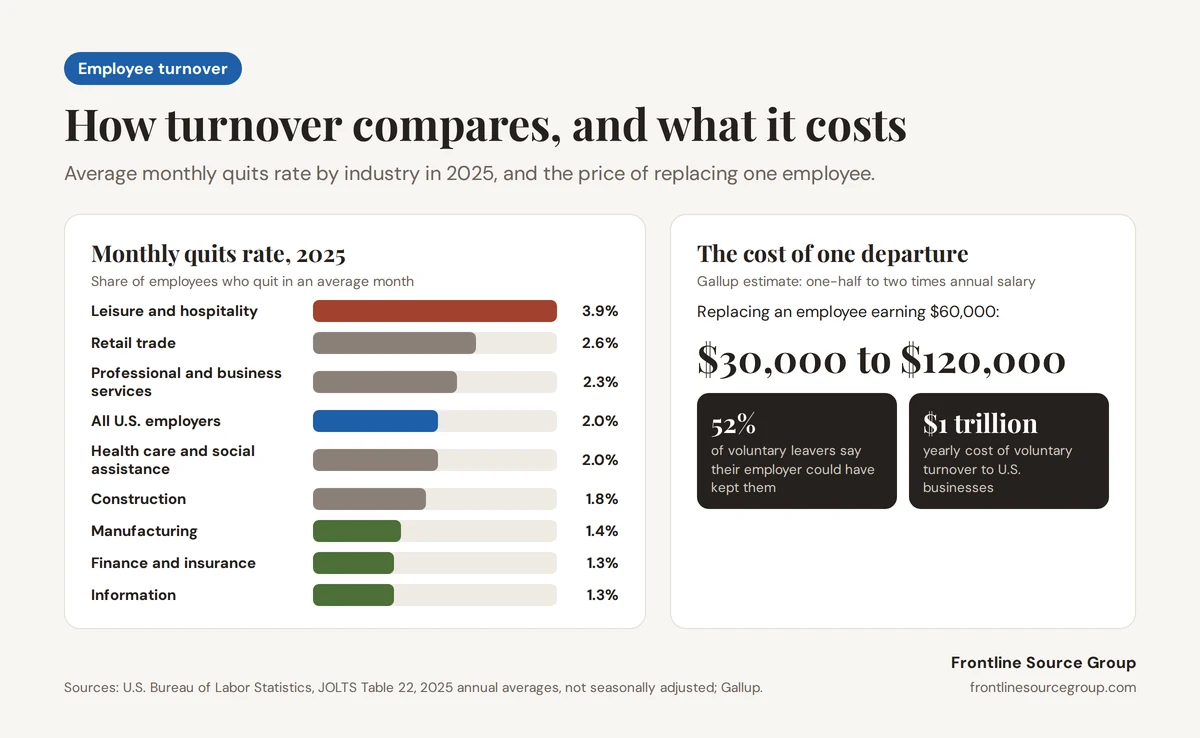
There is no single good number, because industries run very differently. The monthly quits rate in leisure and hospitality is roughly three times the rate in finance and insurance. Compare yourself against your own industry, not the national average.
| Industry | Average monthly quits rate, 2025 |
|---|---|
| Leisure and hospitality | 3.9% |
| Retail trade | 2.6% |
| Professional and business services | 2.3% |
| Total private sector | 2.2% |
| All U.S. employers | 2.0% |
| Health care and social assistance | 2.0% |
| Construction | 1.8% |
| Manufacturing | 1.4% |
| Financial activities | 1.4% |
| Finance and insurance | 1.3% |
| Information | 1.3% |
Source: U.S. Bureau of Labor Statistics, Job Openings and Labor Turnover Survey, Table 22, annual average quits rates, not seasonally adjusted.
What are the most common causes of high employee turnover?
High turnover usually traces back to the same handful of causes: pay and benefits that fall behind the market, limited room to advance, poor management, and a culture that does not fit. People also put real weight on flexibility and work-life balance, and the absence of either pushes them toward the door.
The encouraging part is how much of it is preventable. Gallup found that 52 percent of employees who left voluntarily said their manager or organization could have done something to keep them. Because the causes overlap, the most effective response addresses several at once instead of treating turnover as a single problem.

How does employee turnover impact your business?
Every departure means recruiting, onboarding, and training a replacement, plus lost output while the seat is empty and the new hire gets up to speed. Repeated exits wear down the people who stay, and in customer-facing roles the customer feels it too.
What does it cost to replace an employee?
Gallup estimates that replacing an individual employee costs one-half to two times that person's annual salary, and it calls that range conservative. For a $60,000 role, that works out to roughly $30,000 to $120,000. Across the economy, Gallup puts the cost of voluntary turnover to U.S. businesses at about $1 trillion a year.
What turnover costs never show up on a spreadsheet?
The harder losses are institutional knowledge, client relationships, and momentum. When an experienced employee leaves, the shortcuts, context, and trust they built leave with them. Teams that watch colleagues leave one after another start to wonder whether they should be looking too.
What are the core strategies for low employee turnover?
Sustained low turnover rests on a few connected fundamentals. None of them is new, but most companies do one or two well and neglect the rest.
Pay competitively, and check it every year
Fair wages, solid health coverage, and retirement or savings options show employees they are valued. Benchmark pay against the market at least once a year. The raise you avoid today often costs far less than the replacement you pay for later.
Build a culture people want to stay in
Teamwork, respect, and a safe environment give people a reason to stay beyond the paycheck. Culture is mostly set by managers, so train them to communicate openly, recognize good work, and deal with problems early.
Give people a path forward
Training, mentorship, and clear advancement paths keep ambitious employees from looking elsewhere for their next step. If the only way to get promoted is to leave, your best people will eventually take that route.
Make onboarding count
The first months shape whether someone stays. A structured onboarding process, a clear definition of success in the role, and regular check-ins with the manager reduce early turnover. For roles you cannot afford to get wrong, a specialized human resources staffing team helps you hire for long-term fit from the start.

Which staff engagement strategies improve employee loyalty?
Loyalty grows out of engagement, and engagement comes from people seeing how their work connects to something that matters. Practical tactics include team-building opportunities, real channels for employees to share ideas and feedback, and support for community involvement. When people feel heard and see their contributions recognized, they develop a sense of belonging that deepens commitment. For more ideas, see Frontline's guide on strategies to boost employee morale.

How do you reduce employee turnover in the hotel industry and other high-turnover fields?
Hospitality has the highest turnover of any major sector. BLS data shows leisure and hospitality averaged a 3.9 percent monthly quits rate in 2025, nearly double the national average, and retail was not far behind at 2.6 percent. Fast pace, seasonal demand, and unpredictable schedules all play a part.
Tailored approaches work best. Customized training that builds real skills, recognition programs that highlight individual contributions, predictable scheduling, and rotational roles that add variety all give hospitality employees a visible future. The same playbook applies to other high-turnover, customer-facing work such as customer service and call center teams, where consistent coaching and a clear path to a lead or supervisor role make a real difference.
How do you measure and track employee retention?
You cannot improve what you do not measure. Useful tracking combines turnover rate by department and by manager, tenure trends, first-year turnover, regular satisfaction surveys, and themes from exit interviews. Consistent metrics turn retention from guesswork into a managed process. Compare your numbers to the BLS benchmark for your industry, and review them on a regular schedule so you can adjust before a small problem becomes a pattern.
What employee retention tips does Frontline Source Group recommend?
Frontline Source Group works with employers nationwide, and the practices that consistently make a difference are simple: build trust through transparent communication, offer career development paths tailored to the individual, and make recognition a habit rather than an annual event. Avoiding common leadership mistakes matters just as much. Frontline's posts on common management mistakes and micromanagement tactics to eliminate cover two of the most frequent culprits.
How can a staffing partner help you retain top talent?
Retention starts with the hire. When a candidate is matched to the right role, culture, and long-term trajectory, they stay longer and contribute more. Frontline Source Group approaches every search as a fit exercise, not a seat-filling one, whether the need is contract, contract-to-hire, or direct hire.
Every direct hire is backed by the 5-Year Placement Warranty, and Frontline's approach to keeping placements in their seats is covered in retaining employees placed by staffing agencies. Its published pricing, its 5.0-star Trustpilot rating across 683 verified reviews, and the client feedback on its testimonials page reflect a partnership built on trust.
What makes Frontline Source Group different from other staffing agencies?
- Track record and recognition. 22 years in business, 5,619 placements, 32 plus offices nationwide, and sustained Forbes and ClearlyRated recognition. See the full list on the staffing awards page.
- Retention outcomes. A 98.94% executive placement retention rate against an industry average of 70 percent, which reflects how well Frontline's matches hold.
- The 5-Year Placement Warranty. Every direct hire is covered for five years, 20 times longer than the 90-day guarantee common in the staffing industry.
How do you get started with Frontline Source Group?
Employers can share an open role or a retention challenge through the employer request form or reach the team through the contact page. Job seekers looking for their next opportunity can apply at frontlinesourcegroup.com/how-to-apply.html.
Frequently Asked Questions: Low Employee Turnover
What is a good employee turnover rate?
It depends on your industry. U.S. Bureau of Labor Statistics JOLTS data shows an average monthly quits rate of 2.0 percent across all U.S. employers in 2025, ranging from 1.3 percent in finance and insurance to 3.9 percent in leisure and hospitality. A good rate is one that sits below your industry's benchmark and keeps your strongest performers in place.
What is the difference between voluntary and involuntary turnover?
Voluntary turnover happens when an employee chooses to leave, often for better pay, growth, or culture elsewhere. Involuntary turnover happens when the employer ends the relationship through a layoff or termination. Retention strategies focus mainly on reducing regrettable voluntary turnover among the people you want to keep.
How do you calculate employee turnover rate?
Divide the number of employees who left during a period by your average headcount for that period, then multiply by 100. For example, 6 departures from an average headcount of 120 in one year is a 5 percent annual turnover rate. Track voluntary and involuntary departures separately so you can see which one is driving the number.
How much does employee turnover cost a business?
Gallup estimates that replacing an individual employee costs one-half to two times that employee's annual salary, and calls that a conservative estimate. For a $60,000 role, that is roughly $30,000 to $120,000 once recruiting, onboarding, training, and lost productivity are counted. Gallup puts the total cost of voluntary turnover to U.S. businesses at about $1 trillion a year.
What is the number one reason employees quit their jobs?
There is rarely a single cause. The most common drivers are pay that falls behind the market, limited career growth, poor management, and a culture that does not fit. Gallup found that 52 percent of employees who left voluntarily said their manager or organization could have done something to keep them.
How does compensation affect employee retention?
Competitive compensation is the foundation. When pay and benefits fall behind the market, even engaged employees start looking. Reviewing pay against the market at least once a year, with fair wages, solid health coverage, and retirement or savings options, removes one of the easiest reasons for a strong performer to leave.
How does company culture reduce employee turnover?
A positive and inclusive culture gives people a reason to stay beyond the paycheck. When employees feel respected, included, and connected to a shared mission, they are more engaged and more committed. Culture built on teamwork, transparency, and a safe and respectful environment is one of the strongest retention tools available.
Why is onboarding important for employee retention?
Onboarding sets the tone for the whole employment relationship. New hires who understand their role, feel welcomed, and see a clear path forward are far more likely to stay. A structured onboarding process reduces early turnover and confirms for the employee that they made the right decision.
How do you reduce employee turnover in the hotel and hospitality industry?
Start by knowing the benchmark. BLS data shows leisure and hospitality averaged a 3.9 percent monthly quits rate in 2025, nearly double the 2.0 percent national average. Customized training, recognition programs that highlight individual contributions, predictable scheduling, and rotational roles that add variety all help hospitality employees see a future worth staying for.
How do you measure employee retention?
Track turnover rate by department and by manager, tenure trends, first-year turnover, employee satisfaction survey results, and exit interview themes. Review the numbers on a regular schedule so retention decisions rest on evidence rather than assumptions.
Can a staffing agency help reduce employee turnover?
Yes. A specialized staffing and executive search partner improves retention at the source by matching candidates to the right role, culture, and long-term fit rather than just filling a seat. Frontline Source Group has a 98.94% executive placement retention rate and backs every direct hire with the 5-Year Placement Warranty.
What is the Frontline Source Group 5-Year Placement Warranty?
It is Frontline Source Group's replacement warranty on direct hire placements, covering a full five years. That is 20 times longer than the 90-day guarantee common in the staffing industry. Full details are at frontlinesourcegroup.com/5year-placement-guarantee.html.


