Why Choose Engaged Search Over Contingent Search for Executive Hiring?

Published on: May 17, 2026
Updated on: October 1, 2026.
Engaged search beats contingent search when a role is senior, specialized, or confidential. An upfront engagement fee buys a committed recruiter and a quality-first process instead of a race to submit resumes. Frontline Source Group offers engaged, contingent, and retained search, and backs qualifying direct hires with the 5-Year Placement Warranty.
Frontline Source Group was founded in Dallas in 2004 and has completed 5,619 plus placements from 32 plus offices nationwide. Its executive placements hold a 98.94% retention rate against an industry average near 70 percent, and clients give the firm a 5.0-star Trustpilot rating across 683 plus verified reviews.
Forbes has named Frontline a Best Professional Recruiting Firm for 9 consecutive years (2018 to 2026, #158 in 2026) and a Best Executive Recruiting Firm (#148 in 2026). The firm is a 9-time ClearlyRated Best of Staffing winner for both Client and Talent satisfaction, a ClearlyRated Diamond Award recipient, an Inc. 5000 honoree, an Expertise.com Best Staffing Agency, and a member of the American Staffing Association (ASA).
What is the difference between engaged search and contingent search?
The difference comes down to who carries the risk and how committed the recruiter is. In contingent search, the firm is paid only if its candidate is hired. In engaged search, the client pays an upfront engagement fee that buys a dedicated recruiter and a structured search. Most hiring managers also run into a third model, retained search, so it helps to know all three.
What is engaged search?
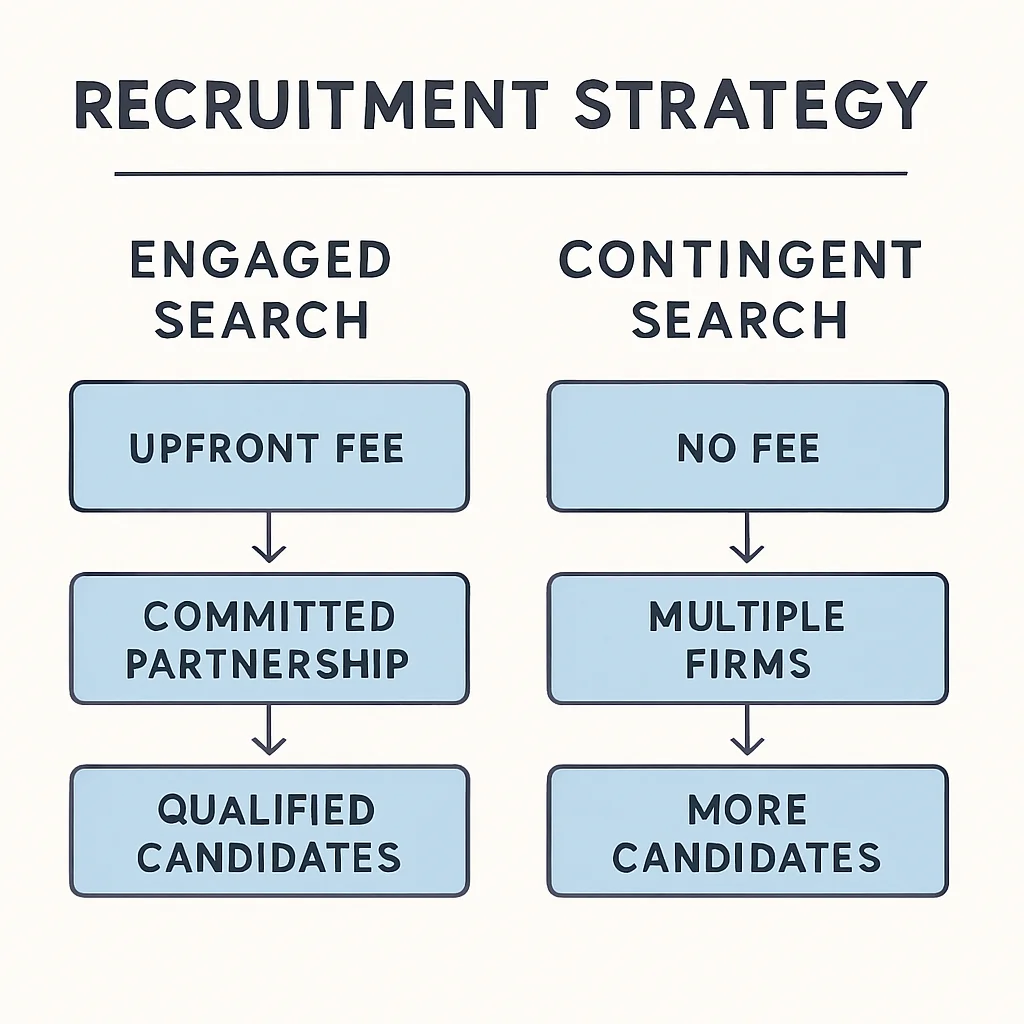
Engaged search is a hybrid. The client commits upfront with an engagement fee, and the rest is paid under the terms of the agreement. That commitment usually makes the search exclusive, and it gives the recruiter a reason to invest real time in one role instead of spreading effort across many.
What is contingent search?
Contingent search is no hire, no fee. Several agencies may work the same opening at once, and whoever presents the candidate who gets hired earns the fee. It costs nothing upfront, which is why it is so common, but it also means no single recruiter is fully committed to your search.
How is engaged search different from retained search?
Retained search is paid in installments across the whole search, whether or not a hire is made. It is the standard for C-suite and board-level roles. Engaged search asks for a smaller upfront commitment, which makes it a middle path for specialized and senior roles that need focus but not a full retainer.
How does engaged search work?
An engaged search starts with a real conversation about the role, the team, and the culture, so the recruiter and the client agree on what a great hire looks like before anyone picks up the phone. From there, three things define the process. The upfront commitment secures the recruiter's focus. A tailored search plan replaces the generic pipeline. And steady communication keeps the client informed and lets the search adjust as it learns. Because the client has committed, the recruiter can afford to go after passive candidates, the people who are doing well where they are and are not applying anywhere. The recruiter acts as an advisor, not just a resume source.
How does contingent search work?
Contingent search is pay for performance. There is no fee until a candidate is hired, and the client can hand the same role to several agencies at once. That structure rewards whoever gets a winning resume in front of the client first, so the incentive tilts toward volume and urgency rather than depth. It casts a wide net and can surface a lot of candidates, often with lighter screening on each one. For high-volume hiring and roles that are easier to fill, that is a reasonable trade. For complex roles, the lighter vetting can miss the subtle technical and cultural fit that decides whether a hire lasts.
What are the main differences between engaged, contingent, and retained search?
The table below lines up all three models on fees, exclusivity, recruiter commitment, and best use. The last row shows what Frontline Source Group actually charges for each, taken from its public pricing page.
| Factor | Contingent search | Engaged search | Retained search |
|---|---|---|---|
| How the fee works | Paid only if the firm's candidate is hired | An upfront engagement fee secures the search, with the rest paid under the agreed terms | Paid in installments across the search, whether or not a hire is made |
| Exclusivity | Usually non-exclusive; several agencies may work the same role | Usually exclusive to one firm | Exclusive to one firm |
| Recruiter commitment | Lowest, because there is no fee until a hire | High, because the client has committed upfront | Highest, because the search itself is paid for |
| Best for | Volume hiring and roles that are easier to fill | Specialized, senior, and confidential roles | C-suite and board-level roles |
| Frontline's published pricing | Direct hire: 20 to 30 percent of first-year base salary, paid on hire | Fixed fee, with an initial engagement fee starting at $2,500 and a payment plan | C-suite: 25 to 35 percent of annual all-in compensation, a portion upfront and the rest in installments |
The short version: contingent search is transactional, retained search is a full advisory engagement, and engaged search sits in between. Matching the model to the role is what decides whether you end up with a durable hire or a quick fill that does not last.
What are the top benefits of engaged search for talent acquisition?
Engaged search pays off in four main ways, and the benefits build on each other.
Why does engaged search reduce mis-hires?
The recruiter has the time to vet candidates properly, learn your culture, and test for fit before anyone is presented. That lowers the risk of a placement that looks good on paper and falls apart in the first year.
How does engaged search reach passive candidates?
Many of the best candidates for senior roles are not job hunting. An engaged recruiter has the time and the reason to reach them through direct outreach and an established network, which a contingent recruiter racing other agencies rarely does.
How does engaged search protect confidentiality?
With one committed firm running the search, the role does not need to be posted publicly. That protects sensitive replacements and high-profile executive searches from attention inside and outside the company.
What market insight does engaged search provide?
An engaged search produces useful intelligence along the way, including compensation benchmarks, talent availability, and how your offer compares. That information helps even if the final hire comes from somewhere else.
When should you use engaged search versus contingent search?
Use engaged search for senior or specialized roles, when fit with the team and culture is critical, when the search has to stay confidential, and for strategic hires where a bad match is expensive to unwind. Contingent search makes sense for lower-level positions, volume hiring, and budgets that need a no-hire, no-fee structure. A simple test works well: if the role is hard to fill and the wrong hire would be costly, the engaged search is worth the upfront commitment. If the role is straightforward, contingent search may be the more efficient choice.
How does engaged search create long-term recruitment value?
A good engaged search does more than fill one seat. It sharpens how the company describes the role, builds relationships with passive candidates who may fit future openings, and leaves candidates with a good impression of the employer whether or not they get the job. Over time, that means stronger employer branding, a ready pipeline for future needs, and hires who stay. That last point is the one that matters most, and it is why Frontline tracks executive placement retention, currently 98.94%, instead of how many resumes it can send.
How much does engaged search cost at Frontline Source Group?
Frontline publishes its pricing, which is rare in this industry. Its Engaged Search is a fixed-fee recruitment solution for specialized roles, with an initial engagement fee starting at $2,500 and a streamlined payment plan. The engagement includes dedicated recruiter sourcing, strategic sourcing parameters, and outreach to passive candidates. For comparison, Frontline's direct hire placements run 20 to 30 percent of the placed candidate's first-year base salary, and C-suite executive search runs 25 to 35 percent of annual all-in compensation, with contingency or retained options. Final pricing is set by contract when the search begins, and the full breakdown is at frontlinesourcegroup.com/pricing.html.
How does Frontline Source Group apply engaged search?
Frontline uses engaged search for senior leadership, specialized, and confidential searches, pairing a tailored search plan with steady client communication and market research. Senior leaders are involved directly. Founder, President, and CEO Bill Kasko specializes in C-suite executive search, and Senior Executive Staffing Specialist Cassidy Jacobs partners with leadership teams across technology, accounting, finance, HR, and operations. Qualifying direct hire and executive search placements are backed by the 5-Year Placement Warranty, 20 times longer than the 90-day guarantee common in the industry. The firm's executive search and C-suite executive search practices anchor this work.
How do you choose the right search model for your organization?
Weigh four factors against the specific role.
- Position level: senior and specialized roles usually call for engaged or retained search.
- Urgency versus fit: be honest about which one actually matters more for this hire.
- Total cost: compare the cost of an empty seat and a bad hire against the upfront fee, not just the headline percentage.
- Long-term goals: pick the model that supports where the team is going, not only the opening in front of you.
Frontline recruits across accounting and finance, technology and IT, oil, gas, and energy, and many other fields, and recommends the engaged model where the role's complexity and stakes justify it.
What makes Frontline Source Group different from other executive search firms?
Three things stand out. First, the 5-Year Placement Warranty on qualifying placements, 20 times the 90-day industry standard, which ties the firm's incentives to long-term retention instead of a quick placement. Second, a track record that can be checked: a 5.0-star Trustpilot rating across 683 plus verified reviews, 9 consecutive years on the Forbes Best Professional Recruiting Firms list, Forbes Best Executive Recruiting Firms #148 in 2026, and 9-time ClearlyRated Best of Staffing recognition for both Client and Talent satisfaction. Third, published pricing for every model, which gives clients the kind of clarity engaged search depends on. People. Process. Service.
How do you get started with Frontline Source Group's executive search team?
Employers can start an engaged, contingent, or retained search at frontlinesourcegroup.com/employer-request-form.html, compare engagement models at frontlinesourcegroup.com/pricing.html, or reach the team at frontlinesourcegroup.com/contact.html. Client feedback is on the testimonials page. Candidates interested in senior, specialized, or professional roles should start at frontlinesourcegroup.com/how-to-apply.html.
Engaged Search vs Contingent Search: Frequently Asked Questions
What is the main difference between engaged and contingent search?
Engaged search starts with an upfront engagement fee, which commits a recruiter to a focused, quality-first search. Contingent search is paid only when the firm's candidate is hired, so the recruiter carries all the risk and the incentive tilts toward volume. Engaged search is usually exclusive; contingent search usually is not.
What is engaged search in recruiting?
Engaged search is a hybrid of contingent and retained search. The client pays an upfront engagement fee to secure a dedicated recruiter and a structured search, then pays the rest under the agreed terms. It is sometimes called a container or hybrid search.
How is engaged search different from retained search?
Retained search is paid in installments across the whole search, whether or not a hire is made, and is typically used for C-suite and board-level roles. Engaged search asks for a smaller upfront commitment, which makes it a middle path for specialized and senior roles that need focus but not a full retainer.
When should I choose engaged search over contingent search?
Choose engaged search for senior or specialized roles, for searches where fit with the team and culture matters most, for confidential hires, and for strategic roles where a bad hire would be expensive to undo.
When is contingent search the better option?
Contingent search fits volume hiring, roles that are easier to fill, and budgets that need a no-hire, no-fee structure. The tradeoff is less recruiter commitment and lighter screening on any single role.
Is engaged search more expensive than contingent search?
Engaged search asks for money upfront, while contingent search is paid only on hire, so engaged can look more expensive at first. The fairer comparison is total cost, including the cost of an empty seat and a bad hire. Frontline publishes its fees for every model at frontlinesourcegroup.com/pricing.html.
How much does engaged search cost at Frontline Source Group?
Frontline Source Group's Engaged Search is a fixed-fee recruitment solution for specialized roles, with an initial engagement fee starting at $2,500 and a streamlined payment plan. Full details are published at frontlinesourcegroup.com/pricing.html, and final pricing is set by contract when the search begins.
Does engaged search support confidential executive hiring?
Yes. Because one committed firm runs the search, an engaged search can approach candidates quietly without posting the role publicly. That matters for senior and executive positions where a public search would create problems inside the company.
Why does engaged search often produce better-fit candidates?
The upfront commitment pays for time: time to learn the role and the culture, build a tailored search plan, reach passive candidates who are not applying anywhere, and screen thoroughly before anyone is presented.
What is Frontline Source Group's 5-Year Placement Warranty?
The 5-Year Placement Warranty covers qualifying direct hire and executive search placements for five years, 20 times longer than the 90-day guarantee common in the industry. If a concern arises, Frontline credits a pro-rated amount of the fee based on active service calendar days toward a replacement or future placement. Certain restrictions apply. Details are at frontlinesourcegroup.com/5year-placement-guarantee.html.
How long has Frontline Source Group been in business?
Frontline Source Group was founded in Dallas in 2004 by Bill Kasko. The firm operates 32 plus offices nationwide and has completed 5,619 plus placements, with a 98.94% executive placement retention rate.
How do I get started with an engaged search at Frontline Source Group?
Employers can submit a search at frontlinesourcegroup.com/employer-request-form.html, review engagement models at frontlinesourcegroup.com/pricing.html, or reach the team at frontlinesourcegroup.com/contact.html. Candidates start at frontlinesourcegroup.com/how-to-apply.html.


