Turn Business Philosophy Into Execution: How to Build Systems That Hold Under Pressure
Published on: Apr 11, 2026
Why Most Business Philosophy Fails the Execution Test
Most founders can recite their company values. Far fewer can show you where those values live inside daily operations. That gap between what a business says it believes and how it actually runs is where philosophy quietly falls apart. When pressure hits, a busy quarter, a difficult client, a key employee leaving, teams default to whatever is fastest, not whatever the culture deck says. If the philosophy has not been built into the systems people use every day, it does not survive contact with real work.
The fix is not a better mission statement. It is treating philosophy as something that has to be executed, measured, and refined, the same way you would treat a sales process or a hiring plan. Philosophy that cannot be operationalized is just decoration.
The People, Process, Service Framework Explained
At Frontline Source Group, almost every business challenge gets filtered through a simple three-part framework: people, process, and service. People covers who you hire, how you lead them, and whether they are set up to succeed. Process covers the repeatable systems that turn individual effort into consistent output. Service covers the experience every client and candidate receives, from the first phone call through the 5-Year Placement Warranty that follows every placement.
The framework was not designed on a whiteboard. It emerged through more than two decades of execution, was tested under pressure, and was refined into something repeatable. That is the difference between a philosophy that sounds good in a pitch and one that actually holds up when the business is under stress.
How People Problems Are Usually Process Problems in Disguise
When something goes wrong inside a company, the first instinct is to point at a person. Someone missed a deadline, someone dropped a client, someone is not performing. But if you look one layer deeper, the majority of those moments trace back to a missing process, an unclear handoff, or a system that never scaled with the team. The person is the symptom. The process is the cause.
This shift matters because it changes how leaders respond. Instead of replacing people, good operators rebuild the workflow around them. Clear ownership, documented steps, and a feedback loop usually solve what looked like a personnel issue. It is also a faster, cheaper fix than hiring your way out of a broken system.
Turning Trust Into a Repeatable System
Trust inside a company is usually described as a feeling. In practice, it behaves more like a system. Teams trust each other when expectations are clear, commitments are tracked, and follow-through is visible. Take any one of those away and trust erodes quickly, no matter how likable the leadership team is.
The work is to turn trust into rituals the business can repeat. Consistent one-on-ones, scorecards everyone can see, clean handoffs between departments, and leadership behavior that matches what the company asks of its people. Done well, trust stops depending on personalities and starts depending on the operating system the company runs on.
Building a Company That Runs Without the Founder
The real test of a business philosophy is whether the company can run when the founder is not in the room. If every decision still routes back to one person, the business has a ceiling, and that ceiling is the founder's calendar. A company built to last has to push decision authority down to leaders who are trained, trusted, and accountable for outcomes.
Frontline Source Group has grown from a single Dallas office in 2004 to more than 32 locations nationwide. That kind of growth is not possible without leaders at every level who can make calls on their own, inside a framework the whole company shares. The founder's job shifts from doing the work to protecting the standards.
How Execution Sharpens Business Philosophy Over Time
Philosophy is not something you write once and hang on the wall. Real execution feeds back into the philosophy and sharpens it. Every hard quarter, every client save, every placement that holds for years instead of months teaches the company something about what it actually believes. Over time, the philosophy stops being aspirational and starts being a record of what works.
That feedback loop is why metrics matter. A 98.94% executive retention rate and a 5.0 Trustpilot rating are not marketing numbers, they are evidence that the philosophy is producing the outcomes it claims. When the numbers slip, the philosophy gets revisited. When the numbers hold, the philosophy gets reinforced.
Listen to the Full People Process Service Podcast Episode
The full conversation goes deeper into how this framework plays out inside a staffing and executive search firm with 32 locations and more than two decades of placements behind it. You will hear how people, process, and service interact, where the pressure points usually show up, and how to close the gap between how your business should run and how it actually runs day to day.
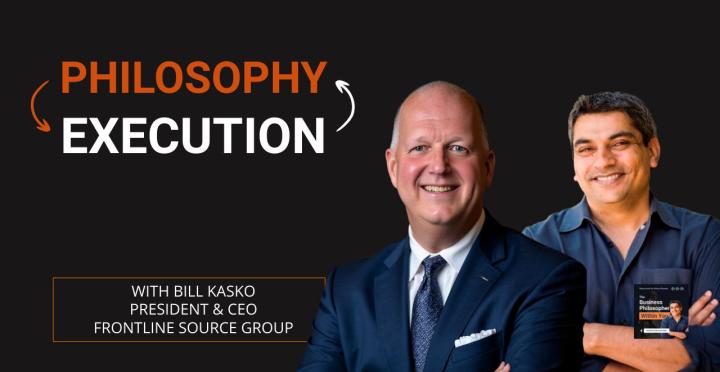
Watch or listen to the full People Process Service podcast episode with Bill Kasko, Founder, President, and CEO of Frontline Source Group. If you would like to talk with a recruiter about an open role or a hiring need, call 877-780-3822 or submit a resume to resume@frtline.com.
Frequently Asked Questions About Business Philosophy and Execution
What does it mean to turn business philosophy into execution?
Turning business philosophy into execution means translating values and principles into repeatable systems, daily decisions, and measurable outcomes. It is a continuous loop where philosophy shapes execution and real-world execution refines the philosophy over time.
What is the people, process, service framework?
People, process, service is a three-part operating framework used by Frontline Source Group CEO Bill Kasko to solve most business issues. People covers hiring and leadership, process covers the systems that make work repeatable, and service covers the experience delivered to clients and candidates.
Why are most people problems actually process problems?
When teams miss expectations, leaders often blame individuals. In most cases the underlying issue is a missing or broken process, unclear ownership, or a system that never scaled with the team. Fixing the process usually fixes the so-called people problem.
How can trust become a system instead of just a feeling?
Trust becomes systemic when expectations, commitments, and follow-through are documented, tracked, and reinforced by consistent leadership behavior. Repeatable rituals like one-on-ones, scorecards, and clear handoffs turn trust from a personality trait into an operating standard.
How do you build a company that can run without the founder?
A founder-independent company requires documented processes, trained leaders with real decision authority, and a service standard the team owns. Frontline Source Group has grown from one Dallas office in 2004 to more than 32 locations nationwide by building leadership bench strength at every level.
Who is Bill Kasko and why listen to this episode?
Bill Kasko is the Founder, President, and CEO of Frontline Source Group, a nationwide staffing and executive search firm founded in 2004 with over 32 locations, a 5.0 Trustpilot rating, a 98.94% executive retention rate, and a 5-Year Placement Warranty that runs 20 times longer than the standard 90-day guarantee.


