How Should Job Seekers Communicate with Their Recruiter?

Published on: Feb 24, 2025
Updated on: October 16, 2026
Job seekers who land their best roles through a recruiter practice five habits: honesty about goals, salary, and situation; timely responses; specific post-interview feedback; transparency about changes; and treating the recruiter as a career advocate. Frontline Source Group recruiters see these habits separate the candidates who get offers from those who stall, at no cost to the job seeker.
This article is based on candidate conversations Frontline Source Group's recruiters have with job seekers across the United States. Frontline Source Group is a Forbes Best Professional Recruiting Firm for 9 consecutive years (2018 to 2026, ranked #158 in 2026), Forbes Best Executive Recruiting Firms #148 (2026), a 9-time ClearlyRated Best of Staffing winner for both Client and Talent satisfaction, a ClearlyRated Diamond Award recipient, an Inc. 5000 Fastest-Growing Companies honoree, an Expertise.com Best Staffing Agency, and a member of the American Staffing Association, with 5,619 plus completed placements over 22 years at 32 plus offices nationwide.
Why does communication with your recruiter shape your job search?
Because the recruiter is your representative inside the hiring process. As an executive recruiter at Frontline Source Group, I have watched countless job searches succeed or fail based on one factor more than any other: the quality of communication between the candidate and the recruiter. While good communication might sound obvious, many job seekers underestimate just how directly it shapes the outcome. A recruiter cannot advocate for a candidate they do not fully understand, cannot act on opportunities when they cannot reach the candidate, and cannot adjust a search based on feedback they never receive.
How common are communication breakdowns in hiring?
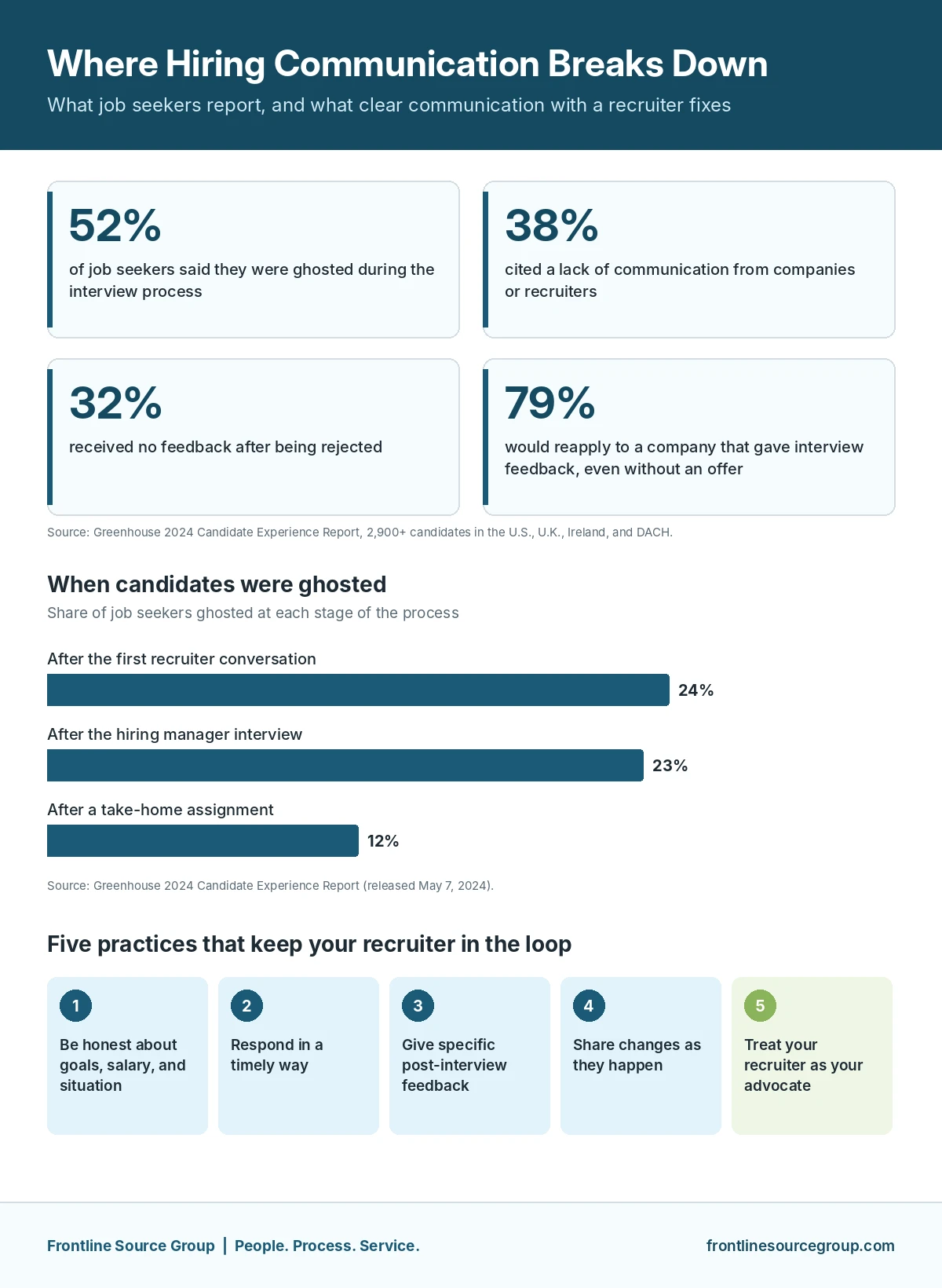
More common than most people think, on both sides. In the Greenhouse 2024 Candidate Experience Report, which surveyed more than 2,900 candidates, 52 percent of job seekers said they had been ghosted during the interview process, 38 percent cited a lack of communication from companies or recruiters, and 32 percent received no feedback after a rejection. The same survey found that 79 percent would reapply to a company that gave them interview feedback even without an offer. Communication is the part of hiring people remember, and it is the part you can control in your relationship with your recruiter.
Practice 1: Why should you be honest about your goals, salary, and situation?
Clear communication begins with complete honesty about career goals, salary expectations, and current situation. The recruiter is not just trying to fill a position; the recruiter is trying to find the right fit for both the candidate and the employer. The more information the recruiter has about goals, constraints, deal-breakers, and competing options, the better positioned the recruiter is to advocate effectively on the candidate's behalf.
What should you share in your first conversation?
Share everything that affects your decision-making: the roles and titles you want, your salary floor and target, your notice period, the locations and work arrangements that work for you, and any deal-breakers. If you are not sure about something yet, say that too. An honest "I am still figuring that out" is far more useful than a guess.
Should you tell your recruiter about other interviews?
Yes. I often see candidates hesitate to share that they are interviewing with multiple companies or that they have concerns about a particular role. This hesitation is understandable, but it leads to missed opportunities and mismatched placements. Knowing your other options lets the recruiter manage timing with the client and advocate for you with full information.
Practice 2: How quickly should you respond to your recruiter?
Promptly enough that opportunities do not move past you. The job market moves quickly, especially for in-demand positions in the Dallas-Fort Worth area and other competitive metros. When a recruiter reaches out about an opportunity, it is often because the client wants to see candidates soon. A delay can sometimes mean the difference between securing an interview and missing out entirely.
What is a reasonable response rhythm?
This does not mean candidates need to be available around the clock. It does mean establishing a reasonable communication cadence, such as checking email and voicemail at least once per business day during an active search, and sticking to it. Candidates who maintain a responsive communication rhythm significantly improve their chances of landing the roles they actually want.
Practice 3: What post-interview feedback should you give your recruiter?
Both what worked and what did not. Post-interview feedback is one of the most valuable things a candidate can share. Immediate impressions of a company, team, or role help the recruiter refine the search and better understand what the candidate is actually looking for. If the company culture did not feel right or the role was not exactly what was described, telling the recruiter right away helps them adjust search parameters and avoid setting up more interviews with the same mismatch. If the candidate is excited about a position, letting the recruiter know lets them communicate that enthusiasm to the employer and help move the process forward.
What does useful feedback sound like?
Vague feedback ("it was fine") helps nobody. Specific feedback ("the team was strong but the role focused too heavily on operational reporting and I want more strategic work") moves the search forward, because it tells the recruiter exactly what to look for next.
Practice 4: Which changes in your situation should you share with your recruiter?
All of them, as soon as they happen. Whether it is a shift in salary requirements, a competing offer from another firm, a change in availability to start a new position, a family situation that changes what cities are viable, or a sudden urgency in the candidate's current employment situation, keeping the recruiter informed lets them manage expectations on all sides. The recruiter can often negotiate on the candidate's behalf, but only if they know what is happening in real time. Candidates who go quiet about a competing offer, then surface it at the last minute, leave the recruiter without the leverage to act effectively on their behalf.
Practice 5: How do you turn your recruiter into a career advocate?
Go beyond skills and experience to share workplace preferences, deal-breakers, and long-term career direction. The recruiter is the candidate's advocate inside the job market. The more effectively the recruiter can communicate the candidate's value to potential employers, the better the candidate's chances of landing the right position. This means sharing not only resume credentials but also workplace preferences (remote, hybrid, in-office), management style preferences, industry vertical interests, growth trajectory expectations, and the kind of company culture the candidate thrives in. When the candidate maintains open, honest, and timely communication, the recruiter transforms from a simple job matchmaker into a powerful career ally who can guide the candidate toward opportunities that genuinely align with their professional direction.

How does Frontline Source Group partner with candidates?
Frontline Source Group places candidates across Accounting and Finance, Information Technology, Human Resources, Administrative, Legal, Customer Service, Pharmacy, Dental, Engineering, Marketing, Revenue Cycle, Aviation, Life Sciences, Grocery and Retail, and C-suite executive search verticals through the firm's 32 plus nationwide offices. Every direct hire placement is backed by the 5-Year Placement Warranty, which is 20 times longer than the 90-day industry-standard guarantee. The firm has completed 5,619 plus placements over 22 years, maintains a 98.94% executive placement retention rate, and holds a 5.0-star rating across 683 plus verified Trustpilot reviews. Engagement terms for employers are published openly on the pricing page.
What are the next steps in your job search?
Submit a resume through the secure how to apply page, where a Frontline recruiter will review the application and follow up if there is a current match. Candidates can also explore additional resources on the candidates hub, prepare for the next interview with interview instructions, complete optional skills testing to validate technical proficiency, and learn about the candidate ambassador program and the referral program.
What happens after you apply?
When you apply for a job or upload your resume, you may get a call from Lexi Reed, Frontline's AI recruiter, who helps our recruiting team with first conversations. That first call is a good place to start practicing everything above. Every legitimate Frontline recruiter email comes from an @frtline.com address, so if anything looks off, check the scam alert page before you respond.
Frequently Asked Questions: Communicating Effectively with Your Recruiter
What are the five communication practices that drive job search success with a recruiter?
The five practices are: 1) complete honesty about career goals, salary expectations, and current situation, 2) timely responses to recruiter outreach so opportunities do not pass by, 3) specific post-interview feedback (both positive and negative) that helps the recruiter refine the search, 4) transparency about any changes in your situation as they happen, and 5) treating the recruiter as a career advocate rather than a transactional job matchmaker. Candidates who execute all five consistently outperform candidates who treat job search as a one-way push of applications.
How common is ghosting in the hiring process?
Very common. In the Greenhouse 2024 Candidate Experience Report, 52 percent of job seekers said they had been ghosted during the interview process, 38 percent cited a lack of communication from companies or recruiters, and 32 percent received no feedback after rejection. Clear, two-way communication with your recruiter is the best defense against falling through the cracks.
Should I tell my recruiter that I am interviewing with other companies?
Yes. Recruiters need to know about competing opportunities because they shape how the recruiter advocates on your behalf and manages timing with their client. Hiding competing interviews from your recruiter often leads to missed opportunities, lost leverage in offer negotiation, and mismatched placements. The recruiter is not in competition with your other options; the recruiter is trying to find the role that fits you best.
How quickly should I respond when a recruiter reaches out about a new opportunity?
Promptly enough that the opportunity does not move past you. The job market moves quickly, particularly for in-demand roles in competitive metros like Dallas-Fort Worth. A reasonable rule is to check email and voicemail at least once per business day during an active job search, because a delay can sometimes mean the difference between securing an interview and missing out.
What should I tell my recruiter after an interview?
Share both what worked and what did not, in specific terms. Generic feedback like "it was fine" does not help the recruiter refine the search. Specific feedback ("the team was strong but the role focused too heavily on operational reporting and I want more strategic work" or "the company culture felt right and the manager's leadership style matched what I am looking for") gives the recruiter the information they need to either move the current opportunity forward or pivot to a better-aligned search.
What changes in my situation should I share with my recruiter?
All of them, as soon as they happen. This includes shifts in salary requirements, competing offers from other firms, changes in availability to start a new position, family situations that change what cities are viable, and any urgency in your current employment situation. Recruiters can often negotiate on your behalf, but only when they know what is happening in real time.
How can I help my recruiter advocate for me more effectively?
Go beyond resume credentials to share workplace preferences, deal-breakers, and long-term career direction. The recruiter advocates by communicating your value to employers, and they need a full picture to do that well. Share workplace preferences (remote, hybrid, in-office), management style preferences, industry vertical interests, growth trajectory expectations, and the kind of company culture you thrive in.
Is my recruiter working for me or for the employer?
A recruiter at a firm like Frontline Source Group is working to find the right fit for both sides. The recruiter is paid by the employer when a placement is made, but the recruiter's reputation and long-term career depend on placing candidates into roles that actually work for them. A bad placement leads to early turnover, which costs the recruiter their reputation with both the employer and the candidate.
What roles does Frontline Source Group place candidates into?
Frontline Source Group places candidates across Accounting and Finance, Information Technology, Human Resources, Administrative and Executive Assistant, Legal and Paralegal, Customer Service and Call Center, Pharmacy and Pharmacist, Dental and Dental Hygienist, Oil Gas and Energy, Engineering, Marketing and Digital, Revenue Cycle, Aviation, Life Sciences, Grocery and Retail Management, and C-suite executive search. The firm covers contract, contract-to-hire, direct hire, and retained executive search engagement types.
How does Frontline Source Group's 5-Year Placement Warranty work?
The 5-Year Placement Warranty is Frontline Source Group's hiring protection program that covers every direct hire and executive search placement for five full years from the date of hire. The warranty uses a pro-rated credit system based on active service calendar days, includes the Promotion Protection Plan for promoted placements, and is 20 times longer than the 90-day industry-standard guarantee that most staffing firms offer. Details are at frontlinesourcegroup.com/5year-placement-guarantee.html.
What happens after I apply with Frontline Source Group?
After you apply for a job or upload your resume, you may get a call from Lexi Reed, Frontline's AI recruiter, and a Frontline recruiter will review your application and follow up if there is a current match. Every legitimate Frontline recruiter email comes from an @frtline.com address. Report anything suspicious at frontlinesourcegroup.com/scam-alert.html.
How do candidates apply for jobs with Frontline Source Group?
Candidates can apply through the secure how to apply page at frontlinesourcegroup.com/how-to-apply.html. A Frontline recruiter will review the application and follow up if there is a current match. The firm covers placements nationwide, with engagement types including contract, contract-to-hire, direct hire, and retained executive search.


