When Executive Search Beats Internal HR: 7 Clear Signals

Published on: Jul 22, 2026
Executive search beats internal HR when the role is C-suite or board-level, when confidentiality is required, when a prior search has already stalled, when the hire is transformational, when you need talent from outside your industry, when you have no ready internal pipeline, and when the cost of a vacant seat is significant. Frontline Source Group has guided this decision with clients for 22 years, and every direct hire we place is backed by the 5-Year Placement Warranty, which runs 20 times longer than the 90-day industry standard guarantee.
Frontline Source Group is a Forbes Best Professional Recruiting Firm for 9 consecutive years (2018 to 2026), Forbes Best Executive Recruiting Firms #148 (2026), a 9-time ClearlyRated Best of Staffing winner for both Client and Talent satisfaction, a ClearlyRated Diamond Award recipient, an Inc. 5000 honoree, and an Expertise.com Best Staffing Agency. The firm holds a 5.0-star Trustpilot rating across 683 plus verified reviews, has completed 5,619 plus placements, maintains a 98.94% percent executive placement retention rate, operates 32 plus offices nationwide, and is a member of the American Staffing Association.
What does it actually cost to get the executive search versus internal HR decision wrong?
Before you pick a path, understand what is on the line. This is not a process conversation. It is a business risk conversation. A failed executive hire carries direct and indirect losses that CHRO surveys and retained search industry benchmarks place well into seven figures for senior roles, and the decision about who runs the search deserves as much thought as the search itself.
When a failed executive hire bleeds into the millions
A University of South Carolina Center for Executive Succession study of roughly 150 CHROs found that a plurality of respondents estimated the direct cost of a single failed executive hire between $2 million and $5 million, and a further share placed the figure above $5 million. For a C-suite role with a substantial compensation package, even conservative estimates put the loss well into seven figures once you factor in severance, lost productivity during the vacancy and onboarding period, team disruption, and the strategic delay that accumulates while the seat sits empty. According to that same body of research, worst-case economic impact can climb to a multiple of base salary many times over.
These are not theoretical numbers. They are what a flawed process or a wrong hire actually costs, and both outcomes are avoidable with the right decision made upfront.
Why the internal default often backfires
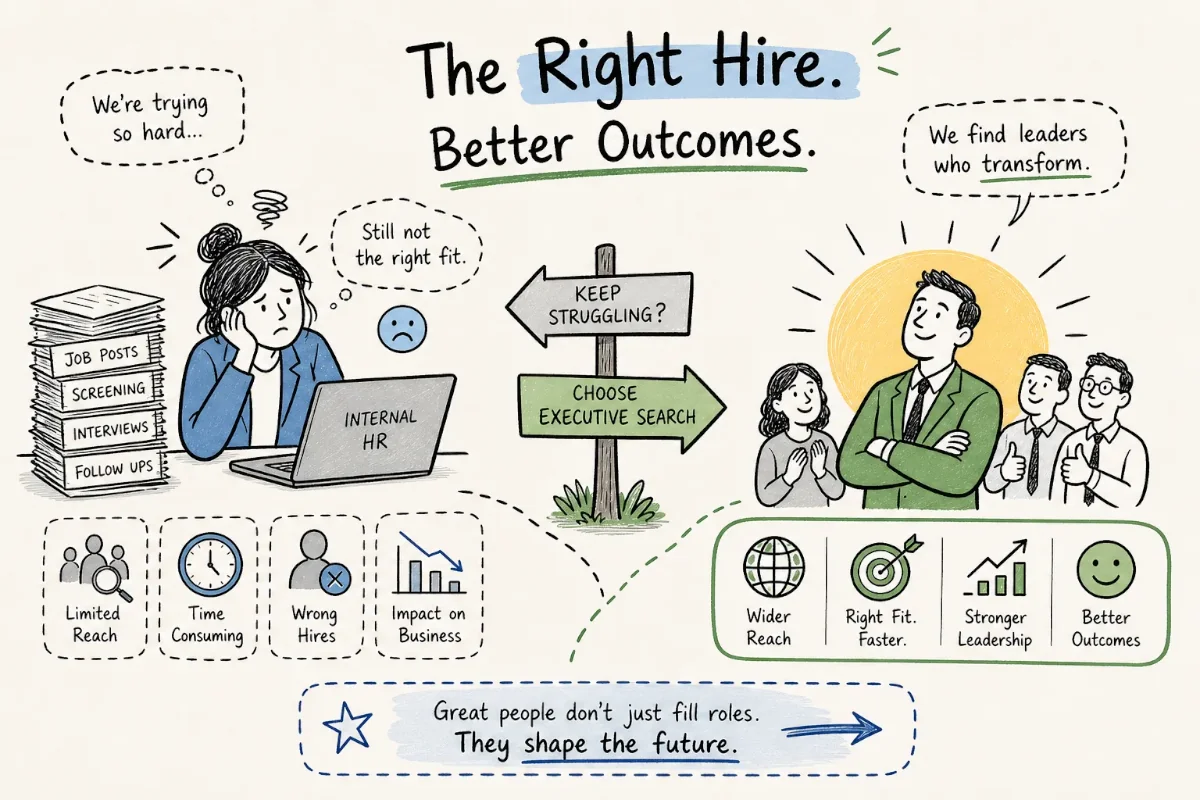
Internal HR teams are built for operational hiring. Executive search is a different discipline entirely. Internal recruiters often do not have the cross-industry passive candidate networks that senior roles require, and they cannot always maintain the confidentiality that sensitive searches demand. Beyond network access, internal teams frequently lack the deep market intelligence to credibly pressure-test a seasoned C-suite candidate during the vetting process, a capability gap that retained search research consistently identifies at the VP level and above. None of that is a criticism of your HR team. It is a reality of scope. A great HR team optimized for mid-level hiring is like a great local contractor: you would not hire them to build a skyscraper.
The data reinforces this. According to retained search industry benchmarks, internal teams fill only a small minority of C-suite roles without external support, while retained search firms account for the majority of placements at that level. Reported retention rates for search firm placements at the senior level run meaningfully higher than the average for internal hires at the same level, a gap that is not small.
What are the 7 signals that point toward executive search over internal HR?
These are not abstract rules. Each one represents a real-world situation where internal recruitment is genuinely outmatched.
Signals 1 through 4: role level, confidentiality, prior failure, and transformation
The role is C-suite or board-level. Retained search is the standard for CEO, CFO, COO, CMO, and board seats. According to executive search industry benchmarks, external firms fill these roles faster on average than internal teams, and that difference carries a real dollar cost when you multiply it by the weekly economic value of the position.
Confidentiality is required. If a sitting executive is being replaced without their knowledge, or if the search cannot be publicly posted without signaling something to competitors or shareholders, internal processes simply cannot contain the exposure. One wrong conversation in the wrong direction and the situation becomes a crisis.
A prior search has already failed. If the role has already been open at the VP level or above with no viable shortlist, the market is telling you something. The network is not wide enough, the message is not resonating, or both. Engaging an external firm at that point is not an admission of failure. It is the logical response to evidence.
The hire is transformational. When the hire is designed to redirect the business entirely, the rules change. A CEO brought in to reposition a company, a CFO hired ahead of an IPO, a CMO tasked with entering a new market: these are not backfill situations. The candidate you need almost certainly does not exist in your current network, and finding them requires a sourcing methodology your internal team was not built to run.
Signals 5 through 7: cross-industry talent, no pipeline, and strategic urgency
You need talent from outside your industry. External firms maintain cross-sector networks built over decades. Internal teams draw from the same pool they have always used. If your CFO search requires someone with fintech experience and your company has never operated in fintech, that is a sourcing problem a single recruiting platform will not solve.
You have no ready internal pipeline. The succession planning reality test is blunt: according to succession planning readiness data, a large majority of organizations do not have an internal candidate ready to step into a C-suite role immediately. If you do not have at least two internal candidates within a reasonable window of readiness, external search is not optional. It is the only viable path.
The cost of the vacancy is significant. When every week a role sits vacant carries a measurable revenue or operational cost, the economics alone justify the search fee. The math is straightforward: take the role's annual compensation, divide by 52 to get the weekly value, and multiply by the expected vacancy gap. For a high-compensation role, that calculation alone often funds a significant portion of the search fee, making the external versus internal cost comparison far closer than it first appears.
When is keeping the search internal the smarter call?
Not every executive role needs an external firm. Honest advice acknowledges that.
VP-level backfills where internal wins
For VP-level roles, the calculus often flips. When the role is a known backfill, there is no confidentiality requirement, and the team has a strong internal pipeline, the cultural continuity and stakeholder familiarity of internal hiring are genuine advantages. Running it internally in that situation is the right call, not the lazy one.
The internal pipeline reality test
Two honest questions settle this. Does your team have at least two candidates within a reasonable window of readiness? Does your HR team have the seniority and network to credibly recruit at this level? If both answers are yes, run it internally with a structured process, clear stakeholder alignment, and a defined competency framework before outreach begins. If either answer is no, you already know what to do.
What does retained executive search cost versus handling it yourself?
Here are the real numbers, without vagueness.
The retained search fee and what it actually covers
Retained executive search firms typically charge a percentage of first-year total cash compensation, with a modal rate around 30 percent and minimum engagement fees that scale with role seniority. For a CFO earning a substantial total compensation package, the fee lands in the low six figures all-in, including expense reimbursements. That fee is generally paid in three installments: at engagement, at shortlist delivery, and at placement. The installment structure keeps the firm accountable at every stage. Frontline Source Group publishes its own engagement model openly at frontlinesourcegroup.com/pricing.html, a level of pricing transparency that is rare in staffing and is reinforced by our 5.0-star Trustpilot rating across verified reviews.
Weighing the fee against the cost of a failed hire
Now anchor that number against the alternative. Based on CHRO survey data and retained search industry benchmarks, a failed hire at the C-suite level costs seven figures by conservative estimates, and that range excludes the broader economic disruption that can push total impact significantly higher. The search fee is not overhead. It is risk mitigation with a strong track record. Reported retention rates for retained search placements run meaningfully higher than the broader executive hiring average, and that retention gap is where the value lives. Frontline Source Group maintains a 98.94% percent executive placement retention rate across 5,619 plus placements, and backs every direct hire with the 5-Year Placement Warranty.
What is the practical action plan once you have made the call?
A diagnosis without a prescription is just an observation. Here is what to do next.
If you go external: the 5 phases to expect
A well-run retained search follows five phases. Discovery and strategy, where the firm learns the business deeply and builds the position profile and competency framework. Market mapping and outreach, where passive candidate targeting begins with regular pipeline reviews to keep stakeholders informed. Shortlisting and first-round interviews, where the selection committee reviews a vetted slate of three to five candidates. Final selection and negotiation, where the firm manages the offer and close process through to signed acceptance. Integration support, where structured post-hire reviews are built into the engagement rather than added as an afterthought.
A quality search partner stays involved after placement. That is how results get protected. At Frontline Source Group, our 5-Year Placement Warranty and track record reflect what happens when a firm treats the post-hire period as part of the engagement, not the end of it. You can explore our full executive search practice at frontlinesourcegroup.com/executive-search-c-level.html.
If you stay internal: 4 checkpoints to keep it on track
Internal searches fail most often at stakeholder alignment, when decision-makers launch the process without agreeing on what success actually looks like. Four checkpoints prevent that: executive committee approval before the search launches, a finalized competency framework before any outreach begins, a structured shortlist of three to five candidates before any final interview rounds, and formal structured reviews after the hire. The most common stall point is between the first two checkpoints, when the search goes live before everyone agrees on the profile. Lock that down first and the rest of the process moves cleanly.
How do you make the executive search versus internal HR call deliberately?
The choice between executive search and internal HR is not about budget or preference. It is about matching the right tool to the actual challenge. For C-suite roles, confidential searches, transformational hires, cross-industry talent needs, and any situation where the cost of failure is significant, an external search firm is the lower-risk path. The evidence supports that conclusion clearly.
For organizations that have worked through these signals and identified they need an external partner, Frontline Source Group brings 22 years of executive search experience across a broad range of industries, with a presence in markets nationwide through 32 plus offices. Our 5-Year Placement Warranty backs every engagement we take on. Employers can start a search at frontlinesourcegroup.com/employer-request-form.html or reach the team at frontlinesourcegroup.com/contact.html. Candidates exploring executive opportunities can begin at frontlinesourcegroup.com/how-to-apply.html.
Frequently Asked Questions: Executive Search vs. Internal HR
When does executive search beat internal HR?
Executive search beats internal HR when the role is C-suite or board-level, when confidentiality is required, when a prior search has stalled, when the hire is transformational, when you need talent from outside your industry, when you have no ready internal pipeline, and when the cost of a vacant seat is significant. In those situations an external firm is the lower-risk path.
What are the 7 signals that point toward external executive search?
The seven signals are a C-suite or board-level role, a required confidentiality, a prior search that already failed, a transformational hire, a need for cross-industry talent, the absence of a ready internal pipeline, and a vacancy whose ongoing cost is significant. When several of these apply at once, external search is almost always the correct call.
When is keeping an executive search internal the smarter choice?
Keeping a search internal makes sense for VP-level backfills with no confidentiality requirement and a strong internal pipeline. In those cases the cultural continuity and stakeholder familiarity of internal hiring are genuine advantages, and running the search in-house is the right call rather than the lazy one.
How much does a failed executive hire cost?
CHRO surveys and retained search benchmarks place the direct cost of a single failed C-suite hire well into seven figures, with a large share of respondents estimating losses between $2 million and $5 million and some placing it higher. Once you add severance, lost productivity, team disruption, and strategic delay, the true impact climbs further.
Why do internal HR teams struggle with C-suite searches?
Internal HR teams are built for operational hiring. They often lack the cross-industry passive candidate networks, the confidentiality controls, and the market intelligence to pressure-test seasoned senior candidates. That is a matter of scope, not competence. A team optimized for mid-level hiring is simply built for a different task than executive search.
How much does retained executive search cost?
Retained executive search firms typically charge a percentage of first-year total cash compensation, with a modal rate around 30 percent and minimum engagement fees that scale with role seniority. The fee is generally paid in three installments tied to engagement, shortlist delivery, and placement. Frontline Source Group publishes its engagement model openly at frontlinesourcegroup.com/pricing.html.
What is the internal pipeline reality test?
Two questions settle it. Does your team have at least two candidates within a reasonable window of readiness, and does your HR team have the seniority and network to recruit credibly at this level? If both answers are yes, run the search internally with a structured process. If either is no, external search is the safer path.
What are the phases of a retained executive search?
A well-run retained search moves through five phases: discovery and strategy, market mapping and outreach, shortlisting and first-round interviews, final selection and negotiation, and integration support after the hire. A quality partner treats the post-hire period as part of the engagement rather than the end of it.
What is the 5-Year Placement Warranty?
The 5-Year Placement Warranty is Frontline Source Group's direct hire assurance, which runs 20 times longer than the 90-day industry standard guarantee. It reflects the firm's confidence in its executive placements and its practice of staying engaged well beyond the placement date. Details are available at frontlinesourcegroup.com/5year-placement-guarantee.html.
What industries does Frontline Source Group recruit for at the executive level?
Frontline Source Group conducts C-suite and executive search across accounting and finance, technology, human resources, legal, engineering, oil and gas energy, pharmacy, dental, life sciences, grocery and retail, and more. This cross-sector reach is exactly what allows the firm to source leaders from outside a client's own industry when a search calls for it.
Who is the CEO of Frontline Source Group?
Bill Kasko is the Founder, President, and CEO of Frontline Source Group, which he founded in Dallas in 2004. He specializes in C-suite executive search across sales, energy, and dental verticals, and has grown the firm to 32 plus offices nationwide over 22 years in business.
How do I engage Frontline Source Group for an executive search?
Employers can start a search by submitting the employer request form at frontlinesourcegroup.com/employer-request-form.html or by contacting the team at frontlinesourcegroup.com/contact.html. Candidates exploring executive opportunities can begin at frontlinesourcegroup.com/how-to-apply.html.


