What Is a Practice Manager to a Dental and Medical Office?

Published on: May 15, 2026
Updated on: Oct 2, 2026
A practice manager is the senior administrator who runs the business side of a dental or medical office: scheduling, billing, staffing, compliance, and the patient experience. A strong one owns the metrics that decide whether a practice runs well, from provider utilization and no-show rates to collections, staff turnover, and patient reviews.
Frontline Source Group recruits practice managers, office managers, and dental practice leaders nationwide through our dental staffing and healthcare operations executive search practices. Frontline is a Forbes Best Professional Recruiting Firm for 9 consecutive years (2018 to 2026, ranked #158 in 2026), ranked #148 on the 2026 Forbes Best Executive Recruiting Firms list, a 9-time ClearlyRated Best of Staffing winner for both Client and Talent satisfaction, a ClearlyRated Diamond Award recipient, an Inc. 5000 honoree, an Expertise.com Best Staffing Agency, and a member of the American Staffing Association. We hold a 5.0 star Trustpilot rating across 683 plus verified reviews, have completed 5,619 plus placements with a 98.94% executive placement retention rate, and back every direct hire with the 5-Year Placement Warranty, 20 times longer than the 90-day industry standard.
What is a practice manager in a dental or medical office?
A practice manager is responsible for the day-to-day operational success of a dental practice or medical office. The role spans administrative systems like scheduling, patient records, and billing, financial oversight like budgets, reporting, and payroll, people management like hiring, training, and reviews, and compliance with HIPAA, OSHA, and state healthcare rules. Dental practices tend to lean harder on scheduling and equipment, and medical offices on insurance claims and care coordination, but the core job is the same: keep the practice running efficiently, profitably, and in compliance.
Key responsibilities typically include:
- Overseeing office operations and the patient appointment workflow
- Managing billing, payroll, and budgeting
- Maintaining compliance with HIPAA, OSHA, and state standards
- Handling patient questions, complaints, and escalations
- Recruiting, onboarding, training, and reviewing staff
- Coordinating with providers, vendors, and outside consultants
How does a practice manager improve operational efficiency and patient satisfaction?
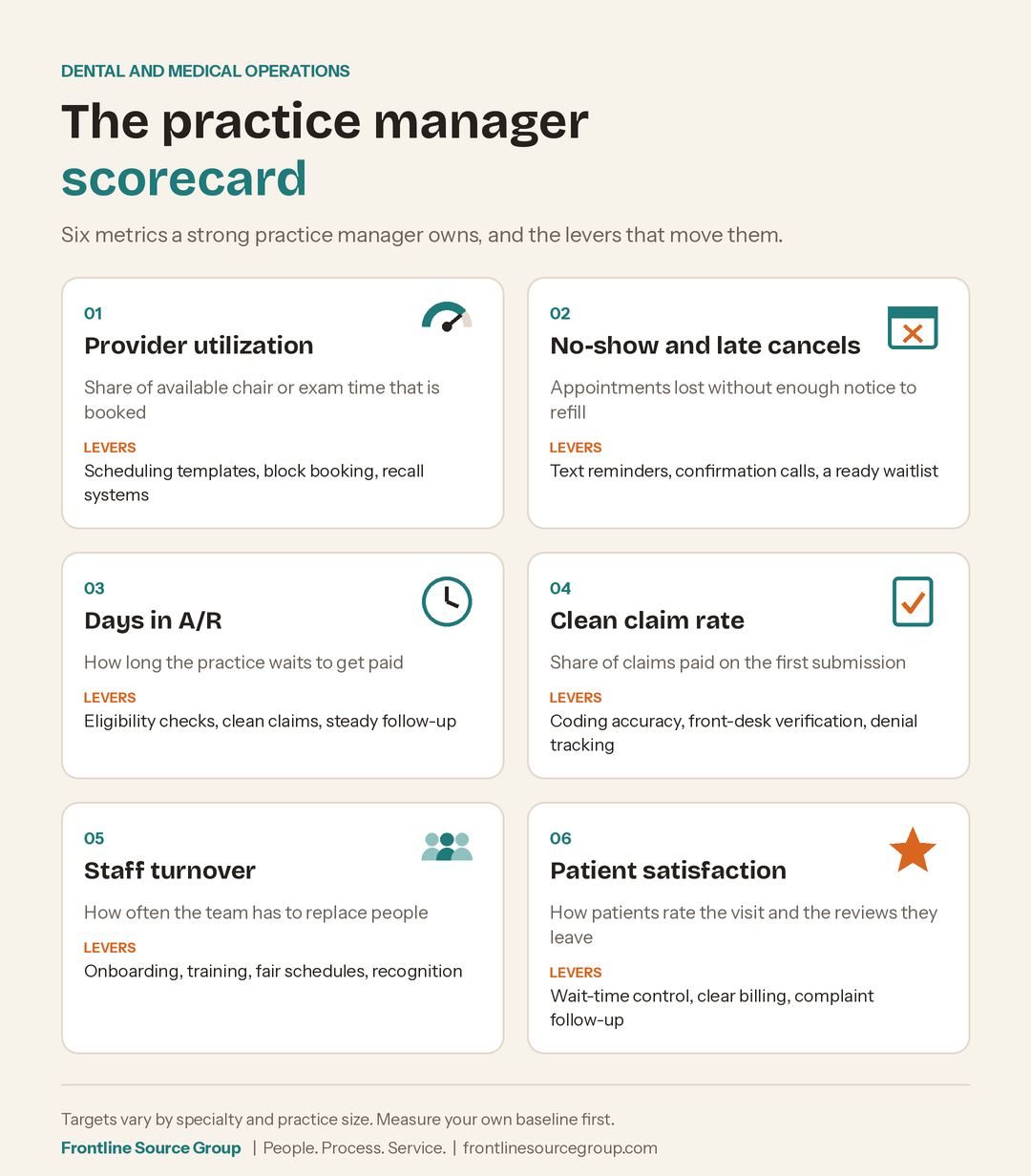
By owning a short list of numbers and pulling the levers behind them. The infographic and table below show the six metrics we see strong practice managers track, and what they actually do to move each one.
Which metrics should a practice manager track?
These six cover most of what matters, and they connect to each other: a full schedule with few no-shows protects revenue, clean claims shorten the wait to get paid, a stable team keeps service consistent, and consistent service shows up in patient reviews.
| Metric | What it measures | How a practice manager moves it |
|---|---|---|
| Provider utilization | Share of available chair or exam time that is booked | Builds scheduling templates, uses block booking, runs recall systems |
| No-shows and late cancels | Appointments lost without enough notice to refill | Sets up text reminders and confirmation calls, keeps a waitlist ready |
| Days in accounts receivable | How long the practice waits to get paid | Verifies eligibility up front, submits clean claims, follows up on a steady cadence |
| Clean claim rate | Share of claims paid on the first submission | Trains on coding accuracy, tightens front-desk verification, tracks denials |
| Staff turnover | How often the team has to replace people | Structured onboarding, ongoing training, fair schedules, recognition |
| Patient satisfaction and reviews | How patients rate the visit and what they say online | Manages wait times, makes bills clear, closes the loop on complaints |
What are the key duties and daily responsibilities of a practice manager?
The daily mix requires adaptability and attention to detail. On the administrative side, that means organizing appointments and provider calendars. Financially, it means billing, payroll, budgeting, and reviewing reports. On compliance, it means keeping policies current as rules change. With the team, it means hiring, onboarding, training, reviews, and resolving HR issues. With patients, it means being the go-to person for concerns and feedback. The balance between operational control and people leadership is what separates high-performing practice managers from administrators who only handle the mechanics.
What skills and qualities does a successful practice manager need?
Communication comes first, because the practice manager sits between patients, staff, providers, insurers, and vendors. Adaptability matters in a busy office where staffing gaps, rule changes, claim denials, and upset patients all show up without warning. Problem-solving helps find bottlenecks, and empathy keeps both patients and employees feeling heard, which drives retention on both sides.
- Strong leadership and decision-making
- Organization and time management
- Comfort with practice management software such as Dentrix, Eaglesoft, Open Dental, athenahealth, Epic, or Oracle Health (formerly Cerner)
- Working knowledge of HIPAA, OSHA, and state healthcare rules
- Conflict resolution and negotiation
- Financial literacy: budgeting, payroll, and basic accounting
- Empathy for patients and staff
How does a practice manager differ from a medical office manager?
The titles overlap and are sometimes used interchangeably, but the scope usually differs. The practice manager typically works closer to the owner and handles strategy, while the office manager keeps the front office running day to day.
| Practice manager | Medical or dental office manager | |
|---|---|---|
| Scope | Whole practice, clinical and non-clinical operations | Front office and administrative workflow |
| Strategy | Budgets, growth plans, provider partnerships, major purchases | Limited; carries out the plan day to day |
| Finance | Owns budgets, financial reporting, vendor and lease negotiations | Oversees billing, collections, and payroll processing |
| People | Hires and develops the full team | Supervises front-desk and billing staff |
| Reports to | Practice owner or managing partner | Practice manager or the providers |
How does a practice manager handle staff and patient management?
On the staff side, the practice manager leads hiring, structured onboarding, training, regular reviews, and the culture that keeps good people. Turnover is expensive in any practice, because every departure means recruiting costs, onboarding time, and lost productivity while the new person ramps up.
On the patient side, the practice manager owns the whole experience: scheduling, intake, wait times, clear bills, follow-up, and complaint resolution. Patients increasingly judge practices by online reviews on Google and healthcare review sites, so this work compounds over the years through reviews, referrals, and loyalty.
Why is dental team recruiting a practice manager priority in 2026?
Because the roles are hard to fill. The ADA Health Policy Institute's Q1 2026 dental economy update found that 91.7 percent of dentists recruiting hygienists rated it very or extremely challenging, and nearly 4 in 10 practices said they did not have enough hygienists. A practice manager who can recruit, onboard, and keep this team protects the schedule and the patient experience.
Dentists recruiting for each role who rate it very or extremely challenging
Practices that say they do not have enough staff in each role
What financial, regulatory, and operational oversight does a practice manager provide?
Financial. Practice managers build budgets, monitor spending, oversee billing, collections, and payroll, review financial reports, negotiate vendor contracts and equipment leases, and work with the practice's CPA on tax and planning. Strong collections often depend on revenue cycle discipline.
Regulatory. They keep the practice compliant with HIPAA, OSHA, state dental or medical board rules, CLIA where applicable, and payer contracts. That means documented policies, staff compliance training, and coordinating with outside consultants on audits.
Operational. They organize daily workflows, design scheduling templates that make good use of provider time, oversee equipment, leases, and supplies, and find the bottlenecks that slow providers down or frustrate patients.
How does a practice manager drive technology adoption and quality improvement?
Practice management software is now the backbone of the office. Practice managers lead selection, setup, and optimization of platforms such as Dentrix, Eaglesoft, Open Dental, Curve Dental, athenahealth, Epic, Oracle Health, AdvancedMD, and Tebra (formerly Kareo). How well the platform is implemented affects billing accuracy, scheduling, records, and reporting.
They also evaluate patient-facing tools like online scheduling, text reminders, patient portals, and telehealth, plus eligibility verification and claims tools that cut billing errors. Then they measure: set targets for the scorecard metrics above and run structured improvement projects. That discipline is what separates well-run practices from average ones over time.
What are the career pathways, education, and certifications for practice managers?
Many practice managers hold a degree in healthcare administration, business administration, or a related field. Others come up through clinical roles, such as dental hygienist, nurse, or medical assistant, and move into administration after several years in a practice.
Which certifications matter most for practice managers?
On the medical side, the Certified Medical Practice Executive (CMPE) through the American College of Medical Practice Executives is widely recognized, along with the Certified Medical Office Manager (CMOM) and Certified Medical Manager (CMM). On the dental side, the American Association of Dental Office Management offers three distinctions: Fellow (FAADOM), Master (MAADOM), and Diplomate (DAADOM). Managers who specialize in revenue cycle often add a Healthcare Financial Management Association credential. Staying active in groups like MGMA, AADOM, and state medical and dental associations keeps managers current.
How much do practice managers earn?
It depends on practice size, specialty, location, and scope. The U.S. Bureau of Labor Statistics reports a May 2025 median annual wage of $123,860 for medical and health services managers. That category includes practice administrators but also leaders of larger facilities, so managers of smaller single-location offices often earn less, and senior administrators of multi-location groups can earn more.
When should a dental or medical practice hire a practice manager?
Usually once the owner or lead provider is spending meaningful clinical time on administration, staffing, or billing problems. Multi-provider practices hit that point sooner, because coordination work grows with each added provider. Specialty practices benefit from a manager with specialty experience, and larger groups and multi-location organizations often need a senior administrator or regional operations leader.
How should you hire a practice manager?
Define the scope first: responsibilities, financial authority, team size, software, and pay range. Use scenario-based interviews about staff conflict, billing problems, compliance, and patient complaints. Check references from a recent supervisor and a provider they supported. And ask for a written placement warranty before you sign. Ours is five years, 20 times longer than the 90-day industry standard.
What is the bottom line on the practice manager role?
The practice manager runs the daily, weekly, and monthly mechanics of a dental or medical practice, and the results compound. Small gains in scheduling, billing accuracy, staff retention, and patient satisfaction add up to a meaningfully stronger practice over the years. Owners who hire well and give the role real authority usually outperform those who treat it as overhead.
Practices ready to hire can start with the employer request form, review our pricing, or explore dental executive search and our full services. Candidates exploring practice management roles can apply through the Frontline Source Group application page.
Practice Manager Role: Frequently Asked Questions
What is a practice manager in a dental or medical office?
A practice manager is the senior administrator who runs the day-to-day operations of a dental practice or medical office. The role covers scheduling and patient flow, billing and financial reporting, staff hiring and development, and compliance with HIPAA, OSHA, and state regulations, and it connects providers, staff, patients, insurers, and vendors.
What are the day-to-day responsibilities of a practice manager?
Managing schedules and provider calendars, overseeing billing, collections, and payroll, keeping policies current with healthcare rules, handling patient concerns and escalations, and leading the team through hiring, training, reviews, and staff meetings.
How does a practice manager improve operational efficiency and patient satisfaction?
By owning a handful of metrics and pulling the levers behind them: provider utilization, no-show rate, days in accounts receivable, clean claim rate, staff turnover, and patient satisfaction. Better scheduling templates, reminders, eligibility checks, clean claims, stronger onboarding, shorter waits, and clear bills all move those numbers.
What metrics should a dental or medical practice manager track?
Six core metrics cover most of the operation: provider utilization, no-shows and late cancellations, days in accounts receivable, clean claim rate, staff turnover, and patient satisfaction and online reviews. Set targets from your own baseline, specialty, and payer mix.
How does a practice manager differ from a medical office manager?
A practice manager usually oversees the whole practice, including strategy, budgets, and provider partnerships, and reports to the owner or managing partner. An office manager usually focuses on front-office workflow, billing, and front-desk supervision and often reports to the practice manager or the providers. Titles vary, so read the actual scope.
What skills does a successful practice manager need?
Leadership, clear communication, organization, financial literacy, conflict resolution, and comfort with practice management software such as Dentrix, Eaglesoft, Open Dental, athenahealth, or Epic, plus working knowledge of HIPAA, OSHA, and state healthcare rules and real empathy for patients and staff.
How much do practice managers earn?
Pay depends on practice size, specialty, location, and scope. The U.S. Bureau of Labor Statistics reports a May 2025 median of $123,860 for medical and health services managers, a category that includes practice administrators but also larger facility leaders, so managers of smaller offices often earn less.
What certifications can a practice manager pursue?
Medical practice managers often pursue the Certified Medical Practice Executive (CMPE) through the American College of Medical Practice Executives, the Certified Medical Office Manager (CMOM), or the Certified Medical Manager (CMM). Dental office managers can earn the American Association of Dental Office Management distinctions: Fellow (FAADOM), Master (MAADOM), and Diplomate (DAADOM).
Why is staff recruiting such a big part of a dental practice manager's job?
Because dental teams are hard to hire. In the ADA Health Policy Institute's Q1 2026 survey, 91.7 percent of dentists recruiting hygienists said it was very or extremely challenging, and 39.7 percent of practices said they did not have enough hygienists. Keeping and replacing that team falls largely on the practice manager.
When does a practice need a dedicated practice manager?
Usually once the owner or lead provider is spending meaningful clinical time on administration, staffing, or billing problems. Multi-provider practices, specialty practices, and multi-location groups typically need one sooner, and larger groups often need a senior administrator or regional operations leader.
How should a dental or medical practice hire a practice manager?
Define the scope first: responsibilities, financial authority, team size, software, and pay range. Use scenario-based interviews about staff conflict, billing problems, compliance, and patient complaints, check references from a recent supervisor and a provider they supported, and ask for a written placement warranty. Frontline's 5-Year Placement Warranty is 20 times longer than the 90-day industry standard.
How does Frontline Source Group recruit practice managers?
Frontline Source Group recruits practice managers, office managers, dental practice administrators, and healthcare operations leaders nationwide through its dental and healthcare operations practices, with every direct hire backed by the 5-Year Placement Warranty. Employers can start at frontlinesourcegroup.com/employer-request-form.html and candidates at frontlinesourcegroup.com/how-to-apply.html.


