What did Bill Kasko Share About Building a Different Kind of Staffing Firm?
Published on: Dec 7, 2025
Updated on: Jun 11, 2026
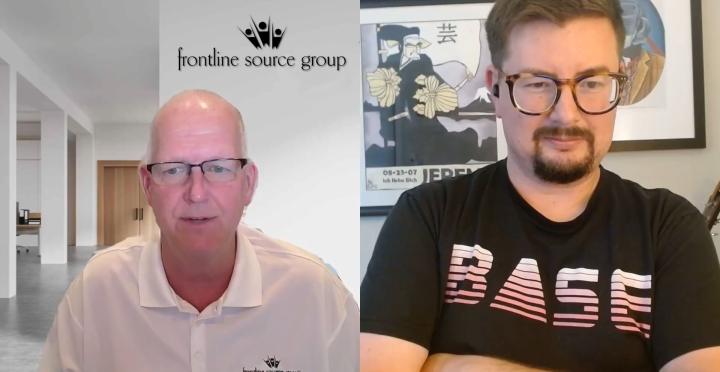
On the Unscripted Small Business podcast, Frontline Source Group Founder and CEO Bill Kasko explained how 22 years of doing the opposite of industry norms built the firm, covering the inverted recruiter-to-salesperson model, a rare public pricing page, 24/7 customer service, honest client conversations, the fragmenting search landscape, and the rise of AI and fake candidates. Frontline Source Group backs every direct hire placement with the 5-Year Placement Warranty, 20 times the 90-day industry-standard guarantee.
Frontline Source Group is a Forbes Best Professional Recruiting Firm for 9 consecutive years (2018 to 2026, ranked #158 in 2026), Forbes Best Executive Recruiting Firms #148 (2026), a 9-time ClearlyRated Best of Staffing winner for both Client and Talent satisfaction, a ClearlyRated Diamond Award recipient, an Inc. 5000 honoree, and an Expertise.com Best Staffing Agency. The firm holds a 5.0-star Trustpilot rating across 666 plus verified reviews, has completed 5,619 plus placements, operates 32 plus offices nationwide, and is a member of the American Staffing Association (ASA).
What is the Costanza theory, and how did it shape Frontline Source Group?
Bill Kasko founded Frontline Source Group on what he calls the Costanza theory, a nod to the Seinfeld episode where George Costanza succeeds by doing the exact opposite of his instincts. As Bill put it: "That was kind of the same idea how I started the company. That philosophy wasn't just our business model, it was truly the foundation." He describes it as the tip of the iceberg, a principle that worked its way into every part of how the firm operates. From the beginning, that meant being willing to challenge the conventional wisdom about how a staffing agency and executive search firm should run.
How did Frontline challenge staffing industry norms?
Early on, Bill recalls people telling him he was doing it wrong: "You guys run a staffing agency, an executive search firm. That's not how you do it. This is how you do it." His response was that no one tells Starbucks it can only serve hot coffee. From the firm's distinctive approach to its 5-Year Placement Warranty, Frontline deliberately built a model around doing things differently rather than copying the rest of the industry.
Why did Frontline invert the traditional sales-to-recruiter model?
In a typical agency, Bill explains, you might have 20 salespeople and 10 recruiters. Frontline inverted that, building around recruiters rather than sales: "Because my belief was the one with the best candidate was the one who got hired, not the person who had all the job orders." Twenty years later, he believes that bet helped open the door to the many different staffing models that exist today, but Frontline got there by simply doing the opposite of the crowd.
Why did Frontline build a public pricing page when no competitor had one?
Bill describes a recent realization that became a major traffic driver. Looking to buy software one night, he checked the vendor's pricing first, the way most buyers do, and wondered why his own industry had no pricing page. He looked at more than a hundred competitors among the thousands of firms in the space and could not find a single public pricing page. So Frontline built one. Today the pricing page is among the most-visited pages on the site, because prospective clients go looking for exactly that information and rarely find it anywhere else. It reflects his broader advice to bring clients options rather than a fixed menu.
How did early customer service innovation set Frontline apart?
As a near one-man operation in the early days, Bill needed to be more efficient, so he built the firm's first website himself and added an online chat more than two decades ago, long before it was common. "Nobody had an online chat 21 years ago," he notes. The goal was simple: let people find the website, ask questions, and do business online without friction. Solving his own efficiency problem turned into a customer-experience advantage.
Why does Frontline take calls outside standard business hours?
Bill questions why service businesses only take calls Monday through Friday, eight to five: "Because it's convenient for me?" Frontline added online scheduling that lets clients book any time, and recruiters take intake calls on weekends. One client told him Frontline was the only company he had seen that took calls on Saturdays, to which Bill replied that they take them on Sundays too. His point is that a service business should be available to its clients, not the other way around, and owners should look hard at their model and change what only serves their own convenience.
What is the hospital model problem in service businesses?
Host Jeremy Rivera framed a common service-business failure as the hospital model, where systems are built around the staff rather than the customer. Bill's recommendation for any service business owner is direct: call your competitor and try to buy. You will find the flaws fast, from no callback, to an uninformative call, to no quote follow-up, to a no-show, to a price three times higher. The exercise reveals exactly where the customer experience breaks down.
Why does honest communication win more business than overselling?
Bill recounted a Saturday intake call with a prospect who had already contacted several firms. The others all told him, in effect, "Yeah, absolutely, we can fill this, not a problem." Bill took a different approach, explaining that the role was a hard-to-find, in-demand skill and walking the client honestly through what the search would actually involve while expressing full confidence in the outcome. The prospect was surprised: no one else had been straight with him. When he asked why, Bill answered simply: "Because we don't like to fail." Honesty, not overselling, is what converts.
How has customer service technology evolved over the years?
Bill traces the arc from the early fill-in-the-form online chat, to the chatbot era, and beyond. When Frontline first launched a chatbot, the lead volume was substantial, and the team learned that responding to inbound interest while it is fresh matters because prospects move on to another site if too much time passes. The lesson is that businesses have to keep evolving their tech stack while recognizing that adoption curves differ across generations.
Why is the search landscape fragmenting, and what does it mean for businesses?
Search is no longer just one engine. Bill and Jeremy discussed how presence now matters across Google, Bing, TikTok, Reddit, and YouTube rather than a single traditional search engine. Bill recounts learning the word "TikTok" from his niece as a generational marker of how fast the landscape shifts. For businesses, the takeaway is that visibility now requires showing up across multiple platforms rather than optimizing for one.
How is AI changing recruiting and creating fake candidates?
One of the most striking parts of the conversation is the rise of fake candidates. As Bill put it: "The number of fake individuals looking for work is unbelievable what we're at. We are fighting through to identify if these people are real people or not real people." AI is being used to generate resumes, assist in interviews, and even fabricate references, which is forcing staffing agencies to build more sophisticated verification processes to confirm that candidates are real and that their experience is genuine.
What concerns Bill Kasko about AI and the future of work?
While Bill sees AI as a powerful tool, he voiced a concern about overreliance: "AI makes us lazy. And that's what concerns me. It concerns me that we're not using our minds enough still." He acknowledges that technological advancement will displace some jobs, but points to history showing that new opportunities tend to emerge, which calls for adaptation rather than resistance. The future of work is uncertain, in his view, but manageable for those willing to evolve.
What are the key takeaways from the interview?
The conversation distills into a few durable lessons. Doing the opposite of industry standards can produce breakthrough results, as Frontline's inverted recruiter ratio and public pricing page show. Customer convenience should outweigh business convenience. Honesty wins more business than overselling. Technology requires constant adaptation, and the search landscape is fragmenting across many platforms. AI is creating new verification challenges through fake candidates, transparency in pricing is rare but powerful, and the future of work, while uncertain, rewards adaptation over resistance.
How do you get started with Frontline Source Group?
Employers can submit hiring details through the employer request form, explore the executive search practice, or reach a recruiter through the contact page, with engagement models outlined on the rare-in-the-industry public pricing page. Candidates can start at the how to apply page.
Frequently Asked Questions: Bill Kasko on Building a Different Staffing Firm
What is the Costanza theory in business?
The Costanza theory, named after the Seinfeld character who succeeds by doing the opposite of his instincts, is the founding philosophy of Frontline Source Group. Bill Kasko built the firm by deliberately doing the opposite of staffing industry norms, from inverting the recruiter-to-salesperson ratio to publishing a public pricing page.
Why did Frontline Source Group invert the traditional staffing model?
Where a typical agency might have 20 salespeople and 10 recruiters, Frontline built around recruiters instead, on the belief that the firm with the best candidate is the one whose candidate gets hired, not the firm with the most open job orders. Doing the opposite of the crowd became a core part of the firm's identity.
Why does Frontline Source Group publish a public pricing page?
After reviewing more than a hundred competitors and finding none with public pricing, Bill Kasko built one for Frontline because buyers consistently look for pricing information first and rarely find it in the staffing industry. The pricing page became one of the most-visited pages on the site and a clear transparency differentiator.
Why does Frontline take calls on weekends?
Bill Kasko questions why service businesses limit calls to weekday business hours when that schedule serves the business rather than the client. Frontline offers online scheduling and takes intake calls on weekends because a service business should be available to its clients, not the other way around.
How does honest communication help win business?
Bill Kasko recounts a prospect who had been told by several firms that a difficult role would be no problem. By being honest about what the search would realistically involve while expressing full confidence in the outcome, Frontline stood out. As Bill put it, the firm is candid because it does not like to fail, and honesty converts more prospects than overselling.
How is the search landscape changing for businesses?
Search has fragmented beyond a single engine. Visibility now matters across Google, Bing, TikTok, Reddit, and YouTube, and Bill Kasko notes that staying current means showing up across multiple platforms rather than optimizing for one traditional search engine.
How is AI affecting the recruitment process?
AI is accelerating sourcing and screening, but it is also being used to generate fake resumes, assist in interviews, and fabricate references. That is forcing staffing agencies like Frontline Source Group to build more sophisticated verification processes to confirm that candidates are real and their experience is genuine.
What is the challenge of fake candidates in hiring?
Bill Kasko describes a growing volume of fake individuals applying for work, with AI used to fabricate resumes, interviews, and references. Staffing agencies now have to verify that applicants are real people with genuine experience, which has made candidate verification a critical part of the hiring process.
What concerns Bill Kasko about AI?
Bill Kasko's main concern is overreliance. In his words, AI can make people lazy and discourage them from using their own minds. He sees AI as a valuable tool but cautions that businesses and individuals should keep thinking critically rather than outsourcing judgment to it.
What does Bill Kasko say about the future of work?
Bill Kasko acknowledges that AI and technology will displace some jobs, but points to history showing that advancement also creates new opportunities. His view is that the future of work is uncertain but manageable, and that adaptation serves people and businesses better than resistance.
What is the 5-Year Placement Warranty?
The 5-Year Placement Warranty is Frontline Source Group's commitment standing behind every direct hire placement for five years, 20 times longer than the 90-day industry-standard guarantee. It reflects confidence in how carefully candidates are matched to roles, supported by a 98.94 percent executive placement retention rate.
How do I get started with Frontline Source Group?
Employers can submit hiring details through the employer request form, explore the executive search practice, or reach a recruiter through the contact page, with engagement models on the public pricing page. Candidates can start at the how to apply page.


