Why Do Soft Skills Matter So Much in Accounting and Finance Careers?

Published on: Dec 8, 2024
Updated on: October 13, 2026
Soft skills matter in accounting and finance because technical proficiency only gets a professional in the door. Communication, leadership, and problem-solving decide who advances, who earns the trust of clients and leadership, and who stays in a role long term. Frontline Source Group screens for them on every search and backs every direct hire with its 5-Year Placement Warranty. As an accountant turned recruiter, I have watched these skills separate good candidates from the ones who build lasting careers.
I am Shelly Hubble, Senior Vice President of Operations at Frontline Source Group, with a strong focus on the accounting and finance sector. I have worked both in the field as an accountant and in recruitment, where I have seen firsthand how soft skills shape the success of professionals in these industries. Frontline has completed 5,619 placements since 2004 with a 98.94% executive placement retention rate. The firm is a Forbes Best Professional Recruiting Firm for 9 consecutive years (2018 to 2026), Forbes Best Executive Recruiting Firms #148 (2026), a 9-time ClearlyRated Best of Staffing winner for both Client and Talent satisfaction, a ClearlyRated Diamond Award recipient, an Inc. 5000 honoree, and an Expertise.com Best Staffing Agency. It holds a 5.0-star Trustpilot rating across 679+ verified reviews and is a member of the American Staffing Association (ASA).
Accounting and finance have long been known as fields that require exceptional technical expertise. While that is undoubtedly true, the landscape of our profession is evolving, and the demand for soft skills is increasing. Below I want to shed light on the significance of soft skills, such as communication, leadership, and problem-solving, alongside technical skills, for career success in accounting and finance.
What soft skills do employers look for in accounting and finance candidates?
The short list is consistent across almost every search we run: communication, teamwork, problem-solving, and judgment. The research backs up what recruiters see every day.
Which skills do employers screen for on resumes?
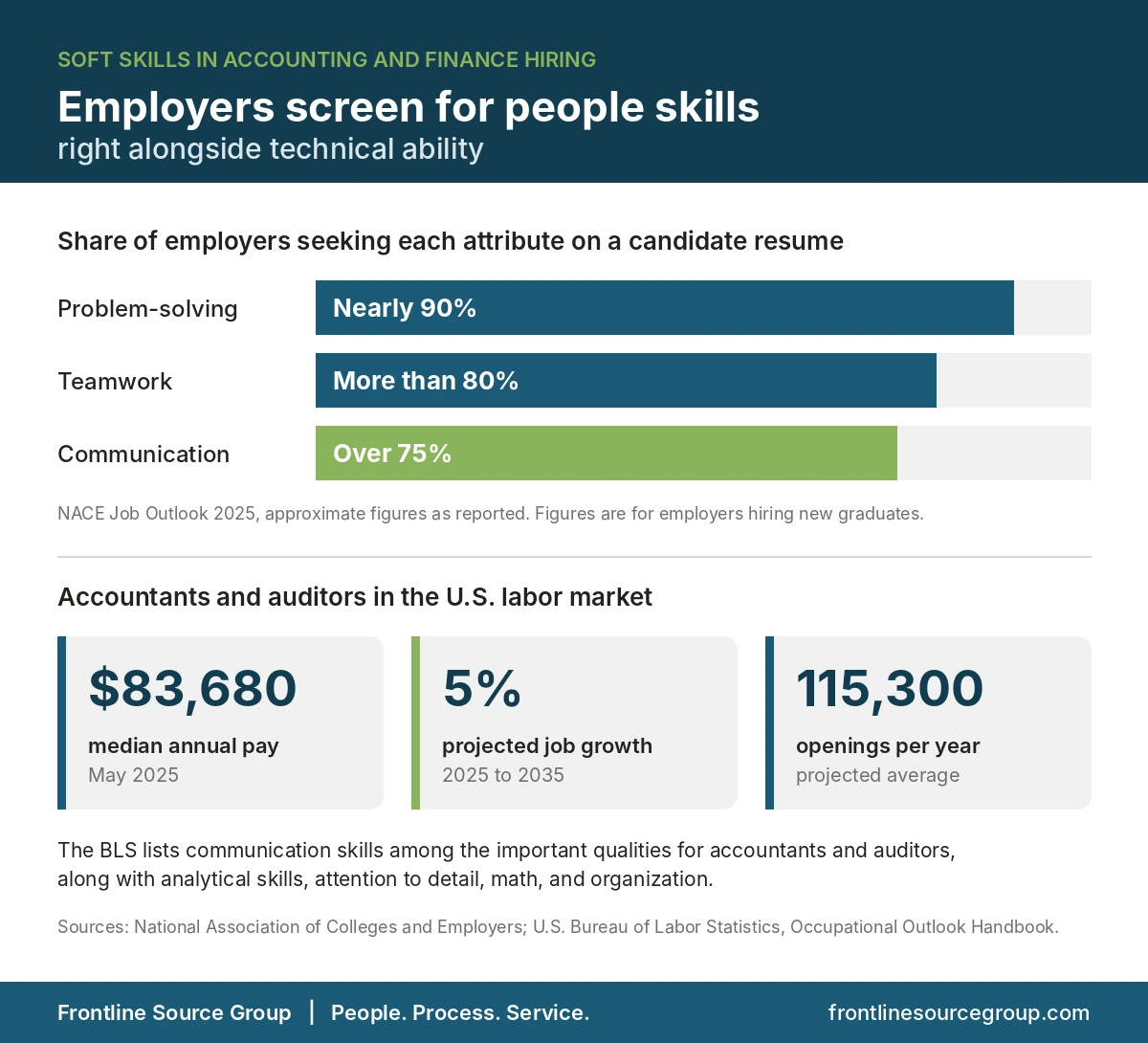
In the National Association of Colleges and Employers (NACE) Job Outlook 2025 survey, nearly 90% of employers said they look for evidence of problem-solving on a candidate's resume, more than 80% look for teamwork, and over three-quarters look for communication skills. Those figures come from employers hiring new graduates, but the pattern holds as careers progress. The higher the role, the more these skills carry the weight.
What does the Bureau of Labor Statistics say about accountants' key qualities?
The U.S. Bureau of Labor Statistics Occupational Outlook Handbook lists communication skills among the important qualities for accountants and auditors, next to analytical skills, attention to detail, math, and organization. Demand is steady, too. The BLS reports a median annual wage of $83,680 for accountants and auditors as of May 2025, projects 5% employment growth from 2025 to 2035, and expects about 115,300 openings each year on average. With that many openings, the candidates who stand out are rarely the ones with the most technical certifications alone.
Why is communication a critical soft skill in accounting and finance?
One of the most crucial soft skills in accounting and finance is effective communication. As an accountant, I understand the importance of clear and concise communication when dealing with clients, colleagues, or even regulators. Without strong communication skills, it can be challenging to explain complex financial data, convey your ideas effectively, or build trust with clients and colleagues.
In my recruiting work, I often observe that candidates with excellent communication skills tend to perform better in interviews and excel in their roles. Employers value professionals who can express their ideas, listen actively, and collaborate effectively within a team. Clear communication helps reduce misunderstandings, streamlines processes, and ultimately delivers better results. Frontline's accounting and finance staffing practice evaluates communication skills during every candidate screen, not just technical proficiency.
How do accountants explain complex numbers to non-finance audiences?
Lead with the answer, then the support. A department head wants to know whether the quarter is on budget and why, not how the accrual was booked. Strong finance communicators translate variances into business terms, use one clear chart instead of five tabs, and say plainly what they recommend. They also listen. Asking what a stakeholder actually needs to decide is often the fastest way to make a report useful.
How do leadership and teamwork shape accounting and finance careers?
Accounting and finance professionals are no longer just number crunchers. They often find themselves leading teams, managing projects, and working in cross-functional groups. Leadership and teamwork skills are invaluable, because they enable individuals to inspire and guide their peers while fostering a culture of collaboration.
Being an accounting professional has taught me that leadership is about more than managing numbers; it is about motivating and influencing others to achieve common goals. In my recruiting work, I have noticed that candidates who can demonstrate leadership and teamwork are in high demand. Employers want individuals who can manage their own tasks and also inspire others to perform at their best. This is especially true at the senior and executive level, where our accounting and finance executive search practice places Controllers, CFOs, and Finance Directors whose ability to lead cross-functional teams matters as much as their technical credentials.
What does leadership look like before you manage people?
Leadership shows up long before a title does. Owning the month-end close checklist, training a new hire on the reconciliation process, flagging a control gap before audit season, or volunteering to document a messy workflow are all leadership. Hiring managers notice these moments, and they are exactly the stories that make a candidate credible for a supervisor or manager role.
Why are problem-solving abilities so valued in finance roles?
In accounting and finance, problem-solving is a daily task. Whether it is analyzing financial discrepancies, resolving complex issues, or making critical decisions, professionals in these fields must be adept problem-solvers. While technical knowledge is essential, the ability to think critically and find innovative solutions is equally crucial.
My background in the industry has taught me that the ability to tackle complex financial problems, adapt to changing regulations, and identify opportunities for improvement is highly prized. From my perspective as a recruiter, candidates who demonstrate strong problem-solving skills stand out in the job market. Employers value those who approach challenges with a logical and creative mindset.
How do you show problem-solving in an interview?
Tell a specific story with a measurable outcome. Use the STAR format: the Situation, the Task you owned, the Action you took, and the Result. For example, a reconciliation that kept failing, the root cause you traced to a mapping error in the ERP, the fix you put in place, and the hours saved each close afterward. Specifics like dollar amounts, timeframes, and who you worked with make the story believable. Frontline's interview instructions walk through how to prepare.
Which soft skills matter most at each stage of an accounting and finance career?
The mix changes as responsibilities grow. Here is what recruiters listen for at each level.
What matters most at the staff level?
For Accounts Payable, Accounts Receivable, Staff Accountant, and Bookkeeper roles, the most valued soft skills are attention to detail, reliability, and the habit of asking a clarifying question when instructions are unclear rather than guessing and creating errors downstream. Communication at this level is mostly written and transactional, so clear, accurate emails and notes go a long way.
What matters most at the senior and manager level?
For Senior Accountants, Accounting Managers, Financial Analysts, and Budget Managers, the shift is toward peer communication and upward influence. That means translating financial data into plain-language explanations for department heads, pushing back constructively when assumptions are flawed, and developing junior team members without becoming a bottleneck.
What matters most at the Controller and CFO level?
For Controllers, Directors of Finance, VPs of Finance, and CFOs, the dominant skills are strategic communication with boards, investors, and lenders, change management through system implementations or acquisitions, and executive presence: being seen as a credible, calm authority when the stakes are high. Technical mastery is assumed at this level, so these skills often decide who gets the offer.
How do soft skills affect long-term success in accounting and finance?
While technical skills are the foundation of a successful career in accounting and finance, soft skills like communication, leadership, and problem-solving are equally vital. As an accountant turned recruiter, I have seen how the industry places more emphasis on these skills every year. The ability to communicate effectively, lead teams, and solve problems not only sets professionals apart but also supports long-term success in an ever-evolving profession.
So whether you are a seasoned professional or just starting your career, remember that your soft skills are as important as your technical expertise. Invest in developing them, and you will find yourself better equipped to excel. If you are ready to take the next step in your accounting or finance career, submit your resume to Frontline Source Group to connect with a recruiter who understands both sides of the desk.
Frequently Asked Questions: Soft Skills in Accounting and Finance
Which soft skills matter most at different career levels in accounting and finance?
It shifts as you advance. At the staff level, attention to detail, reliability, and asking clarifying questions matter most. At the senior and manager level, the focus moves to explaining financial data in plain language, pushing back constructively, and developing junior staff. At the Controller and CFO level, strategic communication with boards and lenders, change management, and executive presence become the main differentiators.
How do accounting and finance professionals demonstrate soft skills on a resume?
Show them through results instead of listing them as traits. Rather than writing detail-oriented, describe what your attention to detail produced, such as discrepancies you caught in a reconciliation and what that saved. Communication shows up in presentations to leadership or documentation for non-finance teams, leadership in mentoring or leading an implementation, and problem-solving in turnaround stories. Frontline's recruiters coach candidates on this framing before submission, so the strongest examples are on the page before a client ever sees it.
How do employers evaluate soft skills during accounting and finance interviews?
Mostly through behavioral questions, such as asking about a time you delivered a financial finding leadership did not want to hear. Strong answers use the STAR format, covering Situation, Task, Action, and Result, with specific dollar amounts, timeframes, and stakeholders. Technical rounds reveal soft skills too: how you handle a question you cannot answer, whether you ask clarifying questions, and how clearly you explain your reasoning. Frontline's recruiters prepare candidates for the competencies and interview format each client uses.
What does Frontline Source Group look for in accounting and finance candidates beyond technical skills?
Behavioral signals that predict long-term success, which matters because every Frontline direct hire is backed by the 5-Year Placement Warranty. Recruiters pay attention to how candidates describe past managers and colleagues, how they handle clarifying questions, and whether they explain career moves in terms of growth rather than conflict. They also match communication and work style to each client's culture, since that fit matters as much as technical background. Accounting and finance candidates can submit a resume at frontlinesourcegroup.com/how-to-apply.html.
Are soft skills more important than technical skills in accounting and finance?
Neither replaces the other. Technical skills are the price of entry, and no amount of communication ability makes up for inaccurate work. Soft skills are the multiplier that decides how far technical competence travels. Two candidates with identical credentials can have very different careers if only one can present to a board, lead a system conversion, and earn trust outside finance. In our experience placing accounting and finance professionals nationwide, the fastest risers pair strong fundamentals with those skills.
Can soft skills be learned, or are they innate?
They can be learned. Some people start with natural advantages, but soft skills improve with deliberate practice. Communication gets better by presenting findings regularly and asking for feedback. Leadership grows with progressively larger responsibilities, from mentoring one colleague to running a close. Problem-solving sharpens with varied challenges and honest reflection. The professionals who plateau usually stop investing in these skills once their technical training is done.
Why do accounting and finance employers increasingly prioritize soft skills?
Automation has absorbed much of the routine work that once defined entry-level accounting, so human value has shifted toward judgment, communication, and collaboration. Finance teams are also more involved in strategy than they were a generation ago, which rewards people who can turn numbers into a clear story for operations and leadership. Employers have also learned that communication and culture mismatches are harder to spot and more disruptive than technical gaps, so more clients ask us to weight soft skills heavily.
What soft skills do CFOs and Controllers need most?
Strategic communication, change management, and executive presence. Senior finance leaders must present financial reality clearly to boards, investors, and lenders, lead teams through system implementations, acquisitions, and restructurings, and stay composed when the stakes are high. Technical mastery is assumed at this level, so these skills become the main differentiators. Frontline's executive search practice assesses them as rigorously as technical and regulatory expertise.
How does working with a recruiter help me develop and present soft skills?
A specialized recruiter coaches you to frame accomplishments so your soft skills show up as results, prepares you for each client's interview format and the competencies they evaluate, and tells you whether an organization values assertive communicators or consensus-builders. That preparation is something candidates applying on their own rarely get.
What industries does Frontline Source Group recruit accounting and finance talent for?
Technology, healthcare, energy, manufacturing, professional services, and financial services, among others. Roles run from Accounts Payable clerks, Bookkeepers, and Staff Accountants through Accounting Managers and Controllers to VPs of Finance and CFOs, on a contract, contract-to-hire, or direct hire basis. Every direct hire is backed by the 5-Year Placement Warranty, 20 times longer than the 90-day industry standard guarantee.
Who is Shelly Hubble?
Shelly Hubble, CSP, is the Senior Vice President of Operations at Frontline Source Group, where she leads day-to-day operations and the executive recruiting team alongside Founder and CEO Bill Kasko. She holds the Certified Staffing Professional credential from the American Staffing Association, is an SMU alumna, and has deep experience across accounting, finance, energy, and C-suite executive search.
How do I work with Frontline Source Group on an accounting or finance job search?
Candidates can submit a resume at frontlinesourcegroup.com/how-to-apply.html, and a recruiter who specializes in accounting and finance will review your background and reach out about matching opportunities. Frontline never charges job seekers a fee. Employers looking to hire accounting and finance talent can submit a request at frontlinesourcegroup.com/employer-request-form.html to be matched with a dedicated recruiter, with every direct hire placement backed by the 5-Year Placement Warranty.


