How Is Grocery Management Recruitment Changing in 2026?

Published on: May 20, 2026
Updated on: October 11, 2026
Grocery management recruitment in 2026 is shifting toward leaders who can run omnichannel operations on thin margins. With 80 percent of food retailers now selling online and profit margins around 2 percent, chains want store, district, and regional leaders who pair classic operator skills with digital fluency, team development, and a real succession plan. Frontline Source Group's grocery and retail practice is led by Mike Cook, "Grocery Store Mike," who spent 35 plus years in grocery operations before moving into executive search. The firm has completed 5,619 plus placements since 2004 and backs every direct hire with the 5-Year Placement Warranty, 20 times longer than the 90-day industry standard guarantee. Certain restrictions apply.
Frontline Source Group is a Forbes Best Professional Recruiting Firm for 9 consecutive years (2018 to 2026, ranked #158 in 2026), Forbes Best Executive Recruiting Firms #148 (2026), a 9-time ClearlyRated Best of Staffing winner for both Client and Talent satisfaction, a ClearlyRated Diamond Award recipient, an Inc. 5000 honoree, and an Expertise.com Best Staffing Agency. The firm is a member of the American Staffing Association, holds a 5.0-star Trustpilot rating across 679 plus verified reviews, and has a 98.94% executive placement retention rate across 32 plus offices nationwide.
Why is grocery management recruitment changing so fast?
Three pressures are hitting grocery leadership at the same time, and each one changes who chains need to hire.
Consolidation and ownership changes
Mergers, acquisitions, and private equity roll-ups keep redrawing the map of regional and national chains. Every deal brings leadership turnover and integration hiring across operations, merchandising, supply chain, and corporate roles, often at the same time.
The omnichannel operating model
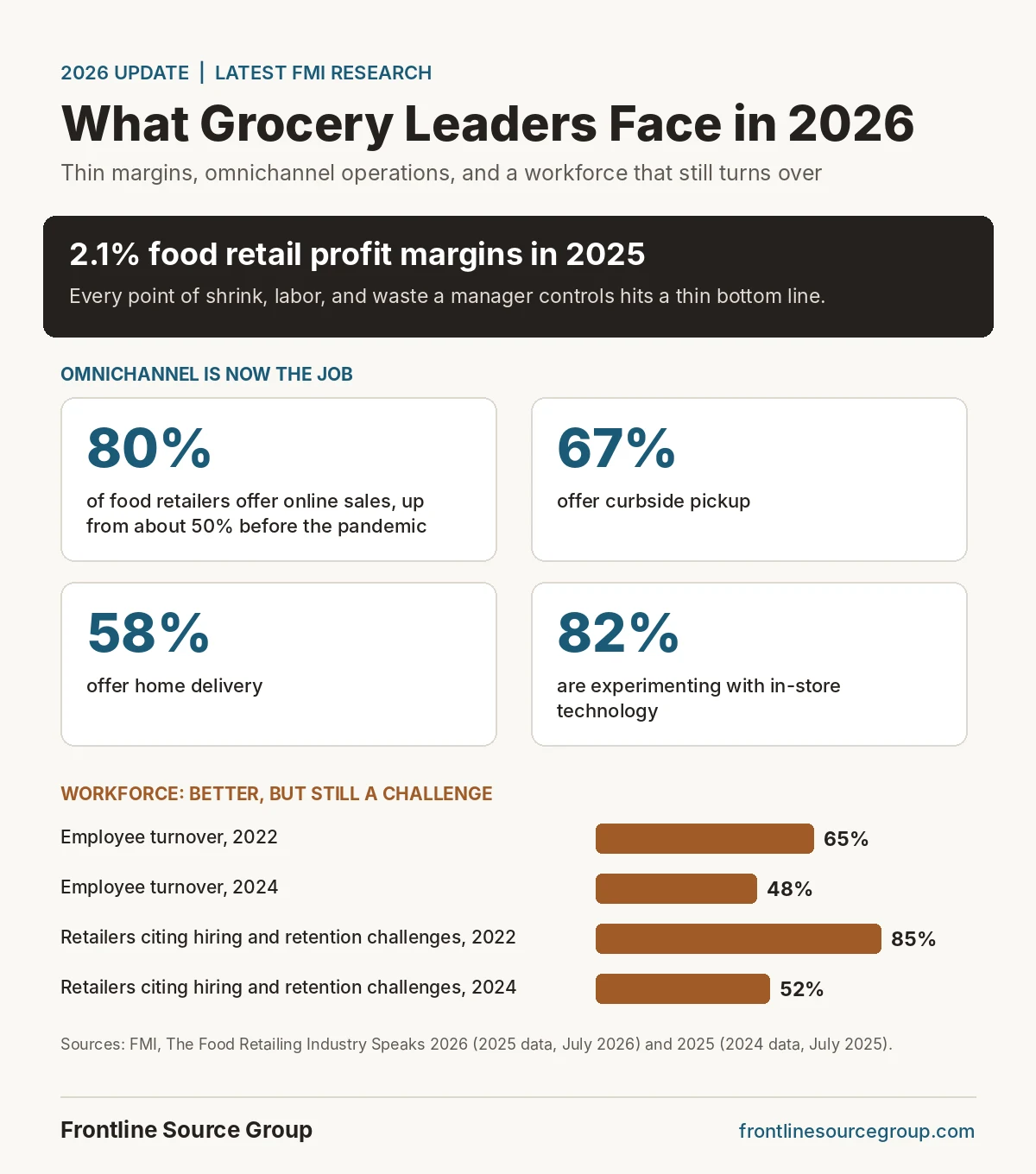
The store manager's job now includes running a fulfillment center. According to FMI's The Food Retailing Industry Speaks 2026, 80 percent of food retailers now offer online sales, up from about half before the pandemic. Sixty-seven percent offer curbside pickup, 58 percent offer home delivery, and 82 percent are experimenting with in-store technology. All of that runs on profit margins of about 2.1 percent. A candidate who can run a clean, profitable store but can't read a fulfillment dashboard or manage a third-party delivery partnership is losing out to candidates who can do both.
The operator bench gap
Many of the industry's most experienced operators are reaching retirement, and not every chain has developed the next generation behind them. Chains without a succession plan end up competing for outside talent in the middle of a transition, which is the most expensive time to hire. FMI's prior report found employee turnover fell from 65 percent in 2022 to 48 percent in 2024, and the share of retailers citing hiring and retention challenges dropped from 85 percent to 52 percent. That's progress, but it still means about half of grocers are fighting to hire and keep good people.
What grocery management roles are in highest demand?
Frontline's grocery and retail desk sees steady demand across the full operator stack:
- Store Manager and Assistant Store Manager, across formats from convenience to supercenter
- District Manager and Area Manager with multi-store oversight
- Regional Vice President and Regional Director of Operations
- Director and Senior Director of Operations
- Vice President of Operations and Chief Operating Officer
- Vice President of Merchandising and Category Manager for fresh, center store, perishables, and private label
- Vice President of Supply Chain and Director of Logistics
- Director of Pharmacy and Pharmacist in Charge
- Director of Loss Prevention and Asset Protection
- Director of HR and Vice President of People for grocery retail
- Chief Marketing Officer, Chief Financial Officer, and Chief Information Officer
- President and Chief Executive Officer
What skills matter most for grocery managers today?
Nothing has been taken off the list. New skills have just been added on top.
Operator fundamentals
Shrink control, labor scheduling, perishables yield, vendor negotiation, weekly P and L ownership, and the ability to run a clean, well-stocked, friendly store still decide whether a manager succeeds. With margins around 2 percent, every one of those levers matters.
Digital and omnichannel fluency
Managers need to act on dashboards, not just receive reports. That means comfort with workforce management systems like UKG, replenishment platforms, and e-commerce tools, plus a working understanding of substitution rates, order accuracy, and the economics of online orders versus in-store sales. Experience running curbside, delivery handoff, and third-party delivery partnerships is now a real differentiator.
People development and resilience
The best candidates can spot high-potential associates and grow them into department managers, assistant store managers, and store managers. They've also led through supply disruptions, labor shortages, severe weather, and price increases. Sustainability work, from food waste reduction to refrigeration efficiency, is increasingly part of the job, as is building teams that reflect the communities a store serves.
Why does grocery operating experience matter in a recruiter?
Because it changes the conversation on both sides. Mike Cook spent 35 plus years in grocery, hiring, training, and developing leaders at operations ranging from small independent supermarkets to chains with hundreds of locations, before joining Frontline Source Group.
When a candidate describes turning around a struggling store, Mike can dig into the real mechanics: the staffing changes, the merchandising resets, the shrink discipline, and the vendor conversations behind the result. Recruiters without that background often can't tell a real operator story from a polished one. On the employer side, grocery chains differ a great deal in format, geography, supplier relationships, union exposure, and culture. A leader who thrives at one large regional chain may struggle at another, not because of talent but because of fit. Operating experience lets Mike judge that fit before both sides invest in a long interview process.
How do specialized recruiters improve grocery management hiring?
They do four things most internal HR teams can't do at scale. First, they reach passive candidates. The best grocery operators usually aren't job hunting; they're running stores and hitting plan. A specialized recruiter keeps relationships with those people over years. Second, they screen like an operator, asking the questions that separate someone who can describe a P and L from someone who has owned weekly P and L decisions. Third, they know the compensation market across regions, formats, and ownership structures, including public, private, family-owned, cooperative, and union chains. Fourth, they protect retention by getting the fit right the first time, which is what makes Frontline's 5-Year Placement Warranty sustainable.
Which grocery sectors does Frontline Source Group recruit for?
Frontline's grocery and retail executive search practice covers the full grocery landscape:
- National and regional supermarket chains
- Independent and family-owned grocers
- Specialty grocery, including natural, organic, ethnic, and gourmet
- Warehouse club and bulk retail
- Convenience store operators with foodservice programs
- Discount and limited-assortment formats
- Cooperative and union-affiliated grocers
- Foodservice distribution and grocery wholesale
- Online grocery and meal kit operators
- Grocery pharmacy, supported by Frontline's pharmacist executive search desk
What are the best practices for grocery management recruitment?
Five practices consistently lead to better grocery hires.
Write job descriptions for the store you run today, not the one from ten years ago. Add omnichannel responsibilities, the digital tools the manager will own, and your expectations for developing people.
Interview for decisions, not just resumes. Ask candidates to walk through a labor reduction, a category reset, a supplier dispute, or a recovery from a big shrink or out-of-stock problem. Real operators give detailed answers.
Use contract-to-hire for transitional leadership. During an acquisition, turnaround, or leadership change, an interim leader with the option to convert lowers risk for both sides. Frontline supports contract, contract-to-hire, and direct hire engagements, and the 5-Year Placement Warranty applies when a contract leader converts to direct hire.
Build a succession bench, not just a candidate slate. A single search fills a vacancy. A bench identifies the next two or three leaders for each critical role.
Benchmark pay to your region and format. A district manager package at a Texas independent grocer looks very different from one at a Northeast union chain, and a specialized recruiter sees real offers across both.

What is the outlook for grocery management recruitment?
Three trends will keep building through the rest of the decade. AI-assisted forecasting, replenishment, and scheduling will become standard, and leaders who won't engage with those tools will fall behind. Sustainability will shift from a marketing program to a store-level operating measure. And with margins this thin, retention and internal promotion will matter as much as outside hiring below the vice president level. The chains that build a succession bench now will be in the best position when the next round of consolidation comes.
What makes Frontline Source Group different from other grocery executive search firms?
First, the 5-Year Placement Warranty. Most search firms offer a 90-day guarantee. Frontline's warranty is 20 times longer, with a pro-rated credit based on active calendar days of service if a placed hire leaves within five years. Certain restrictions apply. It's backed by a 98.94% executive retention rate, compared with an industry average around 70 percent.
Second, a recruiter who has run stores. Mike Cook brings 35 plus years of grocery operations to every search, so candidate screening and fit assessment go deeper than a generalist can.
Third, outside recognition and transparency. Frontline has been on the Forbes Best Professional Recruiting Firms list for 9 consecutive years and publishes its engagement model on its pricing page, which is rare in staffing.
How do you get started with Frontline Source Group's grocery executive search team?
Grocery and retail employers can outline a role through the employer request form, and Mike Cook or another recruiter on the grocery and retail desk will follow up to scope the search. Grocery management candidates can apply at frontlinesourcegroup.com/how-to-apply.html and complete skills testing.
Frequently Asked Questions: Grocery Management Recruitment
How is grocery management recruitment changing in 2026?
Grocery chains are hiring leaders who can run omnichannel operations on thin margins. Consolidation, the shift to online ordering and delivery, and a thinning bench of experienced operators are pushing demand toward candidates who combine classic store operations skills with digital fluency, team development, and succession planning.
How are thin margins and online grocery changing the store manager role?
FMI's 2026 report found food retail profit margins of about 2.1 percent, while 80 percent of food retailers now offer online sales, 67 percent offer curbside pickup, and 58 percent offer home delivery. Store managers now run fulfillment alongside the store, and shrink, labor, and waste control matter more than ever.
What grocery management roles are in highest demand?
Demand is steady for store managers, district managers, regional vice presidents, directors and vice presidents of operations, COOs, merchandising and category leaders, supply chain leaders, directors of pharmacy, loss prevention leaders, HR leaders, and C-suite roles for grocery retail.
What skills are most in demand for grocery management roles today?
Operator fundamentals like shrink control, labor scheduling, perishables yield, vendor negotiation, and P and L ownership remain essential. On top of those, chains want digital and omnichannel fluency, people development, crisis leadership, and sustainability experience.
Is grocery employee turnover improving?
Yes, but it is still high. FMI reported that grocery employee turnover fell from 65 percent in 2022 to 48 percent in 2024, and the share of retailers citing hiring and retention challenges dropped from 85 percent to 52 percent.
Who is Mike Cook and why does grocery experience matter in recruitment?
Mike Cook, known as "Grocery Store Mike," is Frontline Source Group's Grocery, Retail, and Pharmacy Executive Recruiter, with 35 plus years of grocery operations experience before executive search. That background lets him test candidates' operating stories in detail and judge fit against each chain's format, culture, and operating model.
How do specialized recruiters improve grocery management hiring?
Specialized recruiters reach passive operators who aren't job hunting, screen candidates the way an experienced operator would, benchmark compensation across regions, formats, and ownership types, and get the fit right the first time to protect retention.
What grocery industry sectors does Frontline Source Group recruit for?
Frontline recruits for national and regional supermarket chains, independent and family-owned grocers, specialty grocery, warehouse clubs, convenience operators with foodservice, discount formats, cooperatives and union-affiliated grocers, foodservice distribution and wholesale, online grocery, and grocery pharmacy. Details are at frontlinesourcegroup.com/executive-search-grocery-store-and-retail.html.
What are the best practices for grocery management recruitment?
Write job descriptions that reflect today's omnichannel store, interview for specific operating decisions, use contract-to-hire for transitional leadership, build a succession bench for critical roles, and benchmark pay to your region and format.
What is the 5-Year Placement Warranty?
The 5-Year Placement Warranty is Frontline Source Group's protection on direct hire placements, including grocery and retail leaders. It is 20 times longer than the 90-day industry standard guarantee and provides a pro-rated credit based on active calendar days of service if a placed hire leaves within five years. Certain restrictions apply. Terms are at frontlinesourcegroup.com/5year-placement-guarantee.html.
What awards has Frontline Source Group won?
Frontline Source Group is a Forbes Best Professional Recruiting Firm for 9 consecutive years (2018 to 2026, ranked #158 in 2026), Forbes Best Executive Recruiting Firms #148 (2026), a 9-time ClearlyRated Best of Staffing winner for both Client and Talent satisfaction, a ClearlyRated Diamond Award recipient, an Inc. 5000 honoree, an Expertise.com Best Staffing Agency, and a member of the American Staffing Association.
How do I get started with Frontline Source Group's grocery executive search team?
Employers can start a search at frontlinesourcegroup.com/employer-request-form.html and review engagement details at frontlinesourcegroup.com/pricing.html. Grocery management candidates can apply at frontlinesourcegroup.com/how-to-apply.html.


