How Is Technology Transforming Staffing and Recruitment in Dallas?

Published on: Jul 25, 2025
Updated on: November 7, 2026.
Technology is changing Dallas staffing agencies by handing the research and scheduling work to software, so recruiters spend more of their time judging fit. Frontline Source Group, founded in Dallas in 2004, pairs three AI recruiters with human recruiters who make every hiring call, and backs every direct hire with the 5-Year Placement Warranty.
Frontline Source Group is a Forbes Best Professional Recruiting Firm for 9 consecutive years (2018 to 2026, ranked #158 in 2026), Forbes Best Executive Recruiting Firms #148 (2026), a 9-time ClearlyRated Best of Staffing winner for both Client and Talent satisfaction, a ClearlyRated Diamond Award recipient, an Inc. 5000 honoree, and an Expertise.com Best Staffing Agency. The firm is a member of the American Staffing Association (ASA), holds a 5.0-star Trustpilot rating across 683 verified reviews and a 5.0 rating on G2 from validated reviewers, has completed 5,619 plus placements from 32 plus offices, and tracks a 98.94% executive placement retention rate against an industry average of 70 percent. People. Process. Service.
TL;DR
- For employers: technology lets a good agency search wider and vet deeper, but a person should still read every candidate before you see a name.
- For candidates: a complete LinkedIn profile and a full application make you easier for AI sourcing to find. At Frontline, your first interview after applying is with Lexi Reed, and a human recruiter reviews you next.
- The rules: Texas's TRAIGA law took effect January 1, 2026 and bars AI used with intent to unlawfully discriminate.
- The public view: 71 percent of Americans oppose AI making the final hiring decision (Pew Research Center), which is why Frontline keeps that decision with people.
In this article
- How technology changed staffing
- The recruiting tech stack
- How AI works, and where it stops
- Frontline's AI recruiters
- How job seekers feel about AI
- Texas AI hiring law
- Why Dallas leans on recruiting tech
- Technology challenges
- The future of staffing tech
- What it means for you
- How to get started
- Common questions
How has technology changed the way Dallas staffing agencies work?
Technology has changed the whole recruiting workflow, not just one step. The shift shows up in five places:
- Sourcing: AI tools can scan far larger candidate populations across professional networks, job board databases, and an agency's own candidate pool than a recruiter could ever canvass by hand.
- Ranking: models that look at career progression, scope of responsibility, platform skills, and certifications surface strong candidates that keyword matching misses.
- Screening: structured interviews, asynchronous video, and skills assessments replace much of the old phone tag.
- Planning: analytics help agencies see which roles are getting harder to fill and build pipelines before demand peaks.
- Candidate experience: automated status updates and scheduling close the long silences that used to frustrate job seekers.
What recruitment technologies are Dallas staffing agencies using?
A modern agency stack usually covers about ten categories: an applicant tracking system for the candidate database and workflow, a recruiting CRM for long-term client and candidate relationships, AI sourcing tools, video interview platforms, pre-employment skills testing, automated reference checks, background check integrations, salary benchmarking data, pipeline analytics, and communication automation. Frontline also offers candidate sourcing services for employers that want sourcing depth without a full search engagement.
How does AI work in Dallas recruiting, and where does it stop?
AI is good at volume and pattern-finding. It is not good at reading people. The agencies doing this well draw a clear line between the two.
What does AI do well in recruiting?
Three things. It widens the search, finding people whose function, industry, seniority, and location match a role across far more profiles than a person can review. It ranks more precisely, weighing things like company size progression, budget responsibility, named software skills, and career trajectory. And it handles routine work such as scheduling, status updates, and first-round questions, so recruiters can focus on judgment.
What should stay with human recruiters?
Technical vetting, behavioral assessment, the hard conversations with candidates and hiring managers, offer negotiation, confidential searches, and the long-term relationship that decides whether a hire stays. Those are the steps behind Frontline's 98.94% executive placement retention rate, and they are why every direct hire is backed by the 5-Year Placement Warranty, 20 times longer than the 90-day guarantee common in staffing.
How does Frontline Source Group use AI recruiters?
Frontline works with three AI teammates and is open about the fact that they are AI. Each one has a specific job, and none of them makes a hiring decision.
What does Joy Lee do?
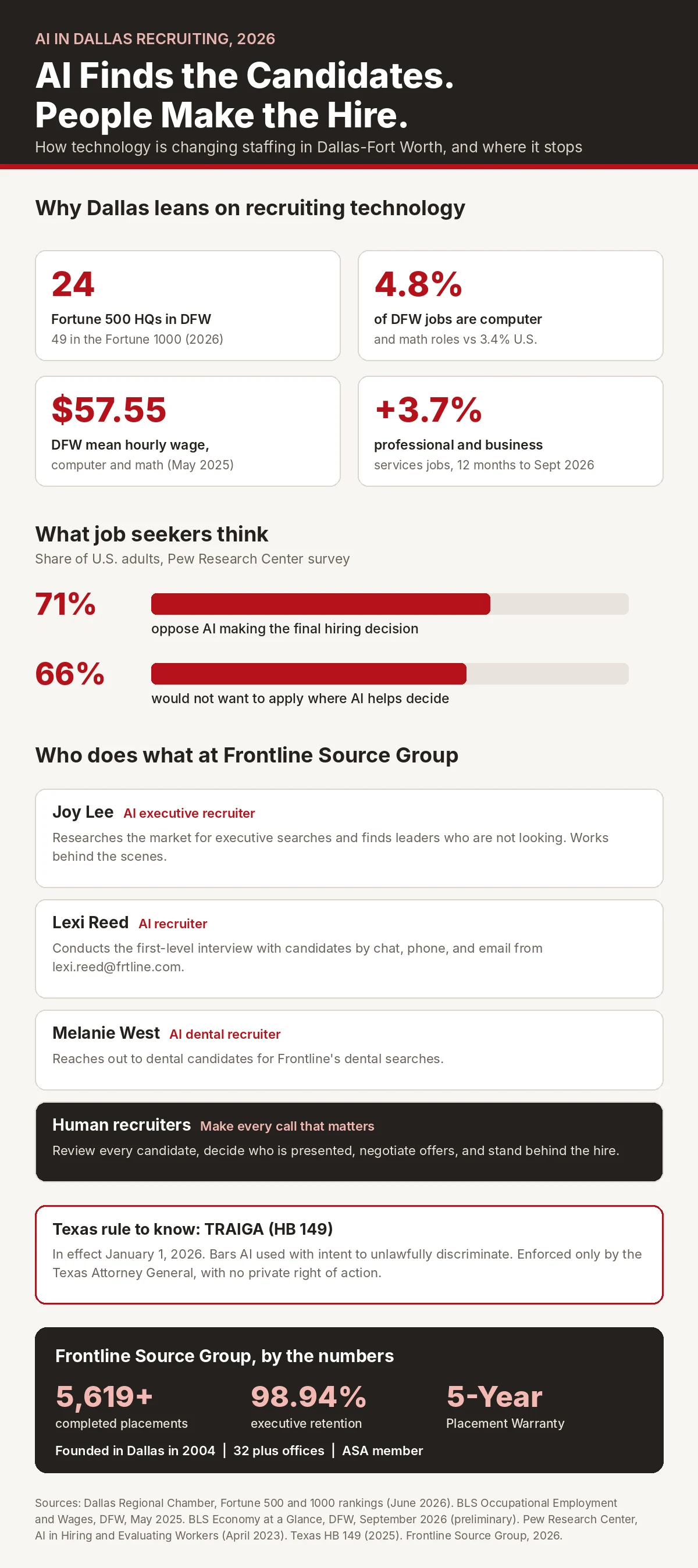
Joy Lee is Frontline's AI executive recruiter. Joy works behind the scenes on executive searches, mapping the market, finding leaders who are not looking, and pulling together what is publicly known about their careers. Most candidates never talk with Joy. What Joy finds goes to a human recruiter, who decides who is worth a call.
What does Lexi Reed do?
Lexi Reed is the AI recruiter candidates talk with. She has answered questions in the website chat since 2015 and now conducts full first-level phone interviews, calls candidates, answers return calls, and follows up by email from lexi.reed@frtline.com. A call from Lexi is triggered when a candidate applies or uploads a resume. A human recruiter reviews every candidate after the Lexi interview.
What does Melanie West do?
Melanie West is Frontline's AI dental recruiter. She reaches out to dental candidates by phone and text for Frontline's dental searches, with the same rule: people make the decisions. You can read more about the overall approach on the AI staffing page.
"We use AI for the work that used to bury our recruiters: research, first interviews, and follow-up. We don't let it decide who gets hired. A person reads every candidate before a client ever sees a name, and that's the part of the job I never want to automate."
Bill Kasko, Founder, President, and CEO, Frontline Source Group, leading the firm since founding it in Dallas in 2004
How do job seekers feel about AI in hiring?
Many are wary, and agencies should take that seriously. In a Pew Research Center survey of 11,004 U.S. adults conducted in December 2022 and published in April 2023, 71 percent opposed AI making the final hiring decision, compared with 7 percent in favor. Sixty-six percent said they would not want to apply for a job with an employer that uses AI to help make hiring decisions. That is a strong argument for being transparent about where AI is used and for keeping the final call with people.
What Texas law applies to AI in hiring?
The Texas Responsible Artificial Intelligence Governance Act (TRAIGA, House Bill 149) was signed on June 22, 2025 and took effect January 1, 2026. For private employers, it bars developing or using AI with the intent to unlawfully discriminate against a protected class. Disparate impact alone is not enough to show a violation, the Texas Attorney General is the only enforcer, and there is no private right of action. Employers using AI in hiring should still document how their tools work and review outcomes, because federal and other state anti-discrimination laws continue to apply.
I am not a lawyer, and this section is general information, not legal advice. If you have questions about how AI hiring laws apply to your organization, consult an attorney.
How does Dallas's corporate base shape staffing technology?
Dallas-Fort Worth is home to 24 Fortune 500 headquarters and 49 Fortune 1000 headquarters on the 2026 lists, according to the Dallas Regional Chamber. That concentration creates hiring volume that justifies real investment in recruiting technology. The sector mix adds breadth: banks and financial services firms need fintech and ERP-savvy accounting talent, the Telecom Corridor in Richardson needs software, network, and security talent, the Fort Worth aerospace and defense cluster needs security-conscious sourcing, and large hospital systems need healthcare operations and revenue cycle professionals.
Technology roles are a bigger share of the market here than nationally. Computer and mathematical occupations make up 4.8 percent of DFW employment versus 3.4 percent nationally, with a mean hourly wage of 57.55 dollars in May 2025, according to the Bureau of Labor Statistics. Professional and business services, which includes staffing, grew 3.7 percent in the 12 months to September 2026 (preliminary). Frontline's Dallas IT staffing team and Dallas office recruit across this market.
What technology challenges do Dallas staffing agencies face?
Five challenges come up most often:
- Integration: connecting the ATS, CRM, AI sourcing, video interview, and assessment tools into one workflow without data silos takes real effort.
- Privacy and compliance: searches often cross state lines, so agencies have to follow state privacy laws and the federal Fair Credit Reporting Act for background checks.
- Transparency: black-box scoring is not acceptable for senior placements, so agencies need to explain why a candidate was ranked where they were.
- Bias: AI can reduce or amplify bias depending on how it is built and run, and only ongoing review shows which is happening.
- The human element: technology should handle the parts of recruiting where volume is the bottleneck, not the parts where trust and judgment decide the outcome.
What is the future of staffing technology in Dallas-Fort Worth?
Expect tighter connections between agency tools and the HR systems employers already run, so candidate data flows straight into hiring workflows. Expect models that learn from retention and promotion outcomes, not just first-year turnover. Expect more AI in remote and distributed hiring, where structured assessment matters more than in-person impressions. And expect a shift from generic AI tools toward AI built for staffing work, with clear disclosure that candidates are talking to AI and regular bias reviews. Agencies that combine that capability with published pricing, verified reviews, and long warranties will stand out.
What does this mean for Dallas employers and candidates?
For employers, ask any agency to show you where AI fits in its process and who reviews candidates before you see them. An agency still running a decade-old process will struggle to search as wide or vet as consistently. Frontline publishes its engagement models at frontlinesourcegroup.com/pricing.html and shares client feedback on its testimonials page.
For candidates, AI sourcing finds people with complete profiles. Keep your LinkedIn profile current with your function, industry, seniority, software skills, certifications, and target location. When you apply at frontlinesourcegroup.com/how-to-apply.html, expect a first-level interview with Lexi Reed, followed by review from a human recruiter. And check that any message claiming to be from Frontline comes from an @frtline.com address; the scam alert page lists the warning signs.
How do you get started with Frontline Source Group in Dallas?
Employers can submit a search through the employer request form or call the national hire line at 877-780-3822. Candidates across DFW can apply at frontlinesourcegroup.com/how-to-apply.html. Frontline recruits from its Dallas headquarters and local teams in Plano, Frisco, Addison, Richardson, Irving, Arlington, Lewisville, and Southlake.
All interviews are set by appointment only and we do not allow walk-ins at any location. Everything starts online: candidates apply at frontlinesourcegroup.com/how-to-apply.html, and employers request talent at frontlinesourcegroup.com/employer-request-form.html.
What are the most common questions about technology in Dallas staffing?
How is technology changing Dallas staffing agencies?
Technology is taking over research, sourcing, scheduling, and status updates, and it is improving how agencies rank candidates against a role. That frees recruiters to spend more time on technical vetting, behavioral assessment, and offer conversations. Frontline Source Group pairs three AI recruiters with human recruiters who make every hiring call.
Who is Joy Lee at Frontline Source Group?
Joy Lee is Frontline Source Group's AI executive recruiter, a platform that researches, sources, and evaluates senior leadership talent behind the scenes. Most candidates never talk with Joy directly. What Joy finds goes to a human recruiter, who decides who is worth a call and who is presented. Learn more at frontlinesourcegroup.com/virtual-ai-executive-recruiter.html.
Who is Lexi Reed, and will she contact me?
Lexi Reed is Frontline's AI recruiter. When you apply or upload your resume, Lexi reaches out for a first-level interview by phone and follows up by email from lexi.reed@frtline.com. A human recruiter then reviews every candidate and calls those who match open roles. Learn more at frontlinesourcegroup.com/lexi-reed-ai-executive-recruiter.html.
Will AI replace human recruiters in Dallas?
No. AI is taking over the parts of recruiting that benefit from scale, such as research, sourcing, scheduling, and status updates. Human recruiters still own technical vetting, behavioral assessment, offer negotiation, confidential searches, and the long-term relationship with clients and candidates.
Does AI make hiring decisions at Frontline Source Group?
No. Frontline's AI recruiters research, interview, and organize information, but people make the decisions. A human recruiter reviews every candidate before a client sees a name, and the client makes the hiring decision. Every direct hire is backed by the 5-Year Placement Warranty.
How do Americans feel about AI in hiring?
Many are wary. In a Pew Research Center survey of 11,004 U.S. adults conducted in December 2022, 71 percent opposed AI making the final hiring decision, and 66 percent said they would not want to apply for a job with an employer that uses AI to help make hiring decisions.
Is there a Texas law on AI in hiring?
Yes. The Texas Responsible Artificial Intelligence Governance Act (HB 149) took effect January 1, 2026. It bars using AI with the intent to unlawfully discriminate against a protected class, does not treat disparate impact alone as a violation, and is enforced by the Texas Attorney General with no private right of action. This is general information, not legal advice; consult an attorney about your situation.
Are Dallas staffing agencies using AI for diversity hiring?
AI can reduce certain forms of bias when it is designed and audited correctly, and it can amplify bias when it is not. Agencies that take diversity seriously pair AI sourcing with structured assessment and recruiter judgment. Frontline's team includes recruiters who hold the Certified Diversity Recruiter (CDR) credential.
How can I tell a real Frontline recruiter from a scam?
Every Frontline Source Group email ends in @frtline.com, including Lexi Reed's address, lexi.reed@frtline.com. Frontline never recruits through Gmail, WhatsApp, Signal, or Google Voice and never asks for fees or bank details during outreach. Report anything suspicious to legal@frtline.com and see frontlinesourcegroup.com/scam-alert.html.
What Dallas-Fort Worth areas does Frontline Source Group serve?
Frontline recruits across Dallas-Fort Worth from its corporate headquarters at 901 Main Street, Suite 4650, Dallas, TX 75202, with local teams in Plano, Frisco, Addison, Richardson, Irving, Arlington, Lewisville, Southlake, and other DFW markets. See the Dallas office at frontlinesourcegroup.com/dallas.html.
How long has Frontline Source Group been in Dallas?
Frontline Source Group was founded in Dallas in 2004 by Bill Kasko and has recruited in the Dallas-Fort Worth area for 22 years. The firm operates 32 plus offices nationwide, has completed 5,619 plus placements, and has a 98.94% executive placement retention rate against an industry average of 70 percent.
How do I get started with Frontline Source Group?
Employers can submit a search at frontlinesourcegroup.com/employer-request-form.html, call the national hire line at 877-780-3822, or review engagement models at frontlinesourcegroup.com/pricing.html. Candidates apply at frontlinesourcegroup.com/how-to-apply.html. Candidates never pay a fee.


