How Is Digital Transformation Reshaping Administrative Roles?

Published on: Sep 22, 2024
Updated on: October 5, 2026
Digital transformation is turning administrative roles from task execution into technology-fluent coordination and analysis. Scheduling, correspondence, and filing are being automated, while admins who add platform, data, and AI skills move toward roles like executive assistant, which paid a $76,590 median in 2025. Frontline Source Group backs every direct hire with a 5-Year Placement Warranty.
Table of contents
- What does digital transformation actually mean for administrative roles?
- Which traditional admin tasks are being automated first?
- Are administrative jobs going away?
- What new skills do administrative professionals need to stay relevant?
- How should admin professionals upskill?
- What should employers look for in a modern administrative hire?
- How does Frontline Source Group support admin staffing?
- How do you get started with Frontline Source Group?
- Frequently Asked Questions: Digital Transformation in Admin Roles
Frontline Source Group, founded in Dallas in 2004, places contract, contract-to-hire, and direct hire administrative professionals nationwide from 32 plus offices. We have completed 5,619 plus placements, with a 98.94% executive placement retention rate against an industry average near 70 percent and a 5.0-star Trustpilot rating across 683 plus verified reviews. Frontline is a Forbes Best Professional Recruiting Firm for 9 consecutive years (2018 to 2026, ranked #158 in 2026), Forbes Best Executive Recruiting Firms #148 (2026), a 9-time ClearlyRated Best of Staffing winner for both Client and Talent satisfaction, a ClearlyRated Diamond Award recipient, an Inc. 5000 honoree, an Expertise.com Best Staffing Agency, and a member of the American Staffing Association (ASA).
What does digital transformation actually mean for administrative roles?
Digital transformation in the admin function means moving day-to-day work onto digital tools, automation, and data systems, which changes both how the role works and what it contributes. Calendar management, document preparation, expense reporting, vendor coordination, and meeting logistics are moving onto specialized software, AI-assisted scheduling, cloud document platforms, and workflow tools. The time an admin used to spend filing documents now goes to analysis, coordination, and judgment that software cannot do.
Which traditional admin tasks are being automated first?
The high-frequency, low-judgment routines go first:
- Calendar and meeting coordination. AI-assisted schedulers handle availability, room booking, and recurring meetings.
- Email triage and routine correspondence. AI-assisted drafting, templates, and inbox prioritization handle routine email.
- Expense reporting. Mobile receipt capture pushes expense data straight into approval workflows.
- Document filing and version control. Cloud platforms handle storage, versions, and permissions automatically.
- Travel booking. Corporate travel platforms with built-in policy rules do most routine booking.
- Data entry and form processing. Robotic process automation moves structured data between systems.
- Meeting notes. AI transcription tools capture meetings and produce action-item summaries.
Are administrative jobs going away?
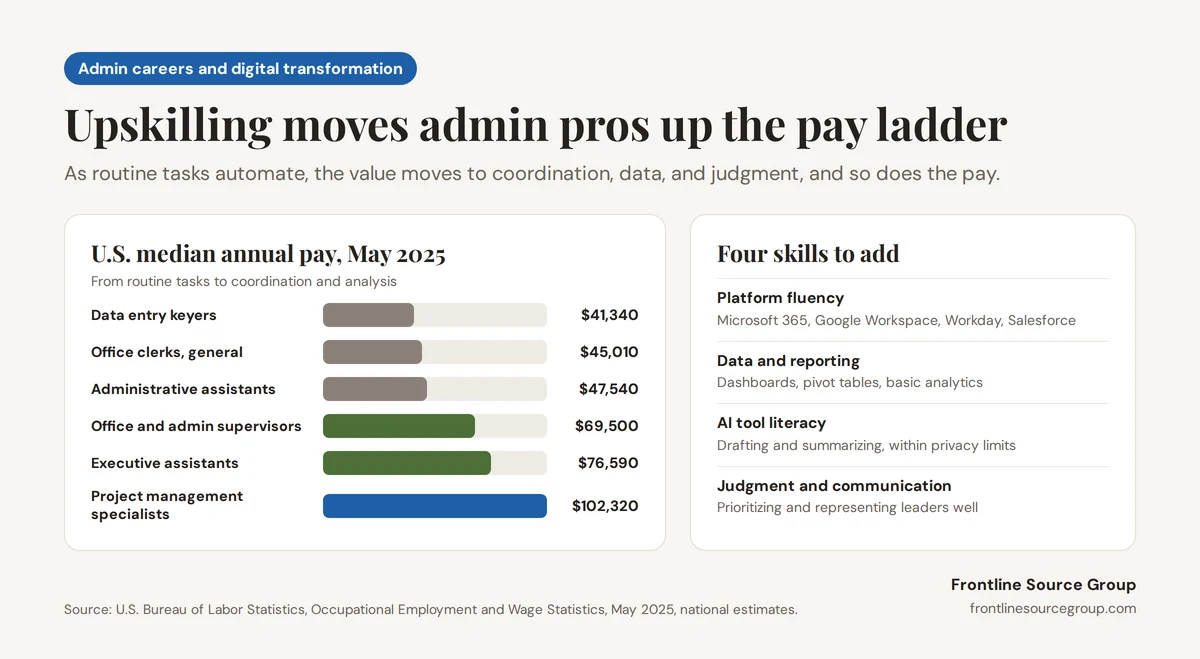
No, but they are changing. The task-execution part of the job is shrinking, and the coordination, analysis, and judgment part is growing. The scale is large: according to the Bureau of Labor Statistics, about 1.7 million secretaries and administrative assistants and about 460,000 executive assistants worked in the U.S. in May 2025. The pay data shows where the value is moving. Routine roles like data entry keyers ($41,340 median) and general office clerks ($45,010) sit at the bottom, while executive assistants ($76,590) and project management specialists ($102,320) sit at the top.
| Occupation | U.S. median annual pay | U.S. jobs |
|---|---|---|
| Data entry keyers | $41,340 | 127,080 |
| Office clerks, general | $45,010 | 2,464,940 |
| Secretaries and administrative assistants | $47,540 | 1,706,790 |
| First-line supervisors of office and administrative support workers | $69,500 | 1,436,680 |
| Executive secretaries and executive administrative assistants | $76,590 | 459,910 |
| Project management specialists | $102,320 | 1,066,670 |
What new skills do administrative professionals need to stay relevant?
- Software platform fluency. Microsoft 365 (especially Outlook, Teams, SharePoint, and Power Automate), Google Workspace, Slack, Zoom, and the employer's CRM, ERP, and HRIS systems. Workday, NetSuite, and Salesforce are now baseline admin tools.
- Data fluency. Reading dashboards, building pivot tables and lookups, and helping leadership pull meaning out of reports.
- AI tool literacy. Using tools like ChatGPT, Claude, Copilot, and Gemini for drafting, summarizing, and documentation, within each tool's data security and privacy limits.
- Judgment and communication. Stakeholder management, executive correspondence, prioritization, and acting as a real force multiplier for senior leaders.
How should admin professionals upskill?
Which certifications help?
Microsoft Office Specialist (MOS) Master, Microsoft Certified: Power Platform Fundamentals, Google Workspace certifications, Workday administrator training, Salesforce Administrator, and the IAAP Certified Administrative Professional (CAP) credential. Pairing a platform credential with a professional association credential signals both technical skill and professional discipline.
How do you build AI and data skills on the job?
Use AI tools in everyday work, learn prompt basics and verification habits, and take an Excel or Google Sheets power-user course followed by an introduction to Power BI or Looker Studio. Then document your impact: automation wins, time saved, and stakeholder feedback. Modern admin roles are judged on results, not tenure.
What should employers look for in a modern administrative hire?
The strongest admin hires bring platform fluency across Microsoft 365 or Google Workspace, comfort with AI tools and the judgment to use them well, basic data literacy, executive presence and discretion, and a record of improving processes rather than just completing tasks. Screen with platform tests, real-work samples (a calendar reorganization, an executive summary, a data pull and summary), and behavioral interviews focused on judgment and prioritization.
How does Frontline Source Group support admin staffing?
Our administrative desk screens candidates against the modern skill set, not the old task list. We place executive assistants, administrative coordinators, office managers, project coordinators, operations coordinators, and senior admin professionals on contract, contract-to-hire, and direct hire terms. The desk is led by Lindsey Davidson, CDR, Senior Lead Executive Recruiter for administrative, HSE, and HR placements. See our administrative staffing and executive assistant search pages.
What does Frontline's pricing look like for admin staffing?
We publish our pricing at frontlinesourcegroup.com/pricing.html, which is rare in staffing. Contract and contract-to-hire admin staffing is billed at a 50 to 85 percent markup on the worker's hourly pay, covering wages, payroll taxes, insurance, and our margin. Direct hire placements run 20 to 30 percent of first-year base salary and are backed by the 5-Year Placement Warranty, with terms at frontlinesourcegroup.com/5year-placement-guarantee.html. All major credit cards are accepted at no additional charge.
How do you get started with Frontline Source Group?
Employers can submit a hiring request at frontlinesourcegroup.com/employer-request-form.html, and a recruiter will follow up to scope the search, or call our national hire line at 877-780-3822. Candidates can apply at frontlinesourcegroup.com/how-to-apply.html; you may get a first-round phone interview from Lexi Reed, our AI recruiter. People. Process. Service.
Frequently Asked Questions: Digital Transformation in Admin Roles
What do administrative professionals earn?
According to May 2025 Bureau of Labor Statistics data, secretaries and administrative assistants earned a median of $47,540, executive secretaries and executive administrative assistants $76,590, and first-line supervisors of office and administrative workers $69,500. Project management specialists, a common next step, earned $102,320.
How do current digital trends impact professional development for admin professionals?
Current digital trends like artificial intelligence, machine learning, cloud computing, and workflow automation are reshaping admin job descriptions and skill requirements. Administrative professionals need to continuously update their skills in software platform fluency, AI tool literacy, basic data analytics, and strategic communication to stay relevant and advance in their careers. The admin professionals who treat upskilling as a continuous discipline are the ones who grow into senior coordinator, chief of staff, and operations leadership roles.
What role does data analytics play in digital transformation for admin work?
Data analytics provides the insights that drive decision-making across the business, and admin professionals increasingly serve as the bridge between data sources and the executives who consume them. Modern admin work involves reading dashboards, building Excel and Google Sheets pivot tables, surfacing trends in internal reporting, and translating numbers into briefings that leadership can act on. Basic data fluency is now a baseline admin skill, not a specialist skill.
How can companies ensure successful digital transformation of their admin function?
Companies can ensure successful digital transformation of the admin function by fostering a culture of innovation, investing in employee training, setting clear objectives aligned with strategic goals, leveraging the right technology stack (Microsoft 365 or Google Workspace, plus the appropriate CRM/ERP/HRIS systems), and maintaining flexibility to adapt as tools evolve. Hiring admin professionals who already operate at the modern competency level accelerates the transformation significantly.
What challenges do organizations face when transforming admin roles?
Organizations face several challenges: resistance to change from long-tenured admin staff, the upfront cost of new technology, cybersecurity and data privacy risks introduced by AI tools, the need for continuous upskilling of the existing workforce, and the difficulty of writing modern admin job descriptions that attract the right candidates. The most successful transformations pair internal upskilling investment with targeted external hiring through specialized staffing agencies.
Which admin tasks are being automated first?
The earliest admin tasks to be automated are high-frequency, low-judgment routines: calendar and meeting coordination, email triage and routine correspondence, expense reporting, document filing and version control, travel booking, structured data entry, and meeting transcription. AI-assisted schedulers, mobile receipt capture, cloud document platforms, corporate travel systems, robotic process automation (RPA), and AI transcription tools have collectively shifted these tasks off the admin professional's plate.
What software platforms should modern admin professionals know?
Modern admin professionals should be fluent in Microsoft 365 (advanced Outlook, Teams, SharePoint, Power Automate) or Google Workspace, plus Slack and Zoom for collaboration. Enterprise systems vary by employer but commonly include Workday, NetSuite, Salesforce, and SAP. AI tool literacy (ChatGPT, Claude, Copilot, Gemini) is now a baseline expectation rather than a specialist skill.
What certifications help admin professionals stay competitive?
High-leverage certifications include the Microsoft Office Specialist (MOS) Master credential, Microsoft Certified: Power Platform Fundamentals, Google Workspace administrator tracks, Workday administrator training, Salesforce Administrator, and the IAAP Certified Administrative Professional (CAP) credential. Combining a platform certification with a professional association credential (IAAP or ASAP) signals both technical competence and professional discipline to hiring managers.
What should employers screen for in a modern admin hire?
Employers should screen on software platform fluency across the full Microsoft 365 or Google Workspace stack, comfort with AI tools and judgment about when to use them, basic data and reporting literacy, demonstrated executive presence and confidentiality discipline, and a track record of process improvement rather than task execution. Real-work samples (a calendar reorganization scenario, an executive summary writing test, a data pull and summarize exercise) outperform resume review for these hires.
Are administrative jobs going away because of AI and automation?
No, but the role is changing. The task-execution part is shrinking and the coordination, analysis, and judgment part is growing. About 1.7 million secretaries and administrative assistants and about 460,000 executive assistants worked in the U.S. in May 2025, according to the Bureau of Labor Statistics. Professionals whose roles consist mostly of automatable tasks are most at risk.
How does Frontline Source Group support admin staffing in the digital transformation era?
Frontline's administrative desk, led by Lindsey Davidson, CDR, screens candidates against the modern skill set rather than the old task list. It places executive assistants, administrative coordinators, office managers, project coordinators, and senior admin professionals on contract, contract-to-hire, and direct hire terms. Details are at frontlinesourcegroup.com/administrative.html.
How do candidates apply for admin roles through Frontline Source Group?
Apply at frontlinesourcegroup.com/how-to-apply.html, which routes your resume to the right Frontline recruiter. You may get a call from Lexi Reed, Frontline's AI recruiter, for an initial phone interview. There is never a fee to candidates.


