How Do You Find Qualified Passive Candidates in 2026?

Published on: Aug 29, 2024
Updated on: November 7, 2026.
You find qualified passive candidates by going to them: recruiter relationships built before a role opens, AI-assisted research, referrals, and personal outreach. In September 2026 there were 7.5 million job openings and 7.1 million unemployed people, so most strong candidates already have jobs. Frontline Source Group backs every direct hire with the 5-Year Placement Warranty.
Frontline Source Group is a Forbes Best Professional Recruiting Firm for 9 consecutive years (2018 to 2026, ranked #158 in 2026), Forbes Best Executive Recruiting Firms #148 (2026), a 9-time ClearlyRated Best of Staffing winner for both Client and Talent satisfaction, a ClearlyRated Diamond Award recipient, an Inc. 5000 honoree, and an Expertise.com Best Staffing Agency. The firm holds a 5.0-star Trustpilot rating across 683 verified reviews and a 5.0 rating on G2 from validated reviewers, has completed 5,619 plus placements since 2004 with a 98.94% executive placement retention rate, and is a member of the American Staffing Association (ASA). People. Process. Service.
TL;DR
- Reach people who are not looking: with more open jobs than unemployed people, the candidate you want is probably employed and not reading your posting.
- Use the channels that work: recruiter relationships, AI-assisted research, referrals, and personal outreach with a clear role and pay range.
- Lower the risk: screen skills, motivation, and references before the offer, and work with an agency that stands behind the hire. Frontline backs every direct hire with the 5-Year Placement Warranty.
In this article
- What the hidden talent pool is
- How the 2026 market shifted
- Why passive candidates are harder to reach
- How to find passive candidates
- Frontline's sourcing methodology
- How a specialized agency helps
- Pros and cons of passive sourcing
- Examples of hidden talent hiring
- Lowering the risk of a wrong hire
- How pricing works
- How to get started
- Common questions
What is the hidden talent pool in 2026 hiring?
The hidden talent pool is the group of qualified professionals who are not applying to job postings but will consider the right opportunity if it reaches them through a credible channel. They are employed, often well paid, and busy. A meaningful share of them will respond to personal outreach that explains a specific role, the pay range, and why it is worth a conversation. The hidden pool is not a secret database. It is the simple reality that the best person for most roles is working somewhere else when the role opens.
How has the 2026 job market shifted, and why does it matter for hiring?
The short answer: there are more open jobs than unemployed people, so employers have to reach candidates who already have jobs.
What do the September 2026 labor numbers show?
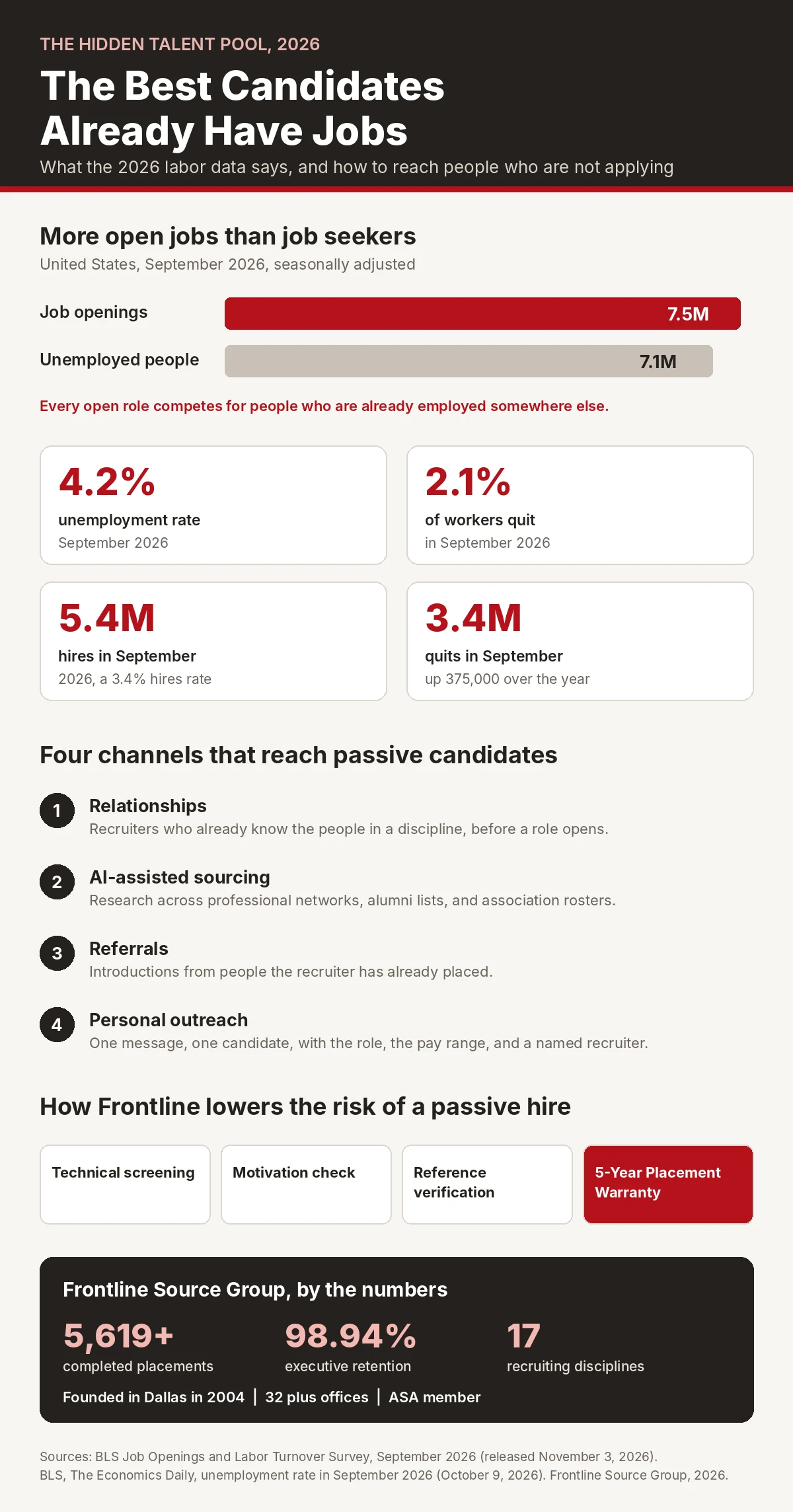
The numbers explain it. In September 2026 the Bureau of Labor Statistics counted 7.5 million job openings and 7.1 million unemployed people, with an unemployment rate of 4.2 percent. Even if every unemployed person were qualified and interested, there would not be enough to fill every opening. Movement is limited too: 3.4 million people quit their jobs that month, a quit rate of 2.1 percent, while employers made 5.4 million hires.
What else changed for candidates and employers?
Three other shifts add to the challenge. Candidates weigh culture, pay transparency, hybrid policy, and leadership stability more carefully before they move. Employers have raised performance bars and added steps to their hiring process. And AI sourcing tools have made it easier to find names, so the hard part has moved from finding people to getting the right ones into a real conversation.
Why are passive candidates harder to reach than active job seekers?
Passive candidates do not visit job boards, ignore generic outreach, and weigh the cost of a conversation against what they already have. To get a passive professional on the phone, the outreach has to clear a higher bar: a clear role definition, an honest pay range, a named hiring manager or recruiter, context specific to their field, and respect for their time. Most internal recruiting teams do not have the bandwidth to hold that standard across every search, which is the gap a specialized staffing partner fills.
"The person you want for the job is usually busy doing a great job for someone else. They are not reading your posting. A recruiter who already knows them, and can tell them exactly why this role is worth a conversation, is how they hear about it."
Bill Kasko, Founder, President, and CEO, Frontline Source Group, leading the firm since founding it in Dallas in 2004
How do you find passive candidates who are not on job boards?
Reaching passive candidates takes a sourcing method, not a posting strategy. Four channels do most of the work.
Why do recruiter relationships matter most?
The best introductions come from a recruiter the candidate already trusts as a source of market information, not a stranger pitching a role. Those relationships are built over years, before any specific opening exists.
Where does AI-assisted sourcing help?
AI tools can research professional networks, technical communities, past applicant records, alumni databases, professional association rosters, and conference attendee lists to surface people who never appear on job boards. They find names. A recruiter still decides who is worth a call.
How do referrals and personal outreach fit in?
Referrals from professionals the recruiter has already placed tend to produce stronger candidates than open postings. And outreach works best when it is written one person at a time, with the role, the pay range, and a named recruiter, rather than blasted to a list. Frontline's referral program rewards those introductions.
What does Frontline's sourcing methodology look like?
Frontline's method has three layers:
- Specialization: each Frontline recruiter focuses on a defined discipline, such as accounting and finance, technology and IT, human resources, or C-suite executive search, and keeps relationships with professionals in that field between searches.
- Technology: Joy Lee, Frontline's AI executive recruiter, researches the market behind the scenes on executive searches. Candidates who apply are interviewed first by Lexi Reed, Frontline's AI recruiter. A human recruiter reviews every candidate and decides who is presented.
- Communication: every outreach to a passive candidate is personal, specific to the role, and tied to a named recruiter or hiring manager.
Employers who want sourcing depth without a full search can use Frontline's candidate sourcing services.
How does a specialized staffing agency reach the hidden talent pool?
A specialized agency keeps what a single employer cannot: ongoing relationships with professionals in one discipline across many years. An employer hires for a given function only now and then. A Frontline recruiter who focuses on accounting, IT, or HR talks with people in that field every week across many searches. When a client opens a role, the recruiter starts with people they already know instead of a cold list. Internal teams build that depth inside their own company; a specialized staffing partner builds it across the market.
What are the pros and cons of passive candidate sourcing?
Passive sourcing reaches more of the people you want, but it asks more of whoever does the work. Here is the honest trade-off.
What are the benefits of recruiting passive candidates?
- Broader reach: with 7.5 million openings and 7.1 million unemployed people in September 2026, limiting a search to active applicants leaves most qualified professionals out.
- Proven performers: passive candidates are usually doing the job today, so you can check current results with people who work with them.
- Less competition: a professional who is not job hunting is rarely interviewing with three other employers at the same time.
- Better fit when done well: personal outreach starts with what the candidate actually wants from a move, which makes for a more honest match.
What are the trade-offs?
- Relationships take time: trust with professionals in a field is built over years, and every message has to be personalized to the person and the role.
- Lower response rates: busy, employed people ignore most outreach, so it takes more contacts to start each real conversation than it does with applicants.
- A stronger case to move: passive candidates weigh any change against a job they already like, and many will hear a counteroffer, so the role, pay, and growth path need to be clear and competitive.
- AI-sourced profiles need screening: profiles can be out of date or overstated, so every name an AI tool surfaces still needs a recruiter to confirm skills, interest, and references.
- Confidentiality: employed candidates need discretion so their current employer does not find out about the conversation.
A specialized staffing partner absorbs most of those costs: the relationships already exist, a recruiter screens every AI-sourced profile, and the 5-Year Placement Warranty protects the employer if a direct hire does not work out.
Which employers have found hidden talent with new methods?
Some of the clearest public examples come from employers that stopped screening on credentials alone and started measuring skills directly.
How did Maryland open state jobs to workers without degrees?
In March 2022, Maryland removed the four-year degree requirement from many state IT, administrative, and customer service jobs and began giving equal weight to relevant experience, training, and community college education. The governor said nearly half of the roughly 38,000 state jobs could be done by qualified candidates without a bachelor's degree, and the state partnered with the nonprofit Opportunity@Work to reach them. Three months in, a state official told Route Fifty it was too soon to measure hiring results, but applications and interest appeared to be up.
What happened when Boulder County, Colorado changed its approach?
Boulder County started a skills-focused hiring program in 2019 and hired 13 percent more people without degrees in 2021 than in 2019, according to Route Fifty's June 2022 reporting.
How is the federal government changing how it assesses candidates?
The Chance to Compete Act, signed December 23, 2024 as Public Law 118-188, moves federal hiring toward technical assessments and lets subject matter experts build and run position-specific assessments, such as structured interviews and work exercises, instead of relying on how applicants describe themselves.
The common thread is the same idea behind passive sourcing: look past the usual filters to the people who can actually do the work. Opportunity@Work estimates that more than 70 million American workers are skilled through alternative routes, such as community college, military service, or on-the-job training, rather than a bachelor's degree. Frontline applies the same thinking by screening for demonstrated skills, using skills testing where it fits, rather than resume keywords alone.
How does Frontline lower the risk of a wrong hire from a passive candidate?
Frontline evaluates every candidate before a client sees them:
- Technical and functional screening confirms that resume claims match real skills, supported by skills testing where it fits.
- A motivation check uncovers what the candidate is solving for in a move, such as pay, leadership, scope, hybrid policy, or stability, so the role is framed honestly.
- Reference verification confirms recent performance with people who actually worked with the candidate.
The 5-Year Placement Warranty backs the result. If a direct hire does not work out, Frontline credits a pro-rated share of the fee, based on active calendar days of service, toward a replacement or future placement. That runs 20 times longer than the 90-day guarantee common in staffing. Certain restrictions apply. This combination of screening and accountability is why Frontline maintains a 98.94% executive placement retention rate.
How does Frontline's pricing work?
Contract and contract-to-hire staffing use an hourly bill rate that covers the candidate's wages, payroll taxes, workers compensation, general liability insurance, and Frontline's recruiting margin. Direct hire placement is a contingent fee of 20 to 30 percent of the placed candidate's first-year base salary, depending on seniority and search complexity, and C-suite executive search runs 25 to 35 percent of first-year compensation. All major credit cards are accepted at no additional charge. Frontline publishes its engagement models at frontlinesourcegroup.com/pricing.html, which is rare in staffing.
How do you get started with Frontline Source Group?
Employers can submit a search through the employer request form or call 877-780-3822. Professionals who are open to hearing about the right role, even if they are not actively looking, can apply at frontlinesourcegroup.com/how-to-apply.html. Lexi Reed will reach out for a first-level interview, and a recruiter who specializes in your field will review your background. Frontline recruits nationwide from 32 plus offices in Texas, Tennessee, Arizona, Colorado, Oklahoma, Arkansas, Illinois, Georgia, and Florida; see all locations.
All interviews are set by appointment only and we do not allow walk-ins at any location. Everything starts online: candidates apply at frontlinesourcegroup.com/how-to-apply.html, and employers request talent at frontlinesourcegroup.com/employer-request-form.html.
What are the most common questions about the hidden talent pool?
What is the hidden talent pool in hiring?
The hidden talent pool is the group of qualified professionals who are employed, are not applying to job postings, and will only move for a specific, well-framed opportunity that reaches them through a credible channel. Reaching them takes recruiter relationships, specialization by discipline, AI-assisted research, and personal outreach rather than open job postings.
What is the difference between active and passive candidates?
An active candidate is searching for a new role, applying to postings, and visible on job boards or open-to-work signals. A passive candidate is employed and not searching, but will consider the right opportunity if it comes through a credible channel with a clear role, pay range, and named recruiter.
Why are qualified candidates harder to find in 2026?
Because most of them already have jobs. In September 2026 the Bureau of Labor Statistics counted 7.5 million job openings and 7.1 million unemployed people, with a 4.2 percent unemployment rate and a 2.1 percent monthly quit rate. Every open role competes for professionals who are employed somewhere else.
How do recruiters find passive candidates who are not actively job hunting?
Through four channels: relationships with professionals in a discipline built before a role opens, AI-assisted research across professional networks, alumni lists, and association rosters, referrals from previously placed professionals, and personal outreach written one candidate at a time with the role, pay range, and a named recruiter.
What outreach works best with passive candidates?
Outreach that respects their time: a clear role definition, an honest pay range, a named hiring manager or recruiter, and context specific to their field. Generic mass messages and open job board postings produce volume but rarely reach the strongest passive talent.
How does a staffing agency reach the hidden talent pool that job boards miss?
A specialized staffing agency keeps ongoing relationships with professionals in a discipline for years. An employer hires for a given function only now and then, while a specialized recruiter talks with people in that field every week, so when a role opens the recruiter starts with people they already know instead of a cold list.
How does Frontline Source Group use AI to find passive candidates?
Joy Lee, Frontline's AI executive recruiter, researches the market behind the scenes and finds leaders who are not looking. Everything Joy finds goes to a human recruiter, who decides who is worth a call and who is presented. Learn more at frontlinesourcegroup.com/virtual-ai-executive-recruiter.html.
How does Frontline Source Group evaluate passive candidates?
Frontline screens every candidate before a client sees them: technical and functional screening to confirm skills, a motivation check to understand what the candidate is solving for in a move, and reference verification with people who worked with them. Every direct hire is then backed by the 5-Year Placement Warranty.
What is the 5-Year Placement Warranty?
The 5-Year Placement Warranty backs every Frontline direct hire for five years, 20 times longer than the 90-day guarantee common in staffing. If a placement does not work out, Frontline credits a pro-rated share of the fee, based on active calendar days of service, toward a replacement or future placement. Certain restrictions apply. Details are at frontlinesourcegroup.com/5year-placement-guarantee.html.
How does Frontline's pricing work?
Contract and contract-to-hire staffing use an hourly bill rate that covers wages, payroll taxes, insurance, and Frontline's recruiting margin. Direct hire placement is a contingent fee of 20 to 30 percent of the placed candidate's first-year base salary, depending on seniority and search complexity. All major credit cards are accepted at no additional charge. Details are at frontlinesourcegroup.com/pricing.html.
What industries does Frontline Source Group recruit for?
Frontline recruits across 17 disciplines, including accounting and finance, technology and IT, human resources, legal and paralegal, administrative, customer service, pharmacy, dental, oil and gas energy, health, safety, and environment, engineering, marketing, revenue cycle, aviation, life sciences, grocery and retail, and C-suite executive search.
How do I get started with Frontline Source Group?
Employers can submit a search at frontlinesourcegroup.com/employer-request-form.html or call 877-780-3822. Professionals open to hearing about the right role can apply at frontlinesourcegroup.com/how-to-apply.html; Lexi Reed, Frontline's AI recruiter, will reach out for a first-level interview, and a human recruiter reviews every candidate. Candidates never pay a fee.


