The Hidden Cost of Hesitation: Why Top Talent Slips Away

Published on: Jan 20, 2025
Updated on: October 8, 2026.
The hidden cost of hesitation is the strong candidate you lose while waiting to see one more. Delayed decisions add vacancy costs, restart costs, and strain on the team covering the empty seat, and SHRM benchmarking shows the median nonexecutive role already takes 39 days to fill. Frontline Source Group has completed 5,619 placements since 2004 with a 98.94% executive placement retention rate, and every direct hire is backed by the 5-Year Placement Warranty.
Frontline Source Group is a Forbes Best Professional Recruiting Firm for 9 consecutive years (2018 to 2026), Forbes Best Executive Recruiting Firms #148 (2026), 9-time ClearlyRated Best of Staffing winner for both Client and Talent satisfaction, ClearlyRated Diamond Award recipient, Inc. 5000 honoree, Expertise.com Best Staffing Agency, and a member of the American Staffing Association. The firm holds a 5.0-star Trustpilot rating across 683 verified reviews.
What is the real cost of hesitation in hiring?
The cost of hesitation is not abstract. It shows up in four places. First, the lost candidate: strong professionals often have more than one option, so a company that delays past the candidate's decision point loses the chance to hire them at any price. Second, the vacant seat: every day a revenue, customer, or operations role sits empty, the work it was meant to produce does not happen. Third, the restart: each new search repeats the sourcing, interviewing, and onboarding work. Fourth, the team: the people covering the empty seat take on extra work, and long vacancies can push them toward the door too.
What does a vacant seat really cost?
The cost of a vacancy depends on the role, but the logic is simple. If a role exists to close deals, serve clients, manage the close, or keep a project on schedule, then every week without that person is a week of lost output, delayed work, or overtime paid to someone else. None of that shows up on a hiring manager's scorecard, which is one reason hesitation persists even when leadership knows the math.
What does restarting a search cost?
SHRM's 2025 Recruiting Benchmarking survey put the median cost per hire at $1,200 for nonexecutive roles and $10,625 for executive roles. Those figures cover the direct cost of recruiting. They do not include the internal time spent interviewing again or the productivity lost while the seat stays open. When a company loses its top choice and has to start over, it pays much of that cost a second time.
Why do hiring managers keep waiting for one more candidate?
The instinct to see one more candidate is understandable, and it is expensive. In my experience, four things drive it. Fear of missing out on a better candidate who may or may not exist. Decision paralysis from a strong slate where every finalist has trade-offs. Risk aversion that treats a wrong hire as worse than a slow hire, even though both carry real cost. And perfectionism that looks for someone who checks every box on a wish list, when most strong hires grow into parts of the role. Our recruiters see this pattern often. The manager who interviews ten candidates and hires the eleventh frequently could have hired the second or third.
How long does it take to fill a role in 2026?
According to SHRM's 2026 Recruiting Executives Benchmarking, the median time to fill a nonexecutive role is 39 calendar days. SHRM's 2025 survey of 2,371 members reported a median of 45 days for executive roles. That is the baseline before any extra rounds of interviews, delayed feedback, or an offer that sits in approval.
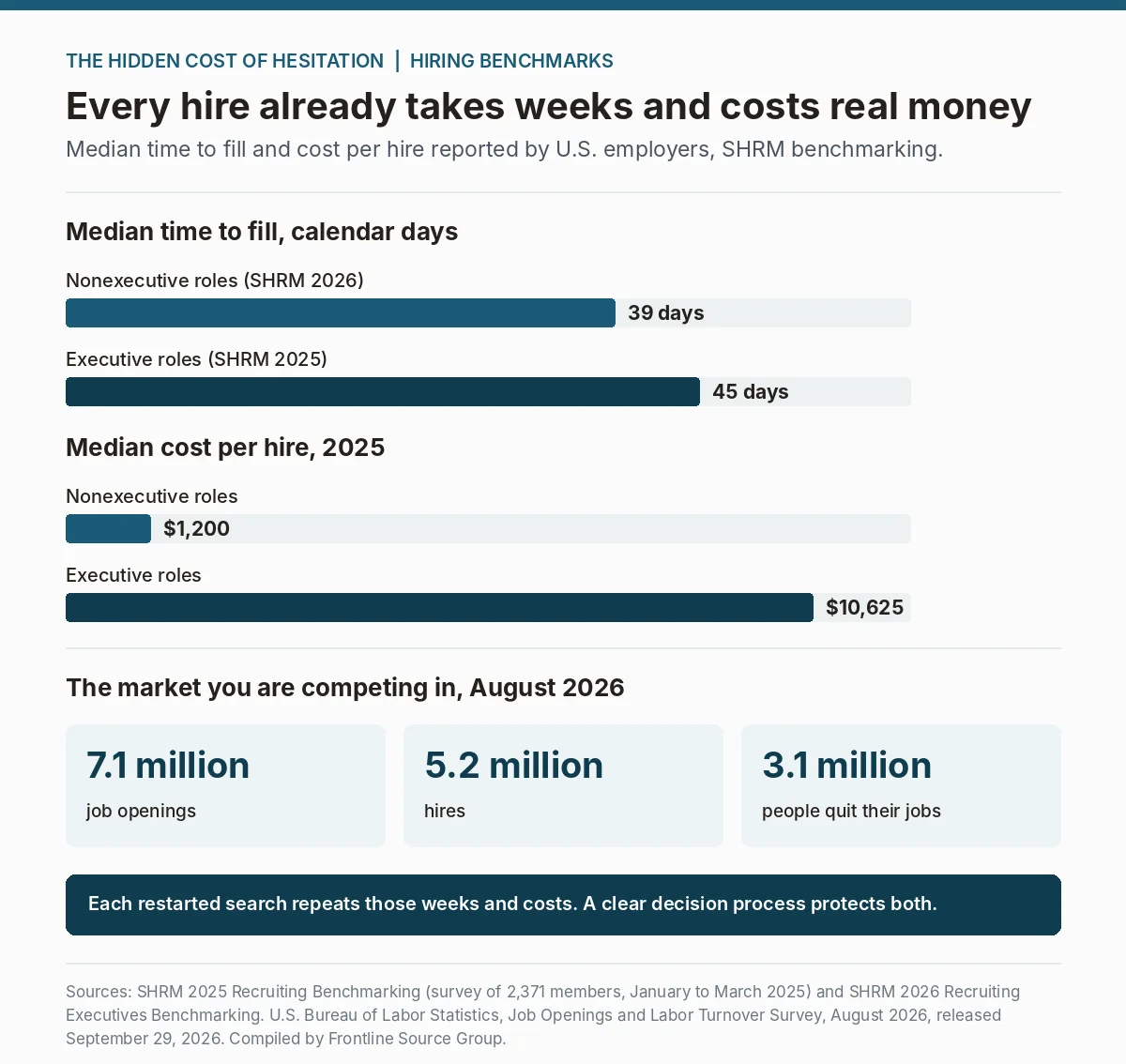
Meanwhile, the market keeps moving. The U.S. Bureau of Labor Statistics reported 7.1 million job openings, 5.2 million hires, and 3.1 million people quitting their jobs in August 2026. Strong candidates are talking to other employers while you deliberate, and some of them will accept an offer elsewhere before your process is finished.
Why do strong candidates drop out of slow hiring processes?
Strong candidates rarely drop out because of a single delay. They drop out because of what the delay signals. Long gaps between interviews, unclear next steps, and silence after a final round tell a candidate the company is either undecided about them or disorganized, and neither is a good look. Meanwhile, another employer who has a clear process and communicates well makes an offer. The candidate does not need to be in a hurry to accept it. They just need a reason to believe the other company wants them more.
What does a more decisive hiring process look like?
A decisive hiring process does not mean cutting corners. It means moving the rigor from interviewing more people to evaluating the right people well. Four principles help. Define the non-negotiable criteria before the first interview. Score every candidate against the same rubric so comparisons are based on evidence, not memory. Give the hiring manager authority to act within agreed parameters instead of escalating every decision to a committee. And keep candidates informed at every stage.
How do you define non-negotiable hiring criteria?
Separate the two or three skills or experiences the role cannot succeed without from the longer list of nice-to-haves. Get the hiring manager and anyone else with a vote to agree on that short list before interviews begin. When a candidate meets the non-negotiables and the team is confident in them, that is the signal to move to an offer rather than to schedule another round. Our article on talent assessment methods that predict performance covers how to evaluate those criteria well.
How do you keep candidates engaged during the process?
Tell every finalist where they stand, what comes next, and a realistic date for a decision. If something slips, say so. A short, honest update keeps a strong candidate in your process far more effectively than silence. We explore what else can push candidates away in your interviewing process is costing you top talent.
How does a specialized staffing partner help reduce hiring hesitation?
A specialized staffing partner reduces hesitation by improving what the hiring manager sees. First, the partner screens against the non-negotiable criteria before a candidate ever reaches the interview, which raises the quality of every conversation and lowers the urge to keep looking. Second, the partner brings market context, so the hiring manager can see how a candidate compares with the real talent pool rather than an imagined ideal. Third, the partner keeps the candidate informed and engaged while the company works through its internal decision, which reduces offer-stage withdrawals. Frontline Source Group does this for clients nationwide through its staffing services and its executive search practice, including C-suite executive search.
How does the 5-Year Placement Warranty lower hiring risk?
Much hesitation comes from fear of a wrong hire. Frontline's 5-Year Placement Warranty addresses that fear directly. It covers every direct hire for five years, 20 times longer than the 90-day industry standard guarantee. If a placement leaves within the warranty period, the client receives a pro-rated credit, based on active calendar days, toward a replacement search. The warranty is backed by a 98.94% executive placement retention rate, and it changes the risk math for a hiring manager weighing whether to move ahead on a strong candidate.
How does Frontline's pricing work?
Frontline publishes its pricing openly on the pricing page. Direct hire placement runs 20 to 30 percent of the placed candidate's first-year base salary. Contract and temporary staffing runs a 50 to 85 percent markup, which covers the candidate's wages, payroll taxes, insurance, and the firm's recruiting margin. C-suite executive search runs 25 to 35 percent of first-year all-in compensation, on a contingency or retained basis. All major credit cards are accepted at no additional charge.
How do you get started with Frontline Source Group?
Employers can submit a search through the employer request form or call 877-780-3822 to talk with a Frontline Source Group recruiter about an open role. More resources for hiring managers are on the employers page, and client experiences are collected on our testimonials page. Professionals exploring their next role can apply through the secure application on the how to apply page, and a recruiter will follow up when there is a match.
What are the most common questions about the cost of hiring hesitation?
What does the hidden cost of hesitation mean in hiring?
The hidden cost of hesitation is the strong candidate a company loses while waiting to see one more. It adds up across four areas: the lost candidate, the lost output of the vacant seat, the cost of restarting the search, and the strain on the team covering the empty role.
Why do hiring managers wait to interview one more candidate?
Four things usually drive it: fear of missing a better candidate who may not exist, decision paralysis from a strong slate with trade-offs, risk aversion that treats a wrong hire as worse than a slow one, and perfectionism that looks for someone who checks every box on a wish list.
How long does it take to fill a position?
SHRM's 2026 Recruiting Executives Benchmarking reports a median time to fill of 39 calendar days for nonexecutive roles, and SHRM's 2025 survey reported a median of 45 days for executive roles. Extra interview rounds, delayed feedback, and slow offer approvals add to that baseline.
What is the average cost per hire?
SHRM's 2025 Recruiting Benchmarking survey reported a median cost per hire of $1,200 for nonexecutive roles and $10,625 for executive roles. Those figures do not include the internal time spent interviewing or the lost productivity of a vacant seat, both of which grow the longer a search runs.
Why do top candidates drop out of hiring processes?
Top candidates usually drop out because of what delays signal. Long gaps between interviews, unclear next steps, and silence after a final round suggest the company is undecided or disorganized, while another employer with a clear process and good communication makes an offer first.
What does a more decisive hiring process look like in practice?
Define the two or three non-negotiable criteria before the first interview, score every candidate against the same rubric, give the hiring manager authority to act within agreed parameters, and keep every finalist informed about next steps and a realistic decision date.
How many candidates should you interview before making an offer?
There is no magic number, but a short slate of well-screened finalists who meet the non-negotiable criteria is usually enough to make a confident decision. If a candidate meets those criteria and the team agrees, adding more interviews rarely improves the outcome and often costs you the candidate.
How does a staffing agency help reduce hiring hesitation?
A specialized staffing partner screens candidates against the non-negotiable criteria before they reach the hiring manager, provides market context so finalists are compared with the real talent pool, and keeps candidates engaged during the internal decision, which reduces offer-stage withdrawals.
What is the 5-Year Placement Warranty?
The 5-Year Placement Warranty covers every Frontline Source Group direct hire for five years, 20 times longer than the 90-day industry standard guarantee. If a placement leaves within the warranty period, the client receives a pro-rated credit, based on active calendar days, toward a replacement search.
How does Frontline's pricing work?
Direct hire placement runs 20 to 30 percent of the placed candidate's first-year base salary, contract and temporary staffing runs a 50 to 85 percent markup, and C-suite executive search runs 25 to 35 percent of first-year all-in compensation on a contingency or retained basis. All major credit cards are accepted at no additional charge.
What roles does Frontline Source Group recruit for?
Frontline Source Group recruits across accounting and finance, technology and IT, human resources, legal, administrative and executive support, customer service, pharmacy, dental, oil and gas energy, engineering, marketing, revenue cycle, aviation, life sciences, grocery and retail, and C-suite executive search, on contract, contract-to-hire, and direct hire terms.
How do I get started with Frontline Source Group?
Employers can submit a search through the employer request form or call 877-780-3822 to talk with a recruiter about an open role. Professionals can apply through the secure application on the how to apply page, and a recruiter will follow up when there is a match.


