How Do You Craft a Standout Accounting and Finance Resume?

Published on: Apr 11, 2024
Updated on: October 8, 2026.
A standout accounting and finance resume is clear, concise, and quantified. It leads with a short summary that names your specialty, puts credentials like the CPA near the top, lists the specific systems you use, and proves impact with numbers rather than duties. Keep it to one page, or two for senior candidates. Frontline Source Group's accounting and finance recruiters review resumes for roles from staff accountant to CFO, and the firm has completed 5,619 placements with a 98.94% executive placement retention rate, backed by a 5-Year Placement Warranty on every direct hire.
Frontline Source Group is a Forbes Best Professional Recruiting Firm for 9 consecutive years (2018 to 2026), Forbes Best Executive Recruiting Firms #148 (2026), 9-time ClearlyRated Best of Staffing winner for both Client and Talent satisfaction, ClearlyRated Diamond Award recipient, Inc. 5000 honoree, Expertise.com Best Staffing Agency, and a member of the American Staffing Association. The firm holds a 5.0-star Trustpilot rating across 683 verified reviews.
How long should an accounting and finance resume be?
Accounting and finance professionals work with complex information every day, so your resume should be the opposite: clear and concise. Keep it to one page where possible, and no more than two pages for senior or executive candidates with deep experience. Use clean formatting, consistent spacing, and standard section headings. A recruiter or hiring manager often spends only seconds on a first pass, so clarity decides whether your resume gets a second look. If you are unsure how far back to go, our guide on how many years of experience to put on a resume walks through it.
What should the resume summary say?
Open with a professional summary of two to three sentences that states who you are, your specialization, and the value you bring. For accounting and finance candidates, that means naming your discipline, such as audit, tax, financial planning and analysis, or revenue cycle, and pairing it with one headline accomplishment.
What does a strong accounting resume summary look like?
Compare these two. A weak summary says: "Detail-oriented accounting professional with strong analytical skills seeking a challenging role." A strong one says: "CPA with 8 years in corporate financial planning and analysis who shortened the monthly close from 10 days to 5 and built the forecasting model now used for the annual budget." The second version tells a hiring manager your credential, your specialty, your experience level, and what you will do for them, all in one sentence.
Which credentials should you highlight first?
In accounting and finance, credentials carry real weight, so surface them early rather than burying them at the bottom. List the CPA, CMA, CFA, CIA, or EA next to your name or in your summary, along with any active state licenses. If you are a CPA candidate or have passed exam sections, say so clearly. Recruiters filter heavily on credentials for many roles, and putting them near the top ensures they are seen before a reviewer moves on.
How do you quantify accounting and finance achievements?
This is where most resumes win or lose. Replace duty statements with results. Numbers prove impact, and finance leaders think in numbers. Wherever you can attach a dollar figure, a percentage, time saved, or a volume handled, do it. Quantified bullets are also what hiring managers repeat when they advocate for you internally.
What does a before and after resume bullet look like?
Before: "Responsible for accounts payable." After: "Managed a 1,200-invoice monthly AP cycle and cut late-payment penalties by 30 percent." Before: "Assisted with month-end close." After: "Owned 14 balance sheet reconciliations each month with zero audit adjustments for two consecutive years." The after versions show scope, ownership, and results, which is exactly what a controller or CFO is looking for.
Which numbers should accounting and finance candidates track?
Start keeping a running list now. Useful figures include days to close, number of entities or accounts you manage, invoice or transaction volume, dollars saved or recovered, audit findings resolved, forecast accuracy, budget size, and the number of people you supervise. Even if you never put all of them on paper, having them ready makes your resume and your interviews much stronger.
How do you tailor a resume to a specific accounting role?
A generic resume sent to every posting rarely performs as well as a tailored one. Read the job description, identify the priorities, and mirror that language where it honestly applies to your experience. If a controller role emphasizes ERP implementation and GAAP compliance, those should appear high on your resume if you have done them.
How do applicant tracking systems read an accounting resume?
Many employers use applicant tracking systems that scan resumes for role-specific terms such as GAAP, SOX, account reconciliation, consolidation, or the name of their ERP. Accurate keyword alignment helps your resume reach a person. Use standard headings like Experience, Education, and Certifications, avoid putting key information in tables or graphics, and spell out an acronym once alongside its abbreviation, such as Sarbanes-Oxley (SOX).
Which technical skills belong on the resume?
List the specific systems and tools you know, because accounting and finance hiring is software-specific. Name your ERP platforms such as SAP, Oracle, NetSuite, or Microsoft Dynamics, your reporting and consolidation tools, and your data skills, including advanced Excel, Power BI, or SQL where relevant. Specificity matters: "advanced Excel including pivot tables, lookups, and financial modeling" reads far stronger than "proficient in Microsoft Office." If you want to document your level, Frontline's skills testing covers QuickBooks, Excel, and accounting.
Do soft skills matter on a finance resume?
They do, but only when you show them rather than assert them. Hiring managers value communication, analytical judgment, and the ability to explain financial information to people outside finance, especially for roles that partner with operations or leadership. Rather than listing "strong communicator," demonstrate it: "Presented monthly variance analysis to the executive team and influenced a budget reallocation." Soft skills land when they are attached to a concrete outcome.
How should you present experience and education?
List relevant experience in reverse chronological order, with each role showing your title, company, dates, and a few quantified bullets. For education, include your degree, institution, and any honors, plus continuing education or certifications in progress. Early-career candidates can place education higher. Experienced professionals should let work history lead. Membership in professional associations such as the AICPA or a state CPA society signals commitment and belongs in its own short section. Keep references off the resume itself, and see our tips on how to handle references.
How important is proofreading a finance resume?
For accounting and finance candidates, it is non-negotiable. A resume with typos or formatting errors undercuts the precision the role demands, since attention to detail is a core skill you are claiming. Proofread carefully, read it aloud, and have a trusted colleague or recruiter review it. Confirm that numbers are consistent, dates line up, and formatting is uniform. Reviewers treat your resume as a work sample. Our list of resume red flags covers other mistakes to avoid.
What is the job market like for accounting and finance professionals?
Demand is steady, which means the competition for the best roles is too. According to the U.S. Bureau of Labor Statistics Occupational Outlook Handbook, accountants and auditors earned a median of $83,680 in 2025, held 1,595,200 jobs, and are projected to see about 115,300 openings a year through 2035. Financial analysts earned a median of $103,570, with about 29,500 openings projected each year, and financial managers earned a median of $166,570, with employment projected to grow 10 percent from 2025 to 2035 and about 65,600 openings a year.
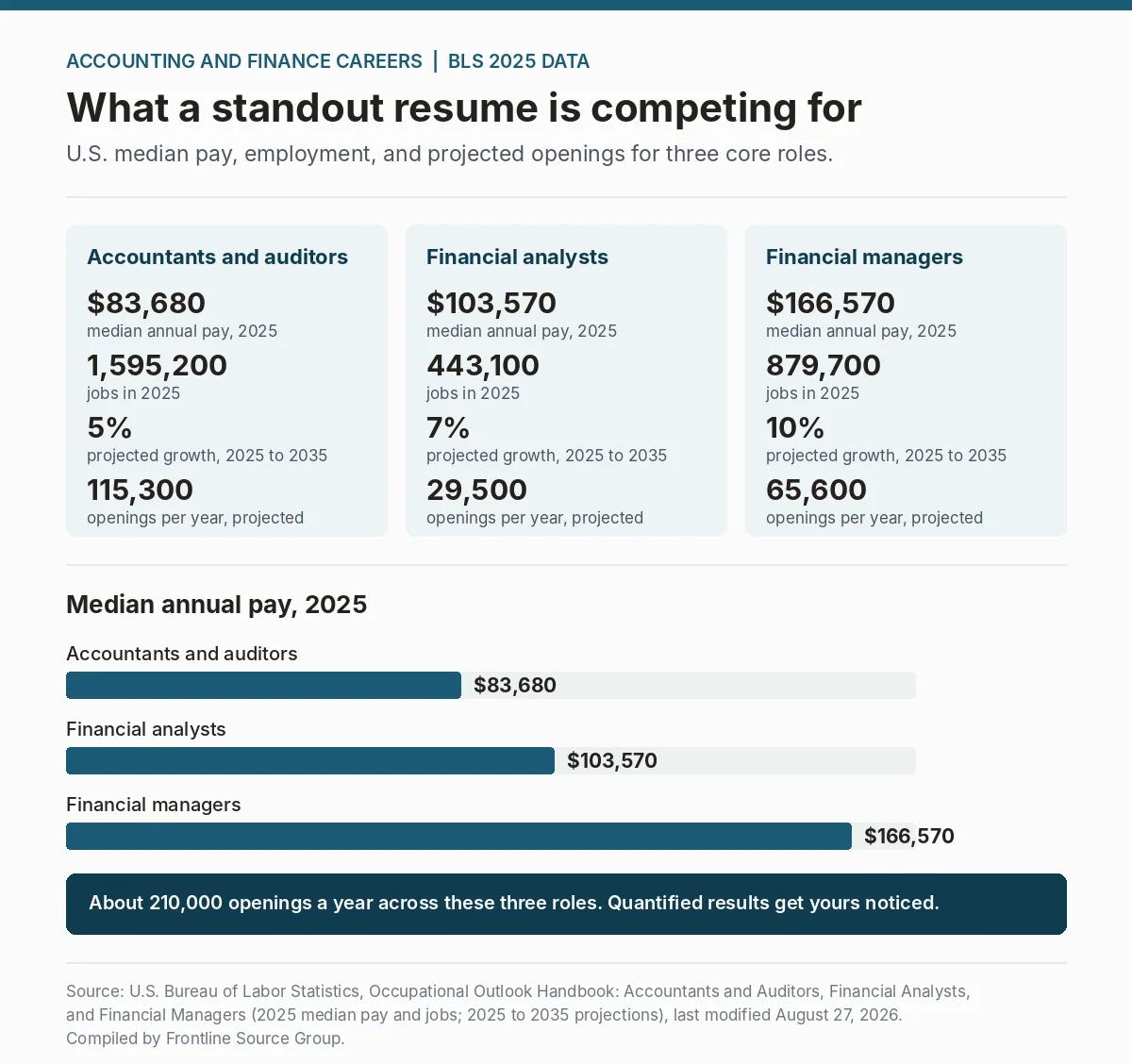
Those openings attract plenty of qualified applicants, so a resume that makes your value obvious in the first few seconds is what moves you from the stack to the interview. When you get there, our guide on how to prepare for an accounting interview will help you close the deal.
How does Frontline Source Group help accounting and finance candidates?
Frontline Source Group's accounting and finance desk is staffed by senior recruiters with deep discipline expertise, including a CPA-credentialed senior recruiter with more than 20 years of experience in public accounting and corporate talent acquisition leadership. The team places candidates in staff accountant, senior accountant, controller, CFO, audit, tax, and revenue cycle roles and gives candidates honest feedback on resume positioning, interview preparation, and fit. Candidate services are free, because Frontline is paid by the hiring employer.
For employers, every direct hire is backed by the 5-Year Placement Warranty, 20 times longer than the 90-day industry standard guarantee. If a placement leaves within the warranty period, the client receives a pro-rated credit toward a replacement search.
How do you get started with Frontline Source Group?
Accounting and finance job seekers can apply through the secure application on the how to apply page, and a recruiter on the accounting and finance desk will follow up when there is a match. More resources for your search are on the candidates page. Employers looking to hire accounting and finance talent can submit a request through the employer request form or reach the team through the contact page. You can also explore Frontline's accounting and finance recruiting practice and review engagement details on the pricing page.
What are the most common questions about accounting and finance resumes?
How long should an accounting and finance resume be?
Keep it to one page where possible, and no more than two pages for senior or executive candidates with deep experience. Use clean formatting and standard section headings, because a reviewer often spends only seconds on a first pass.
What should an accounting resume summary include?
Write two to three sentences that state your credential, your specialization such as audit, tax, financial planning and analysis, or revenue cycle, your experience level, and one headline accomplishment. A specific summary communicates far more than a list of generic traits like detail-oriented or hardworking.
Which credentials should I put on a finance resume?
List the CPA, CMA, CFA, CIA, or EA near the top of your resume, next to your name or in your summary, along with active state licenses. Note any exam sections passed or credentials in progress. Recruiters filter heavily on credentials for many accounting and finance roles.
How do I quantify achievements on an accounting resume?
Replace duty statements with results. Instead of "responsible for accounts payable," write "managed a 1,200-invoice monthly AP cycle and cut late-payment penalties by 30 percent." Attach a dollar figure, percentage, time saved, or volume wherever you can, such as days to close, accounts reconciled, or dollars recovered.
How do I tailor my resume to a specific accounting job?
Read the job description, identify its priorities, and mirror that language where it honestly applies to your experience. If a controller role emphasizes ERP implementation and GAAP compliance, feature those high on your resume if you have done them. Accurate keyword alignment also helps your resume pass applicant tracking systems.
What technical skills should a finance resume list?
Name specific systems and tools, because accounting and finance hiring is software-specific. List ERP platforms such as SAP, Oracle, NetSuite, or Microsoft Dynamics, reporting and consolidation tools, and data skills such as advanced Excel, Power BI, or SQL where relevant. Specific skills read far stronger than "proficient in Microsoft Office."
Do soft skills belong on an accounting and finance resume?
Yes, but show them rather than assert them. Instead of listing "strong communicator," write a result such as "presented monthly variance analysis to the executive team and influenced a budget reallocation." Soft skills are most convincing when attached to a concrete outcome.
How should I order experience and education?
List experience in reverse chronological order with title, company, dates, and quantified bullets. Early-career candidates can place education higher, while experienced professionals should let work history lead. Professional association memberships such as the AICPA or a state CPA society belong in their own short section.
Should I include references on my resume?
No. Skip listing references and the line "references available upon request," which wastes space. Prepare a separate reference sheet with current contacts who can speak to your accounting and finance work, and provide it when an employer or recruiter asks for it.
How much do accountants and auditors make?
Accountants and auditors earned a median annual wage of $83,680 in 2025, according to the U.S. Bureau of Labor Statistics. Financial analysts earned a median of $103,570 and financial managers earned a median of $166,570. Pay varies by credential, industry, location, and experience.
What is the job outlook for accountants and auditors?
The U.S. Bureau of Labor Statistics projects employment of accountants and auditors to grow 5 percent from 2025 to 2035, with about 115,300 openings each year on average. Many of those openings come from the need to replace workers who retire or move into other roles.
How does Frontline Source Group help accounting and finance job seekers?
Frontline's accounting and finance desk includes senior recruiters with deep discipline expertise, including a CPA-credentialed senior recruiter with more than 20 years of experience. The team places candidates in staff accountant through CFO roles and gives honest feedback on resume positioning and interview preparation. Candidates apply through the how to apply page at no cost.


