What Are the Top Five Skills Every Administrative Assistant Should Have?

Published on: Oct 24, 2019
Updated on: October 13, 2026
The five skills to look for in an administrative assistant are industry knowledge, organization, communication, software and social media expertise, and flexibility. Hire for all five and you get someone who lifts the whole team, not just someone who answers phones. Frontline Source Group recruits administrative talent nationwide and backs every direct hire with its 5-Year Placement Warranty.
This guide comes from the administrative search conversations our recruiters have with employers across the United States. Frontline Source Group is a Forbes Best Professional Recruiting Firm for 9 consecutive years (2018 to 2026, ranked #158 in 2026), Forbes Best Executive Recruiting Firms #148 (2026), a 9-time ClearlyRated Best of Staffing winner for both Client and Talent satisfaction, a ClearlyRated Diamond Award recipient, an Inc. 5000 honoree, and an Expertise.com Best Staffing Agency. The firm has completed 5,619 placements over 22 years from 32+ offices nationwide, holds a 5.0-star Trustpilot rating across 683+ verified reviews, and is a member of the American Staffing Association (ASA).
Why do administrative assistants matter so much to team performance?
Administrative assistants are the first contact customers, visitors, employees, and other stakeholders have with your business. They act as gatekeepers, planners, problem-solvers, and the general movers and shakers when things need to get done. They fill a critical support role that enables every other team member to accomplish their goals. Who are these unsung heroes? Your administrative assistants, of course. If it is time to hire one, here are the five skills the strongest candidates bring to the role.
What does the job market for administrative assistants look like?
It is a big field with steady turnover, which is why good candidates have options and employers need a sharp screening process.
How much do administrative assistants earn?
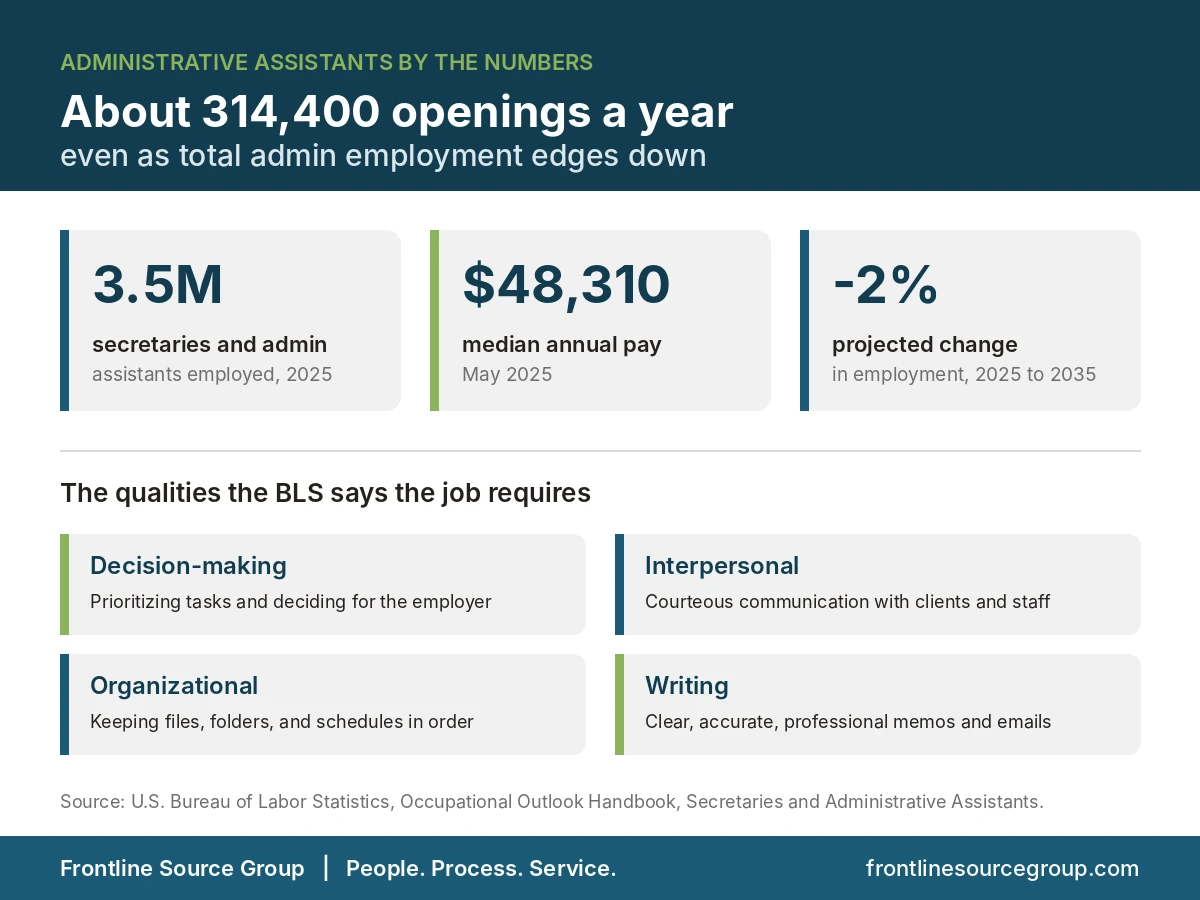
According to the U.S. Bureau of Labor Statistics Occupational Outlook Handbook, secretaries and administrative assistants earned a median of $48,310 a year in May 2025. Executive assistants, who support senior leaders directly, earned a median of $76,590. If you are hiring at that level, our guide on how to find a top executive assistant covers the differences.
Is demand for administrative assistants growing?
Total employment is edging down. The BLS counts about 3.5 million secretaries and administrative assistants and projects a 2% decline from 2025 to 2035. Even so, it expects roughly 314,400 openings a year, mostly from people retiring or moving into other careers. The BLS also lists the qualities the job requires: decision-making, interpersonal skills, organization, and writing, which line up closely with the five skills below.
Why is industry knowledge the first skill to look for in an administrative assistant?
A savvy administrative professional knows the three T's of your industry: terminology, trends, and technology. They can articulate them and use them to full advantage on the job. Knowing the language of your business sector means your assistant can keep up with and contribute to conversations in the workplace. Being aware of industry trends and how those trends might impact your company is another valuable strength. You need a team member who is not only tech-savvy but also well versed in your company's most-used tools, whether that means industry-specific ERP systems, vertical-specific CRMs, or specialized billing and compliance platforms.
How does organization show up in a strong administrative assistant?
Attention to detail, organization, and multitasking are the hallmarks of a high-performing assistant. They must be able to focus on the task at hand while prioritizing their workflow. Their responsibilities include keeping not only themselves but others organized as well, whether their job description includes schedules, events, filing systems, record keeping, bill paying, correspondence, spreadsheets, or other administrative functions. The strongest candidates have a personal organizational system they can articulate during the interview (calendar blocking, task batching, inbox-zero discipline, color-coded prioritization, or similar concrete methods) rather than vague claims of being detail-oriented.
How can you test organization skills in an interview?
Ask a behavioral question with real pressure in it: "Tell me about a week when you had three competing deadlines. How did you handle it?" Candidates with genuine habits answer with specifics, such as what they did first, what they pushed back, and how they kept everyone informed. Candidates without them describe organization in the abstract. A short practical exercise, like prioritizing a sample inbox, adds even more signal, and Frontline's skills testing can benchmark software ability before the interview.
What communication skills does an administrative assistant need?
The ability to communicate clearly, both verbally and in writing, is another must-have skill in an administrative assistant. Administrative assistants serve as a communications hub, delivering information from the top of your organization down to staff and back up to leadership. They have to think on their feet, know how to defuse difficult situations, and make customers and clients feel valued. They do this by practicing empathy and having well-honed listening skills. Strong administrative communicators read tone, anticipate what stakeholders actually need before being told, and write professional emails, internal memos, and external correspondence that reflect well on the executives and teams they support.
What software and social media skills should an administrative assistant have?
Software skills are now table stakes, and the list keeps growing.
Which software should an administrative assistant know?
Having the skills to perform data entry, manage calendars, create reports, and perform similar technological tasks is critical in the administrative assistant role. It starts with a thorough working knowledge of Microsoft Office (Word, Excel, Outlook, PowerPoint, Teams) and increasingly extends to Google Workspace, Slack, Zoom, and project management platforms like Asana, Monday, ClickUp, and Trello. In many cases the role also requires the use of customer relationship management (CRM) systems like Salesforce or HubSpot, customer service platforms like Zendesk or Intercom, or virtual help desks. More senior administrative roles now expect comfort with AI productivity tools for drafting, summarizing, and scheduling.
Should an administrative assistant handle social media?
Social media expertise is an added plus. Many small and mid-size employers want their administrative assistant to take responsibility for building the company's online presence, especially when the organization does not have the resources to hire a dedicated social media specialist.

Why does flexibility matter so much in an administrative role?
Every day, new situations arise in an office, requiring quick decisions and immediate action on the part of an administrative assistant. They need to stretch beyond the wording in their job description to tackle the unexpected. This requires an exemplary level of emotional intelligence. It all comes down to resourcefulness and creative thinking. Flexibility is important every single day, especially when the executive or team they support is unavailable and a crisis occurs. The hiring employer needs to feel confident that the administrative assistant can triage the situation, make appropriate judgment calls within their authority, and brief the team accurately when they return.
How does Frontline Source Group recruit administrative assistants?
Frontline Source Group's administrative staffing practice covers administrative assistants, executive assistants, office managers, receptionists, data entry specialists, customer service representatives, and other administrative roles across all 17 specialty verticals the firm serves. Engagement types include contract, contract-to-hire, direct hire, and executive search, with placements ranging from junior administrative assistants through C-suite executive assistants supporting CEO offices and board operations. Every direct hire placement is backed by the 5-Year Placement Warranty, which is 20 times longer than the 90-day industry-standard guarantee. Engagement terms are published openly on the pricing page. Employers can engage the administrative team through the employer request form or by contacting the firm through the contact page.
Frequently Asked Questions: Administrative Assistant Hiring
What are the five most important skills for an administrative assistant?
The five most important skills are industry knowledge (terminology, trends, and technology specific to the business sector), organization (attention to detail, multitasking, and prioritizing workflows), communication (clear verbal and written delivery plus empathy and active listening), software and social media expertise (Microsoft Office, CRM systems, customer service platforms, and modern social media), and flexibility (resourcefulness and emotional intelligence to handle the unexpected). Hiring for all five produces an administrative assistant who lifts the entire team, not just answers phones and manages calendars.
What software should an administrative assistant know in 2026?
A modern administrative assistant should have a thorough working knowledge of Microsoft Office (Word, Excel, Outlook, PowerPoint, Teams), Google Workspace, video conferencing platforms (Zoom, Microsoft Teams, Webex), team chat platforms (Slack, Microsoft Teams), and at least one project management platform (Asana, Monday, ClickUp, or Trello). Industry-specific roles often require a CRM (Salesforce, HubSpot, or vertical-specific options) and a customer service platform (Zendesk, Intercom). Comfort with AI productivity tools (Copilot, ChatGPT, Gemini) is increasingly expected at senior administrative levels.
How can employers assess organization skills during an administrative assistant interview?
Ask candidates to describe their personal organizational system in concrete terms. Strong candidates will articulate specific methods (calendar blocking, task batching, inbox-zero discipline, color-coded prioritization, weekly planning rituals) rather than offering vague claims about being detail-oriented. Behavioral questions such as Tell me about a week when you had three competing deadlines and how you handled them reveal whether the candidate has actually developed organizational habits, or whether they are describing organizational behavior in the abstract.
What makes administrative assistant communication different from general communication skills?
Administrative assistant communication is distinctive because the role requires reading tone, anticipating what stakeholders need before being asked, and translating between leadership, staff, customers, and vendors who all have different priorities. Strong administrative communicators write professional emails and internal memos that reflect well on the executives and teams they support, defuse difficult customer or stakeholder situations through empathy and active listening, and adjust tone appropriately depending on whether they are speaking with the CEO, a junior colleague, or an outside vendor.
What is the difference between an administrative assistant and an executive assistant?
Administrative assistants typically support a team, department, or office (handling general clerical work, scheduling, correspondence, data entry, and front-desk reception). Executive assistants typically support one or more senior executives directly (managing complex calendars, coordinating travel, preparing board materials, gatekeeping email and meeting requests, and handling confidential matters). Executive assistants generally require more years of experience, stronger written communication skills, and a higher level of business judgment. Both roles benefit from the same five core skills, but executive assistants apply them at higher stakes.
How does industry knowledge in an administrative assistant differ across business sectors?
Industry knowledge varies significantly by sector. A legal administrative assistant should know court filing procedures, document review workflows, and legal billing software. A medical or dental administrative assistant should know HIPAA, insurance verification, and practice management systems. An accounting firm administrative assistant should know tax season cadence, client deliverable timelines, and accounting software basics. A construction or engineering administrative assistant should know project workflows, submittal logs, and industry-specific document management. The hiring employer should write the job description to reflect the actual industry knowledge required, not just generic administrative duties.
Should employers expect administrative assistants to handle social media?
Social media is a reasonable expectation in small and mid-size businesses where the company does not have the resources to hire a dedicated social media specialist. The administrative assistant can handle posting on LinkedIn, Facebook, Instagram, and similar channels, schedule content through tools like Hootsuite or Buffer, and respond to direct messages. Employers should be specific in the job description about which platforms are in scope, expected posting frequency, and whether the assistant is also responsible for content creation versus only publishing pre-approved content.
How do flexibility and emotional intelligence affect administrative assistant performance?
Flexibility and emotional intelligence determine how well an administrative assistant handles the unexpected: an angry caller, a last-minute travel change, a missing executive, a vendor delivery problem, or a deadline shift. Assistants with strong emotional intelligence read situations accurately, make appropriate judgment calls within their authority, and brief the executive or team accurately when they return. Assistants who lack flexibility tend to escalate small problems, miss context, or freeze when their script does not match the situation.
What interview questions help assess all five administrative assistant skills?
Strong interview questions across the five skills include: For industry knowledge, what trends in our industry are most likely to affect this role over the next year. For organization, walk me through how you would handle three competing deadlines in one week. For communication, describe a difficult customer or stakeholder interaction and how you resolved it. For software, what is your most-used productivity tool and why. For flexibility, tell me about a time you had to handle a crisis without your executive present. Behavioral questions reveal more than checklist questions.
How does Frontline Source Group help employers hire administrative assistants?
Frontline Source Group's administrative staffing practice covers administrative assistants, executive assistants, office managers, receptionists, data entry specialists, customer service representatives, and other administrative roles across all 17 specialty verticals the firm serves. The firm runs structured search engagements with industry-specific candidate sourcing, behavioral interview screening against the five core skills, reference and credential verification, and direct presentation to the hiring employer with candidate summaries. Engagement types include contract, contract-to-hire, direct hire, and executive search.
What is the 5-Year Placement Warranty on administrative direct hire placements?
The 5-Year Placement Warranty is Frontline Source Group's hiring protection program that covers every direct hire placement for five full years from the date of hire. The warranty uses a pro-rated credit system based on active service calendar days, includes the Promotion Protection Plan if the placed administrative assistant is promoted internally, and is 20 times longer than the 90-day industry-standard guarantee. The warranty applies to all direct hire administrative, executive assistant, and other professional placements Frontline completes.
How can employers engage Frontline Source Group to hire an administrative assistant?
Employers can engage Frontline Source Group at frontlinesourcegroup.com/employer-request-form.html or through frontlinesourcegroup.com/contact.html. The firm covers placements nationwide across 17 specialty verticals with engagement types including contract, contract-to-hire, direct hire, and executive search. Lindsey Davidson, CDR, leads the administrative, HSE, and human resources executive search practice and works with employers to scope the role, source qualified candidates, and run the screening process.


