Which sign-on incentives actually get open positions filled?

Published on: Feb 6, 2023
Sign-on incentives fill open positions when they remove the candidate's real objection: a signing bonus for a pay gap, relocation help for distance, matched PTO for lost seniority, flexibility for scheduling, or loan repayment for debt. Frontline Source Group, with a 98.94% executive retention rate, matches incentive to barrier and backs direct hires with its 5-Year Placement Warranty.
I have watched employers throw money at the wrong problem for more than 22 years. Frontline Source Group has completed 5,619 placements since I founded the firm in Dallas in 2004, and we hold a 98.94% executive placement retention rate across 32 plus offices nationwide. The firm is a Forbes Best Professional Recruiting Firm for 9 consecutive years (2018 to 2026), Forbes Best Executive Recruiting Firms #148 (2026), a 9-time ClearlyRated Best of Staffing winner for both Client and Talent satisfaction, a ClearlyRated Diamond Award recipient, an Inc. 5000 honoree, and an Expertise.com Best Staffing Agency, with a 5.0-star Trustpilot rating across 683 verified reviews. We are a member of the American Staffing Association (ASA).
Why do sign-on incentives still matter in 2026?
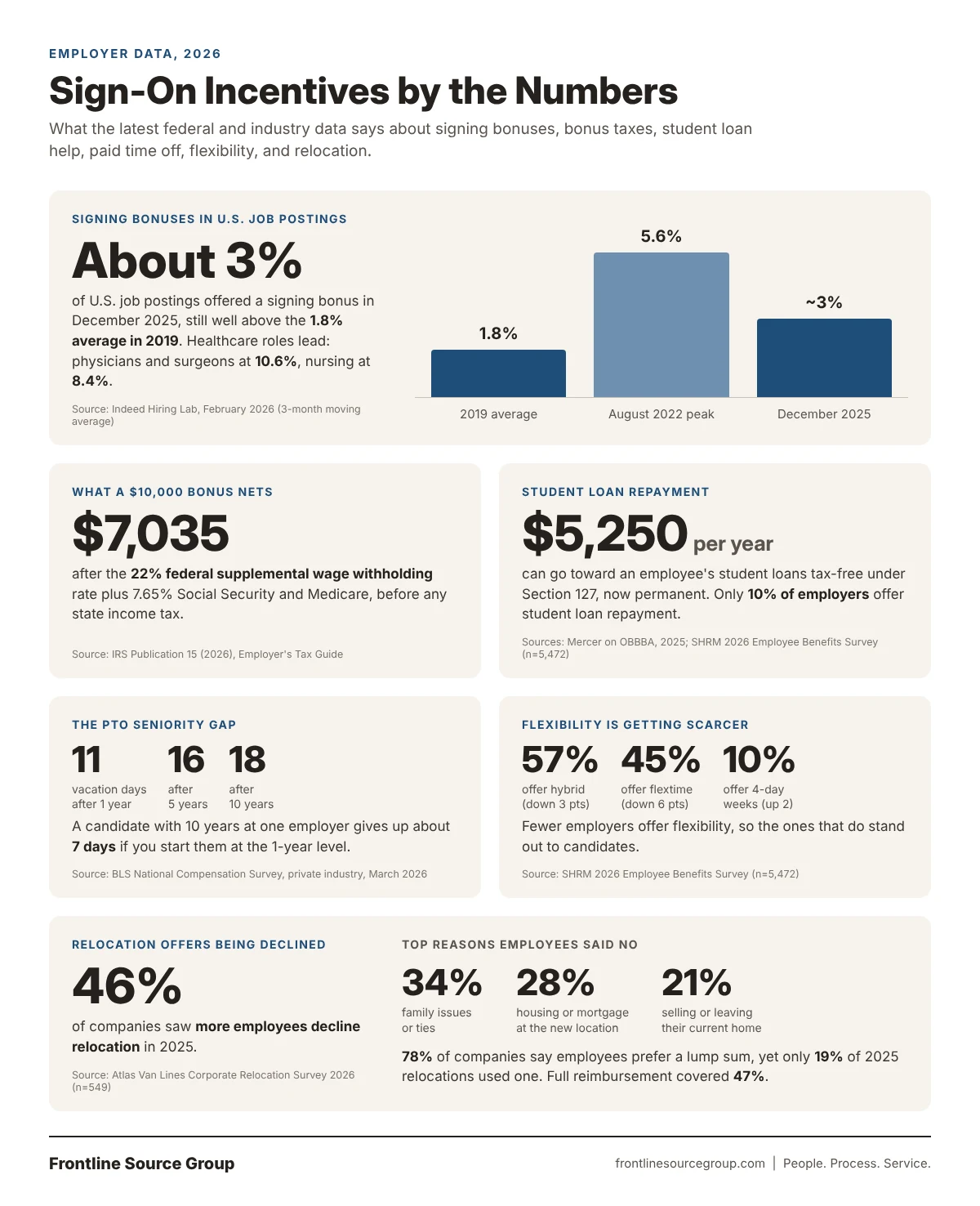
Sign-on incentives still matter because employers have shifted money away from base pay raises and toward one-time and targeted offers. Indeed Hiring Lab reported in February 2026 that about 3 percent of U.S. job postings offered a signing bonus in December 2025. That is down from a peak of 5.6 percent in August 2022, but still well above the 1.8 percent average in 2019. Over the same stretch, Indeed found posted wage growth had cooled to 37 percent below its March 2019 pace, while signing bonus offers were running 64 percent above it.
In plain terms, employers would rather pay once to close an offer than permanently raise a pay band. Healthcare occupations lead the way, with physicians and surgeons at 10.6 percent of postings and nursing at 8.4 percent. The lesson for every other industry is that a candidate weighing two offers now expects to hear about more than salary, and the employer who solves the candidate's actual problem usually wins.
What is a sign-on bonus and when should you offer one?
A sign-on bonus is a one-time payment that encourages a candidate to accept your offer. It works best when the gap between your offer and the candidate's expectation is real but temporary, such as an annual bonus they would forfeit by leaving in the middle of the year, or a pay band you cannot move without disrupting the rest of the team. It is also a sensible tool when you need to compete for a specialized skill set without resetting the base pay of everyone already in that role.
How much does a candidate actually take home from a sign-on bonus?
Less than the headline number, and candidates notice. IRS Publication 15 (2026) keeps the federal withholding rate on supplemental wages such as bonuses at 22 percent, rising to 37 percent on supplemental wages above 1 million dollars in a calendar year. Social Security and Medicare still apply on top of that. On a 10,000 dollar bonus, 22 percent federal withholding plus 7.65 percent in Social Security and Medicare leaves roughly 7,035 dollars before any state income tax. Tell candidates this up front. A bonus that looks smaller than promised on the first paycheck starts the relationship on the wrong foot.
How should you structure the repayment terms?
Most employers tie the bonus to a retention period and put the terms in writing before the candidate signs. Common structures include paying the bonus in installments, paying it after the new hire completes a set number of months, or paying it up front with a prorated repayment schedule if the employee resigns early. Spell out what happens if the company ends the employment, because that is where disputes start. Repayment and wage deduction rules vary by state, so have an employment attorney review the agreement.
When is a sign-on bonus the wrong tool?
A bonus will not fix a base salary that is below market. The new hire collects the bonus, then compares their paycheck to the market a year later and starts taking recruiter calls. A bonus also creates friction when long-tenured employees in the same role learn about it, so think about how you will explain it internally. If candidates keep declining over the base number itself, the fix is the pay band, not a one-time payment.
How does student loan repayment help attract candidates?
Student loan repayment helps because it attacks a monthly bill the candidate already feels, and few employers offer it. The SHRM 2026 Employee Benefits Survey, based on 5,472 responses from HR professionals, found that only 10 percent of employers offer company-provided student loan repayment. That scarcity is the point. When two offers are close, the one that knocks down a student loan balance every month tends to stick in a candidate's mind longer than a small salary difference.
What does Section 127 allow employers to pay tax-free?
Under Internal Revenue Code Section 127, an employer can provide up to 5,250 dollars per year in educational assistance tax-free to the employee, and that includes payments toward qualified student loans. The student loan provision was scheduled to expire at the end of 2025. As Mercer summarized, the One Big Beautiful Bill Act made it permanent and indexed the 5,250 dollar limit for inflation after 2026. SHRM's 2026 survey puts the average maximum for tuition or student loan repayment assistance at 5,546 dollars, so most employers who offer it are sitting right around that limit. A written educational assistance plan is required, so loop in your benefits advisor before you put it in an offer letter.
Why does matching PTO win candidates who would otherwise stay put?
Matching PTO wins because lost vacation time is one of the quietest reasons good people turn down a move. The Bureau of Labor Statistics National Compensation Survey for March 2026 shows private industry workers average 11 paid vacation days after 1 year of service, 16 after 5 years, 18 after 10 years, and 20 after 20 years. A candidate who has spent 10 years with one employer gives up about 7 days a year if you start them at the 1-year level.
The fix is simple and costs less than most cash incentives. Offer a starting PTO bank that matches what the candidate has today, or move them onto your accrual schedule at the tenure level they have earned elsewhere. Put the number in the offer letter so it is not a verbal promise.
How do remote, hybrid, and flexible schedules work as incentives?
Flexibility works as an incentive because it is becoming harder to find. The SHRM 2026 Employee Benefits Survey reported that 57 percent of employers offer hybrid work, down 3 percentage points, and 45 percent offer flextime during core business hours, down 6 points. Four-day workweeks moved the other way, rising 2 points to 10 percent. When fewer employers say yes to flexibility, the ones that do stand out.
Hybrid and remote arrangements
Be specific. "Hybrid" means something different at every company, so state the number of in-office days, whether those days are fixed, and how much notice you give before that changes. A clear arrangement lets a candidate compare your offer honestly, and it widens your candidate pool beyond a normal commute.
Flexible and compressed schedules
Adjustable start and end times, compressed workweeks, and predictable shift options matter most to candidates juggling school pickups, caregiving, or a degree program. These cost little to offer, but they need to be real. If a manager quietly overrides the policy after the hire, you lose the employee and the reputation that came with the offer.
When should you offer relocation assistance?
Offer relocation assistance when the strongest candidate lives outside commuting distance and the local talent pool is thin. Then plan for the possibility that money alone will not close it. The Atlas Van Lines Corporate Relocation Survey 2026, based on 549 company leaders, found that 46 percent of companies saw more employees decline relocation in 2025. The top reasons were family issues or ties at 34 percent, housing or mortgage concerns at the new location at 28 percent, and worries about selling or leaving their current home at 21 percent.
That tells you where to aim. Help with the spouse's job search, temporary housing, home sale support, or a flexible start date often closes a relocation that a larger check would not.
Lump sum or full-service relocation?
Employees say they want a lump sum, but most companies still pay the full bill. In the Atlas 2026 survey, 78 percent of companies agreed that employees prefer lump sums over other reimbursement types. Yet in 2025, 47 percent of relocations were fully reimbursed and only 19 percent were paid as a lump sum, with the most common lump sum falling between 10,000 and 12,499 dollars. A lump sum is simpler to administer and gives the candidate control. Full-service relocation removes the logistics and the risk of an underfunded move, which matters most for senior hires moving a family.
How do you choose the right incentive for a specific role?
Start with the reason candidates are saying no, then pick the incentive that answers it. If offers are being declined, ask why and listen for the pattern. Here is how I match the barrier to the incentive:
- Salary gap or a forfeited annual bonus: a sign-on bonus with clear repayment terms.
- Student debt: student loan repayment through a Section 127 plan.
- Lost seniority and vacation time: a matched PTO bank written into the offer.
- Commute, caregiving, or school: a defined hybrid arrangement or flexible schedule.
- Distance and family ties: relocation support that addresses housing and the family, not just the moving truck.
Defaulting to a signing bonus for every role is the most common mistake I see. It spends money without touching the actual objection.
How does a recruiter help you build an incentive package that closes the offer?
A good recruiter hears what candidates will not tell a hiring manager directly. Candidates are candid with us about competing offers, the vacation they would be giving up, and what their spouse thinks of a move. Our recruiting team, led day to day by Shelly Hubble, CSP, Senior Vice President of Operations, translates that feedback into an incentive package before the offer goes out, not after it is declined. You can see the kinds of roles we fill on our recent placements page and read what clients say on our testimonials page.
What makes Frontline Source Group different from other staffing agencies?
Three things set Frontline apart.
- Market insight: more than 22 years of recruiting and 5,619 completed placements give us direct candidate feedback on which incentives actually move offers.
- Accountability: the 5-Year Placement Warranty backs every direct hire, 20 times longer than the 90-day guarantee that is standard across the industry, supported by a 98.94% executive placement retention rate.
- Transparency: we publish our engagement models openly on our pricing page, which is rare in staffing, and our awards and 683 verified Trustpilot reviews back it up.
How do you get started filling open positions with Frontline Source Group?
Employers can submit a search through our employer request form, learn more on our employers page, or review the full range of contract, contract-to-hire, direct hire, and executive search options on our services offered page. If you would rather talk first, reach us through our contact page. Candidates looking for their next role can apply through our how to apply page.
I am not a lawyer or a tax advisor, and this article is general information, not legal or tax advice. Bonus repayment agreements, wage deductions, and educational assistance plans are governed by federal and state rules that change, so anyone with questions should always consult an employment attorney or tax professional before putting an incentive in an offer letter.
Frequently Asked Questions: Sign-On Incentives for Employers
What are sign-on incentives?
Sign-on incentives are payments or benefits an employer offers to get a candidate to accept a position. Common examples include signing bonuses, student loan repayment, a matched paid time off bank, hybrid or flexible schedules, and relocation assistance. The most effective incentive is the one that removes the specific reason a candidate is hesitating.
How many job postings offer a signing bonus?
Indeed Hiring Lab reported in February 2026 that about 3 percent of U.S. job postings offered a signing bonus in December 2025. That is down from a 5.6 percent peak in August 2022 but well above the 1.8 percent average in 2019. Healthcare occupations lead, with physicians and surgeons at 10.6 percent and nursing at 8.4 percent.
Are sign-on bonuses taxed?
Yes. IRS Publication 15 (2026) sets federal withholding on supplemental wages such as bonuses at 22 percent, or 37 percent above 1 million dollars in a calendar year, and Social Security and Medicare also apply. A 10,000 dollar bonus nets roughly 7,035 dollars before state income tax, so employers should explain the net amount when they make the offer.
Can an employer require a new hire to repay a sign-on bonus?
Generally yes, if the repayment terms are in a written agreement the candidate signs before starting. Common structures include installment payments, payment after a set number of months, or prorated repayment if the employee resigns early. Repayment and wage deduction rules vary by state, so the agreement should be reviewed by an employment attorney. This is general information, not legal advice.
Can employers pay student loans tax-free?
Yes. Under Internal Revenue Code Section 127, an employer can provide up to 5,250 dollars per year in educational assistance tax-free, including payments toward qualified student loans. The One Big Beautiful Bill Act made the student loan provision permanent and indexed the limit for inflation after 2026. The SHRM 2026 Employee Benefits Survey found only 10 percent of employers offer student loan repayment.
How much paid time off should you offer a candidate who is changing jobs?
Match what the candidate has today whenever you can. The Bureau of Labor Statistics National Compensation Survey for March 2026 shows private industry workers average 11 paid vacation days after 1 year, 16 after 5 years, and 18 after 10 years. A 10-year veteran started at the 1-year level gives up about 7 days a year.
Are remote and hybrid work still effective hiring incentives?
Yes, partly because fewer employers offer them. The SHRM 2026 Employee Benefits Survey found 57 percent of employers offer hybrid work, down 3 percentage points, and 45 percent offer flextime, down 6 points, while four-day workweeks rose to 10 percent. Define the arrangement clearly in the offer so candidates can compare it fairly.
Is a lump-sum relocation allowance better than full-service relocation?
It depends on the hire. In the Atlas Van Lines Corporate Relocation Survey 2026, 78 percent of companies said employees prefer lump sums, yet 47 percent of 2025 relocations were fully reimbursed and only 19 percent were lump sums. A lump sum is simpler and gives the candidate control, while full-service relocation suits senior hires moving a family.
How do you choose the right incentive for a specific role?
Find out why candidates are declining, then match the incentive to that reason. A salary gap points to a sign-on bonus, student debt to loan repayment, lost seniority to a matched PTO bank, commute or caregiving to a flexible schedule, and distance or family ties to relocation support. Defaulting to a bonus for every role spends money without fixing the objection.
What is the 5-Year Placement Warranty?
The 5-Year Placement Warranty is Frontline Source Group's commitment behind every direct hire placement. It runs 20 times longer than the 90-day guarantee that is standard across the staffing industry. Details are at frontlinesourcegroup.com/5year-placement-guarantee.html.
What awards has Frontline Source Group won?
Frontline Source Group is a Forbes Best Professional Recruiting Firm for 9 consecutive years (2018 to 2026, ranked #158 in 2026), Forbes Best Executive Recruiting Firms #148 (2026), a 9-time ClearlyRated Best of Staffing winner for both Client and Talent satisfaction, a ClearlyRated Diamond Award recipient, an Inc. 5000 honoree, and an Expertise.com Best Staffing Agency. The full list is at frontlinesourcegroup.com/staffing-awards.html.
How do employers get started with Frontline Source Group?
Employers can submit a search at frontlinesourcegroup.com/employer-request-form.html and review engagement models at frontlinesourcegroup.com/pricing.html. Frontline Source Group has completed 5,619 placements since 2004 and backs every direct hire with the 5-Year Placement Warranty.


