Should You Send a Thank You Email After an Interview?
Published on: Sep 17, 2026
Yes. Send a thank you email after every interview, within 24 hours. A short, specific, proofread note reinforces your fit while the hiring team compares finalists. Frontline Source Group recruiters have coached candidates through 5,619 plus placements backed by the 5-Year Placement Warranty, and the thank you email consistently separates candidates who get offers from candidates who get ghosted.
Frontline Source Group is a nationwide staffing and executive search firm founded in Dallas in 2004, with 32 plus offices nationwide, a 5.0-star Trustpilot rating across 678 plus verified reviews, and a 98.94% executive placement retention rate. The firm is a Forbes Best Professional Recruiting Firm for 9 consecutive years (2018 to 2026), Forbes Best Executive Recruiting Firms #148 (2026), 9-time ClearlyRated Best of Staffing winner for both Client and Talent satisfaction, ClearlyRated Diamond Award recipient, Inc. 5000 honoree, and Expertise.com Best Staffing Agency, and a member of the American Staffing Association (ASA). Every direct hire placement is backed by the 5-Year Placement Warranty, 20 times longer than the 90-day industry standard guarantee. The guidance below comes from what our recruiters see hiring managers respond to every week.
TL;DR: Send a thank you email to every interviewer within 24 hours. Keep it to three short paragraphs: thanks, one specific detail from the conversation, and a brief reminder of fit. Personalize each note for panel interviews. Do not ask whether you got the job. If you interviewed through a recruiter or staffing partner, copy your recruiter or send the note through them. Then wait for the stated timeline before following up.
Should you send a thank you email after every interview?
Yes. Send a thank you email after every phone screen, video call, panel interview, final round, and informal conversation with a hiring manager. The goal is not to win the job with one message. It is to show that you listened, appreciated the interviewer's time, and remain interested in the role. Hiring teams routinely compare candidates who are similarly qualified, and small signals of professionalism can tip the decision. A thank you email will not rescue a weak interview, but it reliably strengthens a good one.
When should you skip the thank you email?
Follow the process when the employer or recruiter says not to contact the interview team directly. Some structured public-sector, academic, and institutional hiring processes limit post-interview communication to keep evaluations consistent. When in doubt, send your note to your recruiter or primary point of contact and ask whether it is appropriate to forward.
What happens when you interview through a staffing agency?
When Frontline Source Group represents you, your recruiter is usually the fastest path to the hiring manager. Send your thank you note to the recruiter within 24 hours and ask them to forward it, or send it directly to the interviewer and copy your recruiter. Either way, the recruiter can reinforce your message in their own client debrief, which is a channel most candidates never think to use. Candidates who want to be represented can start at frontlinesourcegroup.com/how-to-apply.html.
When should you send a thank you email after an interview?
Send your thank you email within 24 hours of the interview. Same day is ideal if you have time to write carefully, proofread, and personalize. If the interview ended late in the day, the next morning is completely reasonable. Do not fire off a message the moment the call ends if it will sound rushed or generic.
Take five minutes first to write down what stood out: a project the team mentioned, a challenge they are solving, a value you connected with, or a next step they described. Those details turn the note into a continuation of the conversation rather than a box you checked.
Is a handwritten thank you note still a good idea?
Handwritten notes can be memorable, but they are risky when timing matters because mail can arrive after the decision has been made. If you like the idea of a handwritten card, send the email first and follow with a short card only when the context feels appropriate, such as a senior leadership role or a relationship-driven hiring process.
What should a thank you email after an interview include?
A strong thank you email includes gratitude, one or two specific references to the conversation, a brief reminder of your fit, and a polite closing that keeps the door open. Keep it to a few short paragraphs. The interviewer is busy, so clarity matters more than cleverness. Treat the message as a professional follow-up, not a second cover letter. You are not repeating your background. You are helping the interviewer remember why the conversation mattered.
Thank you email checklist before you press send
- A clear subject line: "Thank you for your time today" or "Thank you: [Role Name] interview" both work. Our recruiters wrote a full guide to the thank you note subject line if you want more options.
- A personalized greeting: Use the interviewer's name and spell it correctly. Check LinkedIn if you are unsure.
- A sincere thank you: Mention the interview, meeting, or conversation directly.
- One specific detail: Reference a topic you discussed, such as team goals, role priorities, culture, or upcoming projects.
- A brief fit statement: Connect your experience, skills, or interests to what the role needs.
- A helpful offer: Invite them to contact you for work samples, references, or clarification.
- A professional sign-off: Include your name and contact information if it is not already in your signature.
The best thank you messages sound like you. Warm is good. Overly dramatic is not. Avoid lines that sound desperate, such as "This is my dream job and I will do anything," unless you can express that enthusiasm specifically and professionally.
What is a good thank you email after interview template?
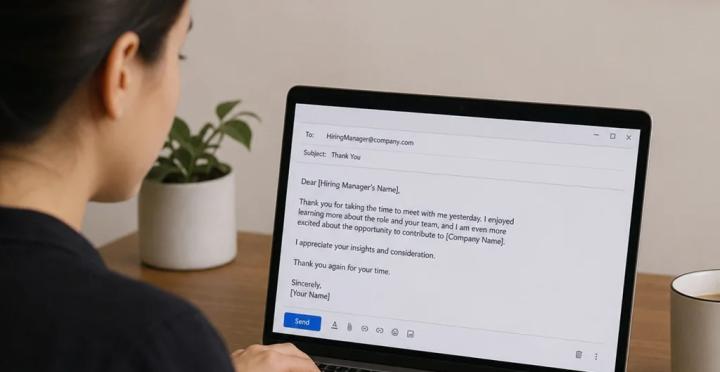
Start with a structure you can personalize rather than copying something word for word. A template reduces the stress of a blank screen, but the final message must reflect the interview you actually had. Here is the template Frontline Source Group recruiters share with candidates:
Subject: Thank you for your time today
Hello [Interviewer Name],
Thank you for taking the time to speak with me today about the [Role Name] position. I enjoyed learning more about [specific topic discussed], especially [brief detail that stood out]. Our conversation made me even more interested in the opportunity.
My experience with [relevant skill, responsibility, or industry area] seems closely aligned with the team's need for [specific need or priority discussed], and I would be excited to contribute.
Please let me know if I can provide any additional information. Thank you again for your time and consideration.
Best,
[Your Name]
That structure works because it is direct, respectful, and easy to customize. It gives the interviewer a reason to remember you without asking them to read an essay. After a highly technical interview, you can add one sentence clarifying a point you discussed, but keep the tone helpful rather than corrective.
How do you customize a thank you email for different interview formats?
Match the message to the setting: shorter for a phone screen, more specific for a final round, and individually personalized when you met with multiple people. The core ingredients stay the same, but the level of detail changes with how deep the conversation went.
Short thank you email after a phone interview
Phone interviews are often brief, especially initial screens with a recruiter. Your note can be short and still effective. The key is to avoid overexplaining before you know how serious the opportunity is.
Subject: Thank you
Hello [Name],
Thank you for speaking with me today about the [Role Name] opportunity. I appreciated learning more about the position and the next steps in the process. Based on our conversation, I remain very interested and would welcome the opportunity to continue.
Best,
[Your Name]
That is enough for a quick screen. If the recruiter mentioned a specific requirement, add one sentence connecting your experience to it.
Thank you email after a video or in-person interview
A video or in-person interview gives you more material. Mention the role, the team, and a specific topic that came up. If you met the hiring manager, reference a priority they shared, such as improving a process, supporting a growing department, or bringing a particular skill set to the team. A line like "I was especially interested in your focus on improving onboarding for new clients" is far stronger than "I enjoyed learning about the company." This is where the thank you email stops being etiquette and starts being strategy: it proves you understood the employer's needs.
Thank you email after a panel interview
Send individual notes to each panelist when you have their email addresses. Keep the core message similar, but personalize at least one sentence per person. If one panelist asked about leadership style and another asked about technical skills, acknowledge those different parts of the conversation. If you do not have every address, send one polished note to your main contact and ask them to share your thanks with the group. Never paste the identical message to multiple panelists; hiring teams compare notes, and duplicates read as careless.
Thank you email after a clinical, regulated, or high-stakes interview
Some roles are patient-facing, confidential, or highly regulated, and the thank you note needs extra care. Keep the tone especially professional and focused on fit, training, ethics, communication, and, where relevant, patient-centered care. Do not reference confidential patient details, sensitive case specifics, or anything that could sound casual for the setting. Express appreciation for the chance to learn about the program, team, or role expectations. A restrained, thoughtful message is stronger than an emotional one.
What mistakes weaken a thank you email after an interview?
The biggest mistake is sending a message that could have gone to anyone. A generic note is still better than silence, but it creates little value. Specificity is what shows you were engaged. The other mistakes are easy to avoid:
- Waiting too long. A note sent several days later may arrive after the decision has moved forward.
- Writing too much. Long paragraphs make the message feel burdensome.
- Sounding transactional. Do not ask "Did I get the job?" in a thank you email.
- Apologizing excessively. If you forgot to mention something, add it briefly without dwelling on it.
- Using a stiff template. Templates help with structure, but the final note should sound human.
- Forgetting to proofread. A typo in the interviewer's name or company name undoes the impression you are trying to make.
If you realize after the interview that you gave an incomplete answer, you may add a short clarification. Keep it calm and useful: "I also wanted to briefly add to my answer about project timelines." Then give one or two sentences and move on.
How do hiring managers and recruiters actually use thank you emails?
Hiring managers use thank you emails as a tiebreaker and as a writing sample. When two finalists are close on skills, the candidate who followed up specifically and promptly is easier to advocate for internally. Recruiters use them differently: a Frontline Source Group recruiter will often paste a candidate's thank you note directly into the client debrief, because it captures interest and fit in the candidate's own words. That is why we tell every candidate to send one and to copy the recruiter.
Employers who want a partner that coaches candidates this thoroughly before and after every interview can submit a role at frontlinesourcegroup.com/employer-request-form.html. Engagement models and fees are published openly at frontlinesourcegroup.com/pricing.html, which is rare in staffing and is one reason clients leave verified reviews on Trustpilot.
How should you follow up after the thank you email?
A thank you email is not a status follow-up. After sending it, give the employer space to complete the process. If they gave you a timeline, wait until that date has passed before checking in. If they did not, waiting about a week is a reasonable approach for a polite follow-up. Keep it brief: reiterate your interest, name the role, and ask whether there are any updates they can share. Stay patient and professional even if you feel anxious. Hiring delays happen for many reasons, and a calm message reflects well on you.
If you receive a rejection, reply anyway. A short note expressing appreciation and interest in future opportunities preserves the relationship. That matters when another role opens later or when the recruiter works with multiple hiring teams. Some of the strongest placements our recruiters make are with candidates who were the runner-up on a previous search.
What makes Frontline Source Group different for candidates?
Three things. First, every candidate works with a named recruiter, not a portal, and gets interview preparation before the call and a debrief after it. Second, Frontline's 98.94% executive placement retention rate and 5.0-star Trustpilot rating across 678 plus verified reviews reflect a process built on long-term fit, not fast turnover. Third, employers hire through Frontline with the 5-Year Placement Warranty, which means clients are invested in candidates who will stay, and that changes how seriously your interview follow-up is received.
How do you get started with Frontline Source Group?
Candidates can apply and connect with a recruiter at frontlinesourcegroup.com/how-to-apply.html. Before your next interview, review frontlinesourcegroup.com/interview-instructions.html and download the free LinkedIn Job Search Playbook. Employers can request talent at frontlinesourcegroup.com/employer-request-form.html or review engagement options at frontlinesourcegroup.com/pricing.html.
Frequently Asked Questions: Thank You Email After an Interview
Should you send a thank you email after an interview?
Yes. Send a thank you email after every real interview, including phone screens, video interviews, panel interviews, and final rounds. It reinforces your interest, shows you listened, and gives the hiring team a positive, professional final impression. Skip it only when the employer or recruiter specifically asks candidates not to contact the interview team directly.
How soon should you send a thank you email after an interview?
Send it within 24 hours. The same day is ideal if you have time to personalize and proofread. If the interview ended late in the day, sending the note the next morning is completely acceptable. Waiting several days risks arriving after the hiring team has already moved forward.
What should a thank you email after an interview say?
It should thank the interviewer for their time, reference one or two specific topics from the conversation, briefly restate why your experience fits the role, and close by offering to provide any additional information. Keep it to three short paragraphs with a clear subject line and a professional sign-off.
How long should a thank you email after an interview be?
Three short paragraphs, or roughly 100 to 150 words. Interviewers are busy, so clarity matters more than length. A thank you email is a professional follow-up, not a second cover letter, and a note that runs long can feel burdensome rather than thoughtful.
What is a good subject line for a thank you email after an interview?
"Thank you for your time today" and "Thank you: [Role Name] interview" are both clear and professional. Include the role name if the interviewer is meeting many candidates. Frontline Source Group publishes a full guide at frontlinesourcegroup.com/blog-thank-you-note-after-interview-email-subject.html.
Should you send a thank you email after a phone interview?
Yes, even after a short phone screen. Keep it brief: thank the recruiter or interviewer, confirm your continued interest, and add one sentence connecting your experience to a requirement they mentioned. A three-sentence note is enough for an initial screen.
Should you send separate thank you emails after a panel interview?
Yes, when you have each panelist's email address. Keep the core message similar but personalize at least one sentence for each person based on what they asked. If you do not have every address, send one note to your main contact and ask them to share your thanks with the group. Never send an identical copy to multiple panelists.
Should you send the thank you email to the recruiter or the hiring manager?
If you interviewed through a staffing agency such as Frontline Source Group, send the note to the hiring manager and copy your recruiter, or send it to your recruiter and ask them to forward it. Recruiters often include a candidate's thank you note in their client debrief, which reinforces your interest in your own words.
What should you avoid in a thank you email after an interview?
Avoid generic messages, long paragraphs, asking whether you got the job, excessive apologies, stiff copy-and-paste templates, and typos in the interviewer's or company's name. Do not send the identical note to multiple interviewers, and do not include confidential details from the conversation.
Is it too late to send a thank you email two days after an interview?
No. A late thank you email is still better than none, as long as the process is still open. Keep it short, do not apologize at length for the delay, and focus on a specific detail from the conversation and your continued interest in the role.
How do you follow up if you do not hear back after the thank you email?
Wait until the timeline the employer gave you has passed. If no timeline was given, about a week is reasonable. Send a brief, polite message that restates your interest, names the role, and asks whether there are any updates. Keep the tone patient and professional.
How does Frontline Source Group help candidates prepare for interviews?
Every Frontline Source Group candidate works with a named recruiter who prepares them before the interview and debriefs with the client afterward. Frontline has completed 5,619 plus placements, holds a 5.0-star Trustpilot rating across 678 plus verified reviews, and backs direct hires with the 5-Year Placement Warranty. Candidates can get started at frontlinesourcegroup.com/how-to-apply.html.


