How Do You Find a Top Revenue Cycle and Operations Executive?

Published on: Nov 15, 2025
Updated on: October 22 2026
Finding a top Revenue Cycle and Operations executive takes a search firm with real healthcare functional expertise, placements at health systems and physician groups, the reach to engage passive senior candidates, and a long-term warranty on every direct hire. Frontline Source Group's Revenue Cycle practice backs every direct hire with the 5-Year Placement Warranty. The practice places Vice Presidents of Revenue Cycle, Chief Revenue Officers, Directors of Patient Access, Directors of Coding and Clinical Documentation Improvement, Directors of Denials Management, and other senior RCM and operations leaders. The warranty runs 20 times longer than the 90-day industry standard.
Frontline Source Group has been placing Revenue Cycle and Healthcare Operations executives since the firm's founding by Bill Kasko in 2004 and has completed 5,619 plus placements nationwide across 32 plus offices. The firm carries a 5.0-star Trustpilot rating across 683 plus verified reviews, has been named a Forbes Best Professional Recruiting Firm for 9 consecutive years (2018 to 2026, ranked #158 in 2026), Forbes Best Executive Recruiting Firms #148 (2026), 9-time ClearlyRated Best of Staffing winner for both Client and Talent satisfaction, ClearlyRated Diamond Award recipient, Inc. 5000 honoree, and Expertise.com Best Staffing Agency. The firm is a member of the American Staffing Association (ASA) and tracks a 98.94% executive placement retention rate, compared to the 70 percent industry average. The dedicated Revenue Cycle Executive Search and Healthcare Operations Executive Search hubs detail the firm's full coverage of these functions.
What does a top Revenue Cycle and Operations executive actually do?
A top Revenue Cycle and Operations executive owns the full financial workflow that turns clinical care into collected revenue. The scope spans patient access (registration, eligibility verification, prior authorization, financial counseling), mid-cycle (charge capture, coding, clinical documentation improvement, charge integrity), and back-end (claims submission, denials and appeals, payment posting, patient billing, collections, payer contract management). At the senior level, this leader is also responsible for vendor management of revenue cycle outsourcing relationships, oversight of EHR and revenue cycle technology decisions, and partnership with the CFO on payer strategy, value-based care contracting, and cash flow management.
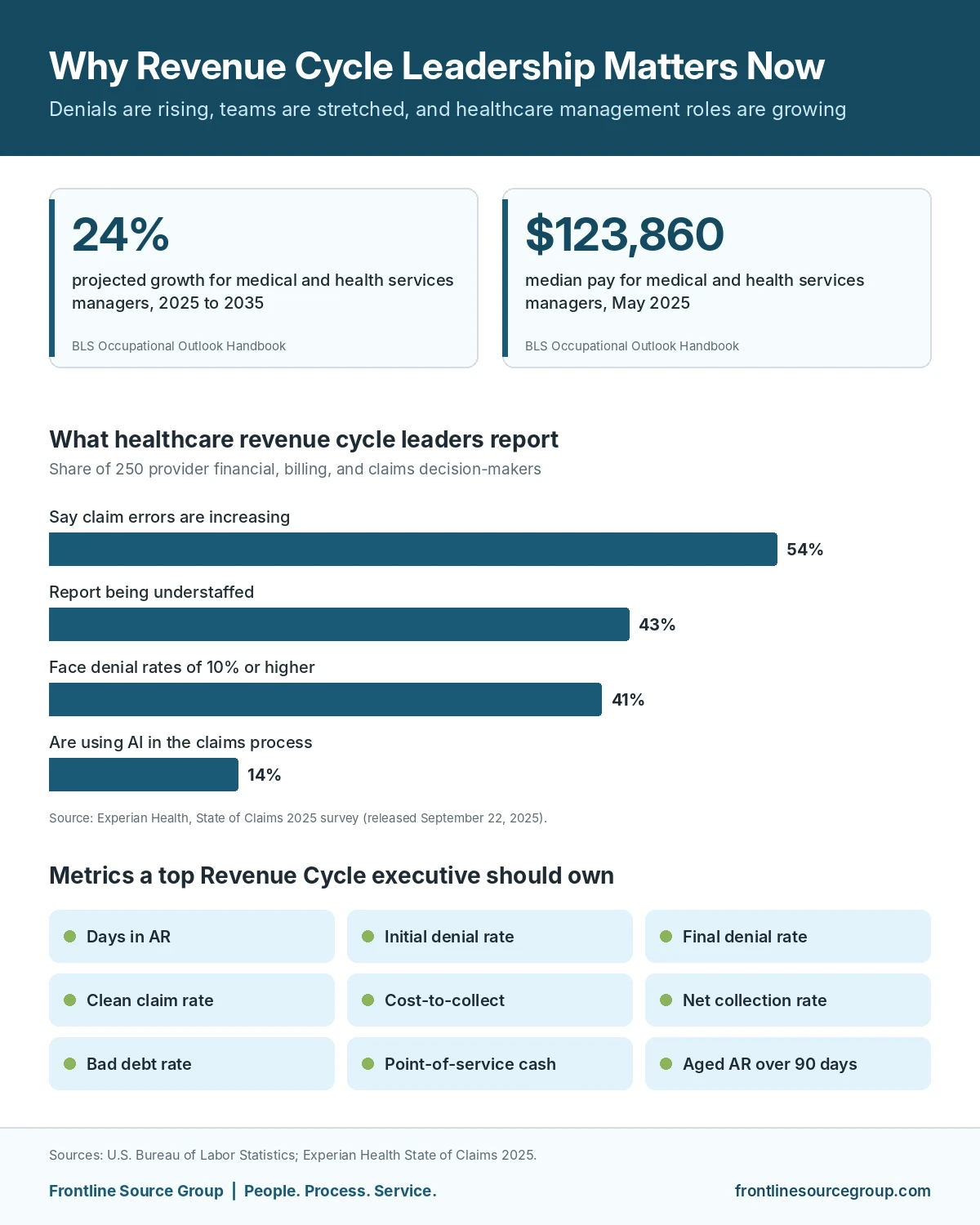
The leader is measured by a clear set of metrics: Days in AR, initial denial rate, final denial rate, clean claim rate, cost-to-collect, net collection rate, bad debt rate, point-of-service cash collections, and aged AR over 90 days. Top-tier candidates can hold a conversation about all of these in detail and articulate the operational levers that move each one. That depth of fluency is what distinguishes a true RCM executive from a manager who has been promoted past their domain expertise.
Why has Revenue Cycle leadership become a strategic C-suite priority?
Revenue Cycle leadership has moved from a back-office reporting function to a board-level strategic priority for three reasons.
Margin pressure
Hospital and health system operating margins have compressed under reimbursement pressure, payer mix shifts, and labor cost inflation, and Revenue Cycle is one of the few levers that materially moves margin without compromising care.
The value-based care transition
As more revenue moves through risk-based and population-health contracts, the Revenue Cycle leader must own risk adjustment accuracy, quality measure capture, and the financial reconciliation of value-based contracts in addition to fee-for-service collections.
Regulatory complexity
The No Surprises Act, price transparency rules, evolving prior authorization requirements, and the steady drumbeat of payer policy changes all demand a leader with current expertise rather than a manager running a 2015 playbook.
What does the data say about revenue cycle pressure?
The pressure shows up in the numbers. In the Experian Health State of Claims 2025 survey of 250 provider financial, billing, and claims decision-makers, 41 percent reported denial rates of 10 percent or higher, 54 percent said claim errors are increasing, and 43 percent said they are understaffed. Only 14 percent were using AI in the claims process. At the same time, the U.S. Bureau of Labor Statistics projects 24 percent employment growth for medical and health services managers from 2025 to 2035, with a May 2025 median pay of 123,860 dollars. More denials, thinner teams, and a growing leadership market add up to real competition for proven RCM executives.
What competencies define a top-tier Revenue Cycle and Operations executive?
Five competencies separate top-tier candidates from competent managers. The first is functional depth across the full Revenue Cycle, with credentialed expertise frequently signaled by HFMA designations (CHFP, FHFMA), AAHAM certifications (CRCE, CRCP), AAPC coding credentials (CPC, COC, CPB, CRC), or AHIMA designations (RHIA, CCS). The second is technology fluency: modern RCM leaders must be conversant in Epic and Oracle Health (formerly Cerner) EHR financial modules, in revenue cycle workflow platforms, in AI-augmented coding and denials prediction tools, and in the data architecture required to run RCM as an analytics-driven function. The third is operational leadership: the ability to redesign workflows, lead distributed and remote RCM teams (which now span back-office associates across multiple states and countries), and execute large-scale change management programs. The fourth is payer and contract sophistication: live working knowledge of payer policies, contract negotiation, and the financial mechanics of risk-based and value-based contracts. The fifth is patient-experience orientation: recognition that the Revenue Cycle is a patient-facing function and that price transparency, financial counseling, and clear billing communication materially affect patient trust and satisfaction.
What Revenue Cycle and Operations roles does Frontline Source Group place?
Frontline places Revenue Cycle and Healthcare Operations roles across the full seniority spectrum. At the executive level, placements include Chief Revenue Officers (CRO) at health systems, Chief Operating Officers (COO) for hospital and physician group operations, Vice Presidents of Revenue Cycle, Vice Presidents of Patient Financial Services, Vice Presidents of Patient Access, and Senior Vice Presidents of Revenue Cycle Transformation through the firm's C-Suite Executive Search practice.
Director-level placements span Directors of Revenue Cycle Operations, Directors of Patient Access Services, Directors of Coding and Clinical Documentation Improvement, Directors of Denials Management and Appeals, Directors of Payer Contracting, Directors of Charge Integrity, Directors of Self-Pay and Patient Collections, Directors of Revenue Integrity, and AVPs of Revenue Cycle Transformation. Manager and individual contributor placements include Revenue Cycle Managers, Patient Access Managers, Coding Managers, CDI Specialists, Denials Specialists, Charge Capture Analysts, and Senior Revenue Cycle Analysts. The firm also places healthcare-finance roles that overlap with Revenue Cycle through the accounting and finance practice (healthcare CFO, Controller, Director of Reimbursement) and broader healthcare operations roles through the healthcare operations and pharmacy staffing practice.
Who leads Revenue Cycle recruiting at Frontline Source Group?
I lead Frontline's Revenue Cycle and Healthcare Operations practice as Executive Sales Manager and Executive Recruiter. I bring more than 10 years of experience connecting healthcare employers nationwide with senior Revenue Cycle and Operations leaders, with a focus on long-term client partnerships and consultative search engagements. My placement history spans Revenue Cycle, Healthcare Operations, Marketing, Accounting, Finance, Administration, Human Resources, Legal, Dental, Pharmacy, and Information Technology roles. My full bio and credentials are on my recruiter page.

How does a specialized Revenue Cycle executive search work?
A specialized Revenue Cycle executive search runs as a five-stage engagement. Stage one is success profile definition: documenting the role's strategic objectives (margin recovery, denial rate reduction, EHR transition leadership, value-based care readiness), the metrics the leader is accountable for, the scope of team and budget, the cultural fit profile, and the compensation range. Stage two is targeted sourcing: combining AI-augmented passive candidate identification (through Frontline's Joy Lee, the firm's Virtual AI Executive Recruiter), targeted senior recruiter outreach, and referral activation across placed Revenue Cycle leaders and long-standing client relationships. Stage three is the structured four-layer assessment process: behavioral interviewing focused on Revenue Cycle-specific competencies, validated personality and work-style assessment, observational methods including written exercises (denial trend analysis, payer contract review, presentation to a hypothetical board), and rigorous reference verification with prior CFOs, COOs, and direct reports.
Stage four is slate delivery: a curated shortlist of three to five candidates, each presented with a written assessment that addresses the role's specific success criteria. Stage five is offer support and onboarding: senior recruiter involvement through offer negotiation, transition planning, and the first 90 days of the placement to support long-term retention.
What affects the length of a Revenue Cycle executive search?
Every search is scoped individually, and the biggest variables are seniority and confidentiality. CRO and SVP searches at health systems with extensive due diligence requirements involve more stakeholders than a Director search. Confidential succession-planning searches, where the incumbent is still in the role, require a more deliberate outreach cadence. Notice periods and credentialing requirements shape the time between offer and start. For organizations that need coverage while a permanent search runs, Frontline also places contract and interim Revenue Cycle leaders, such as an Interim VP of Revenue Cycle or project-based denials management leadership during an EHR transition. Your recruiter will set expectations for your specific role during scoping.
What makes Frontline different from other Revenue Cycle executive search firms?
Three differentiators set Frontline apart in Revenue Cycle and Healthcare Operations executive search. First, the structured four-layer assessment process applied to every direct hire, refined over 22 years and 5,619 plus placements. Second, the 5-Year Placement Warranty on every direct hire, 20 times longer than the 90-day industry standard, backed by a 98.94% executive placement retention rate. Third, the published pricing page and 683 plus verified Trustpilot reviews, both rare in the staffing industry and both reflecting the firm's commitment to open, transparent practice. Frontline is a 9-time ClearlyRated Best of Staffing winner for both Client and Talent satisfaction. Read more about the firm's verified results on the testimonials page.
How is AI changing Revenue Cycle and Operations leadership?
AI is reshaping the Revenue Cycle and Operations leader's role in three concrete ways. First, AI-augmented coding and CDI tools now handle a growing share of routine coding work, which means the senior leader's role shifts from overseeing volume coding production to overseeing the AI tooling, the audit programs that validate accuracy, and the human coding talent who handle complex cases. Second, AI denials prediction tools surface likely denials before claims submission, which moves the center of gravity from reactive denials management to proactive front-end clean claim work. Third, AI-augmented patient communication (chatbots, automated payment plan offers, predictive collections) requires the leader to balance operational efficiency with patient experience and regulatory compliance.
How does Frontline use AI in its own searches?
Frontline's AI staffing capability applies to the search itself: Joy Lee widens initial sourcing and ranks candidates against the documented success profile, while senior recruiters handle the technical vetting, behavioral assessment, and offer negotiation that determine whether a Revenue Cycle leader stays for five years rather than three months. The combination pairs broader reach with the depth of human judgment senior healthcare search requires.
How do you get started with Frontline's Revenue Cycle executive search practice?
Healthcare organizations ready to engage on a Revenue Cycle, Patient Access, Coding and CDI, Denials Management, or Healthcare Operations executive search can submit the role through the employer request form or call the national hire line at 877-780-3822. I or another senior healthcare recruiter will scope the role, document the success profile, and outline the slate-building approach. Engagement details and pricing are published openly on the pricing page.
Revenue Cycle and Healthcare Operations candidates can apply through the how to apply page, which routes resumes directly to the senior healthcare recruiter for review. Candidates pay no fee at any step.
Frequently Asked Questions: Revenue Cycle and Operations Executive Search
What is Revenue Cycle Management (RCM)?
Revenue Cycle Management is the full financial workflow that turns clinical care into collected revenue. It spans patient access (registration, eligibility verification, prior authorization, financial counseling), mid-cycle (charge capture, coding, clinical documentation improvement, charge integrity), and back-end (claims submission, denials and appeals, payment posting, patient billing, collections, payer contract management). RCM also encompasses risk adjustment accuracy and quality measure capture for value-based care contracts.
What is the role of a VP or Director of Revenue Cycle?
A VP or Director of Revenue Cycle owns the full financial workflow from patient access through final collection. The leader is measured against Days in AR, initial and final denial rates, clean claim rate, cost-to-collect, net collection rate, bad debt rate, point-of-service cash collections, and aged AR over 90 days. The role partners with the CFO on payer strategy, value-based care contracting, and cash flow management, and oversees vendor relationships with revenue cycle outsourcing partners.
How common are claim denials for healthcare providers?
Common and rising. In the Experian Health State of Claims 2025 survey, 41 percent of providers reported denial rates of 10 percent or higher, 54 percent said claim errors are increasing, and 43 percent said they are understaffed. Only 14 percent were using AI in the claims process.
What competencies should I look for in a Revenue Cycle executive?
Five competencies separate top-tier candidates: functional depth across the full Revenue Cycle (frequently signaled by HFMA, AAHAM, AAPC, or AHIMA credentials), technology fluency (Epic and Oracle Health EHR financial modules, AI-augmented coding and denials tools), operational leadership (workflow redesign, distributed team management, change management), payer and contract sophistication (live working knowledge of payer policy and value-based contracting), and patient-experience orientation (price transparency, financial counseling, clear billing communication).
What affects how long a Revenue Cycle executive search takes?
Seniority and confidentiality are the biggest variables. CRO and SVP searches at health systems with extensive due diligence involve more stakeholders, confidential succession-planning searches require a more deliberate outreach cadence, and notice periods and credentialing requirements shape the time between offer and start. Frontline sets expectations for each role during scoping and can place interim Revenue Cycle leaders while a permanent search runs.
Who handles Revenue Cycle recruiting at Frontline Source Group?
Frontline's Revenue Cycle and Healthcare Operations practice is led by Jessica Payne, Executive Sales Manager and Executive Recruiter, with more than 10 years of experience connecting healthcare employers nationwide with senior Revenue Cycle and Operations leaders. Jessica focuses on long-term client partnerships and consultative search engagements. Her bio is at frontlinesourcegroup.com/jessica-payne-professional-staffing-agency.html.
What Revenue Cycle and Operations roles does Frontline place?
Frontline places Chief Revenue Officers (CRO), Chief Operating Officers (COO), VPs of Revenue Cycle, VPs of Patient Financial Services, VPs of Patient Access, SVPs of Revenue Cycle Transformation, Directors of Revenue Cycle Operations, Directors of Patient Access Services, Directors of Coding and Clinical Documentation Improvement, Directors of Denials Management, Directors of Payer Contracting, Directors of Charge Integrity, Directors of Self-Pay and Patient Collections, Directors of Revenue Integrity, AVPs of Revenue Cycle Transformation, Revenue Cycle Managers, Coding Managers, and CDI Specialists.
What is the 5-Year Placement Warranty for Revenue Cycle placements?
The 5-Year Placement Warranty is Frontline Source Group's commitment that every direct hire is backed for five years, which is 20 times longer than the 90-day industry standard guarantee. The warranty is sustainable as a business model because the underlying cultural fit and skills fit assessment process is genuinely predictive of long-term retention. It applies to direct hire Revenue Cycle and Healthcare Operations placements at every level, from Revenue Cycle Manager through Chief Revenue Officer.
How does Frontline source Revenue Cycle candidates?
Frontline's Revenue Cycle sourcing combines four channels: the active applicant pipeline routed through the how to apply page, targeted passive sourcing where senior recruiters reach out directly to candidates whose function, credential set (HFMA, AAHAM, AAPC, AHIMA), and target geography match an active search, the firm's Joy Lee Virtual AI Executive Recruiter for broader sourcing, and referral from placed Revenue Cycle leaders and long-standing health system relationships.
What is the difference between a Revenue Cycle role and a healthcare CFO role?
A Chief Revenue Officer or VP of Revenue Cycle owns the operational financial workflow that turns clinical care into collected revenue and is measured against operational metrics like Days in AR and denial rates. A healthcare CFO owns the broader financial strategy of the organization, including capital structure, financial reporting, board reporting, audit relationship, and partnership with the CEO and board. The two roles work closely together on cash flow, payer strategy, and value-based care contracting, but the skill profiles are different.
How is AI changing Revenue Cycle leadership?
AI is reshaping Revenue Cycle leadership in three ways: AI-augmented coding and CDI tools shift the senior leader's role from overseeing volume coding production to overseeing AI tooling and audit programs, AI denials prediction moves the center of gravity from reactive denials management to proactive front-end clean claim work, and AI-augmented patient communication requires balancing operational efficiency with patient experience and regulatory compliance.
How do I get started with Frontline?
Healthcare organizations can submit a Revenue Cycle, Patient Access, Coding and CDI, Denials Management, or Healthcare Operations search at frontlinesourcegroup.com/employer-request-form.html or call 877-780-3822. Revenue Cycle and Operations candidates can apply at frontlinesourcegroup.com/how-to-apply.html, which routes resumes directly to the senior healthcare recruiter. Candidates pay no fee at any step.


