What Are Recruitment Support Services and How Do They Streamline Hiring?

Published on: Mar 2, 2026
Updated on: October 22 2026
Recruitment support services are the sourcing, screening, interview coordination, compliance, and onboarding work a staffing partner takes on so internal HR teams can focus on strategy. Frontline Source Group has delivered them since 2004 across 5,619 plus placements, backing every direct hire with a 5-Year Placement Warranty, 20 times the 90-day industry standard. The firm also holds a 98.94% executive placement retention rate.
Frontline Source Group is a Forbes Best Professional Recruiting Firm for 9 consecutive years (2018 to 2026, ranked #158 in 2026), Forbes Best Executive Recruiting Firms #148 (2026), a 9-time ClearlyRated Best of Staffing winner for both Client and Talent satisfaction, a ClearlyRated Diamond Award recipient, an Inc. 5000 honoree, and an Expertise.com Best Staffing Agency. The firm is a member of the American Staffing Association and holds a 5.0-star Trustpilot rating across 683 plus verified reviews.
What are recruitment support services?
Recruitment support services are the operational functions of hiring, handled by an external partner rather than absorbed by an internal HR team. In practice that means candidate sourcing, resume screening, interview scheduling and coordination, reference and background verification, compliance documentation, offer logistics, and onboarding support.
The distinction that matters is between strategy and execution. An internal HR leader decides what roles the business needs, what the compensation philosophy is, and how the team should be structured. Recruitment support handles the volume of work that follows from those decisions. Most HR teams are not short on strategy; they are short on the hours required to execute it while also running benefits, employee relations, and compliance.
What are the core components of recruitment support?
- Candidate sourcing. Identifying and engaging qualified candidates, including passive candidates who are not applying to postings.
- Resume screening. Filtering applicant volume against the actual requirements of the role rather than keyword matches.
- Interview coordination. Scheduling across multiple stakeholders, preparing both candidate and interviewer, and keeping the process moving.
- Assessment and skills testing. Structured evaluation of capability rather than interview impressions alone. Details are at frontlinesourcegroup.com/skills-testing.html.
- Reference and background verification. Confirming employment history, credentials, and licensure where the role requires it.
- Compliance documentation. Maintaining the records and processes that hold up under audit.
- Onboarding support. Carrying the new hire through the first weeks, which is where retention is won or lost.
Why do internal HR teams outsource recruitment support?
The honest answer is capacity, not capability. A corporate HR team of three people running benefits open enrollment, an employee relations matter, and a compliance review does not have the hours to also source a specialized role properly. What happens instead is that the search gets the leftover time: the posting goes up, applicants get screened when someone has a free afternoon, and good candidates disappear while the process stalls.
Recruitment support changes the constraint. The partner carries the execution load continuously rather than in gaps, which means candidates move through a process instead of waiting in one. That is the actual mechanism behind better hiring outcomes, and it has nothing to do with the partner being smarter than the internal team.
What does SHRM data show about recruiting capacity?
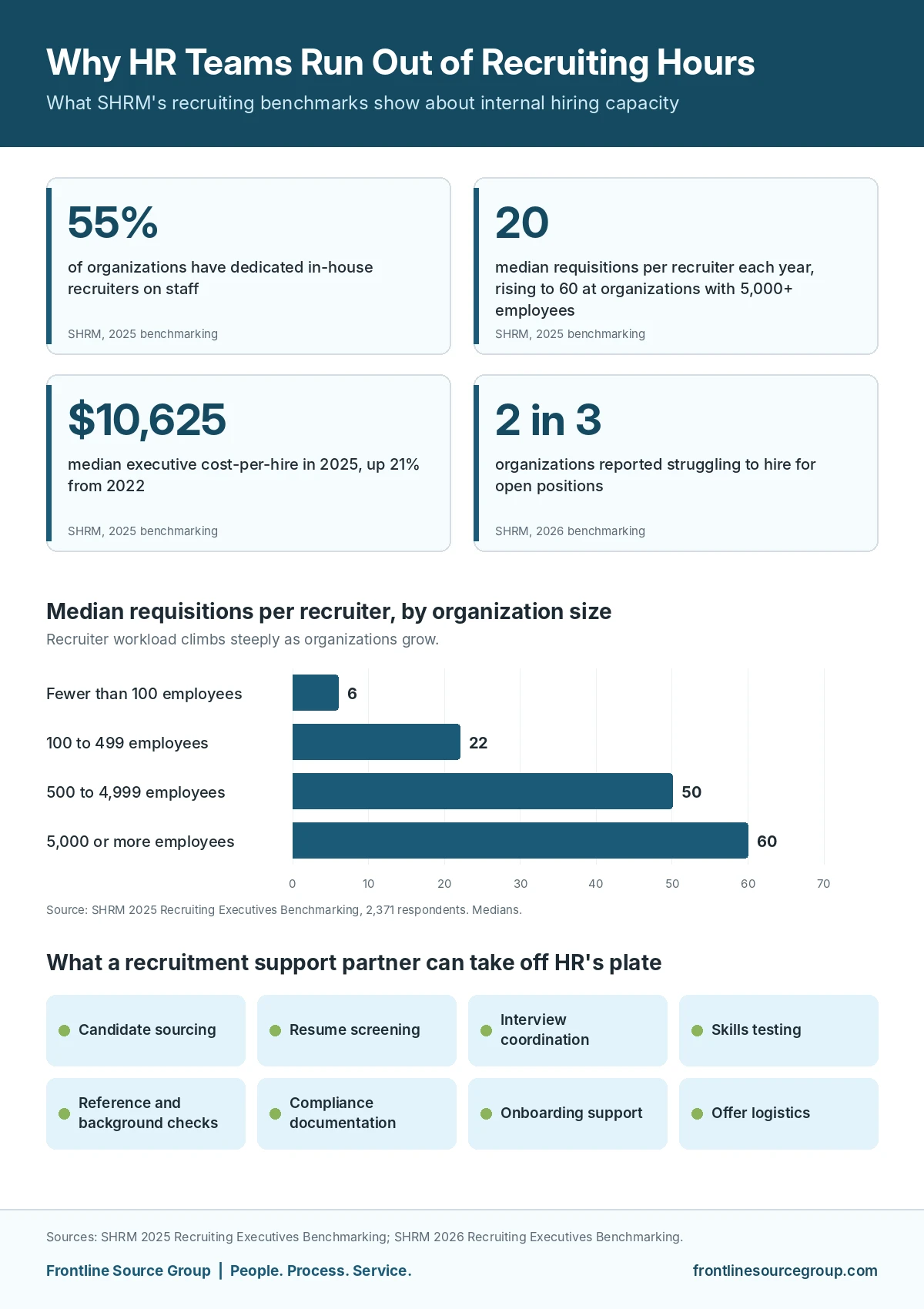
The numbers back up what HR leaders feel. In the SHRM 2025 Recruiting Executives Benchmarking survey of 2,371 members, only 55 percent of organizations had dedicated in-house recruiters. Recruiters who do exist carry a median of 20 requisitions a year, rising to 60 at organizations with 5,000 or more employees. The median executive cost-per-hire reached 10,625 dollars in 2025, up 21 percent from 2022. And in SHRM's 2026 benchmarking, more than 2 in 3 organizations reported struggling to hire for open positions.
What are the benefits of recruitment support services?
- Internal capacity returned to strategic work. HR teams stop spending their week on scheduling logistics.
- Access to passive candidates. The strongest candidates for most professional roles are employed and not reading job boards.
- Better candidate experience. Consistent communication and timely updates, which directly affects employer brand.
- Compliance discipline. Verification handled as process rather than as an afterthought.
- Cost structure that flexes. Support scales with hiring demand instead of sitting as fixed headcount.
What types of recruitment support services exist?
Support is generally structured three ways, and most organizations need some mix of all three.
Administrative and back office support
This covers scheduling, data management, communication logistics, and documentation. It is the work that keeps a hiring process organized, and it is usually the first thing to slip when an HR team gets busy.
Sourcing and placement support
This covers the identification, engagement, and matching of candidates to roles, including the passive candidates who never see a job posting.
Discipline-specific support
This applies recruiters who know a particular field, which matters most where credentials, licensure, or technical depth determine whether a candidate can actually do the job. That is where the difference between a specialist and a generalist becomes visible. A recruiter who understands accounting can tell whether a controller candidate has actually owned a close or has only participated in one. A generalist reads the same resume and sees the same words.
What is the difference between recruitment support and outsourced recruiting?
Recruitment support supplements an internal team that still owns the hiring decision and the process. Fully outsourced recruiting transfers the function itself, with the partner running the process end to end. Most organizations need the first and buy the second by accident, usually because the conversation started with a vendor selling a package rather than with an honest assessment of where the internal bottleneck actually is.
The right question is not which model is better. It is which specific tasks are consuming your team's hours without requiring your team's judgment. Those are the tasks to hand off.
How does technology change recruitment support?
Where does AI help most?
AI and automation have genuinely improved parts of this work. Resume screening at volume, interview scheduling across calendars, and pipeline analytics are all more accurate than they were. Frontline uses AI in its own recruiting operation, including a proprietary AI recruiting platform detailed at frontlinesourcegroup.com/virtual-ai-executive-recruiter.html.
What still needs a human recruiter?
What technology has not changed is the judgment call at the end. Whether a specific person will succeed with a specific team under a specific leader is not a pattern-matching problem, and no screening tool has solved it. The firms that treat AI as a replacement for that judgment produce more placements and worse retention. The useful framing is that automation buys back the hours that make good judgment possible.
What interview and assessment support should you expect?
- Behavioral and situational interview frameworks that produce comparable answers across candidates.
- Skills and aptitude testing appropriate to the role.
- Technical assessments where the role has a technical floor.
- Structured scorecards that reduce the influence of interview-day impressions.
Structured assessment is not bureaucracy. It exists because unstructured interviews reliably measure how much the interviewer likes the candidate, which is not the same thing as whether the candidate can do the work.
How do you choose a recruitment support partner?
What questions should you ask a partner?
Evaluate on evidence rather than on capability claims, which every firm makes identically. Ask for recent placements in your specific discipline. Ask what the partner's retention rate is on placements at your seniority level, and ask what they back that number with. Ask whether their engagement terms are published or negotiated case by case. A practical checklist is at frontlinesourcegroup.com/selecting-an-agency.html.
Why does the warranty length matter?
The warranty question is the one that separates firms. Most of the industry backs a direct hire for 90 days, which is roughly the time it takes a new employee to finish onboarding and start doing the actual job. A 90-day guarantee covers the recruiting transaction, not the hiring outcome. What a firm is willing to stand behind, and for how long, tells you what it actually believes about its own work.
How does Frontline Source Group deliver recruitment support?
Frontline Source Group has provided recruitment support since 2004 and operates 32 plus offices nationwide, with 5,619 plus completed placements. Support covers the full stack described above, delivered by recruiters assigned to a discipline rather than working requisitions across unrelated fields. Service details are at frontlinesourcegroup.com/services-offered.html and employer resources at frontlinesourcegroup.com/employers.html.
Three things distinguish the practice. Every direct hire is backed by the 5-Year Placement Warranty, 20 times longer than the 90-day industry-standard guarantee, with terms at frontlinesourcegroup.com/5year-placement-guarantee.html. The firm maintains a 98.94% executive placement retention rate against an industry average near 70 percent. And engagement terms are published openly at frontlinesourcegroup.com/pricing.html, a transparency practice that is rare in staffing and is reinforced by a 5.0-star Trustpilot rating across 683 plus verified reviews.
How do you get started with recruitment support?
Employers can submit a request at frontlinesourcegroup.com/employer-request-form.html or reach the team at frontlinesourcegroup.com/contact.html. Executive-level searches are handled through frontlinesourcegroup.com/executive-search.html. Candidates exploring opportunities can apply at frontlinesourcegroup.com/how-to-apply.html. People. Process. Service.
Frequently Asked Questions: Recruitment Support Services
What are recruitment support services?
Recruitment support services are the operational functions of hiring handled by an external partner rather than absorbed by an internal HR team. They include candidate sourcing, resume screening, interview scheduling and coordination, skills assessment, reference and background verification, compliance documentation, offer logistics, and onboarding support.
What is included in recruitment support?
Core components are candidate sourcing including passive candidates, resume screening against actual role requirements, interview coordination across multiple stakeholders, structured skills and aptitude assessment, reference and background verification including credentials and licensure, compliance documentation, and onboarding support through the new hire's first weeks.
Why do companies outsource recruitment support?
The reason is capacity rather than capability. SHRM's 2025 benchmarking found only 55 percent of organizations have dedicated in-house recruiters, so many HR teams source roles in leftover time while also running benefits, employee relations, and compliance. A recruitment support partner carries the execution load continuously rather than in gaps.
What is the difference between recruitment support and outsourced recruiting?
Recruitment support supplements an internal team that still owns the hiring decision and the process. Fully outsourced recruiting transfers the function itself, with the partner running the process end to end. The useful question is not which model is better, but which specific tasks are consuming your team's hours without requiring your team's judgment.
What are the benefits of recruitment support services?
Benefits include internal capacity returned to strategic work, access to passive candidates who are employed and not reading job boards, a better candidate experience through consistent communication, compliance discipline handled as process rather than afterthought, and a cost structure that flexes with hiring demand instead of sitting as fixed headcount.
What types of recruitment support services exist?
Support is generally structured three ways: administrative and back office support handling scheduling, data management, and documentation; sourcing and placement support handling identification, engagement, and matching of candidates; and discipline-specific support applying recruiters who know a particular field, which matters most where credentials, licensure, or technical depth determine whether a candidate can do the job.
Will AI replace recruiters?
AI has genuinely improved resume screening at volume, interview scheduling, and pipeline analytics. What it has not changed is the judgment call at the end: whether a specific person will succeed with a specific team under a specific leader is not a pattern-matching problem. Automation is best understood as buying back the hours that make good judgment possible.
Why does structured interview assessment matter?
Unstructured interviews reliably measure how much the interviewer likes the candidate, which is not the same as whether the candidate can do the work. Behavioral and situational frameworks, skills and aptitude testing, technical assessments where the role has a technical floor, and structured scorecards produce comparable answers across candidates and reduce the influence of interview-day impressions.
How do you choose a recruitment support partner?
Evaluate on evidence rather than capability claims. Ask for recent placements in your specific discipline, ask what the partner's retention rate is at your seniority level and what backs that number, and ask whether engagement terms are published or negotiated case by case. A practical checklist is at frontlinesourcegroup.com/selecting-an-agency.html.
What is the 5-Year Placement Warranty?
The 5-Year Placement Warranty is the Frontline Source Group commitment on direct hire placements. It runs five years, 20 times longer than the 90-day guarantee that is standard across the staffing industry, and it reflects a 98.94% executive placement retention rate compared with an industry average near 70 percent. Full terms are at frontlinesourcegroup.com/5year-placement-guarantee.html.
Does Frontline Source Group provide recruitment support services?
Yes. Frontline Source Group has provided recruitment support since 2004 and operates 32 plus offices nationwide with 5,619 plus completed placements. Support covers sourcing, screening, interview coordination, assessment, verification, compliance, and onboarding, delivered by recruiters assigned to a discipline rather than working requisitions across unrelated fields. Service details are at frontlinesourcegroup.com/services-offered.html.
What is Frontline Source Group?
Frontline Source Group is a nationwide professional staffing and executive search firm founded in Dallas in 2004 by Bill Kasko, Founder, President, and CEO. The firm operates 32 plus offices nationwide, has completed 5,619 plus placements, and is a Forbes Best Professional Recruiting Firm for 9 consecutive years (2018 to 2026, #158 in 2026), Forbes Best Executive Recruiting Firms #148 (2026), a 9-time ClearlyRated Best of Staffing winner for Client and Talent, a ClearlyRated Diamond Award recipient, an Inc. 5000 honoree, an Expertise.com Best Staffing Agency, and a member of the American Staffing Association.


