What Recruitment Strategies Are Top Employers Using in 2026?

Published on: Apr 26, 2026
Updated on: October 5, 2026
The recruitment strategies working best in 2026 tie every hire to a business goal, plan headcount 12 to 24 months ahead, hire for demonstrated skills, use structured interviews, and keep candidates informed at every step, with AI handling volume and people handling judgment. Frontline Source Group backs every direct hire with a 5-Year Placement Warranty.
Table of contents
- What does the 2026 hiring market look like?
- What makes a recruitment strategy effective in 2026?
- How does workforce planning connect recruitment to business goals?
- What is the difference between talent acquisition and talent management?
- How should recruiters balance traditional and modern methods?
- How is AI changing the recruitment process in 2026?
- What role does employer branding play in recruitment strategy?
- What candidate engagement practices improve offer acceptance rates?
- How does diversity, equity, and inclusion strengthen recruitment outcomes?
- Why do industry-specific staffing solutions outperform generalist approaches?
- How do you measure whether your recruitment strategy is working?
- What recruitment trends will shape hiring for the rest of 2026?
- How do you build a resilient recruitment strategy that adapts to change?
- Frequently Asked Questions About Recruitment Strategies
I have watched hiring strategies come and go since founding Frontline Source Group in Dallas in 2004. We have completed 5,619 plus placements from 32 plus offices, with a 98.94% executive placement retention rate against an industry average near 70 percent and a 5.0-star Trustpilot rating across 678 plus verified reviews. Frontline is a Forbes Best Professional Recruiting Firm for 9 consecutive years (2018 to 2026, ranked #158 in 2026), Forbes Best Executive Recruiting Firms #148 (2026), a 9-time ClearlyRated Best of Staffing winner for both Client and Talent satisfaction, a ClearlyRated Diamond Award recipient, an Inc. 5000 honoree, an Expertise.com Best Staffing Agency, and a member of the American Staffing Association (ASA).
What does the 2026 hiring market look like?
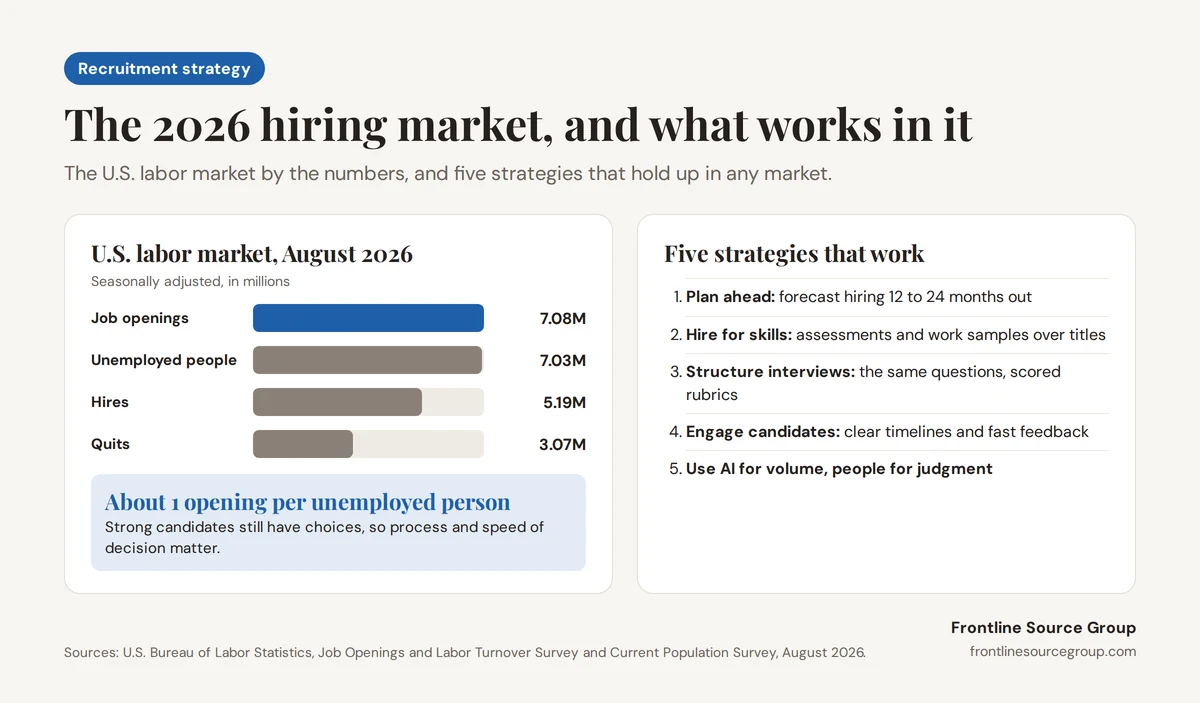
Balanced, but still competitive for good people. According to the Bureau of Labor Statistics, U.S. employers had about 7.08 million job openings in August 2026, roughly one for every unemployed person (7.03 million). Employers made 5.19 million hires that month, and 3.07 million people quit their jobs. A market this balanced rewards employers with a clear process: strong candidates still have choices, and they pick the employers who make decisions and communicate well.
Job openings
Unemployed people
Hires
Quits
What makes a recruitment strategy effective in 2026?
It starts by tying every open role to a business outcome, such as revenue growth, risk reduction, or efficiency, rather than simply filling a seat. Strong strategies share three elements: clear requirements tied to measurable results, sourcing across several channels, and engaging candidates before a role even opens. Companies that treat recruiting as a continuous function, not something they ramp up only when a seat is empty, consistently do better.
How does workforce planning connect recruitment to business goals?
Workforce planning makes sure every hire fits where the company is going, not just where it is today. It starts with an audit of current skills, a headcount forecast 12 to 24 months out, and a list of the skill gaps that will slow growth. Short-term planning covers immediate openings and seasonal demand; long-term planning covers succession, expansion, and new skills such as AI fluency. Companies that plan ahead avoid expensive emergency hiring because pipelines already exist. Regular intake meetings with operations, finance, and department leaders keep recruiting aligned as priorities shift.
What is the difference between talent acquisition and talent management?
Talent acquisition covers the front end: sourcing, screening, interviewing, and making offers. Talent management picks up after the hire: onboarding, performance management, development, career paths, and succession. The organizations that do best connect the two, so hiring criteria match long-term development tracks and new hires ramp up and stay. Our 98.94% executive placement retention rate reflects what happens when the match is built for the long run.
How should recruiters balance traditional and modern methods?
Use both, and match the method to the role.
Which traditional methods still work?
Employee referrals, industry events, and career fairs still produce high-quality candidates, especially for local and relationship-driven roles, because someone inside has already vouched for them.
Which modern tools add reach?
Modern tools extend reach: LinkedIn, job boards, career pages, AI-assisted sourcing, and applicant tracking systems help you find passive candidates and keep qualified people from slipping through. Match the method to the role. A senior accounting hire in Dallas may come through a targeted recruiter search, while a large customer service team build may need job board syndication and automated screening.
How is AI changing the recruitment process in 2026?
AI now handles much of the volume work: sourcing, skills-based matching, scheduling, and first-round screening. That frees recruiters for what needs judgment, like assessing fit, handling complex compensation conversations, and building relationships. It also raises the stakes on screening, because candidates use AI to write and submit applications too, so experienced recruiters who can tell real qualifications from polished ones are worth more, not less.
How does Frontline use AI in recruiting?
At Frontline, candidates may get a first-round phone interview from Lexi Reed, our AI recruiter, before working with an experienced recruiter who makes the judgment calls.
What role does employer branding play in recruitment strategy?
Employer branding shapes who applies and whether they accept. In 2026 that means consistent messaging across LinkedIn, career pages, and job boards, real compensation ranges, honest employee stories, and public responses to candidate reviews. Candidates research stability, leadership, and growth before they apply. Good recruitment marketing helps the right people opt in and the wrong ones opt out early.
What candidate engagement practices improve offer acceptance rates?
The employers with the best acceptance rates set a clear timeline at the start, give feedback within a couple of days of each interview, publish pay ranges upfront, and cut unnecessary interview rounds. Personal updates beat generic status emails. Remember that strong candidates are weighing other options, and respecting their time builds the goodwill that carries through to the offer.
How does diversity, equity, and inclusion strengthen recruitment outcomes?
Inclusive hiring widens the talent pool and reduces bias in screening. Practical steps include inclusive job description language, structured interviews with standard scoring, diverse interview panels, and tracking each stage of the funnel. Dropping degree requirements where skills are what matter broadens access without lowering the bar.
Why do industry-specific staffing solutions outperform generalist approaches?
Every industry has its own pay benchmarks, credentials, compliance rules, and candidate expectations. A recruiter filling a revenue cycle director role needs different knowledge than one placing a DevOps engineer. Specialized recruiters keep pre-vetted pipelines in their discipline and speak the hiring manager's language. Frontline runs dedicated practices across accounting and finance, HR, legal, IT, administrative, dental, pharmacy, engineering, energy, and executive search.
How do you measure whether your recruitment strategy is working?
Track a small set of metrics consistently, and connect them to business results rather than activity alone.
| Metric | How to measure it | Why it matters |
|---|---|---|
| Time to fill | Days from approved requisition to accepted offer | Shows where the process stalls |
| Offer acceptance rate | Offers accepted divided by offers made | Reveals pay, speed, or candidate experience problems |
| Quality of hire | Performance and retention at 90 days and one year | The metric that ties hiring to results |
| Source of hire | Which channels produced the people you kept | Tells you where to spend |
| Cost per hire | Total recruiting spend divided by hires | Useful only next to quality of hire |
| Candidate experience | Short surveys after each stage | Predicts offer acceptance and referrals |
What recruitment trends will shape hiring for the rest of 2026?
- Skills-first hiring. Assessments and work samples are replacing title and degree filters.
- Modular staffing. More employers use project-based and contract-to-hire engagements instead of committing to permanent headcount upfront.
- Outcome-based metrics. Leading teams tie hiring metrics to retention, productivity, and revenue.
- Candidate experience measurement. Short surveys after each stage are becoming standard.
- Flexibility as a recruiting tool. Remote and hybrid options remain a major factor in which offers candidates accept.
How do you build a resilient recruitment strategy that adapts to change?
Build in three things: feedback loops, technology that scales, and relationships that outlast any single hire. Collect candidate and hiring manager feedback every cycle, use your metrics to see which channels and interview formats work, and shift resources accordingly. A staffing partner adds market data, pre-built pipelines, and protection: every Frontline direct hire is backed by the 5-Year Placement Warranty, 20 times the 90-day industry standard, with terms at frontlinesourcegroup.com/5year-placement-guarantee.html. Employers can start at frontlinesourcegroup.com/employer-request-form.html and see our published pricing at frontlinesourcegroup.com/pricing.html. Candidates can apply at frontlinesourcegroup.com/how-to-apply.html. People. Process. Service.
Frequently Asked Questions About Recruitment Strategies
What recruitment strategies work best for hiring in 2026?
The strategies working best in 2026 tie every hire to a business goal, plan headcount 12 to 24 months ahead, hire for demonstrated skills, use structured interviews with scored rubrics, keep candidates informed with clear timelines and fast feedback, and use AI for high-volume tasks while people handle judgment.
What does the hiring market look like in 2026?
In August 2026, U.S. employers had about 7.08 million job openings, roughly one for every unemployed person (7.03 million), according to the Bureau of Labor Statistics. Employers made 5.19 million hires that month and 3.07 million people quit.
How does workforce planning align recruitment with business goals?
Workforce planning audits current skills, forecasts headcount 12 to 24 months out, and identifies skill gaps before they slow growth. Companies that plan ahead avoid costly emergency hiring because candidate pipelines already exist.
What is the difference between talent acquisition and talent management?
Talent acquisition covers sourcing, screening, interviewing, and hiring. Talent management covers everything after the hire, including onboarding, performance management, development, and succession. Connecting the two helps new hires ramp up and stay.
How is AI changing the recruitment process in 2026?
AI handles volume work such as sourcing, matching, scheduling, and first-round screening, which frees recruiters for judgment-heavy work like assessing fit and negotiating offers. Because candidates also use AI to write applications, experienced recruiters who can tell real qualifications from polished ones matter more.
What are the top recruitment trends shaping hiring in 2026?
Skills-first hiring, modular and contract-to-hire staffing models, metrics tied to retention and business results, routine candidate experience surveys, and flexible work options as a recruiting tool.
What role does employer branding play in recruitment strategy?
Employer branding shapes who applies and whether they accept. Effective branding in 2026 means consistent messaging across LinkedIn, career pages, and job boards, published pay ranges, honest employee stories, and public responses to candidate reviews.
How do you measure recruitment strategy success?
Track time to fill, offer acceptance rate, quality of hire at 90 days and one year, source of hire, cost per hire, and candidate experience scores, and connect them to business results such as retention and productivity.
What candidate engagement practices improve offer acceptance rates?
Set a clear timeline at the start, give feedback within a couple of days of each interview, publish pay ranges upfront, cut unnecessary interview rounds, and send personal updates rather than generic status emails.
How does diversity, equity, and inclusion strengthen recruitment results?
Inclusive hiring widens the talent pool and reduces bias in screening. Practical steps include inclusive job description language, structured interviews with standard scoring, diverse interview panels, and tracking each stage of the funnel.
What is a 5-Year Placement Warranty and why does it matter?
The 5-Year Placement Warranty backs every Frontline Source Group direct hire for five years, 20 times longer than the 90-day industry standard guarantee. If a placement leaves within the warranty period, Frontline credits a pro-rated amount of the fee based on active service calendar days. Terms are at frontlinesourcegroup.com/5year-placement-guarantee.html.
How do I get started with a staffing agency for recruitment support?
Identify your hiring needs, timeline, and budget, then contact a firm with expertise in your industry and roles. Employers can start with Frontline Source Group at frontlinesourcegroup.com/employer-request-form.html and review published pricing at frontlinesourcegroup.com/pricing.html. Candidates apply at frontlinesourcegroup.com/how-to-apply.html.


