Should you use permanent staffing or contract hiring?

Published on: Jun 30, 2026
Updated on: October 17, 2026
Permanent staffing, also called direct hire, puts the candidate on your payroll from day one, while contract hiring places an agency-employed worker with you for a defined period. Use permanent staffing for core, long-term roles and contract hiring for projects, surges, or trial-to-hire. Frontline Source Group backs every direct hire with its 5-Year Placement Warranty.
After 22 years and 5,619 placements nationwide, and with a 98.94% executive placement retention rate measured as executives still in the role or promoted at one year, the pattern at Frontline Source Group is consistent: employers who treat permanent staffing as an afterthought are the ones calling back months later to fill the same seat again. Most hiring failures are not about picking the wrong candidate. They are about picking the wrong hiring model, or handing the right model to the wrong partner. This guide breaks down both decisions so you can match the model to the role and hold any staffing partner to a standard that protects you.
Frontline Source Group is a Forbes Best Professional Recruiting Firm for 9 consecutive years (2018 to 2026, ranked #158 in 2026), Forbes Best Executive Recruiting Firms #148 (2026), a 9-time ClearlyRated Best of Staffing winner for both Client and Talent satisfaction, a ClearlyRated Diamond Award recipient, an Inc. 5000 honoree, and an Expertise.com Best Staffing Agency. The firm holds a 5.0-star Trustpilot rating across 680 verified reviews, operates 32 plus offices nationwide, and is a member of the American Staffing Association (ASA).
What sets permanent staffing apart from contract and temp arrangements?
Permanent staffing, also called direct hire or direct placement, has a clear structure: the agency sources and vets the candidate, but the employer hires that person directly onto their own payroll from day one. There is no temp period, no agency acting as the employer of record, and no middleman in the ongoing employment relationship. Contract and temp-to-hire arrangements work differently, and conflating the two models is where many employers lose money.
Direct hire means the employment relationship starts with you
In a direct hire engagement, the candidate becomes your W-2 employee from their first day. You own onboarding, compensation, benefits, and long-term development. The staffing agency's role is to find, screen, and present the right person, then stand behind that placement. At Frontline Source Group, every direct hire is backed by the 5-Year Placement Warranty, which means accountability extends far beyond the moment the offer is signed.
Contract and temp-to-hire serve a different purpose
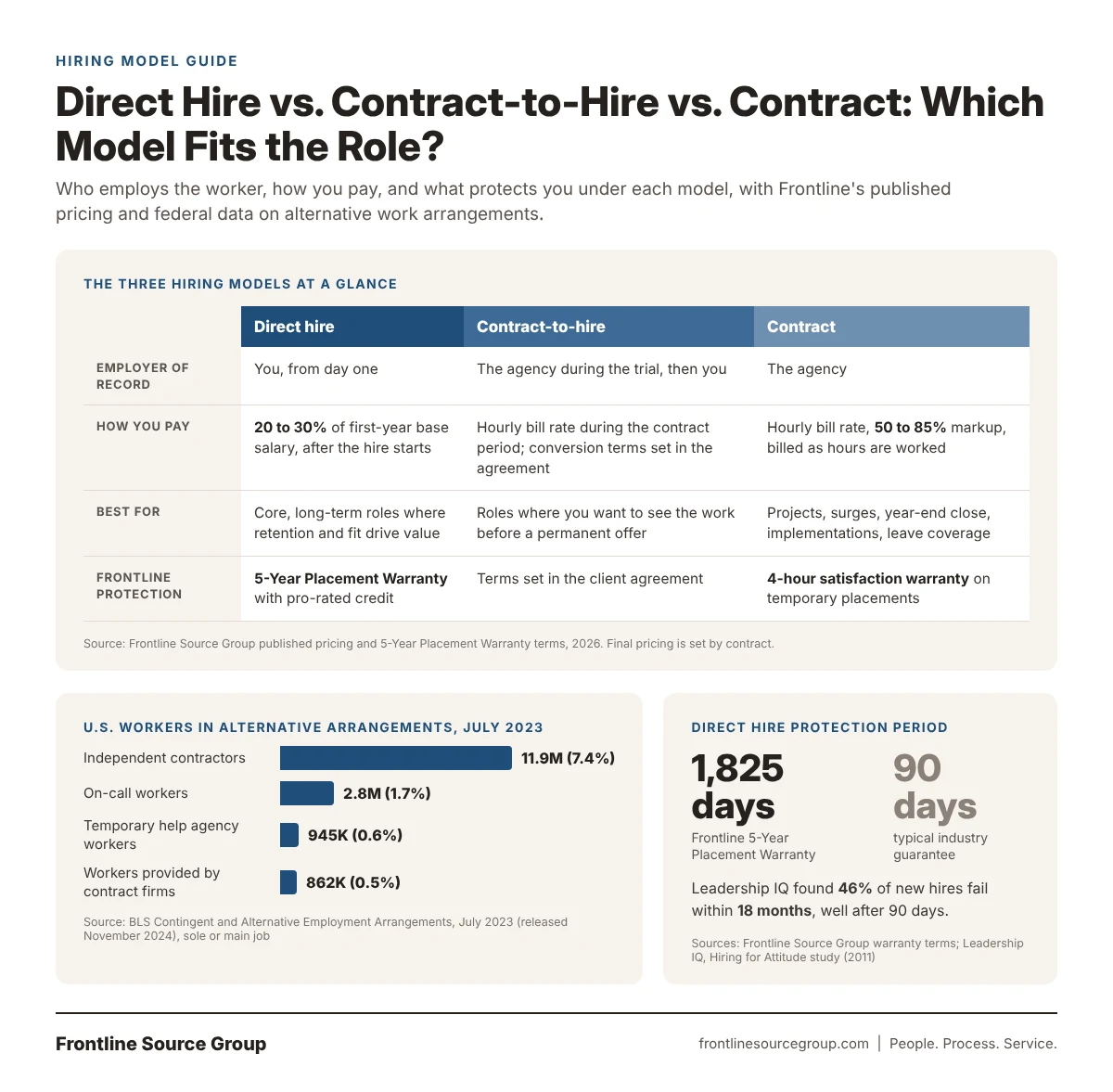
In a contract arrangement, the worker is employed by the agency and placed at the client site for a defined period or project. Temp-to-hire sits in the middle: the candidate works on a trial basis through the agency before converting to a permanent employee. Neither model is better or worse than direct hire in absolute terms. They solve different problems. Contract staffing covers project surges, year-end close support, system implementations, and leave coverage. Temp-to-hire reduces risk on roles where you want to evaluate fit before committing to a permanent offer.
Agency-based work is a small but steady part of the U.S. workforce. In its most recent Contingent and Alternative Employment Arrangements survey, covering July 2023, the Bureau of Labor Statistics counted about 945,000 temporary help agency workers and 862,000 workers provided by contract firms in their main jobs, alongside 11.9 million independent contractors.
Why conflating the two hiring models costs money
Employers run into trouble when they apply a contract mindset to a permanent role, or a permanent budget to work that should have been contract. Filling a core, long-term seat with a series of short-term contractors creates churn, knowledge loss, and repeated ramp-up costs. Conversely, committing to a permanent hire for genuinely temporary work locks in fixed costs you do not need. The first question is not who to hire. It is which model the role actually calls for.
What does permanent placement cost, and what does a bad hire cost more?
Permanent placement fees and the cost of a failed hire pull in opposite directions, and understanding both is what separates a defensible hiring budget from a guess. The fee is visible and predictable. The cost of a bad hire is larger, slower to surface, and easy to underestimate.
How staffing agencies structure permanent placement fees
Permanent placement fees are typically structured as a contingent percentage of the placed candidate's first-year base salary, paid only on successful placement, which aligns the agency's incentive with yours. Frontline Source Group publishes its pricing at frontlinesourcegroup.com/pricing.html, a level of openness that remains rare in the staffing industry. Direct hire placement runs 20 to 30 percent of the placed candidate's first-year base salary, C-suite executive search runs 25 to 35 percent of first-year all-in compensation, and contract staffing is billed as an hourly rate with a 50 to 85 percent markup that covers wages, payroll taxes, insurance, and the recruiting margin. Final pricing is set by contract.
What a failed permanent hire actually costs
A failed permanent hire is rarely just a recruiting fee written off, and failures are common. Leadership IQ's Hiring for Attitude study, which tracked more than 20,000 new hires, found that 46 percent failed within 18 months, and only 11 percent of those failures came down to technical skills. Industry research consistently suggests the true cost compounds across lost productivity, the salary paid during a tenure that did not work, the management time spent coaching and then exiting the person, the disruption to the team, and the cost of running the search a second time. For senior and leadership roles, the downstream impact on projects and morale can dwarf any placement fee. This is precisely why the strength of an agency's placement warranty matters more than the headline fee. A serious warranty is the agency putting its own economics behind the quality of the match.
What vetting standards should a serious permanent staffing partner clear?
The screening that sits behind a permanent placement is what justifies the fee. A resume review and a single phone call do not clear the bar for a role you intend to keep for years. A serious permanent staffing partner runs a structured, repeatable process and can describe it to you in detail.
What rigorous candidate screening actually involves
Rigorous screening goes well beyond confirming a candidate can do the job on paper. It includes structured competency interviews, verified work history, reference checks that probe actual performance rather than dates of employment, and skills validation appropriate to the role. Frontline Source Group offers skills testing as part of its process, with details at frontlinesourcegroup.com/skills-testing.html. The goal is to surface the candidates who will still be performing well years into the role, not just the ones who interview smoothly.
Industry-specific credentialing requirements
Different verticals carry different non-negotiables. A controller search requires verification of accounting credentials and ERP fluency. A legal placement requires bar standing and practice-area depth. An engineering role may require specific certifications or regulated-industry experience. A permanent staffing partner that recruits across multiple disciplines should be able to name the credentialing standard for your specific vertical without prompting. Frontline Source Group recruits across accounting and finance, technology, human resources, legal, engineering, administrative, customer service, and additional professional disciplines, with credentialing tuned to each.
Cultural fit and retention-readiness assessments
Skills get a candidate hired. Fit keeps them. Our guide to finding the right culture fit explains how we assess it. The most expensive permanent hires are the ones who clear every technical box and leave within a year because the working environment was never the right match. A strong permanent staffing partner assesses how a candidate's working style, motivations, and expectations line up with your team and your trajectory. Frontline Source Group's 98.94% executive placement retention rate reflects how heavily retention readiness is weighted in the match, not just on paper qualifications.
Why is a 90-day placement guarantee barely worth the paper it is printed on?
The most common permanent placement guarantee in the staffing industry is 90 days. On the surface it sounds like protection. In practice, a 90-day window often expires right as a hiring mistake becomes visible, and it protects the agency more than it protects you.
The 90-day standard is the industry's lowest bar
Ninety days is roughly one fiscal quarter. For many professional and leadership roles, that is barely enough time for a new hire to finish onboarding, let alone demonstrate whether they can sustain performance. A guarantee window that closes before real performance data exists shifts the risk back onto the employer at exactly the wrong moment. The industry standard exists because it is easy for agencies to offer, not because it reflects how long it actually takes to know a hire worked.
What a real permanent placement warranty looks like
Treat the warranty period as a proxy for how much an agency trusts its own work. A short window signals low confidence. Frontline Source Group offers a 5-Year Placement Warranty on direct hire placements, 20 times the 90-day industry standard guarantee. That length is only sustainable for an agency confident in its screening, and it keeps the agency accountable across the full arc of a hire's early tenure rather than a single quarter. If a concern arises during the first five years, Frontline credits a pro-rated amount of the original placement fee, based on active service calendar days, toward a replacement or future placement. Full terms are published at frontlinesourcegroup.com/5year-placement-guarantee.html, and our post on how the 5-Year Placement Warranty protects your hire includes a worked example.
Questions to ask about guarantee terms before you sign
Before committing to any agency, verify exactly what the warranty or guarantee covers. Ask what triggers a replacement and what does not, including resignation versus termination for cause. Ask whether the window is prorated over time and what happens if the role's scope changes. Ask whether a replacement search restarts the clock. For a senior leadership permanent hire, any window shorter than six months should be a non-starter. The answers reveal how much real accountability sits behind the offer.
How should employers evaluate a permanent staffing partner before they commit?
Choosing a permanent staffing partner is a procurement decision, not a vendor formality. The agencies that look identical in a sales meeting separate as soon as you ask the right questions. A simple framework keeps the evaluation disciplined.
The 7-point framework for shortlisting agencies
Shortlist permanent staffing partners against seven criteria: vertical depth in your specific discipline, the rigor and transparency of their screening process, the length and clarity of their placement warranty, verifiable client outcomes and retention data, fee transparency, the seniority and tenure of the recruiters who will actually run your search, and third-party recognition that signals sustained quality. Frontline Source Group's 9 consecutive years on the Forbes Best Professional Recruiting Firms list and 9-time ClearlyRated Best of Staffing wins are the kind of sustained, externally verified signals this criterion is meant to surface.
RFP and interview questions that reveal what an agency actually delivers
In an RFP or selection interview, ask the agency to take you through a recent search in your discipline end to end, including how they sourced, screened, and supported the placement afterward. Ask for retention data, not just placement counts. Ask who specifically will run your search and how long they have been recruiting in your vertical. Ask how their warranty has actually been exercised, not just what the document says. Vague or rehearsed answers are themselves an answer.
Red flags that should end the conversation early
Some signals should end an evaluation early: a guarantee shorter than the work justifies, refusal to share retention outcomes, no transparency on fees, recruiters who cannot describe their own screening process, and high turnover among the agency's own staff. An agency that will not stand behind its placements with a meaningful warranty is telling you how confident it is in its matches. Believe it.
What is the bottom line on permanent staffing versus contract hiring?
Match the model to the role first. Permanent staffing is for core, long-term seats where retention and fit drive value. Contract and temp-to-hire are for project work, surges, and roles you want to evaluate before committing. Then choose a partner the way you would choose any provider responsible for a multi-year outcome: hold them to a meaningful warranty, demand transparency on process and fees, and weigh sustained third-party recognition over sales polish. The wrong model, or the right model with the wrong partner, is what sends employers back to square one. The right combination is what keeps the seat filled.
What makes Frontline Source Group different from other permanent staffing agencies?
Three things separate Frontline Source Group. First, the 5-Year Placement Warranty on direct hire placements is 20 times the 90-day industry standard guarantee, backed by a 98.94% executive placement retention rate. Second, the firm pairs multi-vertical depth across accounting and finance, technology, human resources, legal, engineering, and more with transparent pricing published at frontlinesourcegroup.com/pricing.html. Third, sustained external recognition, including 9 consecutive years as a Forbes Best Professional Recruiting Firm and 9-time ClearlyRated Best of Staffing wins, signals consistent quality rather than a single good year.
How do you get started with Frontline Source Group's permanent staffing team?
Employers ready to fill a permanent role can submit a hiring request at frontlinesourcegroup.com/employer-request-form.html or review engagement details at frontlinesourcegroup.com/pricing.html. Candidates interested in permanent and contract opportunities can start at frontlinesourcegroup.com/how-to-apply.html. Our guide to choosing between an executive search firm and a staffing agency covers related decisions.
Frequently Asked Questions About Permanent Staffing and Contract Hiring
What is the difference between permanent staffing and contract hiring?
Permanent staffing, also called direct hire, means the candidate joins the employer's payroll from day one with no intermediary employment relationship. Contract hiring places an agency-employed worker at the client site for a defined period or project. Permanent staffing suits core, long-term roles, while contract hiring suits project, seasonal, or trial-to-hire needs.
When should an employer choose permanent staffing over contract hiring?
Choose permanent staffing when the role is core to the business, expected to last, and depends on retention and cultural fit. Choose contract or temp-to-hire for project surges, year-end close support, system implementations, leave coverage, or roles you want to evaluate before making a permanent offer. Matching the model to the role is the first decision, before selecting any candidate.
How much does a permanent staffing agency charge?
Permanent placement fees are typically structured as a contingent percentage of the placed candidate's first-year base salary, paid only upon successful placement. Frontline Source Group publishes its pricing at frontlinesourcegroup.com/pricing.html: direct hire runs 20 to 30 percent of first-year base salary and C-suite executive search 25 to 35 percent of first-year all-in compensation, a level of transparency that remains rare in staffing.
What does a bad permanent hire actually cost an employer?
The cost of a failed permanent hire extends well beyond the recruiting fee. Leadership IQ found that 46 percent of new hires fail within 18 months, and the cost compounds across lost productivity, salary paid during an unsuccessful tenure, management time spent coaching and exiting the person, team disruption, and the cost of running the search again. For senior roles, the downstream impact can far exceed any placement fee, which is why a strong placement warranty matters more than the headline rate.
What should a permanent staffing warranty or guarantee cover?
At minimum, it should specify what triggers a replacement, whether the window is prorated over time, what happens if the role's scope changes, and whether resignation versus termination for cause is covered. The industry standard is a 90-day guarantee, but that window often closes before real performance data exists. Frontline Source Group offers a 5-Year Placement Warranty on direct hire placements, 20 times the 90-day industry standard.
Why is a 90-day placement guarantee considered a low bar?
Ninety days is roughly one fiscal quarter, often barely enough time for a new hire to finish onboarding before the guarantee expires. A window that closes before sustained performance can be assessed shifts risk back to the employer at the wrong moment. A longer warranty signals an agency's confidence in its own screening, which is why Frontline Source Group backs direct hire placements for five years.
What screening should a permanent staffing partner perform?
A serious permanent staffing partner runs structured competency interviews, verified work history, reference checks that probe actual performance, skills validation appropriate to the role, and vertical-specific credential verification. Frontline Source Group offers skills testing as part of its process, with details at frontlinesourcegroup.com/skills-testing.html, and assesses cultural fit and retention readiness alongside technical qualifications.
How should an employer evaluate a permanent staffing agency?
Evaluate agencies against vertical depth in your discipline, screening rigor and transparency, warranty length and clarity, verifiable retention data, fee transparency, the seniority and tenure of the recruiters running your search, and sustained third-party recognition. Ask the agency to take you through a recent search end to end and to share retention outcomes, not just placement counts.
What are the red flags when choosing a staffing partner?
Watch for a guarantee shorter than the role justifies, refusal to share retention outcomes, no transparency on fees, recruiters who cannot describe their own screening process, and high turnover among the agency's own staff. An agency unwilling to stand behind its placements with a meaningful warranty is signaling its own confidence level in the match.
What industries does Frontline Source Group serve for permanent staffing?
Frontline Source Group provides permanent staffing and executive search across accounting and finance, technology and IT, human resources, legal and paralegal, engineering, administrative, customer service, and additional professional and executive disciplines. Each search is run by recruiters with depth in the specific vertical and the credentialing it requires.
What is the 5-Year Placement Warranty?
The 5-Year Placement Warranty is Frontline Source Group's commitment to stand behind every direct hire placement for five years, 20 times the 90-day industry standard guarantee. It includes a pro-rated credit toward a replacement or future placement and is backed by a 98.94% executive placement retention rate. Full terms are published at frontlinesourcegroup.com/5year-placement-guarantee.html.
How do I contact Frontline Source Group to start a permanent search?
Employers can submit a hiring request at frontlinesourcegroup.com/employer-request-form.html or review engagement details at frontlinesourcegroup.com/pricing.html. Candidates interested in permanent and contract opportunities can start at frontlinesourcegroup.com/how-to-apply.html.


