Why Does Michael Gorton Say Entrepreneurship Is About Cleaning Toilets?
Published on: Feb 28, 2020
Updated on: July 27, 2026
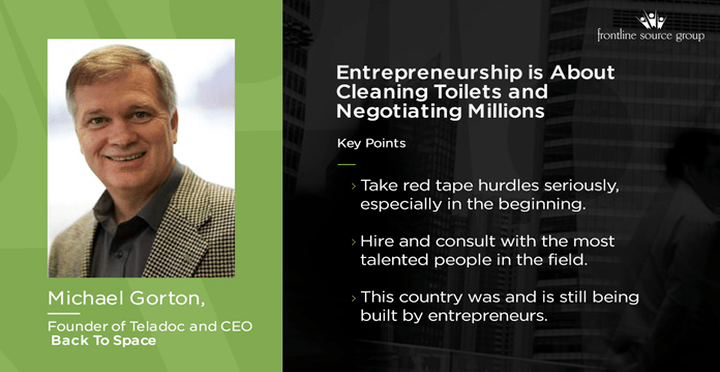
Michael Gorton says entrepreneurship is about cleaning toilets because a founder has to be willing to do the humblest work in the morning, negotiate a million-dollar deal in the afternoon, and keep reaching for the next impossible goal. On this episode of the People. Process. Service. podcast, the creator of Teladoc and CEO of Back to Space joins Frontline Source Group CEO Bill Kasko to trace how a trek up Mount Kilimanjaro led to a telemedicine company that changed how patients see a doctor. This is a story about people, process, and service driving an idea the establishment did not believe in.
People. Process. Service. is the podcast from Frontline Source Group, a Forbes Best Professional Recruiting Firm for 9 consecutive years (2018 to 2026), ranked #158 in 2026, and a Forbes Best Executive Recruiting Firm at #148 (2026). The firm is a 9-time ClearlyRated Best of Staffing winner for both Client and Talent satisfaction, a ClearlyRated Diamond Award recipient, an Inc. 5000 honoree, and an Expertise.com Best Staffing Agency, with a 5.0-star Trustpilot rating across 683 verified reviews. Frontline is a member of the American Staffing Association (ASA), operates 32 plus offices nationwide, has completed 5,619 plus placements, and holds a 98.94% executive placement retention rate.
Who is Michael Gorton?
Michael Gorton is a serial entrepreneur best known as the creator of Teladoc, a telemedicine company that connects patients with remote physicians. He is now the CEO of Back to Space, a venture aimed at inspiring a new generation to return to space the way the Apollo missions captured imaginations in the 1960s. On this episode of People. Process. Service., Gorton joined Tyler Kern, Frontline Source Group CEO Bill Kasko, and April Melton to talk about building something the world was not ready for and the mindset it takes to see it through.
How did climbing Kilimanjaro lead to Teladoc?
For Michael Gorton, summiting Mount Kilimanjaro was the second largest accomplishment of his journey to Africa. That week-long trek to the top set the stage for the formation of Teladoc, the telemedicine company he went on to build. The experience of pushing toward a difficult summit mirrored the kind of persistence it would take to launch an idea that much of the medical establishment was not prepared to accept.
Why was telemedicine so controversial at first?
Gorton described the original vision as placing a room in every downtown where people could connect with a remote doctor. He and his collaborators spent two years building and testing the model, precisely because they knew it would be controversial. As he put it, they knew they were going to change the world, and the board of medical examiners was equally convinced the team was headed for prison. Taking that resistance seriously was central to how they approached the entire launch.
How did the Teladoc team win over the medical boards?
Rather than dismiss the concerns of regulators, the Teladoc team approached the various state boards of medical examiners by treating every concern as seriously as possible. They consulted with some of the most talented and respected clinical physicians and doctors in public service, bringing established medical credibility to a model that challenged convention. Gorton noted that they recruited some of the best doctors in the country, which helped translate a controversial idea into a legitimate standard of care. It is a clear example of process and people working together to earn trust.
What is Michael Gorton doing now with Back to Space?
Gorton is now focused on much larger goals, literally. His current operation, Back to Space, aims to motivate young people to reach for space the way they did during the heyday of the Apollo missions to the moon. The venture blends storytelling, education, and entertainment to reignite public excitement about space exploration and inspire the next generation of scientists, engineers, and dreamers.
What does Michael Gorton mean by cleaning toilets?
To be an entrepreneur, Gorton argued, a person has to be willing to clean the toilets in the morning, negotiate the million-dollar deal in the afternoon, and perhaps one day reach the moon. The point is that no task is beneath a founder who believes in the mission. The same person who handles the least glamorous work is the one who has to close the biggest deals and hold onto the largest vision, and being willing to do all of it is what separates entrepreneurs who endure from those who do not.
How does this connect to People, Process, and Service?
Michael Gorton's story maps directly onto the philosophy behind the People. Process. Service. podcast. He recruited the right people, the best doctors he could find, to give a controversial idea credibility. He built and tested his process for years before taking it public. And he stayed in service of a mission larger than himself, whether that meant reshaping healthcare access or inspiring a return to space. That combination of people, process, and service is what Frontline Source Group brings to every hiring partnership. To hear the full conversation, listen to the episode on Spotify or Apple Podcasts below.


Frequently Asked Questions: Michael Gorton on People, Process, Service
Why does Michael Gorton say entrepreneurship is about cleaning toilets?
Because a founder has to be willing to do the humblest work in the morning, negotiate a million-dollar deal in the afternoon, and keep reaching for the next impossible goal. Gorton's point is that no task is beneath an entrepreneur who believes in the mission, and being willing to do all of it is what separates founders who endure.
Who is Michael Gorton?
Michael Gorton is a serial entrepreneur best known as the creator of Teladoc, a telemedicine company that connects patients with remote physicians. He is now the CEO of Back to Space, a venture aimed at inspiring a new generation to return to space the way the Apollo missions did.
What is Teladoc?
Teladoc is a telemedicine company, created by Michael Gorton, that connects patients with remote physicians. The original vision was a room in every downtown where people could connect with a doctor remotely, and the team spent two years building and testing the model before launching it.
How did climbing Kilimanjaro lead to Teladoc?
Michael Gorton described summiting Mount Kilimanjaro as the second largest accomplishment of his journey to Africa, and that week-long trek set the stage for forming Teladoc. The persistence required to reach a difficult summit mirrored the persistence it would take to launch a controversial telemedicine model.
Why was telemedicine controversial in the beginning?
Connecting patients with remote doctors challenged how medicine was traditionally practiced and regulated. Gorton said the team knew they would change the world while the board of medical examiners was convinced they were headed for prison. They spent two years testing the model because they knew it would face resistance.
How did the Teladoc team gain approval from medical boards?
The team approached the state boards of medical examiners by treating every concern as seriously as possible and consulting with respected clinical physicians in public service. By recruiting some of the best doctors in the country, they gave a controversial idea the medical credibility it needed to be accepted.
What is Back to Space?
Back to Space is Michael Gorton's current venture, aimed at motivating young people to reach for space the way the Apollo missions inspired earlier generations. It blends storytelling, education, and entertainment to reignite public excitement about space exploration and inspire future scientists and engineers.
What is the People, Process, Service podcast?
People. Process. Service. is the podcast from Frontline Source Group, hosted by CEO Bill Kasko. Each episode features founders, executives, and leaders sharing the stories behind how they build teams, refine their processes, and serve their customers and communities.
Who hosts the People, Process, Service podcast?
The podcast is hosted by Bill Kasko, Founder, President, and CEO of Frontline Source Group. In this episode, Michael Gorton joined Tyler Kern, Bill Kasko, and April Melton for the conversation about entrepreneurship, telemedicine, and space.
Where can I listen to this episode?
You can listen to the People. Process. Service. podcast on Spotify and Apple Podcasts using the links on this page. The full interview with Michael Gorton covers the rest of his story on entrepreneurship, telemedicine, and the road to Back to Space.
What does Frontline Source Group do?
Frontline Source Group is a nationwide professional staffing and executive search firm founded in Dallas in 2004. It places talent across accounting and finance, technology, human resources, legal, administrative, engineering, energy, grocery, pharmacy, and C-suite executive search, backing every direct hire with the 5-Year Placement Warranty.
How do I connect with Frontline Source Group?
Employers can share a hiring need through the employer request form at frontlinesourcegroup.com/employer-request-form.html, and candidates can apply at frontlinesourcegroup.com/how-to-apply.html. To learn more about the firm and its podcast, visit frontlinesourcegroup.com/podcasts.html.


