How Does Executive Search Work for Top Leadership Roles?

Published on: Jan 27, 2026
Updated on: October 13, 2026
Executive search is the confidential process of finding and persuading top leaders, usually people who are not looking for a job, to fill an organization's most important roles instead of advertising them. Frontline Source Group, ranked #148 on Forbes Best Executive Recruiting Firms for 2026, runs executive searches nationwide and backs every direct hire with its 5-Year Placement Warranty. Our 98.94% executive placement retention rate is the best evidence that the process works.
Frontline Source Group has placed executives and professionals since 2004, completing 5,619 placements across 32+ offices nationwide. The firm holds a 5.0-star Trustpilot rating across 683+ verified reviews and is a Forbes Best Professional Recruiting Firm for 9 consecutive years (2018 to 2026), a 9-time ClearlyRated Best of Staffing winner for both Client and Talent satisfaction, a ClearlyRated Diamond Award recipient, an Inc. 5000 honoree, and an Expertise.com Best Staffing Agency. The firm is a member of the American Staffing Association (ASA). See the full list on our awards page.
What is an executive search consultant?
An executive search consultant is a specialist hired exclusively by a company to fill its most important leadership roles. Unlike a typical recruiter who helps many candidates find jobs, a search consultant's sole client is the organization with an empty seat at the top. The consultant maps an entire industry, identifies the top performers who are succeeding elsewhere, and begins the delicate process of persuading them to consider a new challenge. Often described as a headhunter, the consultant acts more like a detective and diplomat, investigating reputations, track records, and leadership styles to find the right fit for a problem the client needs to solve.
Why do companies pay so much for executive search?
Companies invest in executive search to solve two problems that public job postings cannot: reaching leaders who are not looking, and keeping a sensitive leadership change quiet until the company is ready to announce it.
Why can't a job posting reach top leaders?
The most qualified leaders are almost never looking for a job, because they are already successful and valued where they are. They do not read job boards, and a posting will not change that. A search firm has to identify them, open a conversation, and make the case for a move.
Why does confidentiality matter so much in executive search?
If news leaked that a major company was quietly looking for a new CEO, investors might react, competitors could gain an advantage, and employee morale could suffer. The same applies to candidates, who cannot risk their current employer learning they are in conversations. A search firm's job is to protect both sides until a deal is done.
How often do companies replace their CEOs?
More often than most people realize, and a large share of those seats are filled from outside.
How many CEOs are leaving their jobs?
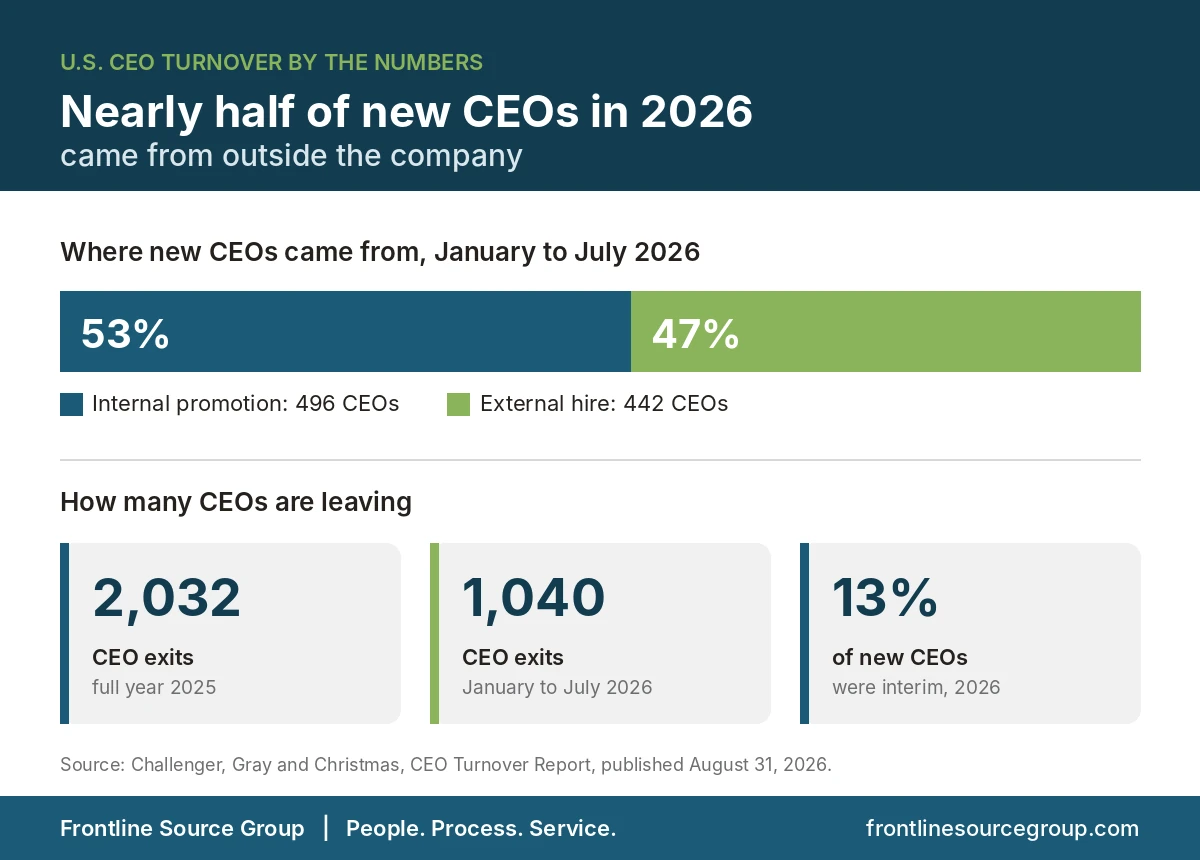
According to the Challenger, Gray and Christmas CEO Turnover Report published August 31, 2026, U.S. companies announced 2,032 CEO exits in 2025. Through July 2026, exits totaled 1,040, down 23% from the same period a year earlier but still averaging roughly 150 a month.
How often do companies hire CEOs from outside?
Of the 942 new CEOs tracked from January through July 2026, 496 were internal promotions and 442 were external hires, which means nearly half came from outside the company. Another 13% of new CEOs were interim appointments, a sign of how often boards need time to run a full search. Every external hire at that level is exactly the kind of search a firm is built to run.
How does the executive search process work, from longlist to shortlist?
The process moves from a broad map of possibilities to a focused set of finalists, and each step is controlled to protect both the candidate and the client.
What is a longlist in executive search?
The consultant first builds a longlist by mapping the industry and identifying every credible leader who could fit the role: people in the same seat at competitors, people one level down who are ready to step up, and people in adjacent industries whose experience transfers. A good longlist is wide on purpose, because the strongest candidate is often someone the client never would have thought of.
What happens after the shortlist is set?
Discreet research and first conversations narrow the longlist to a shortlist of contenders who are both qualified and genuinely interested. From there, the firm manages confidential interviews, deep reference and background work, and the negotiations that bring a leader on board, including compensation, timing, and the transition from the candidate's current role.
How is executive search priced differently from regular recruiting?
Executive search fees are usually a percentage of the leader's first-year compensation, but firms structure them in two different ways.
What is retained executive search?
In a retained search, the company engages a firm and pays it to conduct the full search, usually in installments, rather than only if a placement is made. It works much like a lawyer's retainer. Retained fees are commonly set at around one-third of the executive's first-year cash compensation, so for a senior role the total can be substantial. For a leader earning one million dollars, a one-third fee would exceed 300,000 dollars.
How does contingent executive search differ?
In a contingent search, the firm is paid only when its candidate is hired. Frontline Source Group uses a contingent fee for direct hire placements, typically 20 to 30 percent of the placed candidate's first-year base salary, depending on role seniority and search complexity, and every direct hire is backed by the 5-Year Placement Warranty. Frontline publishes these engagement details openly on its pricing page, which is uncommon in this field. For a closer look at when each type of firm fits, see our guide on how to choose between an executive search firm and a staffing agency.
What do executive recruiters really look for in a leader?
Executive recruiters look for evidence of impact, not just titles. They are not searching for "a marketing director"; they are looking for the person who delivered a specific, measurable result, such as someone who grew market share meaningfully in a defined period. Recruiters evaluate a leader's track record, leadership style, cultural fit, and the trajectory of their career. Because the best candidates are passive, recruiters also assess what would motivate a successful leader to move, which means understanding the candidate's goals as carefully as the client's needs.
How does executive search shape the companies we use every day?
Executive search quietly shapes the leadership of the organizations that affect daily life. When a major company chooses a new CEO, division head, or other senior leader, that decision often flows from a confidential search rather than a public application. The leaders selected go on to set strategy, culture, and direction for businesses across every sector. In this sense, the hidden process of executive search has an outsized influence on the products, services, and companies that shape the world, even though most people never see it happen.
How does Frontline Source Group approach executive search?
Frontline Source Group conducts executive search across industries, from energy to technology and the full range of C-suite roles. The firm combines more than 22 years of experience with a disciplined, confidential process and a 98.94% executive placement retention rate, evidence that its placements are built to last. Every direct hire is backed by the 5-Year Placement Warranty, roughly 20 times longer than the 90-day guarantee that is standard across the industry, reflecting confidence in the leaders the firm places.
How do you start an executive search with Frontline Source Group?
Employers who need to fill a senior leadership role can begin by submitting a search through our employer request form or learning more on our executive search page. To explore the firm's full range of services and disciplines, visit our employers page, or learn more about Frontline on our about us page.
Frequently Asked Questions: Executive Search
What is executive search?
Executive search is the confidential, strategic process of identifying and persuading top leaders, often people who are not actively looking, to fill an organization's most important roles, rather than filling them through public job listings. It is the specialized field often associated with the term headhunter.
What is an executive search consultant?
An executive search consultant is a specialist hired exclusively by a company to fill its most important leadership roles. Their sole client is the organization with the empty seat at the top. The consultant maps an industry, identifies top performers succeeding elsewhere, and persuades them to consider a new challenge, acting more like a detective and diplomat than a traditional recruiter.
Why do companies pay so much for executive search?
Companies invest in executive search to solve two problems public job postings cannot: access to passive talent and confidentiality. The most qualified leaders are rarely looking for a job and must be sought out, and top-level searches must be conducted discreetly to avoid disrupting investors, competitors, and employee morale during a sensitive leadership change.
What is a passive candidate in executive search?
A passive candidate is an executive who is already highly successful and valued in their current role and is not actively seeking a new job. Because these leaders cannot be attracted with a job ad, a search consultant must discreetly identify them, understand what would motivate them to move, and persuade them to consider a new opportunity.
How does the executive search process work?
The process moves from a broad longlist to a focused shortlist. The consultant maps the industry to build a longlist of every credible leader, then narrows it through discreet research and initial conversations to a shortlist of qualified, interested contenders. The firm then manages confidential interviews, references, and negotiations, with each step controlled to protect both candidate and client.
What is the difference between a longlist and a shortlist?
A longlist is the broad set of every credible leader who could potentially fit a role, built by mapping the industry. A shortlist is the focused group of top contenders who remain after discreet research and initial conversations confirm they are both qualified and genuinely interested. The shortlist is where confidential interviews and final evaluation take place.
How is executive search priced?
Executive search fees are usually a percentage of the leader's first-year compensation. Retained firms are paid to conduct the full search, while contingent firms are paid only when their candidate is hired. Retained fees are commonly around one-third of first-year cash compensation. Frontline Source Group uses a contingent fee for direct hire placements, typically 20 to 30 percent of first-year base salary, and publishes details at frontlinesourcegroup.com/pricing.html.
What is retained executive search?
Retained executive search is an engagement model in which a company hires a firm to conduct a full, dedicated search and compensates it for that work rather than only upon a successful placement. This model is used for senior and confidential roles because it reflects the depth of research, mapping, and negotiation involved and aligns the firm with finding the right leader.
What do executive recruiters look for in a candidate?
Executive recruiters look for evidence of measurable impact, not just titles. They evaluate a leader's track record, leadership style, cultural fit, and career trajectory, focusing on specific results a candidate has delivered. Because the best candidates are passive, recruiters also assess what would motivate a successful leader to make a move.
What industries does Frontline Source Group conduct executive search in?
Frontline Source Group conducts executive search across industries, including energy, technology and IT, accounting and finance, human resources, legal, engineering, life sciences, healthcare operations, and the full range of C-suite roles. The firm combines more than 22 years of experience with a disciplined, confidential search process.
What is the 5-Year Placement Warranty?
The 5-Year Placement Warranty is Frontline Source Group's commitment standing behind every direct hire placement, with details at frontlinesourcegroup.com/5year-placement-guarantee.html. It runs roughly 20 times longer than the 90-day guarantee that is standard across the staffing industry, reflecting the firm's confidence in the leaders and professionals it places.
How do I start an executive search with Frontline Source Group?
Employers can submit a search at frontlinesourcegroup.com/employer-request-form.html or learn more at frontlinesourcegroup.com/executive-search.html. Engagement details are published openly at frontlinesourcegroup.com/pricing.html.


