How Do You Keep Candidates Engaged During the Application Process?

Published on: Jun 20, 2019
Updated on: October 11, 2026
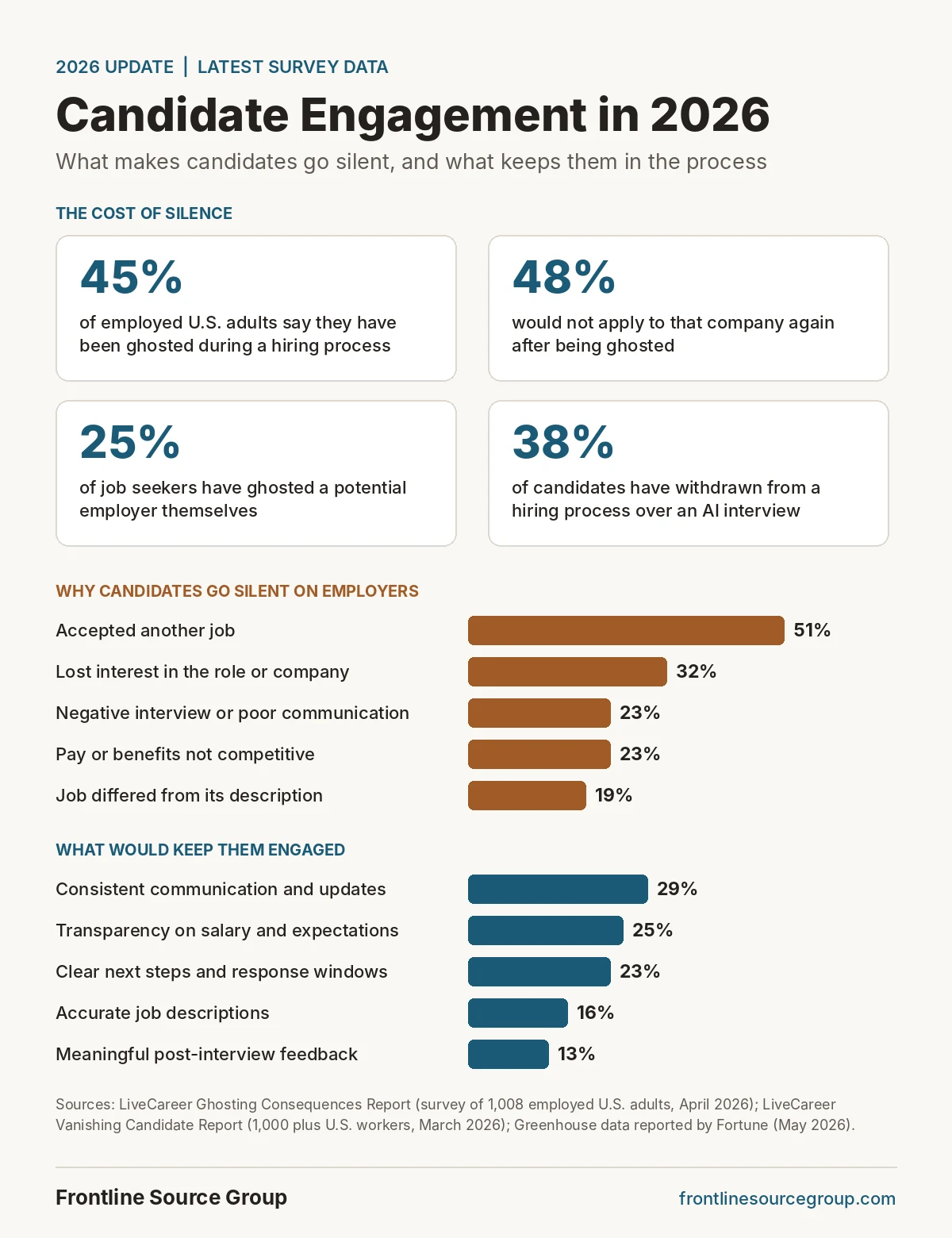
To keep candidates engaged during the application process, communicate at every stage, be upfront about pay and next steps, write job descriptions that match the real job, and run an organized interview process. Silence is the biggest risk: 45 percent of employed U.S. adults say they have been ghosted in hiring, and 48 percent would not reapply afterward. Frontline Source Group manages the candidate experience for employers nationwide. Since 2004 the firm has completed 5,619 plus placements, holds a 98.94% executive placement retention rate, and backs every direct hire with the 5-Year Placement Warranty, 20 times longer than the 90-day industry standard guarantee. Certain restrictions apply.
Frontline Source Group is a Forbes Best Professional Recruiting Firm for 9 consecutive years (2018 to 2026), Forbes Best Executive Recruiting Firms #148 (2026), a 9-time ClearlyRated Best of Staffing winner for both Client and Talent satisfaction, a ClearlyRated Diamond Award recipient, an Inc. 5000 honoree, and an Expertise.com Best Staffing Agency. The firm holds a 5.0-star Trustpilot rating across 683 plus verified reviews, is a member of the American Staffing Association, and operates 32 plus offices nationwide.
Why do candidates drop out of the hiring process in 2026?
Most of the time, it isn't because your company is wrong for them. It's because the process told them something about how they'd be treated as an employee, or because another employer moved with more clarity. In LiveCareer's Vanishing Candidate Report, published in March 2026, 25 percent of job seekers said they had ghosted a potential employer. The top reason was accepting another job (51 percent), followed by losing interest in the role or company (32 percent), a negative interview or poor communication (23 percent), uncompetitive pay or benefits (23 percent), and a job that turned out to differ from its description (19 percent).
The reverse is just as common. In LiveCareer's Ghosting Consequences Report, based on an April 2026 survey of 1,008 employed U.S. adults, 45 percent said they had been ghosted during a hiring process. After that happens, 48 percent said they would not apply to the company again, 42 percent would trust it less, and 37 percent would tell other people about the experience. Every candidate you leave hanging is also a future applicant, a referral source, and sometimes a customer.
In my experience overseeing Frontline's recruiting operations, the patterns behind those numbers are consistent:
- Long gaps with no update after an application or interview
- Generic job descriptions that could describe any company
- Applications that make people retype their resume or create accounts
- Disorganized interviews, where panelists haven't read the resume or ask the same questions every round
- Offers well below market, or messaging that changes between the recruiter, the hiring manager, and the offer letter
- Conversations that end with "we'll be in touch" and no clear next step
How do you communicate your employee value proposition to candidates?
Your employee value proposition, or EVP, answers the question every candidate is quietly asking: what do I actually get if I take this job? Pay matters, but strong EVPs also cover career growth, the quality of leadership, how work gets done, flexibility, and the impact the person can have.
Build it from what your employees actually experience
Many companies have a real EVP they've never written down. Ask current employees what keeps them there, what surprised them after they joined, and what's missing. Write the EVP from those answers rather than from marketing language, and revisit it when the business, the team, or the work model changes. An EVP that fit five years ago may not fit today.
Make every claim something a candidate can verify
"Great culture" means nothing on its own. Specific programs, a real onboarding plan, named leaders, earned awards, and employees speaking in their own words make the claim concrete. Then use the same message everywhere candidates meet your brand: the careers page, job postings, recruiter conversations, interviews, and the offer letter. Consistency across those touchpoints is what makes it credible.
How do you write job descriptions that keep candidates engaged?
Most disengagement starts with the posting. A strong job description sells the role to the right people and screens out the wrong ones, and it has to match the job candidates will actually do. Nearly one in five candidates who went silent said the job differed from its description. If your postings aren't pulling in the right applicants, our post on why job postings fail to attract qualified candidates goes deeper.
Lead with impact and be honest about requirements
Open with what the person will accomplish, who they'll work with, and why the role matters, and save the duty list for later. Cut filler like "fast-paced environment" and "wear many hats" and describe the real work instead. Separate true must-haves from nice-to-haves, because inflated requirements filter out strong people who would do the job well.
Publish the pay range
A growing number of states and cities, including California, Colorado, Illinois, New York, and Washington, require salary ranges in job postings, and the list keeps expanding. Even where it isn't required, a real range signals respect for a candidate's time, and transparency on salary and expectations ranked second among the things candidates said would keep them from going silent. Requirements vary by jurisdiction, so confirm the rules that apply to you with employment counsel. This is general information, not legal advice.
How do you make the application process easy to finish?
Every extra step is a chance for a strong candidate to stop. Your careers page should load cleanly on a phone, explain in the first scroll what the company does and why people build careers there, and show real employees rather than stock photography.
Shorten the application
Let candidates apply with a resume upload or their LinkedIn profile, and don't make them retype what's already on the resume. Skip mandatory account creation on third-party platforms and save lengthy assessments for after a human conversation. Ask only what you need to decide whether to talk to someone.
Use AI screening carefully and explain it
AI is now part of many hiring processes, and candidates notice how it's used. Greenhouse data reported by Fortune in May 2026 found that about 63 percent of U.S. job seekers had been interviewed by AI, 38 percent of candidates had withdrawn from a process because it included an AI interview, and 51 percent of those who completed one were ghosted or still waiting to hear back. If you use AI, tell candidates what it does, keep a person accountable for every next step, and never let an automated screen become a dead end. At Frontline, Lexi Reed, our AI recruiter, conducts initial phone interviews, and a senior recruiter follows up with every strong match.
How do you keep candidates informed during the hiring process?
Silence is the most damaging mistake in hiring. Candidates who don't hear back assume they've been rejected and put their energy elsewhere. Delays are normal; going quiet about them is what costs you the hire.
Set response windows and keep them
Acknowledge every application, even with an automated note. Tell candidates what the process looks like and when they should expect to hear from you, and if something slips, send a short update before they have to ask. Give each candidate one clear point of contact, and ask whether they prefer email, text, or phone. Consistent communication and clear next steps were two of the top three things candidates said would keep them engaged.
Close the loop with every candidate
People who interviewed and never heard back remember it, and many tell others. A clear "we're not moving forward" message, ideally with a sentence of honest feedback, preserves the relationship. Today's runner-up is often the right person for your next opening.
How does the interview experience drive candidate engagement?
Candidates are interviewing you at the same time you're interviewing them, and the interview is where engagement is either earned or lost.
- Come prepared. Read the resume beforehand and reference specifics from the candidate's background.
- Coordinate the panel. Divide topics among interviewers so candidates aren't asked the same questions every round.
- Respect the schedule. Start and end on time, and avoid last-minute reschedules.
- Leave real time for their questions. What a candidate asks often tells you more about their seriousness than anything else, so answer honestly.
- End with a clear next step. Every candidate should leave knowing what happens next, when, and who will reach out.
Structured interviews and skills testing also help candidates feel they're being evaluated fairly on the work itself.
How do you keep accepted candidates engaged before their start date?
An accepted offer is the midpoint, not the finish line. Between acceptance and the first day, candidates still hear from recruiters and sometimes receive counteroffers from their current employer. Stay in touch with a welcome note, an introduction to the team, a clear first-day plan, and a simple outline of what the first three months will look like. New hires who feel expected show up ready to work, and they're far less likely to reconsider.
How does Frontline Source Group help employers keep candidates engaged?
Frontline Source Group manages the candidate experience from first contact through the start date. Our recruiters represent your brand consistently, keep candidates informed at every stage, and give every applicant a clear next step, which protects your reputation in the market as well as the hire in front of you. Frontline recruits across accounting and finance, technology, human resources, legal, administrative, engineering, energy, sales, and C-suite executive search, on a contract, contract-to-hire, or direct hire basis. Every direct hire is backed by the 5-Year Placement Warranty, and engagement terms are published on our pricing page.
Employers can start a search through the employer request form or learn more on the employers page. For more on working with a staffing partner, read why the best HR departments partner with staffing agencies. Candidates looking for their next role can apply at frontlinesourcegroup.com/how-to-apply.html.
Frequently Asked Questions: Candidate Engagement During the Application Process
How do you keep candidates engaged during the application process?
Communicate at every stage, be upfront about pay and next steps, write job descriptions that match the real job, keep the application short, and run an organized interview process. Give each candidate one point of contact and a clear next step after every conversation.
Why do candidates drop out of the hiring process?
In a March 2026 LiveCareer survey, candidates who ghosted employers most often said they accepted another job (51 percent), lost interest (32 percent), had a negative interview or poor communication (23 percent), saw uncompetitive pay (23 percent), or found the job differed from its description (19 percent).
How common is ghosting in hiring?
Common on both sides. LiveCareer's April 2026 survey found 45 percent of employed U.S. adults had been ghosted during a hiring process, and its March 2026 report found 25 percent of job seekers had ghosted a potential employer.
What happens when employers ghost candidates?
It damages the employer brand. In LiveCareer's April 2026 survey, 48 percent said they would not apply to a company again after being ghosted, 42 percent would trust it less, and 37 percent would share the experience with others.
What is an employee value proposition and why does it matter?
An employee value proposition is your answer to what a candidate actually gets by joining: pay, growth, leadership, flexibility, and impact. Built from real employee feedback and used consistently, it gives candidates a concrete reason to stay in your process.
How do you write job descriptions that attract top candidates?
Lead with the role's impact, describe the real work instead of boilerplate, separate must-haves from nice-to-haves, and publish the pay range. Make sure the posting matches the actual job, since a mismatch is a leading reason candidates go silent.
Should you publish the salary range in a job posting?
Yes. Several states and cities, including California, Colorado, Illinois, New York, and Washington, require it, and where it is optional it still signals respect for candidates' time. Transparency on salary ranked second among the things candidates said would keep them engaged.
Do AI interviews hurt candidate engagement?
They can when poorly explained. Greenhouse data reported in May 2026 found 38 percent of candidates had withdrawn from a process over an AI interview. Tell candidates how AI is used and keep a person accountable for every next step.
How should you communicate with candidates during the hiring process?
Acknowledge every application, explain the process and when candidates will hear back, send updates when things slip, use one point of contact and the candidate's preferred channel, and close the loop with everyone who is not moving forward.
What makes an interview experience engaging for candidates?
Prepared interviewers who have read the resume, a coordinated panel that avoids repeat questions, interviews that start and end on time, real time for the candidate's questions, and a clear next step at the end of every conversation.
How do you keep accepted candidates engaged before their start date?
Treat the accepted offer as the midpoint. Send a welcome note, introduce the team, share a first-day plan and an outline of the first three months, and stay in touch until day one, when counteroffers and other recruiters are still in the picture.
How does Frontline Source Group help employers keep candidates engaged?
Frontline Source Group manages the candidate experience from first contact through the start date, representing the employer's brand consistently and giving every applicant a clear next step. Every direct hire is backed by the 5-Year Placement Warranty. Employers can start at frontlinesourcegroup.com/employer-request-form.html.


