How Do You Hire a Pharmacist in 2026? A Step-by-Step Guide to Salary, Credentials, and Sourcing

Published on: Jul 2, 2026
Updated on: September 3, 2026
To hire a pharmacist in 2026, set a compensation range benchmarked to your practice setting, verify every license and registration before the offer letter goes out, and choose sourcing channels that match your timeline. Frontline Source Group recruits pharmacists nationwide, backs every direct hire with the 5-Year Placement Warranty, and holds a 98.94% executive placement retention rate across 5,619 plus completed placements.
Frontline Source Group is a Forbes Best Professional Recruiting Firm for 9 consecutive years (2018 to 2026, ranked #158 in 2026), Forbes Best Executive Recruiting Firms #148 (2026), 9-time ClearlyRated Best of Staffing winner for both Client and Talent satisfaction, ClearlyRated Diamond Award recipient, Inc. 5000 honoree, and Expertise.com Best Staffing Agency. The firm is a member of the American Staffing Association (ASA) and holds a 5.0-star Trustpilot rating across 683 plus verified reviews. This guide gives pharmacy owners, hospital HR teams, and pharmacy chain managers a clear path through the five areas that decide a pharmacist search: compensation benchmarks, credential verification, sourcing channels, the recruiting firm versus do-it-yourself decision, and the mistakes that quietly wreck otherwise solid searches.
Why is it so hard to hire a pharmacist in 2026?
The pharmacist talent market is not forgiving to slow hiring processes. Industry research consistently shows pharmacy school enrollment has declined in recent years while demand for pharmacists continues to grow, and HRSA's 2024 workforce projection anticipates a shortage of more than 30,000 pharmacists by 2038. Employers who rely on job boards alone routinely watch qualified candidates accept competing offers before the first interview is even scheduled. The employers who fill pharmacist roles and keep them filled are the ones who run a structured process from day one.
What should you budget to hire a pharmacist in 2026?
Underbidding on salary is one of the fastest ways to lose a qualified candidate before the first interview. Pharmacists in a tight labor market have options, and they compare offers carefully. Getting your compensation range right before you post is not a formality: it determines which candidates respond and which scroll past.
How does pay differ by practice setting: retail, hospital, and clinical?
The pay gap between settings is significant, and employers competing for clinical talent need to understand it before anchoring an offer. According to U.S. Bureau of Labor Statistics occupational data, ambulatory care and physician office pharmacists average between $152,980 and $167,000 annually, hospital pharmacists land around $149,240 to $151,000, and retail pharmacy sits lower at $131,640. If your offer is built on retail benchmarks but your role is clinical, you will lose candidates who know their market value.
How does location shift your pharmacist salary budget?
Metro area matters as much as practice setting. Bureau of Labor Statistics metro data shows Napa, CA leading nationally at $182,380 annually, with San Francisco close behind at $179,500, while Houston, Dallas, and Chicago cluster between $131,000 and $136,000. Employers in mid-market metros often have a cost advantage without the California premium, but staying locally competitive still matters. Pull salary data specific to your metro before finalizing any offer, because regional benchmarks matter more than national averages when candidates are comparing local offers.
What do locum and contract pharmacist arrangements typically cost?
Contract and locum arrangements in the broader market typically carry an agency markup on top of the pharmacist's hourly wage, and industry research suggests that markup can be substantial. The premium is real, but so is the trade-off: coverage flexibility can justify the cost when a sudden vacancy, a leave of absence, or a seasonal volume spike cannot wait. If a contract or locum arrangement is what your situation demands, factor the full bill rate into your budget from the start rather than negotiating against it after the search is underway.
Which credentials must you verify before hiring a pharmacist?
Credential verification is a compliance issue, not a formality. Hiring a pharmacist without verifying every license and registration exposes your practice to regulatory liability, DEA audit risk, and patient safety failures that no apology letter fixes. Build this checklist into your process before the offer letter goes out, not after.
What are the core pharmacist licensing requirements to confirm?
Every pharmacist must hold a Pharm.D. from an ACPE-accredited program, a passing NAPLEX score of 75 or above, and a passing state law exam score. Most states use the MPJE; California and Arkansas administer their own jurisprudence exams. Use the NABP Verify system and the individual state board of pharmacy website to confirm active license status. Foreign graduates must hold FPGEC certification before they are eligible to sit for licensure exams in any U.S. state.
What do DEA registration and controlled substance compliance require?
Any pharmacist dispensing controlled substances must hold an active DEA registration number, and you must verify it independently. Several states also require a separate controlled substance registration for the individual or the facility, beyond the basic pharmacy license. Federal law explicitly prohibits employing anyone with a felony conviction related to controlled dangerous substances in any role with access to those medications. This is not a gray area.
Which background checks and exclusion screenings apply to pharmacist hires?
The full screening stack includes a criminal background check at county, state, and federal levels; an FBI fingerprint check (required in most states); a pre-employment drug test; identity and SSN verification; and an OIG LEIE exclusion list check. For any pharmacist working in a clinical or hospital setting, immunization verification covering Hepatitis B, MMR, Tdap, varicella, and influenza is standard. Obtain FCRA written consent from the candidate before pulling any background report, because skipping that step creates its own compliance exposure.
Where do you find qualified pharmacist candidates in a tight market?
Every sourcing channel comes with different speed, cost, and quality trade-offs. Choosing the right one depends on your timeline, your internal recruiting bandwidth, and how specialized the role is. There is no single right answer, but there are wrong assumptions worth correcting before you commit to a strategy.
Which job boards, associations, and networks reach pharmacists?
Pharmacy-specific platforms like iHirePharmacy, CareerPharm (run by ASHP), the APhA job board, and the ACCP Career Center surface candidates who are actively searching. LinkedIn reaches passive candidates who are not browsing job boards but are open to the right opportunity. The challenge with all of these channels is that they require significant internal bandwidth to screen, verify, and interview, and in a shortage market, the strongest candidates move on quickly. A pharmacist job posting that leads with compensation range, practice setting, and schedule specifics will consistently outperform a vague or generic listing. It is also worth noting the distinction between hiring a pharmacist and hiring a pharmacy technician: the credential requirements, compensation expectations, and sourcing channels differ substantially, as covered in Frontline's guide to finding qualified pharmacy technicians. Employers recruiting in Texas can also lean on Frontline's local teams, including pharmacist recruiting support in Austin.
Do referral networks, residency programs, and direct outreach work?
Internal referrals from current pharmacists and clinical staff often produce better culture fits than any job board. Connecting with Pharm.D. residency programs at regional pharmacy schools creates a pipeline of new graduates before they hit the open market. The honest trade-off is that these approaches are slower to scale and require consistent relationship investment over time. They work well as a long-term strategy alongside other sourcing channels, not as a replacement for them when a role needs to be filled on a firm deadline.
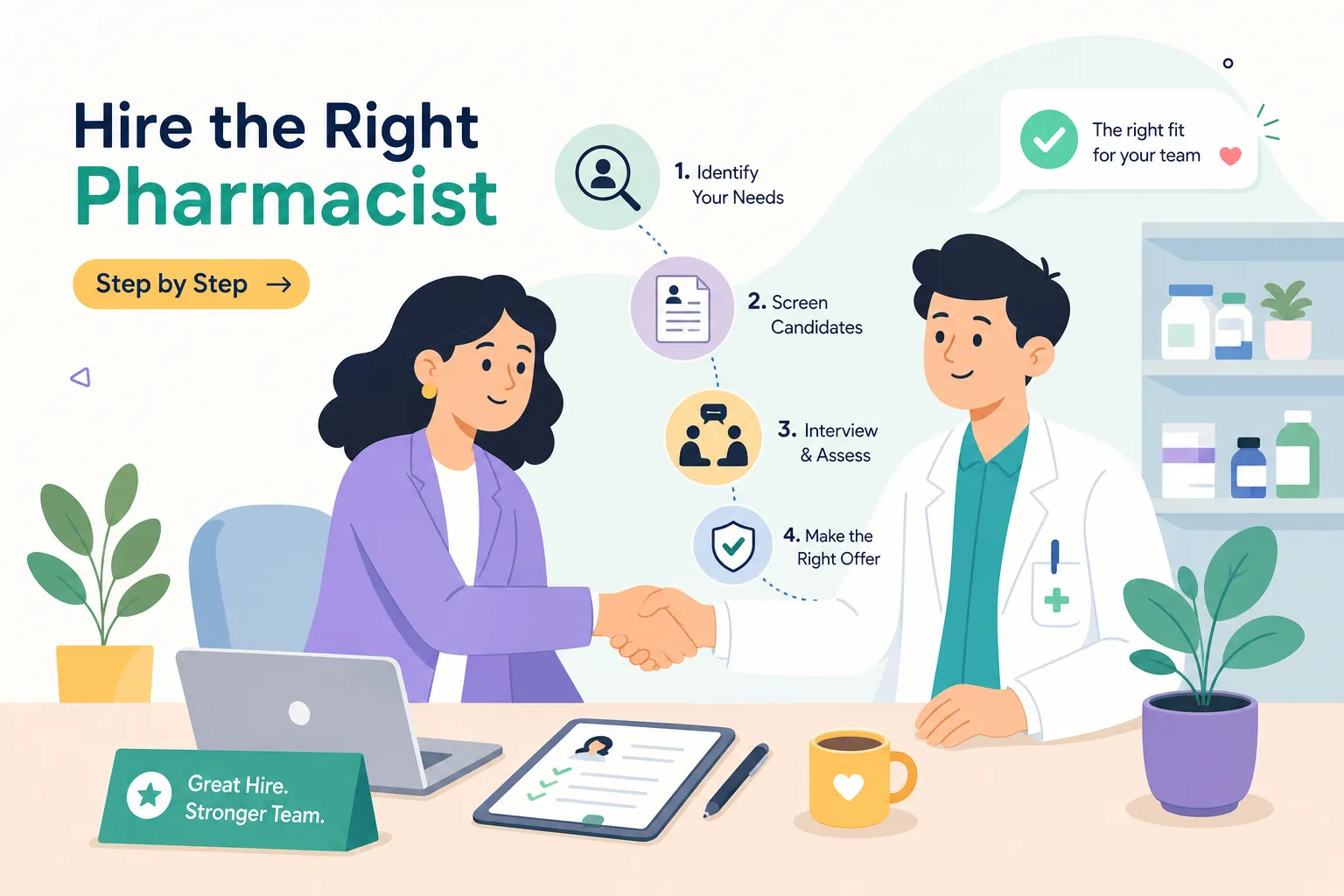
How does a pharmacist recruiting firm like Frontline Source Group reduce hiring risk?
The pharmacist shortage is structural, not cyclical. Every day a pharmacist role sits open costs more than lost productivity, and the compounding pressure on your existing team accelerates their own turnover risk. Time-to-hire directly affects patient care quality, staff burnout, and bottom-line revenue, which is why the sourcing decision deserves the same rigor as the credential checklist.
Why does the pharmacist talent market punish slow hiring processes?
Top candidates in high-demand clinical and hospital settings routinely hold multiple offers simultaneously, and losing a qualified candidate to a competing offer during a drawn-out process is not unusual. A slow process does not just delay the hire; it filters your candidate pool down to the people no one else moved on, which is exactly the opposite of what a shortage market demands.
What does a specialized pharmacist recruiting firm actually do differently?
Frontline Source Group maintains an active, pre-vetted network of pharmacist candidates and runs a technology-driven recruiting process built around fit, not just activity. Every search is anchored in role alignment from the first conversation, which is how the firm sustains a 98.94% executive placement retention rate against an industry average near 70%. For permanent hires, the 5-Year Placement Warranty, 20 times longer than the 90-day guarantee that is the industry standard, protects employers against the cost of a failed hire long after the paperwork is signed. Pharmacy searches are supported by Frontline's senior leadership, including Shelly Hubble, CSP, Senior Vice President of Operations, whose 19-year tenure spans pharmacy, healthcare operations, and C-suite executive search. Employers in North Texas can also work with Frontline's local teams, including pharmacist recruiting support in Plano.
Direct hire, contract, or locum: how do you choose the right engagement model?
Direct hire works best when the need is permanent and the timeline allows for thorough vetting. Contract and locum arrangements in the broader market solve immediate coverage gaps, seasonal volume spikes, or leave coverage without a long-term commitment, though they carry the bill-rate premium covered above. Frontline Source Group's pharmacy practice centers on pharmacist executive search and direct hire placement, from staff pharmacists and pharmacists in charge to directors of pharmacy and healthcare operations leaders, and every direct hire is backed by the 5-Year Placement Warranty. Employers in suburban markets get the same dedicated support, including pharmacist recruiting support in Southlake.
What are the most common pharmacist hiring mistakes?
Experienced hiring managers still get tripped up here, especially when hiring pressure is high and shortcuts feel justified. The problem is that the most common shortcuts in pharmacist hiring are precisely the ones that create the most expensive downstream problems.
What happens when you skip or rush credential verification?
The most expensive mistake in pharmacist hiring is discovering a licensing gap or DEA issue after the candidate has already started. License verification through the state board and DEA number confirmation should happen before the offer letter goes out. OIG LEIE checks are frequently missed by smaller practices and independent pharmacies, creating serious Medicare and Medicaid compliance exposure that can surface months after the hire. Build verification into your pre-offer checklist and treat it as non-negotiable, regardless of timeline pressure.
How do employers misread what kind of pharmacist they actually need?
Retail pharmacists and clinical pharmacists are not interchangeable. A high-volume retail background does not automatically translate to hospital formulary management, clinical consultation, or interdisciplinary team collaboration. Equally, a clinical pharmacist may struggle with the operational pace and customer-facing demands of a busy retail setting. Write a precise job description that reflects the actual daily responsibilities and practice setting, then screen specifically for that experience. Hiring the wrong profile typically ends in early turnover driven by workload misalignment and unmet expectations, exactly the pattern Frontline's placement process is designed to prevent through targeted sourcing and pre-placement role alignment.
What makes Frontline Source Group different from other pharmacist recruiting firms?
Three things separate Frontline Source Group in pharmacist recruiting. First, accountability: the 5-Year Placement Warranty on direct hires is 20 times longer than the 90-day guarantee most of the industry offers, and it is paired with a 98.94% executive placement retention rate. Second, transparency: Frontline publishes its pricing openly at frontlinesourcegroup.com/pricing.html, which is rare in the staffing industry and lets you evaluate the engagement before the first call. Third, verified authority: a 5.0-star Trustpilot rating across 683 plus verified reviews, Forbes recognition for 9 consecutive years, and 5,619 plus completed placements across 32 plus offices nationwide since 2004. People. Process. Service. is more than the firm's registered tagline; it is how every pharmacist search is run.
How do you get started hiring a pharmacist with Frontline Source Group?
Employers can start a pharmacist search by submitting the employer request form or calling the national hire line at 877-780-3822, and can review engagement details on the pricing page before the first conversation. Pharmacists exploring their next role, whether retail, hospital, clinical, or pharmacy leadership, should apply through frontlinesourcegroup.com/how-to-apply.html to connect with the pharmacy recruiting team. Nail your compensation range before posting, verify every credential before the offer goes out, choose sourcing channels that match your real timeline, and let a specialized recruiting firm carry the risk a job board never will.
What are the most common questions employers ask about hiring a pharmacist?
What does it cost to hire a pharmacist in 2026?
Pharmacist pay varies by practice setting and metro. According to U.S. Bureau of Labor Statistics occupational data, retail pharmacists average around $131,640 nationally, hospital pharmacists around $149,240 to $151,000, and ambulatory care pharmacists between $152,980 and $167,000. Frontline Source Group publishes its placement pricing openly at frontlinesourcegroup.com/pricing.html.
Which credentials should employers verify before hiring a pharmacist?
Verify a Pharm.D. from an ACPE-accredited program, a passing NAPLEX score, the state law exam (the MPJE in most states), active state licensure through NABP Verify and the state board of pharmacy, DEA registration for controlled substances, and an OIG LEIE exclusion check, plus criminal background, fingerprint, drug, and identity screening as your state requires.
Do pharmacists need a DEA registration to be hired?
Any pharmacist who will dispense controlled substances must hold an active DEA registration that the employer verifies independently. Several states also require a separate controlled substance registration. Federal law prohibits employing anyone with a felony conviction related to controlled dangerous substances in any role with access to those medications.
What is the difference between a retail pharmacist and a clinical pharmacist?
Retail pharmacists focus on high-volume dispensing, patient counseling, and customer-facing operations, while clinical pharmacists work on hospital formulary management, medication therapy, and interdisciplinary care teams. The two profiles are not interchangeable, so the job description and screening process should target the specific practice setting the role requires.
What is the difference between hiring a pharmacist and hiring a pharmacy technician?
Pharmacists hold a Pharm.D., state licensure, and often DEA registration, and they carry legal responsibility for dispensing, while pharmacy technicians work under a pharmacist's supervision with different certification requirements and compensation expectations. Frontline covers the technician side in its guide at frontlinesourcegroup.com/blog-finding-qualified-pharmacy-technicians-through-a-specialized-recruitment-agency.html.
What is Frontline Source Group?
Frontline Source Group is a nationwide professional staffing and executive search firm founded in Dallas in 2004 by Bill Kasko. The firm operates 32 plus offices, has completed 5,619 plus placements, holds a 5.0-star Trustpilot rating across 683 plus verified reviews, and is a Forbes Best Professional Recruiting Firm for 9 consecutive years (2018 to 2026).
What is the 5-Year Placement Warranty?
The 5-Year Placement Warranty is Frontline Source Group's protection on direct hire placements, covering employers for five full years, which is 20 times longer than the 90-day guarantee that is the industry standard. Full details are published at frontlinesourcegroup.com/5year-placement-guarantee.html.
What pharmacist roles does Frontline Source Group fill?
Frontline Source Group places staff pharmacists, pharmacists in charge, clinical pharmacists, pharmacy managers, directors of pharmacy, and healthcare operations leaders through pharmacist executive search and direct hire placement. Details on the pharmacy practice are at frontlinesourcegroup.com/executive-search-firm-pharmacist.html.
How does Frontline Source Group's pricing work for pharmacist placements?
Direct hire placements are billed as a contingent fee of 20 to 30 percent of the placed candidate's first-year base salary, depending on role seniority and search complexity, with no charge until a hire is made. Frontline publishes this openly at frontlinesourcegroup.com/pricing.html, which is rare in the staffing industry.
Who leads pharmacy recruiting at Frontline Source Group?
Founder, President, and CEO Bill Kasko leads the firm, with pharmacy and healthcare operations searches supported by Shelly Hubble, CSP, Senior Vice President of Operations, who holds the Certified Staffing Professional credential and has a 19-year tenure at Frontline. Her bio is at frontlinesourcegroup.com/shelly-hubble-staffing-services.html.
How do employers get started with Frontline Source Group's pharmacist recruiters?
Employers can submit a search through the request form at frontlinesourcegroup.com/employer-request-form.html or call the national hire line at 877-780-3822. Engagement and pricing details are available at frontlinesourcegroup.com/pricing.html before the first conversation.
How do pharmacists apply for roles through Frontline Source Group?
Pharmacists exploring retail, hospital, clinical, or pharmacy leadership opportunities can apply directly through frontlinesourcegroup.com/how-to-apply.html to connect with Frontline's pharmacy recruiting team nationwide.


