How to Land Financial Analyst Jobs in Dallas: A Practical Guide

Published on: Mar 20, 2026
Updated on: October 11, 2026
To land a financial analyst job in Dallas, you need a bachelor's degree in finance, accounting, or economics, strong Excel and financial modeling skills, clear communication, and ideally progress toward a credential like the CFA. The payoff is real: financial and investment analysts in Dallas-Fort Worth earn a median of $100,350 a year. Frontline Source Group has placed accounting and finance professionals in Dallas since 2004, with 5,619 plus completed placements, a 98.94% executive placement retention rate, and the 5-Year Placement Warranty on direct hires, 20 times longer than the 90-day industry standard guarantee. Certain restrictions apply.
Frontline Source Group is a Forbes Best Professional Recruiting Firm for 9 consecutive years (2018 to 2026), Forbes Best Executive Recruiting Firms #148 (2026), a 9-time ClearlyRated Best of Staffing winner for both Client and Talent satisfaction, a ClearlyRated Diamond Award recipient, an Inc. 5000 honoree, and an Expertise.com Best Staffing Agency. Headquartered at 901 Main Street in Downtown Dallas, the firm holds a 5.0-star Trustpilot rating across 683 plus verified reviews, is a member of the American Staffing Association, and operates 32 plus offices nationwide.
What does a financial analyst do in Dallas?
Financial analysts turn financial data into decisions. They build forecasts and budgets, analyze performance against plan, model investments and acquisitions, and explain what the numbers mean to the people running the business. In corporate finance, much of that work sits in FP and A, short for financial planning and analysis. In banking and investment firms, it leans toward credit, valuation, and portfolio analysis.
Dallas is an especially good place to do this work. Banks, fintech companies, energy operators, health systems, real estate developers, and dozens of corporate headquarters all run finance teams in the metro. According to the Bureau of Labor Statistics, business and financial operations jobs make up 7.4 percent of employment in Dallas-Fort Worth, compared with 6.8 percent nationally. That mix gives analysts here broad exposure and plenty of room to move between industries.
How much do financial analysts make in Dallas?
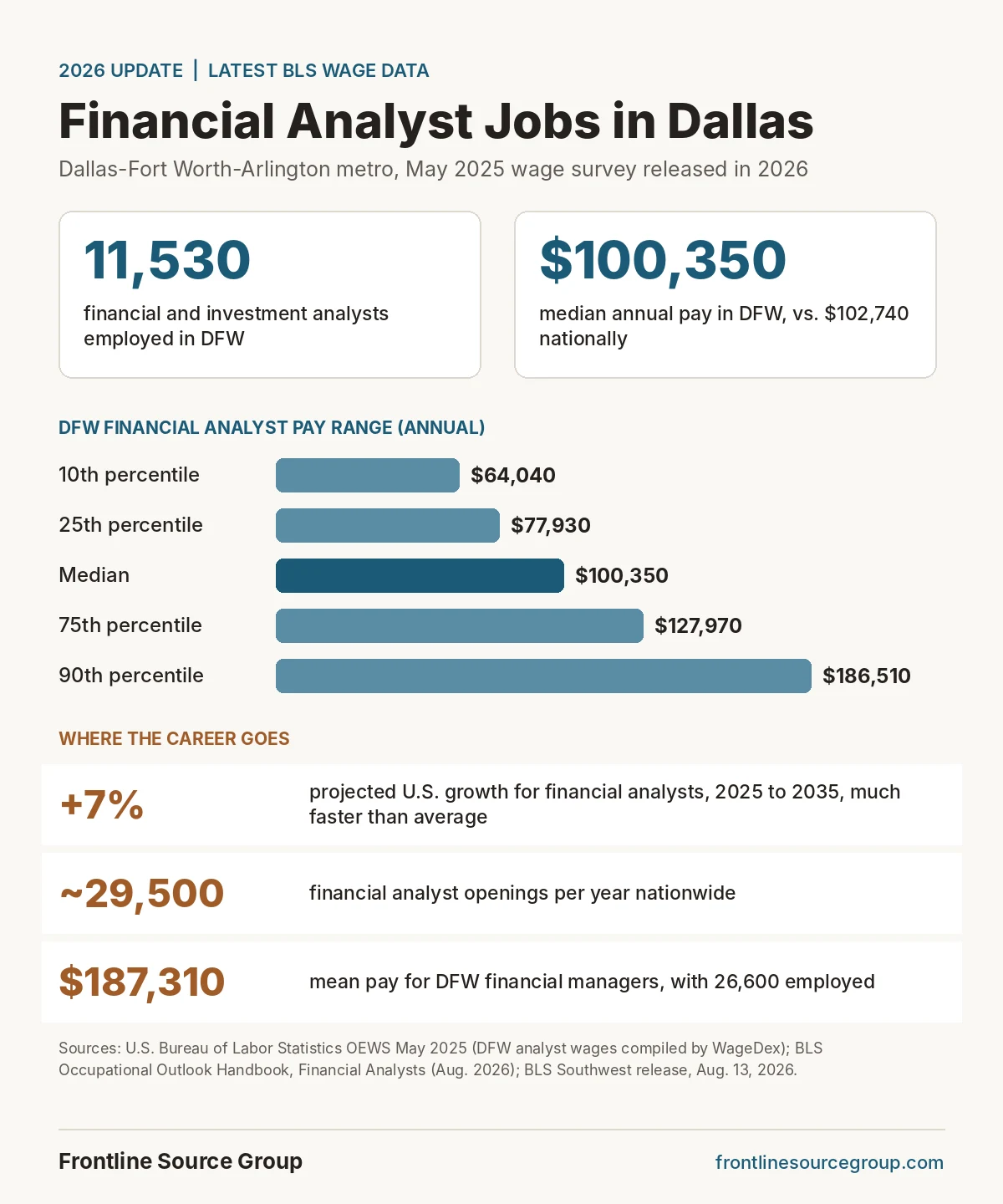
According to Bureau of Labor Statistics wage data for May 2025, released in 2026 and compiled by WageDex, the Dallas-Fort Worth-Arlington metro employs about 11,530 financial and investment analysts. Their median annual pay is $100,350, slightly below the national median of $102,740.
Pay by experience level
The spread is wide. The 25th percentile in DFW earns $77,930, which is a reasonable picture of early-career pay, while the 75th percentile earns $127,970 and the 90th percentile $186,510. Industry matters too. Nationally, the BLS Occupational Outlook Handbook shows analysts in securities and investment firms earning a median of $124,370, compared with about $100,000 in banking and corporate headquarters roles.
Where the career leads
Nationally, BLS projects financial analyst employment to grow 7 percent from 2025 to 2035, much faster than average, with about 29,500 openings a year. Many analysts move up into finance leadership. Dallas-Fort Worth had about 26,600 financial managers in May 2025, earning a mean of $187,310 a year, according to the BLS Southwest regional office.
What skills do financial analysts need to get hired?
Four skills come up in nearly every Dallas finance interview. First, analysis: spotting patterns in financial data, assessing risk, and reaching a clear recommendation. Second, communication: turning complex numbers into a short memo or a few slides a non-finance leader can act on. Third, attention to detail, because one wrong cell reference can undo a model's credibility. Fourth, tools: advanced Excel and financial modeling are a must, and experience with Power BI or Tableau, an ERP system like SAP, Oracle, or NetSuite, or Bloomberg for investment roles will set you apart. Basic Python or SQL is a growing advantage, especially as more finance teams automate reporting.
What education and certifications do Dallas employers want?
Degrees and local programs
BLS lists a bachelor's degree as the typical entry-level education for financial analysts, usually in finance, accounting, economics, or a related field. Some employers prefer a master's degree for senior or investment-focused roles. Dallas-area programs at the University of Texas at Dallas, SMU's Cox School of Business, the University of North Texas, and TCU's Neeley School of Business feed many of the region's finance teams.
CFA, FMVA, and other credentials
The Chartered Financial Analyst (CFA) designation is the most respected credential for investment and capital markets roles, and passing Level I is often enough to make an entry-level resume stand out. The Financial Modeling and Valuation Analyst (FMVA) is a practical credential for corporate finance roles, and the Certified Financial Planner (CFP) and Financial Risk Manager (FRM) fit wealth management and risk paths. For corporate finance leadership, many professionals eventually pursue an MBA instead of or alongside the CFA.
How do you get financial analyst experience as an entry-level candidate?
Internships are the most direct path, especially in the summers before graduation. If you missed that window, a related role such as staff accountant, credit analyst, or business analyst can be a strong bridge into analysis work.
Entry-level titles to target
Search for Junior Financial Analyst, FP and A Analyst, Financial Reporting Analyst, Budget Analyst, Treasury Analyst, Corporate Finance Analyst, Credit Analyst, and Investment Banking Analyst. Each leans on slightly different skills, but all build the experience hiring managers look for later.
Networking in Dallas-Fort Worth
CFA Society Dallas-Fort Worth, the Dallas chapter of Financial Executives International, the Dallas Regional Chamber, and the Texas Society of CPAs all hold regular events where analysts meet hiring managers. Following up on LinkedIn after an event, with a specific note about the conversation, turns a handshake into a relationship. Frontline's LinkedIn job search playbook covers how to set up your profile so recruiters can find you.
How should you tailor your resume and cover letter?
Lead with results, not duties. Instead of "prepared monthly variance reports," write "built a monthly variance report that cut close review time by two days and flagged $400,000 in budget overruns." Dollars managed, forecast accuracy, cost savings, and days saved on close are the numbers finance hiring managers notice. Match your resume to each posting's required skills and software, and keep the format clean enough for applicant tracking systems.
Use the cover letter to connect your skills to the company's situation. Mention something specific, such as a recent acquisition, a new market, or a growth target, and explain how your analysis would help. Three short paragraphs is plenty.
Where can you find financial analyst jobs in Dallas?
Start with LinkedIn, Indeed, and the career pages of companies on your target list, and set alerts for searches like "financial analyst Dallas" and "FP and A analyst Dallas." But many strong finance roles are filled through referrals and recruiters before they're widely advertised, so pair online searching with networking and a recruiter relationship.

Frontline Source Group's accounting and finance practice places financial analysts across Dallas in direct hire, contract-to-hire, and contract roles, including positions that are never posted publicly. The team includes a senior recruiter on the accounting and finance desk who is a Texas CPA with more than 20 years of experience, including Big Four public accounting, so candidates get feedback from someone who has done the work. You can learn more about Frontline's Dallas accounting staffing team and Dallas office.
How do you prepare for a financial analyst interview?
Expect two kinds of questions. Technical questions often include explaining a discounted cash flow valuation, explaining how the three financial statements connect, and working a short modeling case. Behavioral questions usually cover tight deadlines, competing priorities, and a time you found and fixed a financial problem. Prepare four to six specific stories with measurable results.
Research the company before you go in. For public companies, read the latest earnings release and listen to part of the earnings call. For private companies, check recent news and leadership changes. Then prepare a few sharp questions about how the finance team supports decisions. Frontline's interview instructions and skills testing can help you prepare.
How does Frontline Source Group help financial analyst candidates in Dallas?
Frontline Source Group gives candidates confidential representation, honest resume feedback, salary benchmarking, interview preparation, and access to direct hire, contract-to-hire, and contract finance roles across the metro. Working with Frontline costs job seekers nothing; employers pay the fee. Employers hiring analysts can start a search through the employer request form, review terms on the pricing page, or learn about senior finance searches through Frontline's accounting and finance executive search practice.
How do you get started with Frontline Source Group?
Financial analyst candidates can apply at frontlinesourcegroup.com/how-to-apply.html. A recruiter on the accounting and finance desk will review your background against current Dallas openings.
Frequently Asked Questions: Financial Analyst Jobs in Dallas
What does a financial analyst do?
A financial analyst turns financial data into decisions by building forecasts and budgets, analyzing results against plan, modeling investments, and explaining what the numbers mean to leadership. In Dallas, analysts work across banking, fintech, energy, health care, real estate, and corporate headquarters.
How much do financial analysts make in Dallas?
According to May 2025 Bureau of Labor Statistics wage data, compiled by WageDex, financial and investment analysts in Dallas-Fort Worth earn a median of $100,350 a year. The 25th percentile earns $77,930, the 75th percentile $127,970, and the 90th percentile $186,510.
Is financial analyst a growing career?
Yes. The Bureau of Labor Statistics projects financial analyst employment to grow 7 percent from 2025 to 2035, much faster than the average for all occupations, with about 29,500 openings a year nationwide.
What qualifications do I need for financial analyst jobs in Dallas?
Most roles require a bachelor's degree in finance, accounting, economics, or a related field, plus advanced Excel and financial modeling skills. Experience with Power BI or Tableau, an ERP system, or Bloomberg helps, and progress toward a credential like the CFA or FMVA makes a resume stand out.
Should I get a CFA, an MBA, or both?
The CFA is the stronger signal for investment, valuation, and capital markets roles, while an MBA is the stronger signal for corporate finance leadership and FP and A management. Many analysts start with CFA Level I and decide later based on the career path they want.
How can I get experience as an entry-level financial analyst?
Internships are the most direct path. Related roles such as staff accountant, credit analyst, or business analyst can also bridge into analysis work. Target titles like Junior Financial Analyst, FP and A Analyst, Financial Reporting Analyst, Budget Analyst, and Treasury Analyst.
Where can I network with finance professionals in Dallas?
CFA Society Dallas-Fort Worth, the Dallas chapter of Financial Executives International, the Dallas Regional Chamber, and the Texas Society of CPAs all host regular events where analysts can meet hiring managers and mentors.
What questions are asked in a financial analyst interview?
Technical questions often cover a discounted cash flow valuation, how the three financial statements connect, and a short modeling case. Behavioral questions usually cover tight deadlines, competing priorities, and a time you found and fixed a financial problem.
Are financial analyst jobs in Dallas remote or hybrid?
It varies by employer. Hybrid schedules are common, while some banking, energy, and corporate finance teams expect more time in the office, especially during close, audit, and budget season. Confirm the work arrangement early in the interview process.
Does it cost anything to work with a staffing agency for a finance job?
No. Staffing agencies are paid by the employer. Working with Frontline Source Group gives financial analyst candidates confidential representation, resume feedback, salary benchmarking, and access to unposted roles at no cost.
How does Frontline Source Group help financial analyst candidates in Dallas?
Frontline Source Group's accounting and finance practice places financial analysts in direct hire, contract-to-hire, and contract roles across Dallas, including positions that are never publicly posted. Candidates can apply at frontlinesourcegroup.com/how-to-apply.html.
What awards has Frontline Source Group received?
Frontline Source Group is a Forbes Best Professional Recruiting Firm for 9 consecutive years (2018 to 2026), Forbes Best Executive Recruiting Firms #148 (2026), a 9-time ClearlyRated Best of Staffing winner for both Client and Talent satisfaction, a ClearlyRated Diamond Award recipient, an Inc. 5000 honoree, and an Expertise.com Best Staffing Agency, with a 5.0-star Trustpilot rating across 683 plus verified reviews.


