How Do You Find a Good Recruiter Who Actually Helps Your Job Search?

Published on: Jan 1, 2026
Updated on: October 23 2026
To find a good recruiter, define the role and industry you want, search LinkedIn and established staffing firms for recruiters who place that exact role, verify their track record, reach out with a short tailored message, and prepare a clean resume and clear pay expectations. Frontline Source Group backs every direct hire with a 5-Year Placement Warranty.
Table of contents
- Why should you work with a recruiter during your job search?
- What is the difference between a recruiter, a headhunter, and a hiring agent?
- How do you find a good recruiter step by step?
- How should you make first contact with a recruiter?
- How do you know if a recruiter is worth working with?
- What are the most common mistakes job seekers make with recruiters?
- How does Frontline Source Group help candidates find the right recruiter?
- Frequently Asked Questions: How to Find a Good Recruiter
Frontline Source Group has completed 5,619 plus placements since 2004 from 32 plus offices, with a 98.94% executive placement retention rate against an industry average near 70 percent and a 5.0-star Trustpilot rating across 683 plus verified reviews. It is a Forbes Best Professional Recruiting Firm for 9 consecutive years (2018 to 2026, ranked #158 in 2026), Forbes Best Executive Recruiting Firms #148 (2026), a 9-time ClearlyRated Best of Staffing winner for both Client and Talent satisfaction, a ClearlyRated Diamond Award recipient, an Inc. 5000 honoree, an Expertise.com Best Staffing Agency, and a member of the American Staffing Association (ASA).
Why should you work with a recruiter during your job search?
The right recruiter changes the math of a job search in three ways. They surface roles that are not posted, including confidential searches and roles that have not opened publicly yet. They bring market intelligence: which companies are hiring at your level, what pay looks like for your role and city, and what the hiring manager really values. And they give you a structured introduction to the hiring manager, with coaching on how to present your experience.
- Access to unposted roles through retained, contract, and confidential searches
- Expert guidance on resume positioning, interview preparation, and salary negotiation
- Market intelligence on hiring trends, pay ranges, and team dynamics
- Time savings through targeted matching instead of mass applications
- A warm introduction to the hiring manager and someone advocating for you
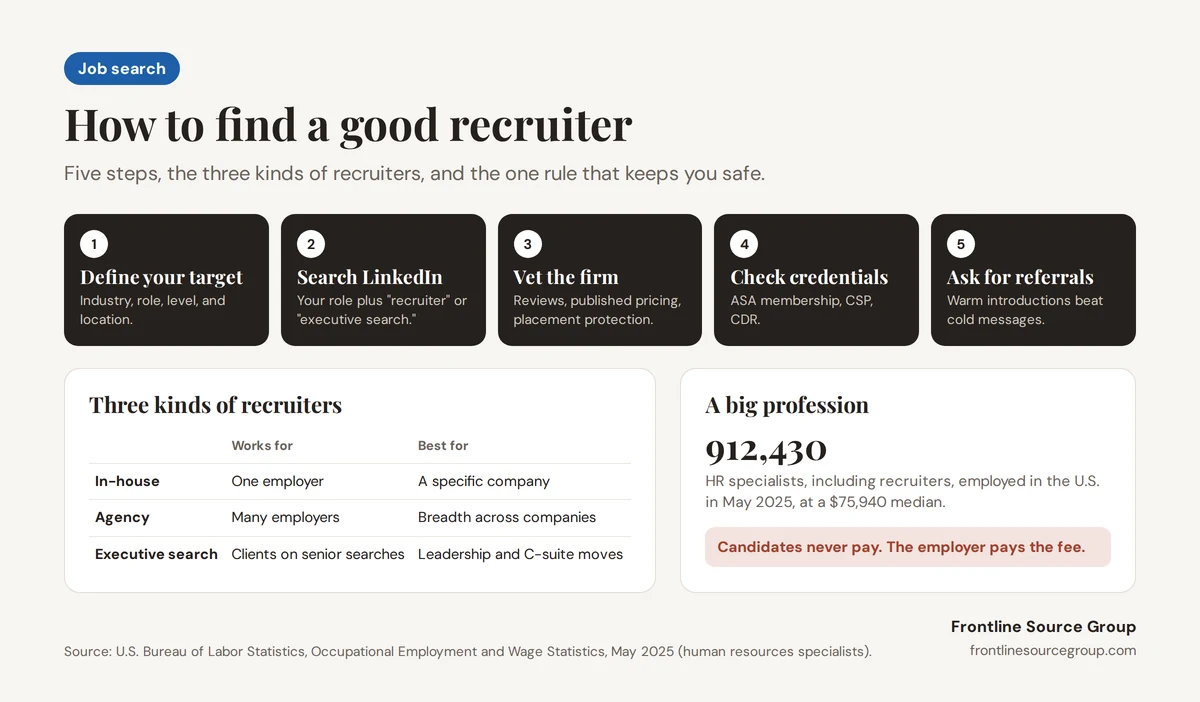
It is a big profession, too. According to the Bureau of Labor Statistics, about 912,430 human resources specialists, the occupation that includes recruiters, worked in the U.S. in May 2025 (BLS). With that many to choose from, knowing how to pick the right one matters.
What is the difference between a recruiter, a headhunter, and a hiring agent?
People use the terms interchangeably, but the jobs differ. A corporate or in-house recruiter works for one employer. An agency recruiter works for a staffing firm and represents many employers. A headhunter usually means an executive search recruiter focused on senior leadership, often reaching out to people who are not looking. "Hiring agent" is a general label that can mean any of these. Match the type to your goal.
| Type | Works for | Who pays | Best for |
|---|---|---|---|
| In-house (corporate) recruiter | One employer | The employer | Getting into one specific company |
| Agency recruiter | Many client employers | The client employer | Breadth across companies, plus contract and contract-to-hire roles |
| Executive search recruiter (headhunter) | Clients hiring senior leaders | The client employer | Director, VP, and C-suite moves, often confidential |
How do you find a good recruiter step by step?
1. Define your industry and role
Before you reach out to anyone, get clear on the industry, role, location, and level you want. A generalist recruiter and a discipline-specific recruiter are different products. For specialized roles such as CFO, controller, CHRO, head of cybersecurity, dental practice manager, or grocery executive, work with a recruiter whose track record shows placements in that exact space. They already have the candidate pool, the hiring-manager network, and current pay data.
2. Search LinkedIn with intent
LinkedIn is the most efficient single tool for finding the right recruiter. Search your role plus "recruiter," "executive search," or "staffing," such as "accounting recruiter," "HR executive search," or "cybersecurity recruiter." Check each profile for placement history, recommendations from candidates and hiring managers, and posts that show they are active in your industry. Keep your own profile current so a recruiter can judge fit at a glance. Helpful reading: frontlinesourcegroup.com/blog-optimizing-your-linkedin-profile-for-executive-recruiters.html.
3. Vet established staffing and executive search firms
Look for firms with a published track record, transparent pricing, and verifiable client reviews. Good firms publish their specializations, their pricing, and their placement protection. The industry standard is 90 days; Frontline's 5-Year Placement Warranty is 20 times longer, supported by a 98.94% executive placement retention rate. Public pricing and long protection signal a firm that stands behind its work.
4. Check directories and credentials
Directories such as the American Staffing Association (ASA) member directory, the National Association of Personnel Services (NAPS), and industry-specific associations can help you find recruiters by specialty and location. Look for credentials such as the Certified Staffing Professional (CSP) and Certified Diversity Recruiter (CDR). ASA membership signals a commitment to professional standards.
5. Network within your industry
A warm referral from someone in your field is the best route to a recruiter who fits. Ask colleagues, former managers, and mentors which recruiters they trust, and go to industry events where recruiters show up. A recruiter introduced by a respected colleague will give you more attention than a cold message. Related reading: frontlinesourcegroup.com/blog-networking-beyond-traditional-job-search-techniques.html.

How should you make first contact with a recruiter?
A strong first message gets you a real conversation. A generic one gets ignored.
Personalize the introduction
Name the specific reason you are reaching out: a role they posted, a candidate they placed whom you know, or a specialty that matches your background. Mention one or two concrete parts of your experience that fit what they place. Keep it under 150 words.
Prepare for the first conversation
Have a polished resume, a clear summary of what you want (role, level, industry, location, pay), and a few recent accomplishments ready. Be honest about your timeline and any constraints. Recruiters put their best effort into candidates who are clear about what they want.
Follow up professionally
If you do not hear back, follow up once after a week with something new, such as an updated resume or a company you would target. Stay in touch with good recruiters even when you are not looking. Your next move usually starts before you are searching.
How do you know if a recruiter is worth working with?
- Specialty match. They place your exact role, not just adjacent ones.
- A public track record. Recent placements, client testimonials, or reviews you can verify.
- A transparent process. They explain how they evaluate candidates and what the process looks like.
- Direct communication. They return calls, send updates without prompting, and give honest feedback.
- Long placement protection. The 90-day industry standard is the floor; Frontline's 5-Year Placement Warranty is 20 times longer.
- No fees to candidates. Legitimate recruiters are paid by the employer, never the candidate. See frontlinesourcegroup.com/blog-does-a-staffing-agency-take-a-cut-of-your-paycheck.html.
- Credentials. ASA membership, CSP, CDR, or similar.
What are the most common mistakes job seekers make with recruiters?
- Sending every recruiter the same generic message
- Working with several recruiters on the same target companies, which creates duplicate submissions
- Being vague about target role, pay, or location
- Going quiet mid-process, or accepting an offer without telling the recruiter who introduced you
- Misstating current pay, title, or notice period, which comes out in references
- Treating a recruiter like a job board instead of a long-term professional relationship
How does Frontline Source Group help candidates find the right recruiter?
Frontline has 32 plus offices and recruiters who specialize in accounting and finance, technology and IT, human resources, legal, administrative, pharmacy, dental, engineering, energy, aviation, healthcare operations, cybersecurity, marketing, revenue cycle, life sciences, grocery and retail, and C-suite executive search. Apply at frontlinesourcegroup.com/how-to-apply.html and a recruiter in your discipline will review your background; you may also get a first-round phone interview from Lexi Reed, our AI recruiter. There is never a fee to candidates. Employer pricing is published at frontlinesourcegroup.com/pricing.html, and direct hires are backed by the 5-Year Placement Warranty, with terms at frontlinesourcegroup.com/5year-placement-guarantee.html.
Frequently Asked Questions: How to Find a Good Recruiter
How do I find a recruiter for my industry?
Search LinkedIn for recruiters whose profiles show repeat placements in your role and discipline, vet established staffing firms with published track records and transparent pricing, check industry directories such as the American Staffing Association member list, and ask colleagues for warm referrals. The fit signal you are looking for is repeat placements in your exact role, not just adjacent ones.
Should I work with one recruiter or several?
Work with one specialized recruiter per target discipline, not several recruiters all targeting the same companies. Multiple recruiters submitting you to the same hiring manager creates duplicate-candidate conflicts that disqualify you from the role. It is reasonable to work with different recruiters in different disciplines or different geographies.
How many recruiters are there in the U.S.?
About 912,430 human resources specialists, the occupation that includes recruiters, worked in the U.S. in May 2025, at a median annual pay of $75,940, according to the Bureau of Labor Statistics.
Do recruiters charge candidates a fee?
No. Reputable agency and executive search recruiters are paid by the employer, never by the candidate. If a recruiter asks you to pay a fee, it is almost certainly a scam or a resume service rather than a legitimate placement recruiter. Frontline Source Group never charges candidates for placement services.
How do I find a recruiter on LinkedIn?
Search LinkedIn keywords combining your role and "recruiter," "executive search," or "staffing," such as "accounting recruiter," "HR executive search," or "cybersecurity recruiter." Filter by location if relevant. Review their profile for placement history, candidate recommendations, and posts that show active engagement in your industry. Send a personalized connection request that names a specific reason you are reaching out.
What should I say in my first message to a recruiter?
Personalize the introduction. Name the specific reason you are reaching out, such as a role they posted, a candidate they placed who you know, or a discipline they specialize in that matches your background. Reference one or two concrete elements of your experience that align with what they place. Keep the message under 150 words and include a clean resume.
What is the difference between a recruiter, a headhunter, and a hiring agent?
A corporate or in-house recruiter works for one employer and fills roles only for that company. An agency or executive search recruiter works for a staffing firm and represents many employers across multiple searches. A headhunter usually refers to a retained executive search recruiter focused on senior leadership or C-suite roles. "Hiring agent" is a general label that can mean any of the above.
How do I know if a recruiter is legitimate?
Legitimate recruiters have a verifiable employer (a staffing firm or company name), a public LinkedIn profile with placement history and recommendations, a business email on a real corporate domain, transparent communication about their client and the role, and no upfront fees charged to candidates. Be cautious of recruiters who ask for payment, refuse to name a client, request sensitive personal data before a job offer, or pressure you to accept terms quickly.
What replacement protection should a staffing firm offer on a direct hire placement?
The 90-day industry standard guarantee is the floor. Frontline Source Group backs every direct hire with the 5-Year Placement Warranty, 20 times longer than the 90-day industry standard, supported by a 98.94% executive placement retention rate against an industry average near 70 percent. Terms are at frontlinesourcegroup.com/5year-placement-guarantee.html.
Can a recruiter help me negotiate salary?
Yes. A good agency or executive search recruiter has current market comp data for the role and seniority level you are pursuing and can quarterback the negotiation with the hiring manager. Share your current total compensation, target range, and any non-cash priorities such as remote flexibility or equity. The recruiter has an aligned incentive: the fee is calculated on your accepted compensation, so a strong offer is good for both of you.
How long does it take to find a job through a recruiter?
There is no universal answer. The time from first conversation to accepted offer depends on the role's seniority, the market for your discipline, the geography, and how clear you are about target role and compensation. The more specific you are about what you want and the more accurately your background maps to the recruiter's active searches, the faster the match.
How do I find a recruiter at Frontline Source Group?
Apply at frontlinesourcegroup.com/how-to-apply.html. A Frontline recruiter aligned with your discipline reviews your background and reaches out when an active search matches, and you may get a call from Lexi Reed, Frontline's AI recruiter, for an initial phone interview. Frontline has 32 plus offices and recruiters across 17 disciplines, and never charges candidates.


